GCI Equipper

The Spirit Who Unites and Empowers Us

The Holy Spirit unites and empowers the Church.

The Argentine footballer Diego Maradona once said, “The game of football is like a canvas, and it’s up to the players to paint the most beautiful picture.” Coming from a player widely regarded as one of the greatest of all time, these words capture how people can come together to create something far greater than the sum of their parts. It is amazing what we can achieve when we work together.

This is why the Jesus’ Church is encouraged so often in the New Testament to be as one — “being of the same mind, having the same love, being in full accord and of one mind” (Philippians 2:2 ESV).

The Gospel accounts reveal that the disciples struggled at times to work together in unity. The disciples argued with each other about who was the greatest amongst them (Mark 10:35). One of the disciples refused to believe the others unless he saw it with his own eyes (John 20:25). The story changes, though, when we come to the book of Acts. Instead of distrusting and competing against each other, they begin to work together. And the results are astonishing!

What brings about this change? The answer is the Holy Spirit. The Father sent the Spirit on the Son’s behalf to unite and empower the Church. So, in the power of the Spirit, may we:

Ask and receive in faith. We can ask God directly to fill us with the Holy Spirit, trusting that he will give the Holy Spirit to those who ask.

Surrender daily. We can consciously yield our will, plans, and desires to God each day, offering our lives as living sacrifices.

Cultivate a life of prayer and Scripture. Prioritise consistent prayer and reflection on the Bible. The Spirit often moves through his word.

Acknowledge dependence. Rely entirely on the Holy Spirit rather than our own strength, knowing he is already present in our midst.

If, as Maradona said, 11 players working together can create something beautiful on the football pitch, imagine what the Church — empowered by the Holy Spirit — can do!

By Gavin Henderson, Superintendent of Europe
Market Harborough, England, UK

On Being Disciples

We can create a natural movement from understanding to participation.

By Michelle Hartman, Communications Director
Steele Creek, North Carolina, US

This year we added to our On Being series with On Being Disciples: Living as Kingdom Citizens, which is a five-session discipleship resource.

The series addresses:

    • What does it actually look like to follow Jesus in everyday life?
    • How do our beliefs, our actions, and even our emotions reflect that he is King?

This series offers a thoughtful and practical pathway for discipleship, helping individuals and ministry teams grow in living as kingdom citizens. It invites participants into a holistic vision of following Jesus.

Download the Leader Guide
Download the Participant Guide

Each session builds on the last, creating a natural movement from understanding to participation:

    • Session 1 explores what it means to be a follower of Jesus, learning from him and living what he teaches.
    • Session 2 reflects on what we know, grounding us in the truth of who God is.
    • Session 3 considers what we do, reminding us that our lives respond to grace already given.
    • Session 4 makes space for what we feel, recognizing that God forms our hearts in love.
    • Session 5 brings it together in the call to live as citizens of God’s present and coming kingdom.

What makes this resource especially meaningful is its intentional design. It is holistic in its approach to formation, interactive in its structure, and consistently rooted in grace. Each session includes Scripture engagement, guided discussion, and simple practices that can be lived out during the week.

This resource works well for congregations building a discipleship pathway, small groups looking for structured and meaningful conversation, leaders walking with new believers, and those who simply want to revisit the heart of kingdom living.

Our prayer is that this series continues to support your congregation in growing in trust, deepening in love, and participating more fully in the life and mission of Christ.

Discipleship Starts Small but Lasts

Jesus builds his kingdom by forming
ordinary people into disciples.

Kingdom Culture involves forming disciples who live sent. Below are some key questions for your leadership to consider. They are summarized from Rev. Dr. Eun Strawser’s interview, Part 3. Listen to the full GC Podcast here.

Join the self-paced book club based on Strawser’s book, Centering Discipleship.

 
  1. Do you need to admit that discipleship is peripheral?

Change begins with humble honesty. Examine:

    • Your assumptions about the congregation
    • Your assumptions about yourselves
    • Your pride

Humility is not optional; it is foundational to Christlike leadership.

  1. What does our members’ behavior reveal about our priorities?

Structures and systems matter, but behavior tells the truth. What assumptions about “how church works” might need to be uprooted? Examine:

    • What assumptions our systems reinforce
    • Whether those systems actually produce Christlike lives

This is “humble work” — but it produces concrete next steps.

  1. Can we agree to start small?

If we started small, what would a first discipleship core look like in our context? Who should be invited? For established churches:

    • Do not roll out a massive new program.
    • Start with a small discipleship core.
    • Experiment.
    • Learn.
    • Build credibility through lived examples.

This is both strategic and kind.

  1. Where are the people already burning with mission but needing clarity and support?

Begin with specific types of people:

    • Those with decision-making authority
    • Those with relational authority (trusted influencers)
    • Those with scriptural authority (spiritually respected)
    • Those already living missionally outside church walls

When these people are discipled intentionally, they become future disciple-makers and catalysts for multiplication.


Jesus builds his kingdom by forming ordinary people into disciples. Discipleship is about becoming people whose lives reflect Christ’s character, wisdom, theology, and sent-ness.

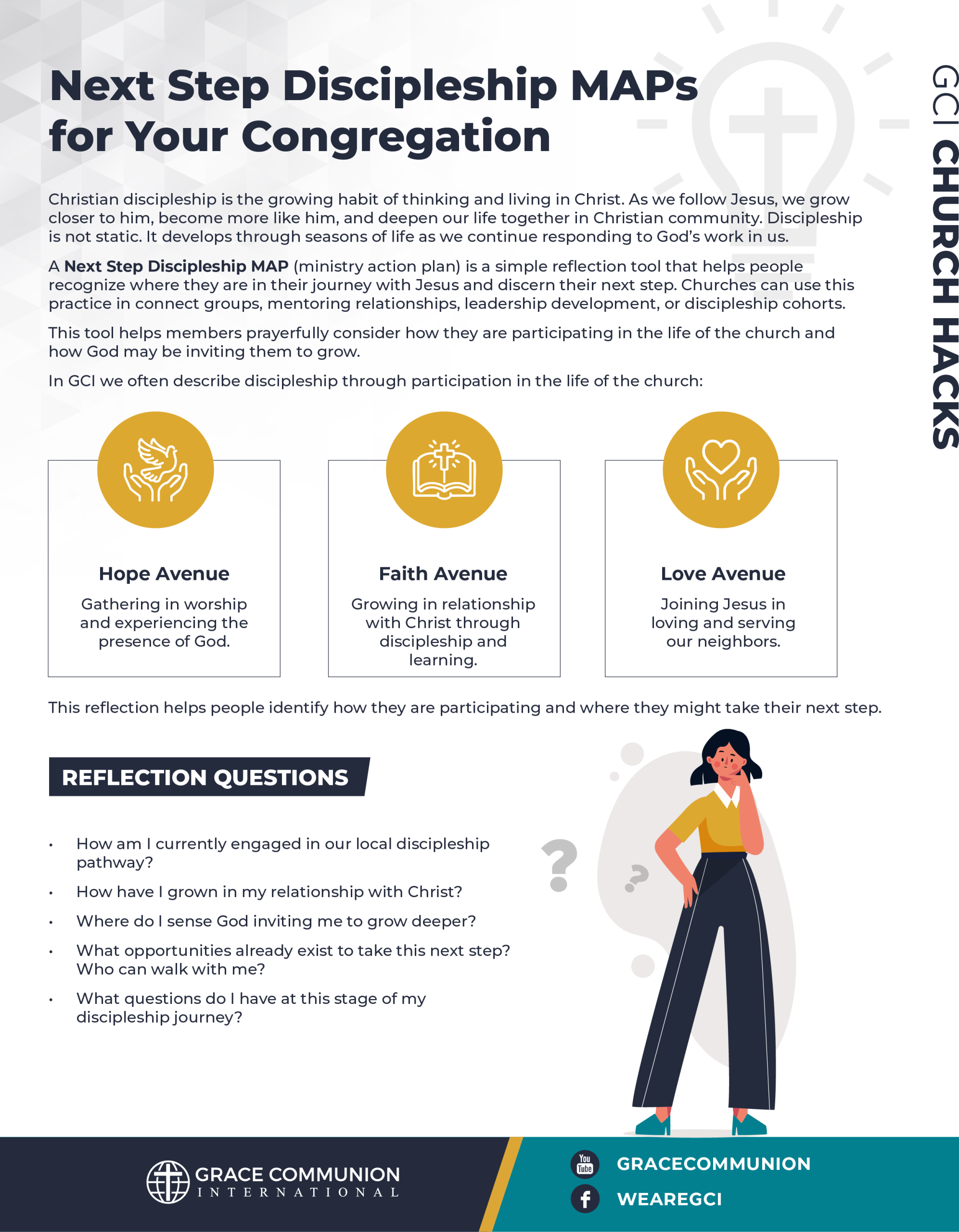
Church Hack—Next Step Discipleship MAPs for Your Congregation

Following Jesus is a journey shaped by growth, reflection, and participation. This Church Hack offers a simple way to help your congregation discern their next step through a discipleship MAP. Invite your team or group to reflect together.

Learn more here.

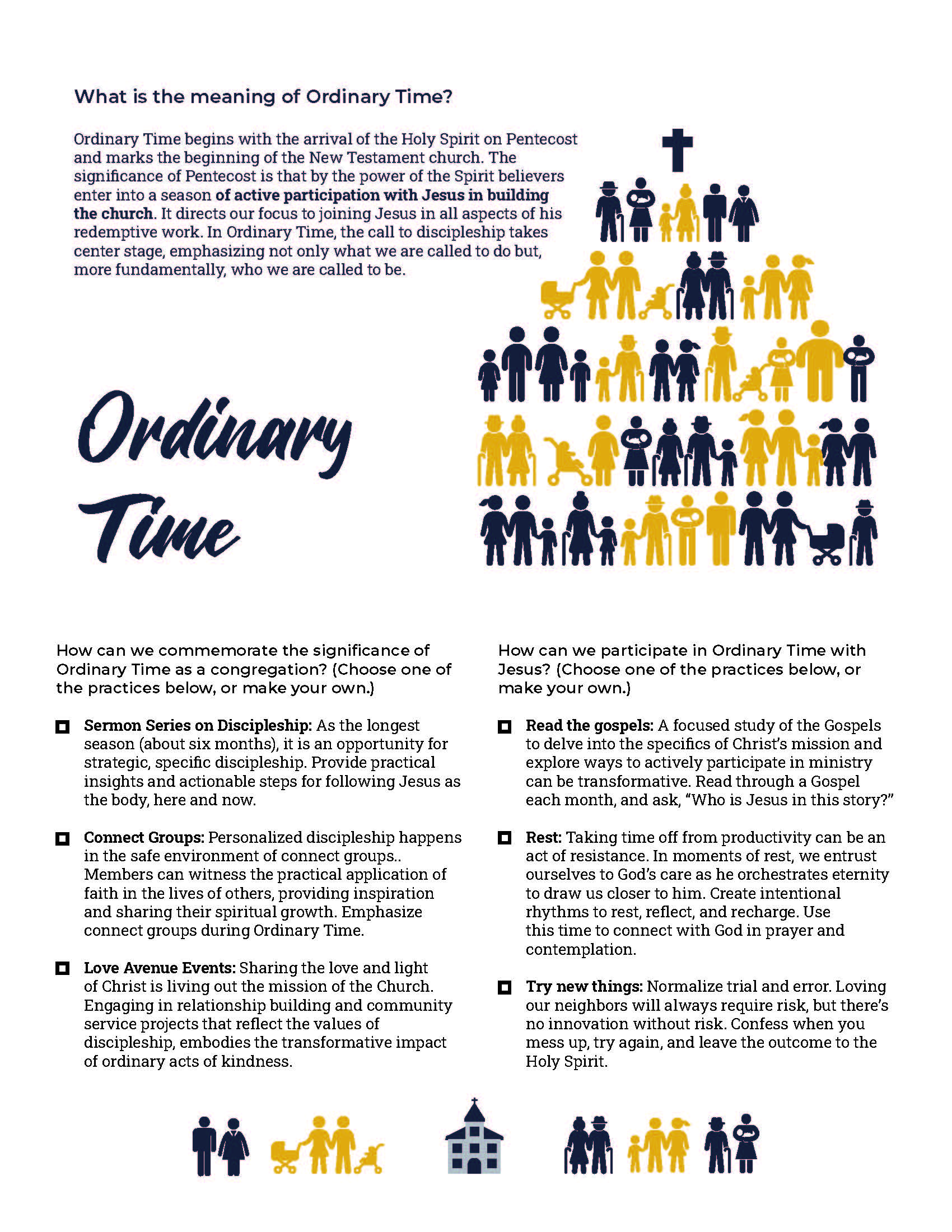
Formation—Ordinary Time

By the Spirit, participation in Jesus’ mission
forms us into who we are created to be.

The significance of Pentecost is that by the power of the Spirit believers enter into a season of active participation with Jesus in building the Church. In Ordinary Time, the call to discipleship takes center stage, emphasizing not only what we are called to do but, more fundamentally, who we are called to be.

Read the full guide for Ordinary Time practices for your congregation.

Entering the Full Humanity of Adolescents

We place-share when we recognize a
young person’s reality and call it what it is.

In this episode of “You’re Included,” Andrew Root discusses how relational youth ministry arises out of place-sharing rather than patterns of influence.

Dr. Root is Chair of Youth and Family Ministry at Luther Seminary in St. Paul, Minnesota, and received a Ph.D. from Princeton Theological Seminary in 2005.

Watch full video here.


GCI Amazon Bookstore

Did you know you can purchase a variety of GCI resources through Amazon?

Through Amazon Kindle Direct Publishing, GCI resources are available as Kindle eBooks, Audible audiobooks, or printed paperbacks shipped directly to your home.

Featured titles include these valuable workbooks:

40 Days of Discipleship: A Self-Paced Doctrinal Education Plan, Vol 1

We Believe: Exploring the Core Beliefs of Our Christian Faith

These resources are available in the following Amazon marketplaces:
US, UK, DE, FR, ES, IT, NL, PL, SE, BE, IE, JP, CA, AU


Now Hiring—Digital Content Developer

Grace Communion International is seeking a Digital Content Developer to serve on our Media Team. This full-time, non-exempt position is based in Charlotte, NC, and reports to the Media Coordinator.

The Digital Content Developer helps tell the story of what God is doing through Grace Communion International by creating thoughtful, engaging digital content including video, podcasts, and graphics. This role collaborates closely with the Media Team to develop projects from concept through completion.

We are looking for someone who values creative excellence, collaboration, and lifelong learning, and who resonates with GCI’s commitment to sharing the gospel and participating in the love and life of the triune God.

Applicants should have relevant education or experience in digital media production and be aligned with GCI’s mission and theological commitments. See the job description here.

If you would like further details on the position or would like a GCI job application, please contact Human Resources at humanresources@gci.org or 980-495-3960.

Please share this announcement with qualified candidates who may be gifted for this position at the Home Office.

GCPodcast

In 2026, the GC Podcast introduced a new format. Instead of monthly episodes, the podcast will feature two miniseries. This shift allows us to go deeper into meaningful conversations that support our shared journey of Kingdom Living. 

The first series featured Rev. Dr. Walter Kim, president of the National Association of Evangelicals (NAE) and keynote speaker for the 2026 Denominational Celebration. With host Cara Garrity, Dr. Kim explored what it means to live as citizens of God’s kingdom in today’s world. 

Stay tuned for the second series that begins in August.

In the meantime, why not revisit these popular episodes?

Theological Ethics w/ Gary Deddo

Ministry Leadership w/ Lance McKinnon

Marty Folsom—Year A Proper 9–12

Marty Folsom—Year A Proper 9–Proper 12

Romans 7:15-25a ♦ Matthew 13:1-9, 18-23 ♦ Matthew 13:24-30, 36-43 ♦ Matthew 13:31-33, 44-52

The host of Gospel Reverb, Anthony Mullins, welcomes Dr. Marty Folsom to unpack the July 2026 RCL Pericopes. Marty is a theologian committed to nurturing relationships. He’s a relational counselor and coach, author, preacher and speaker. He earned a PhD in Philosophy in Theology from the University of Otago in New Zealand. His most recent book is The Psalms: A Sanctuary for the Soul which is available on Amazon or wherever you get your faith-based books. He lives in beautiful Snohomish, Washington.


Sunday, July 5, 2026 — Proper 9
Romans 7:15–25a NRSVUE

Sunday, July 12, 2026 — Proper 10
Matthew 13:1–9, 18–23 NRSVUE

Sunday, July 19, 2026 — Proper 11
Matthew 13:24–30, 36–43 NRSVUE

Sunday, July 26, 2026 — Proper 12
Matthew 13:31–33, 44–52 NRSVUE


If you get a chance to rate and review the show, that helps a lot. And invite your fellow preachers and Bible lovers to join us!

Follow us on Spotify and Apple Podcast.

Program Transcript


Marty Folsom—Year A Proper 9–Proper 12

Welcome to the Gospel Reverb podcast. Gospel Reverb is an audio gathering for preachers, teachers, and Bible thrill seekers. Each month our host, Anthony Mullins, will interview a new guest to gain insights and preaching nuggets mined from select passages of Scripture in that month’s Revised Common Lectionary. The podcast’s passion is to proclaim and boast in Jesus Christ, the one who reveals the heart of God, Father, Son, and Holy Spirit. And now onto the episode.


Anthony: Hello friends, and welcome to the latest episode of Gospel Reverb. Gospel Reverb is a podcast devoted to bringing you insights from Scripture found in the Revised Common Lectionary and sharing commentary from a Christocentric and Trinitarian view.

I’m your host, Anthony Mullins, and it brings me great delight to welcome our guest, Dr. Marty Folsom. Marty is a theologian committed to nurturing relationships. He’s a relational counselor, coach, author, preacher, and speaker. He earned a PhD in philosophy and theology, and his most recent book is The Psalms: A Sanctuary for the Soul, which is available on Amazon or wherever you get your faith-based books.

And he lives, and I’m a little bit jealous about this, he lives in beautiful Snohomish, Washington. Marty, thanks for being with us. Welcome back to the podcast, and we’re curious, how have you been? What have you been up to recently? And especially, what has you experiencing delight these days?

[00:01:39] Marty: Anthony, great to be here with you. We actually have moved from Snohomish and now live on …

Anthony: No.

Marty: … Camano Island. I am looking out …

Anthony: No.

Marty: … at Saratoga Passage with Whidbey Island in the distance, Mount Baker to the right and the Olympic Range to the left, with spring gardens around in front of me …

Anthony: Ah

Marty: … and sailboats going by and things like that.

Anthony: Ah.

Marty: So, life is good. I am here at a place a little bit like John on the island of Patmos, writing like crazy. I’m writing the final volume of my five Karl Barth series, which will tie into some of our Biblical passages here. And I am working on the Psalm series, which is everyday living into those.

But I feel young and healthy and vibrant and glad to be doing what I’m doing. I just finished teaching two classes at Northwest University in theology and psychology, and theology and counseling. So, bringing my work into the doctoral and the master’s level to say theology matters for the care of persons has been huge, and I’ll someday here, hopefully within a year or two, write books out of those.

I’m never bored, Anthony. I am constantly engaged in learning and being with others and helping others. And I do continue to counsel and the frontline sense of life that I am not an academic set aside, but rather someone who walks with people, that all of this matters for everyday life and relationship issues is still vibrantly important for me.

[00:03:10] Anthony: I know this about you, even though we haven’t met in person. I followed your work. And so, talking about your work, you mentioned the Psalms that you’re writing on, but also, I think you’re referring to Karl Barth for Everyone, or Church Dogmatics for Everyone.

[00:03:26] Marty: Correct. Correct.

[00:03:27] Anthony: What would you like to talk about in terms of these new works that you’re writing?

[00:03:31] Marty: I’ll just do a quick catch up on it. There are five volumes. Three of them are out. Number four is in the publisher’s desk. He is reading over it. At some point he’ll say, “Okay, we’re ready to edit and print.” But, so anyway, I’m done writing that one. So, volume five, Karl Barth died and said, “You should be able to figure out what I would’ve written from all the things I’ve done.”

So, I am attempting to do, consistent with the style of what I’ve done in the other volumes, what was it about the doctrine of redemption, the work of the Holy Spirit, the whole sense of living in hope and the Kingdom of God, which is important again for today’s text. All of these things I’m attempting to shape based on all the clues that he left.

So, it’s a huge journey of creating something that isn’t, it’s not there, but everything is pointing to what’s there, if that makes sense. So, it’s quite an undertaking and is quite exciting. My Psalm series, the first volume is out, and to say people are loving the idea that we meet with Jesus and the Father and the Spirit in the garden, and that every Psalm takes us into a place where we have this walk with the One who made the original Garden of Eden and still has the world as the garden, and that every Psalm has nuances and invitation to live within a conversation. So, the ability to bring the arts, there’s two different kinds of poems, as well as my daughter’s done visual representations of the places in the garden that we go.

Anthony: Nice.

Marty: So, it’s a highly creative endeavor. But I go through over 60 books, including thick commentaries, to really ask what is going on in each Psalm. So, they’re not lightly written, quickly written. They are invested with time and care to really put my ear to the heart of each Psalm and hear what it is that’s going on, and to really lead people into a walk with the living God in the garden and to walk away reflecting on how does this really matter to who I am in my everyday relationship with this living God? So, the responses have been wonderful. The word “wow” comes up- quite often with people.

[00:05:53] Anthony: Nice.

[00:05:54] Marty: So, it is a highly participatory literature, I say. It’s not just reading about the Psalms. It takes you into the Psalms and with the one about whom the Psalms are speaking and drawing us into a conversation with.

So, I’m excited just about it almost as a new form of literature. People talk about participating in the life of God, but so often we fall short of what does that really mean? And I think this series with the Psalms is taking us into what, for many people, has been a real heartbeat of something that feels personal with God.

And so, I’m really thinking that there’s something like what both Luther and Calvin saw, and that is if you take the Psalms and bring them into conversation, it is where much of the reformation happened when people really begin to meet with the living God. And for Luther, he put it to everyday music, the music of the pubs and so forth.

Calvin also had a work done that was a modernizing, bringing into the contemporary experience of people. So, to say, we think of simply the reformers bringing kind of theology back, but to say they had a deep sense that the Psalms were a place from which a reformation could happen, and I think we miss that.

And so, as I read and listen and write, this is not polarizing stuff. This is recentering, what does it mean to live in the challenge struggles of everyday life, but also the delights and discovering who we really are. So, the nature of the journey of doing the Psalms for me has been huge.

I did originally write, rewrote every Psalm in 1998, 1999 when I was doing my post doctorate at Regent College. So, I’ve had these poems there all this time, but I have since added a whole dimension of what does it look like to enter into the experience beyond just rewording? What does it look like to be reverbed into the Psalms?

[00:08:03] Anthony: I see what you did there.

[00:08:05] Marty: You see what I did there? Yeah.

Anthony: Yeah, that’s exciting …

Marty: So anyway, I’m almost done with volume two. I have two, two more Psalms. I’m doing Psalm 59 and 60 these two weeks, and that will be, then I’ll be into the editing process on that. So anyway, that series is coming along well also.

[00:08:23] Anthony: That’s so exciting. The volume at which you write is astounding to me, and I can’t wait to get my hands on that book. And anytime I think of the Psalms, I reflect back on what Athanasius said that Holy Scripture speaks to us, but the Psalms speak for us. That it’s the prayer of every human being, isn’t it?

Marty: Yes.

Anthony: It’s, “Go, God,” and “Man, now I’m in the pit of despair,” but it’s all beautiful, and we see a faithful God in our midst in real relationship with us. So, thank you for doing that. So, people, friends, audience do your thing. Go buy the book, and let’s support the work of Christ there in Marty’s work. Thank you so much.

So, let’s dive into our lectionary text. Our first passage of the month is Romans 7:15–25a. I’ll be reading from the New Revised Standard Version, the updated edition. It is a Revised Common Lectionary passage for Proper 9 in Ordinary Time, July 5.

I do not understand my own actions. For I do not do what I want, but I do the very thing I hate. 16 Now if I do what I do not want, I agree that the law is good. 17 But in fact it is no longer I who do it but sin that dwells within me. 18 For I know that the good does not dwell within me, that is, in my flesh. For the desire to do the good lies close at hand, but not the ability. 19 For I do not do the good I want, but the evil I do not want is what I do. 20 Now if I do what I do not want, it is no longer I who do it but sin that dwells within me. 21 So I find it to be a law that, when I want to do what is good, evil lies close at hand. 22 For I delight in the law of God in my inmost self, 23 but I see in my members another law at war with the law of my mind, making me captive to the law of sin that dwells in my members. 24 Wretched person that I am! Who will rescue me from this body of death? 25 Thanks be to God through Jesus Christ our Lord! So then, with my mind I am enslaved to the law of God, but with my flesh I am enslaved to the law of sin.

So, Marty, “I do not understand my own actions, for I do not do what I want, but I do the very things that I hate”, verse 15. In some sense, Paul is diagnosing what has ailed the human condition. So, where’s the good news here?

[00:11:01] Marty: The good news is he recognizes that he often says no to something that is the yes of God, and the yes of God in Jesus is always yes to the heart of the Father. And so, Paul recognizes the gospel is there, the goodness of God is there, and there’s something in him ― call it distracted, call it disconnected, call it whatever you like, the nature of the human ― there is this capacity to look away from the One who is the very source of life even while he still continues us.

And Paul has woken up to this. There’s something that when I recognize that saying no to God, that was choosing death. I was killing the relationship. And what good is this? Nothing. It is simply death. But thanks be to God, the yes is there. The yes of God in the person of Jesus Christ, even in this person who I am, says yes to me and no to my evil.

And to say the cross is, first of all, the yes of God for humanity that says no to the sinfulness of humanity. And so, we could look at the cross and see what Paul’s wrestling with here, the nature of sin, but you have to look deeper and go, “It’s all yes.” It is the yes of the love of God in the person of Jesus Christ who acknowledges what Paul’s acknowledging here and says, “But don’t get stuck there.”

The cross is proclaiming the yes of God, and in his resurrection, he is that yes every day to us, so that even as we wrestle with what Paul wrestles with here, the yes is the pronounced thing when we ask, “Do you love me even today?” And the resounding yes comes back, meets us, embraces us, and each day that yes is there.

And Paul’s ability to recognize the things that he says no to ― that is what comes from what is called “conscience” which, “con” “science”, the two parts are there. Knowing with. Knowing with what or who? Paul knows with God, and he knows that what he is inclined to is so often not a conscience shaped by being with the God who is living and present to him, but gets distracted.

So, he’s living in a tension, but he knows true north. He knows the right thing to do, and therefore his final statements are that delight. “But I know where” truth is. I know what it means not to be caught enslaved in this life apart from, but to be lived in the freedom that God gives to us in himself who is here present with me. I am not abandoned. I am one even in this state who is embraced.

[00:13:49] Anthony: Yeah. Amen and amen. That’s a beautiful heralding of the gospel right there. But if you were to dig or mine something else from this and proclaim it to a congregation, what else would you have to say?

[00:14:04] Marty: So that word enslaved, I’m not enslaved. The nature of Paul’s sense of being enslaved is particularly fear. “I’ve not been given a spirit of slavery leading to fear again, but I’ve been given the spirit of adoption by whom I cry out, ‘Abba Father.’” So if we recognize here that Paul’s wrestling here with the possibility of the unfreedom that comes when we forget our essential orientation as children of the Father, loved to him in and through the Spirit by Jesus’ work in bringing us there, and that this whole sense of slavery that the law even brings ― the law’s always going, “Am I doing it right? Am I doing it wrong?” ― we become attentive to ourselves and not to the delight of the One who loves us. So, to say Paul here in the end is wanting to release us from any sense of being enslaved with the fear that ever makes us judges, and the word law that appears after it would seem to point us towards a kind of law, but it’s not the law of our courts.

This is the law of God. It’s the Torah. It’s the way of walking with the one who has loved us and given himself to us. So, he is, in his whole being, not in slavery to any earthly law. He is submitted to the nature of the way of God, which is the way of freedom. “Where the Spirit of the Lord is, there is freedom.”

And so, this is the law of the Spirit, and sets us free. We’re not enslaved to judgment, condemnation. Even as he’s sitting here wrestling with this, he could get absorbed in that condemnation, but no, he recognizes, “This God calls me to the life of freedom, and I will not be enslaved to any other law, judgment, or anything. Even my own judgment, I will not allow to be enslaved. I will live in the freedom won for me by the One who says, ‘I am the way, the truth, and the life.'” And in knowing Him, you are free.

[00:16:10] Anthony: Oh, wow. The scope of it ― it reminded me of a Thomas Torrance quote that “nothing in all of creation will be able to separate from his love any more than anything can separate the Father and the Son from one another.” Hallelujah, that he says yes to us, even as he says no to evil.

All right, our next passage is Matthew 13:1–9, 18–23. It is a Revised Common Lectionary passage for Proper 10 in Ordinary Time, July 12. Marty, would you read it for us, please?

[00:16:48] Marty: Yes.

That same day Jesus went out of the house and sat beside the sea. 2 Such great crowds gathered around him that he got into a boat and sat there, while the whole crowd stood on the beach. 3 And he told them many things in parables, saying: “Listen! A sower went out to sow. 4 And as he sowed, some seeds fell on a path, and the birds came and ate them up. 5 Other seeds fell on rocky ground, where they did not have much soil, and they sprang up quickly, since they had no depth of soil. 6 But when the sun rose, they were scorched, and since they had no root, they withered away. 7 Other seeds fell among thorns, and the thorns grew up and choked them. 8 Other seeds fell on good soil and brought forth grain, some a hundredfold, some sixty, some thirty. 9 If you have ears, hear!”.

18 “Hear, then, the parable of the sower. 19 When anyone hears the word of the kingdom and does not understand it, the evil one comes and snatches away what is sown in the heart; this is what was sown on the path. 20 As for what was sown on rocky ground, this is the one who hears the word and immediately receives it with joy, 21 yet such a person has no root but endures only for a while, and when trouble or persecution arises on account of the word, that person immediately falls away. 22 As for what was sown among thorns, this is the one who hears the word, but the cares of this age and the lure of wealth choke the word, and it yields nothing. 23 But as for what was sown on good soil, this is the one who hears the word and understands it, who indeed bears fruit and yields in one case a hundredfold, in another sixty, and in another thirty.”

[00:19:15] Anthony: Before we get into exegeting the text, what, if anything, would you want preachers and teachers to know or be cautious about when it comes to the parables?

[00:19:28] Marty: The trick with parables of the kingdom is that we really quickly jump to thinking we need to build the kingdom.

[00:19:36] Anthony: Come on.

[00:19:38] Marty: But the point here really is this, these are parables of the kingdom. The kingdom of God is present, active, and waiting to do work. And so, the ability to align ourself with, to submit to, to yield to the work of the Spirit ― it’s really a matter of ourself getting out of the sense that he’s somewhere and he’s going to give me the power to do my work for the kingdom here, or someday the kingdom will come and then all will be done.

No. The kingdom is here and now. And so, our ability to simply let our hearts be penetrated by the here and nowness of God is where the root goes all the way down into our hearts and does something. But it’s just us all allowing the kingdom to be the shaping of who we are. So, it is just so easy for the question, what should, what do I need to do to take over, instead of what is the kingdom proclaimed here and what’s it doing, and how do I just not get in the way?

[00:20:47] Anthony: Oh. Yeah, that’s a good word. And speaking of good word, when we come to the written word, we’re looking for God. We’re looking for the God revealed in Jesus Christ. So, tell us about what this parable reveals about God, and the second part of this, a theological, anthropological question what does it reveal about God and what does it reveal about us, humanity?

[00:21:12] Marty: I think it’s an amazing thing that the world just grows, and we take it for granted. But to say all of this is here because of the intention of a God who created a world that is the very space within which we live, and to even recognize in our human life, we are alive, we are seeds on the soil because we have been given life and the ability to grow and to bloom.

And so, to recognize even ourselves as seeds who have this capacity to grow or not to grow, it’s all because God has given us already that life-giving capacity for his work to bring to fulfillment that which he intended from the very beginning.

So, to recognize that it, what it says about God is always the God of life. He is always about positioning us where life can happen. And the nature of what it is that humans are is that we have a tendency to place ourself away from what it is that will allow God’s life to work in us. So, the different kinds of soil and places that we might be. I’m not a lover of the city, and it’s partly just the way you can be six inches from somebody else in an apartment.

Anthony: Yeah.

Marty: So, you’re right next to people, but you’re apart from them. And no, the seed has no capacity to know and be known, to love and connect, to serve. If you hear them bumping against the walls, that may be as close a relationship as you have. And the image of a small town, which I heard something that Matt Canlis did this week, spending time in Scotland in a church at Godspeed, and saying, you know, “I had to slow down enough to where I didn’t expect people to come to my office as though that was the ground that people grew in. I had to be in the ground where they are, and the smaller the village, the closer we get.”

[00:23:10] Anthony: Yeah.

[00:23:10] Marty: And so, the positioning of ourself and the slowing down to the speed that God goes is, in a sense, allowing for the soil to do the work that it does to nurture the kind of relationship with God and one another, to be a community where this growth happens, and there’s hundredfold, sixtyfold.

So, you can imagine in a town of 100 people, you know all 100 people, and there’s a sense of love and appreciation for each person that’s there. Whereas you may be in a building of 1,000 people and you know no one.

Anthony: Yeah.

Marty: They’re all there, but nothing is growing. And so, to simply attune ourself to the nature of what does it look like to avail ourself to be those who listen, look, speak with others, and whether we pray out loud for them or not, to be the presence of prayer, that is the presence of the kingdom.

Because the kingdom of God is always just God here and now bringing a yes. How do I be that to that person walking through the door? Maybe I help them hold the door. Maybe I give them a smile. All of those things is being fertile ground for the kingdom to do a work. It is possible in the city. I think it’s just not as good, a good a soil as maybe a smaller place might be.

So, the nature of soil, I think there is a sense where we do make choices that align with positioning ourself both in the place, but also how we will be in the place. And so, I’ve often thought I would love to see a book where somebody just takes a mailman who says, “This town is my congregation, and every place where I drop off mail or packages, I’m going to get to know the people and love them.”

And to see this happen for 50 years, that his soil was this town, his commitment was to be the presence of the kingdom, and when he dies, that the whole town comes out, Christians and non-Christians going, “this person was like the presence of God among us. He cared. He brought us together.”

Anthony: Yes.

Marty: “He spoke our language. He knew us, and we came to know him.” That’s, in a sense, the fulfillment of what this parable invites us into, the hundredfold, that everyone would celebrate not his death, but the life that he lived that brought life to them.

[00:25:32] Anthony: And friends, the documentary that Marty referenced from Matt Canlis called Godspeed, I highly recommend. Just Google Godspeed Matt Canlis. Watch and learn and grow, and I just crack up every time I see it where the priest tells him, “You don’t have an office. Your office is out there. Go be with the people.” It’s awesome.

Marty: Yes.

Anthony: All right. Let’s transition to our next passage of the month. It’s Matthew 13:24–30, 36–43. It is a Revised Common Lectionary passage for Proper 11 in Ordinary Time, July 19.

He put before them another parable: “The kingdom of heaven may be compared to someone who sowed good seed in his field, 25 but while everybody was asleep an enemy came and sowed weeds among the wheat and then went away. 26 So when the plants came up and bore grain, then the weeds appeared as well. 27 And the slaves of the householder came and said to him, ‘Master, did you not sow good seed in your field? Where, then, did these weeds come from?’ 28 He answered, ‘An enemy has done this.’ The slaves said to him, ‘Then do you want us to go and gather them?’ 29 But he replied, ‘No, for in gathering the weeds you would uproot the wheat along with them. 30 Let both of them grow together until the harvest, and at harvest time I will tell the reapers, Collect the weeds first and bind them in bundles to be burned, but gather the wheat into my barn.’”

36 Then he left the crowds and went into the house. And his disciples approached him, saying, “Explain to us the parable of the weeds of the field.” 37 He answered, “The one who sows the good seed is the Son of Man; 38 the field is the world, and the good seed are the children of the kingdom; the weeds are the children of the evil one, 39 and the enemy who sowed them is the devil; the harvest is the end of the age, and the reapers are angels. 40 Just as the weeds are collected and burned up with fire, so will it be at the end of the age. 41 The Son of Man will send his angels, and they will collect out of his kingdom all causes of sin and all evildoers, 42 and they will throw them into the furnace of fire, where there will be weeping and gnashing of teeth. 43 Then the righteous will shine like the sun in the kingdom of their Father. Let anyone with ears listen!

So, Marty, what does the parable of the weeds have to teach us about the kingdom of God?

[00:28:18] Marty: The one big thing is the kingdom of God is the one who comes and plants good seeds.

Anthony: Yes.

Marty: If we ask about the intention of God, we always know, if there’s good seeds, we know where they came from. The nature of the intent of one who plants seeds is that they envision abundance and provision and good things for all the earth. And so, to say the parable of the kingdom is to say that where you see the kinds of things that live out the heart of God the Father, you know where the seeds come from.

And when they’re not, you know that they’re not things that he intended. And Karl Barth says, “If you want to know what sin is, you have to say, we can’t give it an ontology or a being that’s truly real, because what’s really real is the love of God, the freeing love of God, and the heart of the Father that goes out into the world. And that is imaged in these seeds, and it produces all that is good.

[00:29:22] Anthony: Yeah, looking at verse 37, the one who sows is the Son of Man, and so often I hear people proclaiming this in such a way that it feels like I’m the one that’s doing the sowing of the good seed, but it’s truly the Son of Man. Let’s look to him.

What else would you … you know, Jesus says, “Let anyone with ears, listen.” So, we want to listen. What else should we hear and respond to because of this pericope?

[00:29:47] Marty: Yes. Interestingly, the word listen is key here. We tend to think today if only I could see Jesus, all would be well. If only I could see the good things in the world.

But the nature of hearing is something that penetrates more differently, so that the nature of the Jewish confession, Shema Israel, “Hear, O Israel,” to say the world of modern science wants to study that which is observable, but the science of the personal, that is to truly know persons, including the person of God, one has to learn to listen.

And so, listening goes beyond just the lips moving. It goes into the very depths of the heart. And so, in this parable, Jesus is saying that if you listen to this parable well, you will be invited to recognize that there is life in the planting of a seed that is good, that is the seed of the kingdom, that is the seed of the presence of God who brings life, who when there is goodness in the world, we know that it is the intention of the Father being fulfilled in the world in the same way that the good of the days of creation was, and that’s good, and that’s good. And here, this is the good of God in the world.

We’re still living, being focused by Jesus not to ask, “Who are the ones that are weeds?” That’s not the call of this parable. The call of this parable is to be those who are aligned with, attuned to the heart of the One who calls us to listen to his heart. And when you know his heart, then you’re able to discern for others and yourself what it means to follow the way of life. And that is the invitation of this.

[00:31:30] Anthony: In thinking about listening, It took me to a reading I did of Dietrich Bonhoeffer in Life Together and talking about the community of the church. And I’m loosely paraphrasing, but he said, “Often pastors under shepherds of Christ think that their first service to another is to speak,” because we’re often invited- to speak. But he said, “No. The first service to another is to listen and to know.” And so, I think what you’re saying here is vitally important, that we want to have ears to hear and that we can know him through that. Is there anything else from this text that you want to expound on?

[00:32:09] Marty: The idea of shining like the sun the last statement, “The righteous will shine …”

Anthony: Yeah.

Marty: “… like the sun in the kingdom of their Father.” There’s something about what it means to be those who have grown up as seeds that were planted and grew well ― which things are growing really well here right now. When the sun shines, things seem to blossom in ways that they are being what they were intended to be.

And so again, the nature of the likeness of the person who grows because the seed has allowed the sun to do all that is there, those people shine like the sun, too. And the phrase the glory of God is to say that the very nature of glory is not just lightness and brightness in the world. It’s that the very character of God becomes implicit and glows in that person ― which if you’ve ever seen somebody who’s just full of delight, they’re glowing.

There is something in there that this shining of the glory of the goodness of God is in them. And I think that is the invitation to this parable, is that we don’t make ourself shine any more than we make the fruit of the Holy Spirit. But it is fruit, and it is shining because the seed has grown into what the kingdom has called it to be, fully alive, fully with God, fully in the world.

[00:33:33] Anthony: Fully alive. Amen and amen.

All right, we’re in the home stretch. One text to go. Matthew 13:31–33, 44–52. It is a Revised Common Lectionary passage for Proper 12 in Ordinary Time, July 26. Marty, we’d be grateful if you’d read it for us, please.

[00:33:56] Marty: Yes.

He put before them another parable: “The kingdom of heaven is like a mustard seed that someone took and sowed in his field; 32 it is the smallest of all the seeds, but when it has grown it is the greatest of shrubs and becomes a tree, so that the birds of the air come and make nests in its branches.” 33 He told them another parable: “The kingdom of heaven is like yeast that a woman took and mixed in with three measures of flour until all of it was leavened.” 44 “The kingdom of heaven is like treasure hidden in a field, which a man found and reburied; then in his joy he goes and sells all that he has and buys that field. 45 “Again, the kingdom of heaven is like a merchant in search of fine pearls; 46 on finding one pearl of great value, he went and sold all that he had and bought it. 47 “Again, the kingdom of heaven is like a net that was thrown into the sea and caught fish of every kind; 48 when it was full, they drew it ashore, sat down, and put the good into baskets but threw out the bad. 49 So it will be at the end of the age. The angels will come out and separate the evil from the righteous 50 and throw them into the furnace of fire, where there will be weeping and gnashing of teeth. 51 “Have you understood all this?” They answered, “Yes.” 52 And he said to them, “Therefore every scribe who has become a disciple in the kingdom of heaven is like the master of a household who brings out of his treasure what is new and what is old.”

[00:35:52] Anthony: So, “the kingdom of heaven is” gets repeated five times in short succession.  Tell us about this. What’s going on here?

[00:36:01] Marty: So, people often say to me the phrase, “I don’t have time for that” or “I don’t have money for that.” And I say, “Huh, it sounds like that’s not a priority for you.”

Anthony: That’s right.

Marty: The nature of the kingdom is that there is a sense of the greatest value, the distinguishing out of that which defines the rest of your life. The day you decide to get married, it rearranges everything because that relationship has become a priority so that everything else aligns with what it is that is going on there.

So, to say the nature of the kingdom of heaven is that when we pray, “Our Father, who art in heaven,” that’s not a Father far away. We are suddenly submitting, “You are most important. Hallowed be thy name.” “Thy kingdom come” follows immediately because it is this reorientation. The number one priority in my life is to know who you are so that I know who I am. I know your name. I know that you know my name. May your kingdom now become that which is of greatest value in my life so that the choices that I make as I go through this day, they are all lived from the value of who you are in my life. They’re not a possession that I have in the way that some of these tangible things in these parables are.

But to say the kingdom is, it is the relationship with the God who made us and sustains us and gives us the ability for the daily events of our life to become like the mustard tree, for example. We become like those that are a blessing to others, that are a provision for others. We become attentive to being like Jesus as those who notices the sinners, the tax collectors, the outcasts, the marginalized. We become those whose priority is to act congruently with the heart of the Father in a way that’s consistent with the life of the Son, empowered by the Spirit, who gives us eyes to see and ears to hear as we go through our day.

So, this whole continuity of whatever image it is that would look like the kingdom, it’s all the reorientation of the core value around the living God, and then having that echo out in all these different ways of how we spend our life, provide our life, use our life in the goodness of the kingdom for others.

[00:38:22] Anthony: I can almost hear a listener going, “Okay, I’m hearing all this good news of the abundance of God, the goodness of God, how God confronts sin in his own person.” And yet in the last two parables, we hear about fire. We hear about weeping and gnashing of teeth, God separating out the evil from the righteous. What would you have to say about that? How do we see the goodness of God at work in texts like that?

[00:38:55] Marty: It is, of course, the difficult thing for everyone to think that at any point God does anything against anyone. The nature of the Psalms, the psalmist is constantly praying for exactly this kind of thing to happen.

[00:39:10] Anthony: That’s right.

[00:39:10] Marty: Destroy them and all that. So, to say that it is part of the tradition ― Jesus lived and breathed the Psalms, so it was everywhere. Even hanging on the cross, Jesus is quoting Psalm 22. So, he lives within this awareness that there is a world of people who are destructive towards the purposes of God, and a recognition that in the end that he will be the king who sits on the throne.

And to say that the nature of these people in this life to recognize, as I read this week, when somebody kills a rattlesnake in front of you or a cobra that’s about to attack, you don’t say, “Why did you do that? It was a living thing.” Your children were playing there and this rattlesnake was about to get them.

Nobody asks the question about the destruction of things that are destructive towards life. And so, to say there is something in the nature of what is going on here that we have to see as an echo of God will say yes even to evil by saying no to it. And so, the whole sense of that which calls that which is evil and chooses to continue as evil and to say no to it so that it does not do the destructive work that will be done is clearly part of what it is that is part of what is going on here.

I don’t think that it’s intended at all to create a fear in people, that people are wanting to hear this as a sermon and say, ” I don’t want to be end up in the fire. I guess I better make the choice,” right? So, to say the consequence of rejecting life, like stopping breathing or jumping into the water and drowning, there is a stopping of life that if one knows that the consequence of that is death, that one would choose not to do it.

But in these parables, it’s really the choice of life that is present and the consequence of death that is there, which J.B. Torrance said, “we have turned the gospel into something that we have made it so conditional that we’ve forgotten that the “if you don’t do this” are merely the consequences of what has happened. If somebody says, “If you stand too close to the edge of that, you might fall off that cliff and get killed,” it’s not a conditionality. It’s a consequence of the decisions that one makes to do things that are not life-affirming.

Anthony: Amen.

Marty: And so, there’s an acknowledgement, and this is why the Torrances and Barth said, “We are not universalists. We believe God loves even that person that’s standing too close to the cliff and falls down.” To say, “Does God love them?” “Even if I make my bed in Sheol, thou art with me.” People choose to reject God, and they live the consequence of that by rejecting God, not by being rejected by God.

Even in the parables of the kingdom, I think that we can say there is a respecting of the consequences of choices that people make that lives on. But as C.S. Lewis said in The Great Divorce, every day God sends a bus down from heaven, loads of people on the bus goes up so they can see it, and at the end of the day, they get back on the bus and they go back down to hell. They cannot give up their independence to be their own managers of their own life.

And so, I think to recognize that is to say there is built into the nature of Scripture and the nature of God the capacity for people to say no and to bear the consequences of that. But we can never say that is the intention of God.

As Ray Anderson said in a book I read just a week ago, “We have made death to be God’s judgment on sinners.” Anderson said, “No, it’s simply the consequence of rejecting God.” His will is to save humanity. And if you read the whole Bible, what he’s doing at every step of the way is working for bringing his lost ones home. So, to say death and what we’re seeing here as these destructive things, these are the consequences that God has not chosen, and he is doing everything with the kingdom to reverse them, that life might be the message, that life would be the story.

But the whole story is there, and it doesn’t make any less of the judgment of God is that in Christ he has come into the world so that we say, “Who shall separate us from the love of God? Neither height nor depth, angels nor principalities, things present, things yet to come. Nothing can separate us from the love of God.”

So, to say whatever we say with those passages, we cannot say that the love of God has been set aside. That is the persistent message of the kingdom, and the consequences of humans choosing not to accept it is also a real consequence, and that is also made this shadow echo within it.

[00:44:07] Anthony: I think it was C.S. Lewis, wasn’t it, that said, “In the end, there are those that will say to God, ‘Thy will be done,’ and there will be those that God says, ‘Thy will be done.'” We just choose our own consequences in that way and refuse to come into the party.

Marty: Yep.

Anthony: Wow. It’s hard to believe that would even happen, but here we are. We’re actually recording this on Ascension Thursday, which is good news. We often forget the Ascension. We talk about the life, death, and resurrection of Christ, but the Ascension as well is part of the good news that we see in the person and work of Jesus. So, I just wanted to give you an opportunity here at the end as a final good news thought. I want you to riff on the Triune God of grace as seen and apprehended through these parables. Tell us what you want to tell us.

[00:44:55] Marty: Yeah. So, with these parables I think we have a sense that the Father is not far away, but the Father is the Kingdom of God with open arms present, embracing a crowd of people who are listening attentively. They’re like those who have been orphaned who don’t know their parents, but there is something in this message of the kingdom that the Father’s arms are embracing around them in such a way that they’re beginning to feel there is some sense of finding home that is happening here.

And as Jesus is speaking these words, his words are the words of himself as the kingdom who is present, and he is giving them words that are hearing and penetrating deep into their heart, that the words are becoming a seed that is awakening them to say, “Maybe I am somebody who is known. Maybe I am someone who is loved. The way this person is talking, it’s as though there is an availability that’s calling to something deep in me to come home.”

And the Holy Spirit is dancing around on hearts and minds like tongues of fire on heads so that there is a shining that is beginning as there’s a dawning awareness that kingdom is not a place with castles far away. Kingdom is this presence of: I am surrounded by the very nature of the heart of God that embraces this place. This is a holy place. I almost feel like I should take off my shoes. There’s something about here because of who is here, this Father who calls me his child, this Son who’s calling me to submit to his kingdom, and the Spirit who is drawing me to wake up to that which is of greatest value, and that is to know that you are loved, you are seen, you are believed in. You belong with us and one another as a family that will never be let go.

[00:47:05] Anthony: Friends, as a final word, I want to share something from T.F. Torrance, who said, “The whole universe revolves round the love of God in Jesus Christ, and all its motion depends entirely upon Him.” Hallelujah, praise God. He is good, and Jesus is the proof.

I want to thank Marty for being with us. I want to thank of thank our Gospel Reverb team. What a blessing it is to work with such a fine group of people who make this podcast possible. And Marty, our tradition here at Gospel Reverb is to end with a word of prayer. Would you do the honors for us, please?

[00:47:41] Marty: I would be happy to do that. Dear Abba, we are grateful that you speak to us the words, “You belong to me.” And so, we acknowledge humbly that, yes, we do belong to you because you have brought the kingdom close to us. And Jesus, we acknowledge that you promised, “Lo, I am with you always, even to the end of the age.” And so, we acknowledge that this day we have been crucified to that old self, and now we live in you. We are made new because you are here with us as the presence of the kingdom who embraces us. And Holy Spirit, you have come to empower us for a life of love, not with the power that’s our own, but that which can only come from you.

And so, as we leave this moment today, we go with you into the world to embrace the world that you care for, to scoop them up in our arms as we lift them up in prayer and with our touch and with our help. We lift them up by your work, O Holy Spirit, to go into this world and see the kingdom doing its work ― that is, making the Father, the Son, and yourself known and evident in the world.

And so, we submit ourselves to you. We are one body because of who you are. And so, we give ourself to participate in your life, your ministry in the world because you go before us, with us. And we delight and are filled with joy to go with you. And we pray all these things in your name, you who is Father, Son, and Holy Spirit. Amen.

Anthony: Amen.


Thank you for being a guest of Gospel Reverb. If you like what you heard, give us a high rating, and review us on iTunes, Spotify, or wherever you get your podcast content. Share this episode with a friend. It really does help us get the word out as we are just getting started. Join us next month for a new show and insights from the RCL. Until then, peace be with you!


Offering and Communion Starters | July

Last year, we introduced a new resource to help you prepare for the time of giving and taking communion in your Hope Avenue. These are meaningful formational practices that we can plan with care and intentionality.

The Communion and Offering Starters are posted a month ahead, like the sermon resources. Below are the July starters. In case you missed it: June Starters are here.


How to Use This Resource

An outline is provided for you to use as a guide, followed by a sample script. Both the offering moment and communion can be presented as a short reflection before the congregation participates. Here’s how to use it effectively:

  • Scripture Reflection: Include the relevant Scripture to root the offering and communion in biblical teaching.
  • Key Point and Invitation: Briefly highlight the theme’s key point and offer an invitation that connects the theme to the practice.
  • Prayer: Include a short prayer that aligns with the theme. Invite God to bless the gifts and the givers. Ask God to bless the bread and the wine and the partakers.
  • Logistics: Explain the process; this helps everyone know how they can participate. For giving, indicate whether baskets will be passed, if there are designated offering boxes, or if digital options like text-to-give or web giving are available. Clearly explain how the communion elements will be shared and that participation is voluntary.
  • Encouragement: For the giving moment, invite congregants to reflect on their role in supporting the church’s mission, reminding them that their gifts impact both local and global ministry. For communion, encourage congregants to express gratitude for Jesus’ love poured out for us and the unity present in the body of Christ.

For more information, see Church Hack: Offering and Church Hack: Communion


Offering

July Theme: Joyfulness and Gentleness Bring Peace to Our Neighbors

Scripture Focus: Philippians 4:4–7 NRSVUE

Key Point: Our joyfulness and our gentle approach to our neighbors lead them to that peace which surpasses understanding.

Invitation: May our giving reflect the joy we have in sharing God’s love and life with our neighbors. May we be gentle in our approach. May the results of our missions and ministry bring peace to our neighbors.

Sample Script

Rejoice in the Lord always; again I will say, Rejoice. Let your gentleness be known to everyone. The Lord is near. Do not be anxious about anything, but in everything by prayer and supplication with thanksgiving let your requests be made known to God. And the peace of God, which surpasses all understanding, will guard your hearts and your minds in Christ Jesus. Philippians 4:4–7 NRSVUE

Rejoice in the Lord always. We’ve been invited to join Jesus and participate in what he’s doing in our neighborhoods. It’s not our mission or ministry — it’s his —  and we join him with joy.

Let your gentleness be known to everyone. We don’t go out with hellfire warnings; we witness to God’s love. We want our neighbors to know the One who knows and loves them and to see that God is for them. Joyful participation with Jesus shapes a gentle approach as we reach out.

Take your requests and thanksgiving to God. Are we thanking God for placing us in this neighborhood? Are we joyful to share his goodness? Are we gentle in our approach?

May God bless our offerings so our missions and ministry reflect kingdom living. May he fill us with joy, guide us in gentleness, and calm our anxieties as we share the good news. And may he give us his peace to guard our hearts and minds in Jesus Christ.

Prayer


Communion

July Theme: Becoming like Christ in His Death

Scripture Focus: Philippians 3:10–11 NRSVUE

Key Point: We come to the table with the heart-felt desire to know Jesus and to share in his heart toward others.

Invitation: May we receive the broken bread in remembrance of what Jesus was willing to go through for each and every one of us. May we receive the cup in remembrance of the ultimate cost of our forgiveness and reconciliation with the Father. And may we receive both with the desire to love as he loves.

Sample Script

As Jesus stood before his disciples on the eve of what we call the Last Supper, he knew what he was going to face over the next few hours. But he also knew what they were going to face in the years to come. One can only imagine the love pouring out from his eyes as he looked around. Most of them would be martyrs for him, but he knew his resurrection was also their resurrection.

In the days that followed, the disciples’ love for him grew exponentially. They came to realize that when he offered them the bread and the cup, he was inviting them to join him and participate in his mission and ministry. They spent the rest of their lives seeking to know him more.

Years later, Paul expressed this same desire to know Christ above all else. He said everything was loss except for knowing Jesus. All good, all hope, all righteousness comes from our faith in Jesus. Paul participated in Jesus’ suffering heart for the world, and so do we. We love the world because he loved the world. We join him in his suffering heart for so many who live in darkness.

10 I want to know Christ and the power of his resurrection and the sharing of his sufferings by becoming like him in his death, 11 if somehow I may attain the resurrection from the dead. Philippians 3:10–11 NRSVUE

Let us come to the table and receive Christ.

Prayer


Sermon for July 5, 2026 — Proper 9

Speaking of Life 5033 | Our Great Resolution

This week we’re sharing a Speaking of Life message from our archive as a supplemental resource. We encourage you to use this for reflection and preparation, or small group discussion. For your worship gathering, consider how a call to worship from a local voice or contextualized introduction to the theme might serve your congregation well.

Even when we struggle keeping resolutions, the apostle Paul reminds us that our own efforts often fall short. Instead, our hopes and answers lie in Jesus Christ, who brings us true change and delivers us from sin, offering us peace and the power to live transformed lives. He is the ultimate resolution we need, this year and every year to come.

Program Transcript


Speaking of Life 5033 | Our Great Resolution
Cara Garrity

We are in the middle of the year and it’s time to ask how your New Year’s resolution is going. What was your resolution?

One company tracked the top resolutions for 2022. Ranging from, exercising more, to having more time for friends and family, to spending less time on social media, and lastly reducing stress at work

Some of us might be doing great. Some of us didn’t make any resolutions. And some of us might want me to change the subject. I get it.

If you haven’t done so well on your resolution, don’t be discouraged. In 2019, it was reported that only 8.9% of people polled succeeded in keeping their New Year’s resolution throughout the previous year. That’s a failure rate of over 91%.2

Here’s an example:

A friend of mine told me about being quite convicted by a sermon when he was 13. He felt guilty about how he had been treating his younger brother, so he decided that he would show him kindness and not pick on him for an entire day. With all the strength and resolve he had in him, he set out to be a good brother. That lasted about thirty minutes. He discovered that while he knew what he should do, he didn’t have it in him to do it. His resolve was good but misplaced.

In the book of Romans, Paul shares our struggle with keeping resolutions as he wrote to Jewish leaders who were having a difficult time accepting the fact that they could not resolve their way out of sin. Paul explains his own struggle.

So I find it to be a law that, when I want to do what is good, evil lies close at hand. For I delight in the law of God in my inmost self, but I see in my members another law at war with the law of my mind, making me captive to the law of sin that dwells in my members. Wretched person that I am! Who will rescue me from this body of death? Thanks be to God through Jesus Christ our Lord!
Romans 7:21-25a (NRSVUE)

Paul empathizes with us. We know what we want to do – thus the New Year’s resolutions – but we can’t follow through. Paul, himself, had to come to the end of self-effort and throw himself upon the mercy of God.

In this passage, Paul comes to the one answer that gives him peace. Thank you, Jesus. He is the only true rescuer; he alone saves us.

Right after sharing this with his readers, Paul informs them that in Jesus they are no longer slaves of sin, condemnation is removed, and they have been adopted into God’s family and now live by the Spirit.

Resolutions don’t bring about change; Jesus does. We can’t change, but he can change us. We learn to stop trusting in our own efforts but trust in the accomplishments of Christ Jesus. He is our hope and our answer. He is our great resolution this year, and every year to come.  

I’m Cara Garrity, Speaking of Life.

1) https://www.statista.com/chart/26577/us-new-years-resolution-gcs/

2) https://dreammaker.co.uk/blog/new-years-resolutions-statistics/


Psalm 45:10–17 • Genesis 24:34–38, 42–49, 58–67 • Romans 7:15–25a • Matthew 11:16–19, 25–30

Today’s readings hold together a powerful vision of love and freedom: God rescues us through Jesus. Psalm 45 celebrates a royal love that calls us to leave what is familiar and entrust ourselves fully to the beloved. In Genesis, Rebekah does just that, stepping forward in faith into a future shaped by God’s promise. Yet Romans reminds us that even when we desire what is good, we remain unable to free ourselves (Romans 7). Into that tension, Jesus invites us to come to him for rest, because his yoke is kind and his burden light (Matthew 11). God’s love does not demand self‑mastery; it offers rescue and a shared life grounded in trust.

Reminder: This introductory paragraph is intended to show how the four RCL selections for this week are connected and to assist the preacher prepare the sermon. It is not intended to be included in the sermon.

How to use this sermon resource.


God Rescues Us Through Jesus

Romans 7:15–25a NRSVUE

[Read or ask someone to read the passage.]

15 I do not understand my own actions. For I do not do what I want, but I do the very thing I hate. 16 Now if I do what I do not want, I agree that the law is good. 17 But in fact it is no longer I who do it but sin that dwells within me. 18 For I know that the good does not dwell within me, that is, in my flesh. For the desire to do the good lies close at hand, but not the ability. 19 For I do not do the good I want, but the evil I do not want is what I do. 20 Now if I do what I do not want, it is no longer I who do it but sin that dwells within me.

21 So I find it to be a law that, when I want to do what is good, evil lies close at hand. 22 For I delight in the law of God in my inmost self, 23 but I see in my members another law at war with the law of my mind, making me captive to the law of sin that dwells in my members. 24 Wretched person that I am! Who will rescue me from this body of death? 25 Thanks be to God through Jesus Christ our Lord!

So then, with my mind I am enslaved to the law of God, but with my flesh I am enslaved to the law of sin. Romans 7:15–25a NRSVUE

Have you felt like you want to do what is right, but another part keeps pulling you in the opposite direction? Have you ever been left wondering, why did I do that? [Maybe make it personal and give an example from your life or your community.]

If you understand this feeling, then you already get today’s Bible passage. It’s a letter from the apostle Paul, and he’s frank in his honesty. Basically, he’s saying I don’t do what I want to do, but I do what I hate.

This passage describes something we all know, even if we don’t have words for it. We know what it feels like to have a life that feels pulled in two directions at once.

But here’s the good news: we are not stuck in this condition. God rescues us through Jesus.

=

Let’s go back to verses 15–16

I do not understand my own actions. For I do not do what I want, but I do the very thing I hate. Now if I do what I do not want, I agree that the law is good.

Here is Paul, one of the main leaders of the early church, saying, “I don’t even understand myself. I want to do what is right, but I keep doing things I know are wrong.” If you are new to Christianity, this might surprise you. You might think faith is for people who have it all together.

The Bible is a book for and about people who need God. The Bible is a collection of stories telling one overarching story. It is a story about God rescuing people who cannot fix themselves.

Something is off inside us. There is a gap between what we want to do and what we actually do.

Verse 17: 

But in fact it is no longer I who do it but sin that dwells within me.

It is sin that lives within me. And that’s why the next verses make so much sense.

Verse 18–20:

18 For I know that the good does not dwell within me, that is, in my flesh. For the desire to do the good lies close at hand, but not the ability. 19 For I do not do the good I want, but the evil I do not want is what I do. 20 Now if I do what I do not want, it is no longer I who do it but sin that dwells within me.

Wait. No good lives in my flesh?

When we hear “flesh,” we might think Paul just means our physical, flesh and blood bodies. Or we might think that anything physical is bad, compared to so-called “spiritual” things.1

But your body is not evil and being human is not the problem. In fact, Christianity teaches the opposite: God created the body and called it good. Jesus took on a real human body (This is the Incarnation). And Jesus was raised bodily from the dead.

So, “flesh” here is not about our skin and bones. We can consider Romans 7 in light of Paul’s other letters and the overarching message of the Bible. And when we do this, we can understand that the meaning of “flesh” in this passage is a condition, not just a body.

It is human life turned in on itself, apart from God’s life and power. The part of us that tries to live without trusting God. “Flesh” also includes patterns inside us like self-centeredness, fear, pride, harmful desires. It’s the pull away from God and toward ourselves. That’s why Paul describes it almost like a force living in him — a force pulling him in the wrong direction.

Now Paul’s struggle — and ours — makes more sense. We want to do good, but “the flesh” cannot carry it out. So, the problem is not lack of knowledge or a lack of good intentions. We lack the ability.

For the desire to do the good lies close at hand, but not the ability (verse 18b).

We desire to do good. But the flesh cannot produce it. On our own, apart from God, there is no power in us to make ourselves whole.

And we see the struggle further described in verses 21–23:

21 So I find it to be a law that, when I want to do what is good, evil lies close at hand. 22 For I delight in the law of God in my inmost self, 23 but I see in my members another law at war with the law of my mind, making me captive to the law of sin that dwells in my members.

It feels like a battle is going on inside us. There are two forces at work: a desire for good and a pull toward sin. The struggle feels like a war inside the human heart.

Now verse 24:

Wretched person that I am! Who will rescue me from this body of death?

Let’s look at what Paul does not say. “I feel stuck, so what else should I try to fix this?”

Paul does not go on to recommend seven daily habits to become spiritually successful. Thirty days to a stronger will power and more self-discipline. Three keys to living your best life.

He admits he cannot fix this. He feels wretched, weak, helpless, and worn out. He reaches the end of self-reliance. The solution is not “try harder.”

The solution is that we need to be rescued. We need a rescuer! We need to be delivered from the power of sin that dwells in us.

We need to be freed from this body of death. And we are!

Verse 25:

Thanks be to God, who delivers me through Jesus Christ our Lord!

God rescues us through Jesus.

The answer to the struggle is not found in ourselves. It is found in what God has done through Jesus. God provides the rescue we cannot provide for ourselves.

God the Father sends the Son to take on humanity, in all its brokenness — the Incarnation. The Son, Jesus Christ, lives a fully human life — facing temptation, pain, and pressure — but without sin. For us!

This is what we mean by vicarious. It means Jesus does for us, and in our place, what we cannot do for ourselves. Jesus lives the life we could not live. Jesus carries the weight we could not carry. Jesus takes the brokenness we could not fix.

On the cross, Jesus takes the full force of sin — not just the things we’ve done, but the power that holds us. Jesus dies for us, in our place. And when he rises from the dead, he breaks that power.

Therefore, our story is no longer “Try harder to become good.” Our story is “We have been given a new life.”

In fact, it’s the whole world’s story. You see, the Christian life is not a self-help plan. It’s not personal development or self-optimization. The gospel is not practical advice. Following Jesus is not a program to become a better version of yourself or unlock your potential.

It’s death and resurrection. United to him, you died with him. In Christ Jesus, your old self is dead.

Dead.

And Jesus gives you — not a “better” life — a new life.

So, the Christian life is not a self-improvement plan. It’s a substitution. Jesus takes your life and you get his. Jesus shares his life with us by the Spirit. He took our broken, sin-sick humanity and gave us a new healed humanity. He took our sin and gave us his righteousness, which means he gave us his right relationship with his Father.

And it’s union. We are united to Christ so when he died, we died. When he rose from the dead to new life, we did, too. When he ascended to the Father, we ascended. And now we share in his life and perfect, harmonious love with the Spirit and the Father.

Let’s Talk about Sin

Now let’s talk more about sin. We can draw different conclusions from this passage depending on our framework for sin.

This passage is a picture of how we experience sin personally. But sin is more than personal; it goes deeper. Yes, Paul does use the words “I” and “me.” But he is describing a condition that affects us all.

Sometimes we’re tempted to reduce sin to an individualistic model: Sin is my personal moral failure. I repent and I am forgiven. I am saved.

It’s important, though, to frame sin as something far bigger than individual bad choices. This does not deny personal sin. Yes, our actions cause harm and have consequences.

But sin is a power that enslaves all humanity, not just a series of choices. Individual sins are symptoms, not the root problem.

Humans are created to live in communion with the Father, through the Son, in the Spirit. Sin is fundamentally a rupture of that communion.

Sin is the distortion in our participation in the life of the triune God — a twisting of our true relationship with God and one another. Sin even distorts our self-understanding. And it’s pervasive, meaning present everywhere and felt everywhere. It manifests both personally and systemically in ruptured and disturbed relationships, structures, and ways of being. By “structures,” we mean the way society is organized — in institutions, cultural norms, economic arrangements, and social habits.

And this is why you will hear Christians and Paul refer to it as “powers.” These “powers” cannot be limited or reduced to isolated individual choices. They include embodied patterns of sinful human life that have gained momentum, structure, and influence. (Ephesians 6:12)

“Powers” include the ways sin becomes larger than any one person. It takes shape in systems, cultures, and institutions. And these structures then influence how people think and act, holding people in bondage.

Sin has distorted and obscured how we see reality. At every level, humanity’s shared life has become disordered by sin. We are BOTH personally responsible AND we are also formed within corrupt systems that we did not choose and do not control.

You might be wondering: how is this good news? How is it good news to know that sin is present and felt everywhere in every relationship and structure of society?

Because we all feel it and experience it, don’t we? Well, it helps to name it.

Our individual problems and the world’s problems feel bigger than us … because they are! There’s freedom in understanding that. There’s freedom in knowing that it’s not up to us to solve the problem of sin. And it should comfort us to know we do not have to be self-reliant; we are created to rely on God.

God’s solution is rescue. God rescues us through Jesus.

Our Shared Life in Christ

God’s rescue matters for our shared life in the Church. It changes how we see ourselves and each other. We are being formed to be more honest, more patient, and more compassionate.

We stop thinking, “Why can’t you just do better?” And together we start thinking, “We all need God to work in us.”

Together, we say to God, “We need help!” And one way God sends help is by giving us his Body. We care for one another; we bear one another’s burdens. We are being conformed to Christ’s image through our interdependence and mutuality.

God’s rescue also matters as we make disciples. We will encounter neighbors who feel helpless and wretched, just like Paul described. And we will comfort them by saying, “Yes, like us, you are helpless to make yourself whole. But we know the One who does heal us and restore us.” And in community, we demonstrate what reliance on God looks like.

Jesus’ Church is not a group of people who have overcome all struggle. We are a people being held, shaped, and renewed by God in the middle of it.

That means we can be honest about our struggles. We can carry each other’s burdens. We can practice grace — because God is already giving grace to us. We pretend less; we trust more.

We participate in Christ’s ongoing work of restoring right relationships in every sphere of life. As we fill our days with love for Jesus’ Church, love for his mission, and love for our neighbors, we discover something that may surprise us: we naturally spend less time thinking about ourselves. We live in the freedom of God’s presence working in us through the Spirit.

Listen to how The Message, a Bible paraphrase, describes this freedom.

Those who think they can do it on their own end up obsessed with measuring their own moral muscle but never get around to exercising it in real life. Those who trust God’s action in them find that God’s Spirit is in them — living and breathing God! Obsession with self in these matters is a dead end; attention to God leads us out into the open, into a spacious, free life. Focusing on the self is the opposite of focusing on God. Anyone completely absorbed in self ignores God, ends up thinking more about self than God. Romans 8:5–8 MSG

Out of his love for the world, God the Father sends the Son. God the Son, Jesus Christ, takes on our humanity, dies in our place, and rises again to bring new life. God the Holy Spirit comes to live in us, making new life real in us.

This is the work of the Trinity — Father, Son, and Spirit.

So here is the heart of this passage:
We are not alone in our struggle. And we are not responsible for saving ourselves. God sees our divided hearts. God hears our cry, “Who will rescue us?” God answers with a Person — Jesus Christ.

God rescues us through Jesus.


1 Such a philosophy called “dualism” was extant in Paul’s day.


Marty Folsom—Year A Proper 9

Sunday, July 5, 2026 — Proper 9
Romans 7:15–25a NRSVUE

CLICK HERE to listen to the whole podcast.


If you get a chance to rate and review the show, that helps a lot. And invite your fellow preachers and Bible lovers to join us!

Follow us on Spotify and Apple Podcast.

Program Transcript


Marty Folsom—Year A Proper 9

Anthony: So, let’s dive into our lectionary text. Our first passage of the month is Romans 7:15–25a. I’ll be reading from the New Revised Standard Version, the updated edition. It is a Revised Common Lectionary passage for Proper 9 in Ordinary Time, July 5.

I do not understand my own actions. For I do not do what I want, but I do the very thing I hate. 16 Now if I do what I do not want, I agree that the law is good. 17 But in fact it is no longer I who do it but sin that dwells within me. 18 For I know that the good does not dwell within me, that is, in my flesh. For the desire to do the good lies close at hand, but not the ability. 19 For I do not do the good I want, but the evil I do not want is what I do. 20 Now if I do what I do not want, it is no longer I who do it but sin that dwells within me. 21 So I find it to be a law that, when I want to do what is good, evil lies close at hand. 22 For I delight in the law of God in my inmost self, 23 but I see in my members another law at war with the law of my mind, making me captive to the law of sin that dwells in my members. 24 Wretched person that I am! Who will rescue me from this body of death? 25 Thanks be to God through Jesus Christ our Lord! So then, with my mind I am enslaved to the law of God, but with my flesh I am enslaved to the law of sin.

So, Marty, “I do not understand my own actions, for I do not do what I want, but I do the very things that I hate”, verse 15. In some sense, Paul is diagnosing what has ailed the human condition. So, where’s the good news here?

Marty: The good news is he recognizes that he often says no to something that is the yes of God, and the yes of God in Jesus is always yes to the heart of the Father. And so, Paul recognizes the gospel is there, the goodness of God is there, and there’s something in him ― call it distracted, call it disconnected, call it whatever you like, the nature of the human ― there is this capacity to look away from the One who is the very source of life even while he still continues us.

And Paul has woken up to this. There’s something that when I recognize that saying no to God, that was choosing death. I was killing the relationship. And what good is this? Nothing. It is simply death. But thanks be to God, the yes is there. The yes of God in the person of Jesus Christ, even in this person who I am, says yes to me and no to my evil.

And to say the cross is, first of all, the yes of God for humanity that says no to the sinfulness of humanity. And so, we could look at the cross and see what Paul’s wrestling with here, the nature of sin, but you have to look deeper and go, “It’s all yes.” It is the yes of the love of God in the person of Jesus Christ who acknowledges what Paul’s acknowledging here and says, “But don’t get stuck there.”

The cross is proclaiming the yes of God, and in his resurrection, he is that yes every day to us, so that even as we wrestle with what Paul wrestles with here, the yes is the pronounced thing when we ask, “Do you love me even today?” And the resounding yes comes back, meets us, embraces us, and each day that yes is there.

And Paul’s ability to recognize the things that he says no to ― that is what comes from what is called “conscience” which, “con” “science”, the two parts are there. Knowing with. Knowing with what or who? Paul knows with God, and he knows that what he is inclined to is so often not a conscience shaped by being with the God who is living and present to him, but gets distracted.

So, he’s living in a tension, but he knows true north. He knows the right thing to do, and therefore his final statements are that delight. “But I know where” truth is. I know what it means not to be caught enslaved in this life apart from, but to be lived in the freedom that God gives to us in himself who is here present with me. I am not abandoned. I am one even in this state who is embraced.

Anthony: Yeah. Amen and amen. That’s a beautiful heralding of the gospel right there. But if you were to dig or mine something else from this and proclaim it to a congregation, what else would you have to say?

Marty: So that word enslaved, I’m not enslaved. The nature of Paul’s sense of being enslaved is particularly fear. “I’ve not been given a spirit of slavery leading to fear again, but I’ve been given the spirit of adoption by whom I cry out, ‘Abba Father.’” So if we recognize here that Paul’s wrestling here with the possibility of the unfreedom that comes when we forget our essential orientation as children of the Father, loved to him in and through the Spirit by Jesus’ work in bringing us there, and that this whole sense of slavery that the law even brings ― the law’s always going, “Am I doing it right? Am I doing it wrong?” ― we become attentive to ourselves and not to the delight of the One who loves us. So, to say Paul here in the end is wanting to release us from any sense of being enslaved with the fear that ever makes us judges, and the word law that appears after it would seem to point us towards a kind of law, but it’s not the law of our courts.

This is the law of God. It’s the Torah. It’s the way of walking with the one who has loved us and given himself to us. So, he is, in his whole being, not in slavery to any earthly law. He is submitted to the nature of the way of God, which is the way of freedom. “Where the Spirit of the Lord is, there is freedom.”

And so, this is the law of the Spirit and sets us free. We’re not enslaved to judgment, condemnation. Even as he’s sitting here wrestling with this, he could get absorbed in that condemnation, but no, he recognizes, “This God calls me to the life of freedom, and I will not be enslaved to any other law, judgment, or anything. Even my own judgment, I will not allow to be enslaved. I will live in the freedom won for me by the One who says, ‘I am the way, the truth, and the life.'” And in knowing Him, you are free.

Anthony: Oh, wow. The scope of it ― it reminded me of a Thomas Torrance quote that “nothing in all of creation will be able to separate from his love any more than anything can separate the Father and the Son from one another.” Hallelujah, that he says yes to us, even as he says no to evil.


Small Group Discussion Questions

  1. The sermon says the answer isn’t “try harder” but “we need a rescuer.” Where have you been tempted to treat faith like self-improvement, and what changes when you see it as rescue?
  2. How does it land for you to hear sin described as a power that enslaves, not just individual mistakes? How might that help you in understanding the power of sin?
  3. The sermon connects our freedom in the Spirit to shared life in the Church (“bear one another’s burdens”). What’s one concrete way this group could practice that this week?
  4. Was there any part of this sermon that left you feeling in awe of God and drawn into deeper trust? If so, how?

Sermon for July 12, 2026 — Proper 10

Matthew: The Kingdom Hidden in Plain Sight

Program Transcript


Matthew: The Kingdom Hidden in Plain Sight

Sometimes the most important things in life are easy to overlook.

A small seed planted in quiet soil may seem insignificant at first. Yet beneath the surface, something extraordinary is happening. Roots stretch downward. Life begins to unfold. In time, what once seemed small, grows into something that gives shade, shelter, and nourishment.

Jesus often spoke about the kingdom of God this way. Not as something loud or forceful, but as something quietly unfolding in the midst of ordinary life.

(B-roll: Seeds falling into soil; a farmer’s hand planting; time-lapse of plants growing.)

In the stories Jesus tells, the kingdom is like a mustard seed growing into a great tree, like yeast slowly transforming dough, like treasure hidden in a field waiting to be discovered. These images remind us that God’s kingdom does not always arrive with spectacle. It often begins quietly, working within hearts and communities until its life becomes visible.

Yet Jesus also reveals that recognizing the kingdom requires more than simply seeing with our eyes. Some hear his words and understand, while others hear the same words and remain confused. The difference is not intelligence or status, but openness of heart.

The kingdom is revealed to those willing to listen, to trust, and to receive what God is doing in their midst. The very life of Jesus is a revelation of the kingdom. And understanding is a gift from God. May we receive it.

As the story unfolds, we see another dimension of God’s kingdom through the actions of Jesus himself. He meets people where they are — feeding the hungry, healing the sick, and welcoming those who felt like outsiders. Again and again, Jesus shows that the kingdom is not only something we learn about; it is something we experience through his compassion.

Where others saw limits, Jesus saw possibility. Where others saw scarcity, Jesus provided abundance. Where others saw barriers, Jesus extended grace.

Through these encounters, we begin to see the heart of God’s reign. The kingdom grows quietly. It transforms lives from the inside out. And it reveals itself most clearly through the compassion and generosity of Christ.

Those who follow Jesus are invited to participate in that same kingdom life — trusting that even small acts of faith and love can become part of God’s greater work in the world.

The stories and actions of Jesus invite us to look deeper, to listen carefully, and to recognize the kingdom already unfolding around us. As we turn to today’s passage, we hear Jesus describe the surprising and transformative nature of God’s kingdom.

9 “Whoever has ears, let them hear.”

10 The disciples came to him and asked, “Why do you speak to the people in parables?”

11 He replied, “Because the knowledge of the secrets of the kingdom of heaven has been given to you, but not to them. 

16 But blessed are your eyes because they see, and your ears because they hear. 17 For truly I tell you, many prophets and righteous people longed to see what you see but did not see it, and to hear what you hear but did not hear it.”

Matthew 13:9–11, 16–17

As we continue exploring the Gospel of Matthew, may we grow attentive to the quiet work of God’s kingdom among us. And may our lives reflect the compassion, generosity, and hope we see in Jesus.

Psalm 119:105–112 • Genesis 25:19–34 • Romans 8:1–11 • Matthew 13:1–9, 18–23

Today’s readings invite us to consider how God’s life-giving word moves from promise to fruit because the Father has sown his Son for the whole world. The psalm proclaims God’s word as a lamp that guides us along the path of faith (Psalm 119). In Genesis, that word works patiently through generations, shaping a family marked by struggle, desire, and God’s surprising choice (Genesis 25). In Jesus Christ, that word is not mere information but liberation — “no condemnation,” new life, and the Spirit’s power over sin and death (Romans 8). Jesus’ parable proclaims the extravagant generosity of God, who scatters the word of the kingdom freely and abundantly. God bring life and fruit beyond all expectation (Matthew 13).

Reminder: This introductory paragraph is intended to show how the four RCL selections for this week are connected and to assist the preacher prepare the sermon. It is not intended to be included in the sermon.

How to use this sermon resource.


The Father Has Sown His Son for the Whole World

Matthew 13:1–9, 18–23 NRSVUE

[Read or ask someone to read the passage.]

That same day Jesus went out of the house and sat beside the sea. Such great crowds gathered around him that he got into a boat and sat there, while the whole crowd stood on the beach. And he told them many things in parables, saying: “Listen! A sower went out to sow. And as he sowed, some seeds fell on a path, and the birds came and ate them up. Other seeds fell on rocky ground, where they did not have much soil, and they sprang up quickly, since they had no depth of soil. But when the sun rose, they were scorched, and since they had no root, they withered away. Other seeds fell among thorns, and the thorns grew up and choked them. Other seeds fell on good soil and brought forth grain, some a hundredfold, some sixty, some thirty. If you have ears, hear!”

18 “Hear, then, the parable of the sower. 19 When anyone hears the word of the kingdom and does not understand it, the evil one comes and snatches away what is sown in the heart; this is what was sown on the path. 20 As for what was sown on rocky ground, this is the one who hears the word and immediately receives it with joy, 21 yet such a person has no root but endures only for a while, and when trouble or persecution arises on account of the word, that person immediately falls away. 22 As for what was sown among thorns, this is the one who hears the word, but the cares of this age and the lure of wealth choke the word, and it yields nothing. 23 But as for what was sown on good soil, this is the one who hears the word and understands it, who indeed bears fruit and yields in one case a hundredfold, in another sixty, and in another thirty.” Matthew 13:1–9, 18–23 NRSVUE

We just heard what’s called the Parable of the Sower. But chances are you may not be familiar with the word “sow” or “sower.” They are not common words today unless you grew up in the Christian church or you’re a farmer.

Sow simply means to plant seeds by scattering them on or in the ground. And the sower is the person doing the planting, the scattering.

Fewer and fewer people in industrialized countries farm. Some people garden on a small scale. If you live in the city, you might grow plants in a container on your balcony. Even fewer still raise their plants from seed. We buy our vegetables and flowers as potted plants that a commercial nursery has grown.

Many of us never see the seed, but the entire life of the plant is contained in the seed. Seeds are small. So small, you may lose sight of it once it’s dropped into the soil. Even a large, white seed, like a bean — once it’s covered with dirt, you no longer see it.

And if you dug up the mature plant up, you would only find roots, no sign of the seed. The seed dies to give life to the plant.

And Jesus says, the kingdom of God is like this.

Today we will hear the good news that the Father has sown his Son for the whole world.

Let’s go back to the beginning of the passage.

1 That same day Jesus went out of the house and sat beside the sea. Such great crowds gathered around him that he got into a boat and sat there, while the whole crowd stood on the beach. And he told them many things in parables … (verses 1–3a)

Jesus spoke to the crowd. Jesus’ messages were often meant for groups of people heard in community. This is a good reminder for us to ask: what does this message mean for our community of believers, not just for my personal life?

And Jesus told the crowd many things in parables. What is a parable? A parable is a type of teaching or storytelling that places two things side-by-side so that one sheds light on the other.

So, what gets placed side-by-side in Jesus’ parables? It’s typically an everyday image placed beside a kingdom reality. Jesus takes something you already understand and places it next to something you do not understand fully, so you can begin to see God’s kingdom in a whole new way.

Parables were a common Jewish teaching method in the first century and earlier. Jesus was not the only person to use parables. But Jesus tended to take this teaching device and turn it into something that created mystery more than providing straightforward explanation.

So, if we’re expecting Jesus’ parables to be straightforward, we’ll be disappointed. His parables are mysterious because God’s kingdom is mysterious. That is not the same as being unknowable, though.

We understand God’s kingdom as God’s gracious rule, already present in Christ. It’s the reality of God renewing the world according to his love and purposes. Because the kingdom is often hidden and still unfolding, we ask for the Spirit to reveal the kingdom to us in new ways.

Our scripture passage says, the kingdom is like a sower who went out to sow. But this is not a tidy object lesson. As we’ve said, Jesus’ parables are more than mere illustrations.

Instead, Jesus sets the idea of his kingdom beside (side-by-side) something surprising and lets the tension do the work. It’s true that Jesus often took time after speaking to the crowds to give more meaning to his close followers, but the tension remained.

And we do not really like unresolved tension, do we?

The tension in the comparison disrupts. The comparison flips assumptions, challenges thinking, and surprises the listener. Because of this “side-by-side” tension parables often contain unexpected elements and create surprise.

So, parables can be difficult to interpret. But please do not avoid reading and studying Jesus’ parables because they aren’t perfectly clear — even scholars disagree about their meanings. Parables are rich and fascinating, and it’s good to wrestle with them.

Trust God in the tension. Stay with the tension. Return to them over and over again, asking the Spirit to give you the things of Christ.

We should not confuse them with neat, little stories with a lesson, like a children’s book or Aesop’s Fables. Even if you’ve never heard the name Aesop’s Fables, you may be familiar with one of the stories in the collection, called “The Boy Who Cried Wolf.” It is likely some of you can even recite the moral of that story: liars are not believed even when they tell the truth.

But Jesus’ parables cannot be reduced to something simple like, “Here’s a picture, and here’s the lesson.” Instead, we keep asking a deeper question: What does placing these things side‑by‑side reveal about God and his kingdom?

That’s because the comparison almost always reveals something surprising about God’s action — about what God is doing in the world. The parable keeps God central. Jesus’ parables are not merely instructions for human behavior or tidy moral lessons.

So, when we read the Parable of the Sower, if our main focus becomes the soils, we’ve probably shifted the spotlight onto ourselves instead of God. When the takeaway becomes, Here’s the lesson: be good soil, we’ve collapsed the parable into moralism — into a principle — rather than allowing it to reveal the character and work of God.

So, let’s return to the parable and see what we can learn about our generous God the Father who has sown his Son for the whole world.

18 “Hear, then, the parable of the sower. 19 When anyone hears the word of the kingdom and does not understand it, the evil one comes and snatches away what is sown in the heart; this is what was sown on the path. 20 As for what was sown on rocky ground, this is the one who hears the word and immediately receives it with joy, 21 yet such a person has no root but endures only for a while, and when trouble or persecution arises on account of the word, that person immediately falls away. 22 As for what was sown among thorns, this is the one who hears the word, but the cares of this age and the lure of wealth choke the word, and it yields nothing. 23 But as for what was sown on good soil, this is the one who hears the word and understands it, who indeed bears fruit and yields in one case a hundredfold, in another sixty, and in another thirty.” Matthew 13:18–23 NRSVUE

Is Jesus telling us what kind of soil to be or to avoid?

We could read this as a warning or a threat. “Don’t be rocky. Don’t be choked out by the lure of wealth.” When we look at Jesus’ teachings as a whole, we see that he is far more often describing reality — “This is how things are” — than prescribing action or issuing instructions — “Do this.”

Rather than prescribing behaviors we should do or avoid, Jesus seems to be describing what already exists: The kingdom is here; Jesus is among us. The way that people respond to the good news of Jesus is mixed. He’s naming a pattern.

The parable includes the various kinds of ground or soil, but it’s not the primary force. The point is less “what kind of soil are you?” More “what kind of God is this?”

What is God doing here? Always begin here. What does this parable show about God’s character? What is God doing that is surprising?

Let’s start with the question: who is the sower? It’s often identified as Jesus. Yes — and that’s true. But there’s more here.

Jesus the Sower — and Jesus the Seed

In John 1, we read:

1 In the beginning was the Word, and the Word was with God, and the Word was God. He was in the beginning with God. All things came into being through him, and without him not one thing came into being. What has come into being in him was life, and the life was the light of all people. The light shines in the darkness, and the darkness did not overtake it. John 1:1–5 NRSVUE

We learn that the Word is the eternal Christ, the second Person of the undivided Trinity. He was sent by the Father to save us. In other words, Jesus has been sown into our world; he is among us. The kingdom is here because the King is here. Jesus is God’s Word, and he embodies the kingdom — he is the Word (capital/upper case “W”) of the kingdom.

So, we can also say this: the Father is the Sower, and the Son is the Seed. The Father has sown his Son for the whole world.

As the Seed, Jesus falls into the ground and dies — and in that dying he bears fruit for the whole world. Jesus speaking about his death, said,

“Very truly, I tell you, unless a grain of wheat falls into the earth and dies, it remains just a single grain; but if it dies, it bears much fruit.” John 12:24 NRSVUE

Jesus has entered even hard, rocky, thorn-filled ground — and brought life where none could grow. He enters our dead and barren soil (remember, we were dead in our sins). He bears the thorns (literally, a crown of thorns). He is scorched and withers under suffering and death on the cross. He becomes the Seed that dies and rises.

Christ has already borne our fruitlessness. He took on our bent, fruitless humanity and healed it. And now, by the Spirit, he bears fruit in us. This is why we can say the kingdom is fully — albeit mysteriously — present in the Word. Jesus did for us what we could not do for ourselves.

The Father’s extravagant generosity

In this parable, what shocks us is the Sower and the lavishness of the seed-scattering. The seed is thrown everywhere — on every kind of soil. From the perspective of a wise farmer, it looks like waste and is illogical. It’s unusual, even reckless. But that “wastefulness” is the point: it reveals the extravagant generosity of the triune God — Father, Son, and Holy Spirit.

Even in the face of resistance and hostility, God sows generously. The kingdom is sown lavishly and persistently, even where it seems unlikely to succeed.

But what does verse 23 say?

But as for what was sown on good soil, this is the one who hears the word and understands it, who indeed bears fruit and yields in one case a hundredfold, in another sixty, and in another thirty.

Here’s another surprising element. These numbers do not make sense. A yield of 30, 60, 100-fold is shockingly high. Even though some seed fell on hard paths, rocks, and thorns, the harvest is absurdly abundant.

The kingdom is all-encompassing, and it’s unstoppable. The gates of hell cannot prevail against it. Despite what looks like failure, the reality of the kingdom breaks into unreality.

By the Father, Jesus has been sown everywhere in the world. And he did this without any bit of cooperation or effort or permission from us. Before we ever asked for him or responded to him, God, the Holy Trinity, acted first.

Does our response matter?

The work of the Word of the kingdom takes place in mystery, in secret, largely unseen. Like a seed buried in the soil, it remains hidden. And because we cannot always observe or fully understand this mystery, we receive it through faith. Our response is to trust.

The Word is already fruitful — that’s not in question. Our response does not activate the Word of the kingdom’s presence in the world. The call to respond is for our benefit.

The greatest difference our response to the Word makes is the impact it has on us.

Our response does not determine whether the Word will accomplish his purpose. But our response affects whether we will experience and enjoy what has already been accomplished, what is already true.

When a plant does not bear fruit, it is not a punishment. A fruitless plant misses out on its fullness, its intended life. When we bear fruit, by the Spirit, we become the people God intends for us to be. God transforms us into our true selves, who he meant us to be.

Mission

As God is transforming us into who we were created to be, we become sent people. And his parable helps us think about how we live as sent people.

Because the Father has sown his Son for the whole world, we are not “bringing Jesus” to our neighbors. Jesus is already there. What we bring is the good news of what the Word of the kingdom has already done for them. We tell people, “God is already at work in your life.”

And we don’t just tell; we also show. Through the love of Jesus’ Church, we make visible the work God is already doing. It’s a show and tell faith. A come and see way of life.

This is what mission is: participating in God’s ongoing work in the world — a mission that does not depend on our success. By Jesus, through the Spirit, we have been included into the life of the Father, so we are caught up in this same generous sowing. We speak then this good news generously, everywhere.

As Christ’s Church, we are freed from judging our neighbors by what kind of soil we think they are. We are also freed from scarcity and stinginess. Instead, we lavish the love and goodness we have received from God on others — even to the point of wastefulness.

Just as our efforts do not save us, our efforts do not secure the harvest. Christ secures the harvest. God does not merely respond to good soil; God is the one who creates good soil. Even our faith is a gift from God. It is only by God’s grace that we aren’t unfertile soil. Father God is faithful and persistent even to poor soil.

There’s always more

We cannot cover everything in a single sermon. Why not get together with your friends and neighbors to study it further? Maybe plan to study this parable with friends or in your connect group? The Bible is God-inspired, Spirit-breathed for everyone. It’s not for pastors and teachers only. The Bible is for every disciple … for you!

And at the heart of everything, the Bible shows us this story:

The Father sent the Son.
The Son died for the whole world.
The Spirit lives in us, waking us up to the reality of the kingdom.

The kingdom is here, the kingdom is unfolding, and the harvest is sure.

The Father has sown his Son for the whole world.


(Note for pastor: one helpful resource is Robert Capon’s book, Kingdom, Grace, Judgment: Paradox, Outrage, and Vindication in the Parables of Jesus.)


Marty Folsom—Year A Proper 10

Sunday, July 12, 2026 — Proper 10
Matthew 13:1–9, 18–23 NRSVUE

CLICK HERE to listen to the whole podcast.


If you get a chance to rate and review the show, that helps a lot. And invite your fellow preachers and Bible lovers to join us!

Follow us on Spotify and Apple Podcast.

Program Transcript


Marty Folsom—Year A Proper 10

Anthony: All right, our next passage is Matthew 13:1–9, 18–23. It is a Revised Common Lectionary passage for Proper 10 in Ordinary Time, July 12. Marty, would you read it for us, please?

Marty: Yes.

That same day Jesus went out of the house and sat beside the sea. 2 Such great crowds gathered around him that he got into a boat and sat there, while the whole crowd stood on the beach. 3 And he told them many things in parables, saying: “Listen! A sower went out to sow. 4 And as he sowed, some seeds fell on a path, and the birds came and ate them up. 5 Other seeds fell on rocky ground, where they did not have much soil, and they sprang up quickly, since they had no depth of soil. 6 But when the sun rose, they were scorched, and since they had no root, they withered away. 7 Other seeds fell among thorns, and the thorns grew up and choked them. 8 Other seeds fell on good soil and brought forth grain, some a hundredfold, some sixty, some thirty. 9 If you have ears, hear!”.

18 “Hear, then, the parable of the sower. 19 When anyone hears the word of the kingdom and does not understand it, the evil one comes and snatches away what is sown in the heart; this is what was sown on the path. 20 As for what was sown on rocky ground, this is the one who hears the word and immediately receives it with joy, 21 yet such a person has no root but endures only for a while, and when trouble or persecution arises on account of the word, that person immediately falls away. 22 As for what was sown among thorns, this is the one who hears the word, but the cares of this age and the lure of wealth choke the word, and it yields nothing. 23 But as for what was sown on good soil, this is the one who hears the word and understands it, who indeed bears fruit and yields in one case a hundredfold, in another sixty, and in another thirty.”

Anthony: Before we get into exegeting the text, what, if anything, would you want preachers and teachers to know or be cautious about when it comes to the parables?

Marty: The trick with parables of the kingdom is that we really quickly jump to thinking we need to build the kingdom.

Anthony: Come on.

Marty: But the point here really is this, these are parables of the kingdom. The kingdom of God is present, active, and waiting to do work. And so, the ability to align ourself with, to submit to, to yield to the work of the Spirit ― it’s really a matter of ourself getting out of the sense that he’s somewhere and he’s going to give me the power to do my work for the kingdom here, or someday the kingdom will come and then all will be done.

No. The kingdom is here and now. And so, our ability to simply let our hearts be penetrated by the here and nowness of God is where the root goes all the way down into our hearts and does something. But it’s just us all allowing the kingdom to be the shaping of who we are. So, it is just so easy for the question, what should, what do I need to do to take over, instead of what is the kingdom proclaimed here and what’s it doing, and how do I just not get in the way?

Anthony: Oh. Yeah, that’s a good word. And speaking of good word, when we come to the written word, we’re looking for God. We’re looking for the God revealed in Jesus Christ. So, tell us about what this parable reveals about God, and the second part of this, a theological, anthropological question what does it reveal about God and what does it reveal about us, humanity?

Marty: I think it’s an amazing thing that the world just grows, and we take it for granted. But to say all of this is here because of the intention of a God who created a world that is the very space within which we live, and to even recognize in our human life, we are alive, we are seeds on the soil because we have been given life and the ability to grow and to bloom.

And so, to recognize even ourselves as seeds who have this capacity to grow or not to grow, it’s all because God has given us already that life-giving capacity for his work to bring to fulfillment that which he intended from the very beginning.

So, to recognize that it, what it says about God is always the God of life. He is always about positioning us where life can happen. And the nature of what it is that humans are is that we have a tendency to place ourself away from what it is that will allow God’s life to work in us. So, the different kinds of soil and places that we might be. I’m not a lover of the city, and it’s partly just the way you can be six inches from somebody else in an apartment.

Anthony: Yeah.

Marty: So, you’re right next to people, but you’re apart from them. And no, the seed has no capacity to know and be known, to love and connect, to serve. If you hear them bumping against the walls, that may be as close a relationship as you have. And the image of a small town, which I heard something that Matt Canlis did this week, spending time in Scotland in a church at Godspeed, and saying, you know, “I had to slow down enough to where I didn’t expect people to come to my office as though that was the ground that people grew in. I had to be in the ground where they are, and the smaller the village, the closer we get.”

Anthony: Yeah.

Marty: And so, the positioning of ourself and the slowing down to the speed that God goes is, in a sense, allowing for the soil to do the work that it does to nurture the kind of relationship with God and one another, to be a community where this growth happens, and there’s hundredfold, sixtyfold.

So, you can imagine in a town of 100 people, you know all 100 people, and there’s a sense of love and appreciation for each person that’s there. Whereas you may be in a building of 1,000 people and you know no one.

Anthony: Yeah.

Marty: They’re all there, but nothing is growing. And so, to simply attune ourself to the nature of what does it look like to avail ourself to be those who listen, look, speak with others, and whether we pray out loud for them or not, to be the presence of prayer, that is the presence of the kingdom.

Because the kingdom of God is always just God here and now bringing a yes. How do I be that to that person walking through the door? Maybe I help them hold the door. Maybe I give them a smile. All of those things is being fertile ground for the kingdom to do a work. It is possible in the city. I think it’s just not as good, a good a soil as maybe a smaller place might be.

So, the nature of soil, I think there is a sense where we do make choices that align with positioning ourself both in the place, but also how we will be in the place. And so, I’ve often thought I would love to see a book where somebody just takes a mailman who says, “This town is my congregation, and every place where I drop off mail or packages, I’m going to get to know the people and love them.”

And to see this happen for 50 years, that his soil was this town, his commitment was to be the presence of the kingdom, and when he dies, that the whole town comes out, Christians and non-Christians going, “this person was like the presence of God among us. He cared. He brought us together.”

Anthony: Yes.

Marty: “He spoke our language. He knew us, and we came to know him.” That’s, in a sense, the fulfillment of what this parable invites us into, the hundredfold, that everyone would celebrate not his death, but the life that he lived that brought life to them.

Anthony: And friends, the documentary that Marty referenced from Matt Canlis called Godspeed, I highly recommend. Just Google Godspeed Matt Canlis. Watch and learn and grow, and I just crack up every time I see it where the priest tells him, “You don’t have an office. Your office is out there. Go be with the people.” It’s awesome.

Marty: Yes.


Small Group Discussion Questions

  1. What from the Parable of the Sower leaves you in utter awe of God?
  2. Where do you notice God’s work happening quietly or invisibly in your community right now — like a seed beneath the soil?
  3. In what ways are we tempted to judge “soil” — in ourselves or in others — and what freedom might come from letting go of that judgment?
  4. What would it look like for our group (or church) to reflect God’s extravagant generosity in a practical way this week?

Sermon for July 19, 2026 — Proper 11

Speaking of Life 5035 | He is Already Here

This week we’re sharing a Speaking of Life message from our archive as a supplemental resource. We encourage you to use this for reflection and preparation, or small group discussion. For your worship gathering, consider how a call to worship from a local voice or contextualized introduction to the theme might serve your congregation well.

In our mission to engage with the world, we must remember that we don’t “take” Jesus to places. Rather, we join Him where He already is. Just as God was present in Jacob’s ordinary place, Jesus is already at work in our neighborhoods. Knowing all this, we can confidently love our neighbors and bear witness to the greatness of our Lord, knowing that He is with us wherever we go.

Program Transcript


Speaking of Life 5035 | He is Already Here
Heber Ticas

In the Great Commission, Jesus commanded his followers to go into the world and make disciples. Few believers could argue against the idea that Christians are commissioned by Christ to engage in mission. However, our missional mindset matters. Do we believe we are taking Jesus somewhere? Or are we joining him where he already is? Many Christians have been taught that we need to take Jesus out of the four walls of the church – where he has made his home – and into our communities. Do we really believe we can “take” Jesus somewhere?

Scripture reveals that we don’t take Jesus, we join him. He is already at work in our neighborhoods. In Genesis 28, Jacob is given a vision of God’s activity on earth.

He came to a certain place and stayed there for the night, because the sun had set. Taking one of the stones of the place, he put it under his head and lay down in that place. And he dreamed that there was a stairway set up on the earth, the top of it reaching to heaven, and the angels of God were ascending and descending on it. And the Lord stood beside him and said, “I am the Lord, the God of Abraham your father and the God of Isaac; the land on which you lie I will give to you and to your offspring, and your offspring shall be like the dust of the earth, and you shall spread abroad to the west and to the east and to the north and to the south, and all the families of the earth shall be blessed in you and in your offspring. Know that I am with you and will keep you wherever you go and will bring you back to this land, for I will not leave you until I have done what I have promised you.” Then Jacob woke from his sleep and said, “Surely the Lord is in this place—and I did not know it!”
Genesis 28:11-16 (NRSVUE)

The angels ascending and descending on the stairway symbolize God’s continual work on the earth. The promises God made to Jacob would come about by God’s effort not Jacob’s. Jacob thought he was sleeping in an ordinary place. However, he came to realize that God was already there and at work and he was unaware. Even before the creation of the Promised Land, God’s presence was already there.

The same is true for our neighborhoods. As we go and engage our neighbors, we should have the mindset of participating in the work of Jesus Christ. Instead of doing what we think is right, we should be looking to see what Jesus is already doing.

The truth is we cannot bring Jesus anywhere. He already fills all things and holds everything together. As Jacob learned, there are no ordinary places because God is everywhere. This should give us the confidence to love our neighbors and bear witness to the greatness of our Lord. As we go, not only is Jesus with us, he is already at work all around us. 

Mi nombre es Heber Ticas, Hablando de Vida.

Psalm 139:1–12, 23-34 • Genesis 28:10–19a • Romans 8:12–25 • Matthew 13:24–30, 36–43

The theme for this week is Jesus is faithful to the end. The psalm proclaims a God who knows us fully and holds us fast, even as we ask to be searched and led (Psalm 139). In Genesis, Jacob discovers that God is present and faithful even in uncertainty, fear, and exile (Genesis 28). Romans names our present life as one of groaning and hope — caught between promise and fulfillment, weakness, and glory (Romans 8). In Matthew, we encounter a parable that explores Jesus’ faithfulness to fulfill God’s plan for his people.

Reminder: This introductory paragraph is intended to show how the four RCL selections for this week are connected and to assist the preacher prepare the sermon. It is not intended to be included in the sermon.

How to use this sermon resource.


Jesus is Faithful to the End

Matthew 13:24–30, 36–43 ESV

In today’s scripture reading, we find Jesus in the middle of sharing a series of parables about what the kingdom of God is like. Last Sunday, we looked at the parable of the Sower. We learned that Jesus, as the human who stands in for all of us, has been “sown” into the world. God the Father, the extravagant generous Sower, sent Jesus to reconcile the world to himself. Next Sunday, we will continue in Matthew 13 and hear Jesus tell five parables in quick succession.

Let’s have a quick review of what a parable is. A parable is a literary form that was common in Jesus’ day. It places two things side-by-side or parallel so that one sheds light on the other. (You can hear it in the words: parallel and parable.) Jesus’ use of parables was thought-provoking, dynamic, and transformational teaching. It invites the hearer into new insights or reflections. Parables are not a directive or instructive form of teaching. They are more like a short story that makes you take a second look at how you see the world.

As we hear our Scripture reading for today, let’s listen with a posture of curiosity and reflection. Let’s read Matthew 13:24–30, 36–40:

24 He put another parable before them, saying, “The kingdom of heaven may be compared to a man who sowed good seed in his field, 25 but while his men were sleeping, his enemy came and sowed weeds among the wheat and went away. 26 So when the plants came up and bore grain, then the weeds appeared also. 27 And the servants of the master of the house came and said to him, ‘Master, did you not sow good seed in your field? How then does it have weeds?’ 28 He said to them, ‘An enemy has done this.’ So the servants said to him, ‘Then do you want us to go and gather them?’ 29 But he said, ‘No, lest in gathering the weeds you root up the wheat along with them. 30 Let both grow together until the harvest, and at harvest time I will tell the reapers, “Gather the weeds first and bind them in bundles to be burned, but gather the wheat into my barn.”’”

36 Then he left the crowds and went into the house. And his disciples came to him, saying, “Explain to us the parable of the weeds of the field.” 37 He answered, “The one who sows the good seed is the Son of Man. 38 The field is the world, and the good seed is the sons of the kingdom. The weeds are the sons of the evil one, 39 and the enemy who sowed them is the devil. The harvest is the end of the age, and the reapers are angels. 40 Just as the weeds are gathered and burned with fire, so will it be at the end of the age. 41 The Son of Man will send his angels, and they will gather out of his kingdom all causes of sin and all law-breakers, 42 and throw them into the fiery furnace. In that place there will be weeping and gnashing of teeth. 43 Then the righteous will shine like the sun in the kingdom of their Father. He who has ears, let him hear. Matthew 13:24–30, 36–40 ESV

Jesus’ audience would have been familiar with the seasons of sowing, growing, and harvesting. It was a society based closely on agriculture — that is, the work of growing food: preparing the land, planting the seeds, caring for the crop, and harvesting. Telling a parable using agricultural imagery created a point of connection from everyday life and knowledge into what Jesus was teaching.

Today, most of us are likely less familiar with agricultural practices and knowledge, so there are some helpful things for us to know. The weed referenced here is the darnel weed. It is a weed that looks just like wheat until the ears of the plant appear, or until it is almost mature. The weed is useless and can even harm the wheat crop, reducing the amount of wheat that grows. The grains of the darnel weed are poisonous, creating a drowsy effect if consumed.

While these weeds can spread on their own, they most often spread by mixing in with wheat seeds and being planted alongside the crop. Because of this, their spread is usually the result of human involvement rather than natural growth. Under Roman law, the presence of darnel was even seen as a sign of sabotage or revenge since it rarely appeared on its own and caused real harm to crops.

This weed is a stealthy counterfeit, a misleading imitation that spreads through infiltrating good seed, reduces crop yield, and has a poisonous effect if consumed. This is definitely not a weed a farmer wants in their wheat field!

In the parable, we’re told that good seed is planted or “sown” in the field — seed that has not been contaminated by darnel. And yet, as the crop begins to grow, weeds still appear. We can imagine the questions running through the servants’ minds: Did the landowner really use good seed? Was he honest with us? Is he going to blame us? Did we do something wrong?

They bring their question to the landowner. He confirms that the presence of the darnel weeds is from an enemy. It was sabotage. Someone opposes the landowner and works against the production of a good and healthy crop.

Do you ever feel opposed? Have you ever looked around and wondered where all these weeds came from? Maybe you did something you thought was good to later find out that something counterfeit or harmful came alongside your good intentions. Maybe you look around at God’s creation that he called good and wonder why natural disasters claim the lives of many. Maybe you wonder if Jesus really redeemed humanity because you still see so many evil deeds done in this world. Sometimes when you’re honest, you even come face to face with the evil desires of your own heart.

Have you ever looked around and asked yourself and God, “If you sowed good seed, then where did these weeds come from?” Maybe this question has even revealed some doubts. Is God really good? Is he truthful about his intentions and relationship with humanity? Am I doing this whole faith thing wrong? Is he angry with me? Has he left me? Left all of us?

It may feel comforting then to hear that the weeds are the work of an enemy. Maybe the landowner, maybe God, is trustworthy after all …

In response, the servants ask the landowner if they should remove the weeds. This makes sense. The weeds are from the enemy after all. They could impact the landowner’s crops! Standard practice of the time was what the servants suggested — remove the weeds as soon as possible to minimize damage. Remove them before the ears bear seeds that will mix into the wheat harvest and corrupt the next generation of grains.

This is where the parable takes what is likely an unexpected turn for Jesus’ audience.

The landowner says something different. He says to leave the weeds. Let them grow together with the wheat until the harvest. Why? So that none of the wheat is accidentally taken up with the weeds.

Instead, the weeds would be removed at the harvest. Burning the undesired vegetation was a standard agricultural practice of the time. The undesired weeds would be removed first, burned, and then the wheat would be gathered.

An enemy tainted the landowner’s crop, but the landowner did not panic. The actions of an enemy did not deter him. He had a plan; he stuck to his plan and saw it through to the end.

Removing the weeds immediately was the best move as a wise farming practice. But in the parable — the landowner chooses differently. Parables often do this. They create tension; they take something we think we know and flip it on its head.

And this is where we are invited to reflect how the kingdom of God is different than our world. We’re invited to lean into the mystery of God’s kingdom. How does the kingdom of God work differently than we would expect? How does God do things differently than we do?

This parable casts an image of the kingdom of God. It’s like a man who sowed good seed and has confidence that the crop will do just fine, that the harvest is sure. He is not shocked or frightened by the appearance of weeds. He has absolute assurance that his good harvest of wheat is secure.

What might such an image of the kingdom reveal to us about Jesus? One thing we can receive from this parable is that Jesus is faithful to the end.

Then the disciples ask Jesus for an explanation. The Sower is the Son of Man, the field is the world, the good seed is children of the kingdom, weeds are deeds of evil, the enemy is the devil, the harvest is the end of the age.

We see the story arc of God and humanity.

    • God created the heavens and the earth and humanity and called it GOOD. He sowed good seed.
    • The fall of humanity and entrance of sin came through deception. Something that looked like wisdom but was a counterfeit to the good that God had already given to humanity. God’s good creation was distorted and a season where evil exists alongside good begins. Weed is identified amongst wheat.
    • Jesus creates a path of redemption where all evil is defeated and humanity made new, restored to goodness, God’s original purposes, and brought into the fullness of the kingdom. The weed was separated and the wheat was harvested into the barn.

Jesus is faithful to the end.

There is a phrase used to describe this present moment in God’s story with humanity. The “now but not yet” or “already but not yet.” It’s this weird, messy, in-between time where Jesus has established his kingdom on earth, but it’s still not yet in fullness. It has not come into maturity in this world.

We are still in a version of the world where weeds crop up in the wheat. We are in a time when the kingdom is here — but not yet fully as it will be.

And isn’t this an honest reflection of our experience? Weeds among the wheat. Weeds in our minds, our hearts, our relationships, our communities, our systems, and our world. We talked two Sundays ago about our divided hearts.

This parable describes a day when the weeds will be separated, and the wheat brought into the safety of the barn. In the “already, not yet,” this day has already come. Because of Jesus’ saving acts, the weeds — the power of sin and death, are already destroyed. The wheat — humanity is already joined to Jesus and taken to the Father. In Jesus, we are already safely gathered up in the barn.

But we do not yet experience the fullness of the kingdom subjectively, meaning we don’t always experience or perceive the reality of the present kingdom. One day, every bit of weed will be destroyed. Every cause of sin will be defeated, to the point of non-existence — just like the burning of unwanted vegetation. From every whisper and shadow of a sin hidden deep within our hearts to the worst atrocities of this world will be cleansed, burned away. And we will experience our glorified, redeemed humanity in Jesus.

Then the righteous will shine like the sun in the kingdom of their Father. Matthew 13:43 ESV

This parable invites us to consider something very important:
the presence of the weeds does not mean that God intends for evil. Neither can evil overcome good.

Notice it was the disciples who named this parable the parable of the weeds in verse 36. Imagine Jesus thinking, “That’s what you got from my parable? Why not call it the parable of the Man who sowed good seed? Or the parable of the secure and safeguarded wheat harvest?”

Are we ever tempted to do this? To focus more on evil than the righteousness secured by Christ?

Let’s hear, loud and clear, the good news of this parable, namely that it points to one central truth:
In our present circumstances where evil exists, evil has no power to stop or thwart God’s plan of reconciliation and redemption.

There’s not enough darnel in the world to stop the fruitfulness of what God has sown. This is the mystery of the kingdom.

Jesus is faithful to the end.

As children of the kingdom, what do we do with this extravagant story of grace? We scatter this good news like we’re tossing out seeds — everywhere, generously to the point of wastefulness.

The life, death, resurrection, and ascension of Jesus give us confidence that Jesus has been, is, and will be faithful to the end. In Jesus, God has committed himself to us as one of us. He lives out the story of humanity on our behalf.

In his incarnation, Jesus became one of us — human, living flesh, a person of the kingdom on this earth — sown as “good seed.”

In the power of the Spirit, he lives a life faithful to God the Father, growing into healthy and mature “wheat.”

In his death, he redeems humanity from sin. He separates and burns all of the weeds.

In his resurrection and ascension, Jesus brings humanity into the kingdom of God. He becomes the first fruit of the good harvest.

He cannot forget us any more than he can forget himself. According to the will of God the Father, by the power of the Spirit, Jesus the Son has become one of us. And he brings us into his kingdom and into his own relationship with God the Father and the Spirit.

And we find comfort because Jesus knows what it is like to live in a world where wheat and weeds exist at the same time. We are loved and redeemed by a God that does not just sympathize from afar, but that knows from within. He shares our pains and our burdens.

When we feel overwhelmed by the weeds, we can trust that the weeds do not have the final say. Jesus does. When we are discouraged by the weeds that grow in our own minds and hearts, we can find comfort in Jesus’ promise of full redemption. When we feel alone or forgotten among the weeds, we find hope because Jesus became wheat just like us so that he could show us the way home.

In this beautiful and messy, confusing, scary, joyful, and dark world, we are not forsaken. Jesus is faithful to the end.


Marty Folsom—Year A Proper 11

Sunday, July 19, 2026 — Proper 11
Matthew 13:24–30, 36–43 NRSVUE

CLICK HERE to listen to the whole podcast.


If you get a chance to rate and review the show, that helps a lot. And invite your fellow preachers and Bible lovers to join us!

Follow us on Spotify and Apple Podcast.

Program Transcript


Marty Folsom—Year A Proper 11

Anthony: All right. Let’s transition to our next passage of the month. It’s Matthew 13:24–30, 36–43. It is a Revised Common Lectionary passage for Proper 11 in Ordinary Time, July 19.

He put before them another parable: “The kingdom of heaven may be compared to someone who sowed good seed in his field, 25 but while everybody was asleep an enemy came and sowed weeds among the wheat and then went away. 26 So when the plants came up and bore grain, then the weeds appeared as well. 27 And the slaves of the householder came and said to him, ‘Master, did you not sow good seed in your field? Where, then, did these weeds come from?’ 28 He answered, ‘An enemy has done this.’ The slaves said to him, ‘Then do you want us to go and gather them?’ 29 But he replied, ‘No, for in gathering the weeds you would uproot the wheat along with them. 30 Let both of them grow together until the harvest, and at harvest time I will tell the reapers, Collect the weeds first and bind them in bundles to be burned, but gather the wheat into my barn.’”

36 Then he left the crowds and went into the house. And his disciples approached him, saying, “Explain to us the parable of the weeds of the field.” 37 He answered, “The one who sows the good seed is the Son of Man; 38 the field is the world, and the good seed are the children of the kingdom; the weeds are the children of the evil one, 39 and the enemy who sowed them is the devil; the harvest is the end of the age, and the reapers are angels. 40 Just as the weeds are collected and burned up with fire, so will it be at the end of the age. 41 The Son of Man will send his angels, and they will collect out of his kingdom all causes of sin and all evildoers, 42 and they will throw them into the furnace of fire, where there will be weeping and gnashing of teeth. 43 Then the righteous will shine like the sun in the kingdom of their Father. Let anyone with ears listen!

So, Marty, what does the parable of the weeds have to teach us about the kingdom of God?

Marty: The one big thing is the kingdom of God is the one who comes and plants good seeds.

Anthony: Yes.

Marty: If we ask about the intention of God, we always know, if there’s good seeds, we know where they came from. The nature of the intent of one who plants seeds is that they envision abundance and provision and good things for all the earth. And so, to say the parable of the kingdom is to say that where you see the kinds of things that live out the heart of God the Father, you know where the seeds come from.

And when they’re not, you know that they’re not things that he intended. And Karl Barth says, “If you want to know what sin is, you have to say, we can’t give it an ontology or a being that’s truly real, because what’s really real is the love of God, the freeing love of God, and the heart of the Father that goes out into the world. And that is imaged in these seeds, and it produces all that is good.

Anthony: Yeah, looking at verse 37, the one who sows is the Son of Man, and so often I hear people proclaiming this in such a way that it feels like I’m the one that’s doing the sowing of the good seed, but it’s truly the Son of Man. Let’s look to him.

What else would you … you know, Jesus says, “Let anyone with ears, listen.” So, we want to listen. What else should we hear and respond to because of this pericope?

Marty: Yes. Interestingly, the word listen is key here. We tend to think today if only I could see Jesus, all would be well. If only I could see the good things in the world.

But the nature of hearing is something that penetrates more differently, so that the nature of the Jewish confession, Shema Israel, “Hear, O Israel,” to say the world of modern science wants to study that which is observable, but the science of the personal, that is to truly know persons, including the person of God, one has to learn to listen.

And so, listening goes beyond just the lips moving. It goes into the very depths of the heart. And so, in this parable, Jesus is saying that if you listen to this parable well, you will be invited to recognize that there is life in the planting of a seed that is good, that is the seed of the kingdom, that is the seed of the presence of God who brings life, who when there is goodness in the world, we know that it is the intention of the Father being fulfilled in the world in the same way that the good of the days of creation was, and that’s good, and that’s good. And here, this is the good of God in the world.

We’re still living, being focused by Jesus not to ask, “Who are the ones that are weeds?” That’s not the call of this parable. The call of this parable is to be those who are aligned with, attuned to the heart of the One who calls us to listen to his heart. And when you know his heart, then you’re able to discern for others and yourself what it means to follow the way of life. And that is the invitation of this.

Anthony: In thinking about listening, It took me to a reading I did of Dietrich Bonhoeffer in Life Together and talking about the community of the church. And I’m loosely paraphrasing, but he said, “Often pastors under shepherds of Christ think that their first service to another is to speak,” because we’re often invited- to speak. But he said, “No. The first service to another is to listen and to know.” And so, I think what you’re saying here is vitally important, that we want to have ears to hear and that we can know him through that. Is there anything else from this text that you want to expound on?

Marty: The idea of shining like the sun the last statement, “The righteous will shine …”

Anthony: Yeah.

Marty: “… like the sun in the kingdom of their Father.” There’s something about what it means to be those who have grown up as seeds that were planted and grew well ― which things are growing really well here right now. When the sun shines, things seem to blossom in ways that they are being what they were intended to be.

And so again, the nature of the likeness of the person who grows because the seed has allowed the sun to do all that is there, those people shine like the sun, too. And the phrase the glory of God is to say that the very nature of glory is not just lightness and brightness in the world. It’s that the very character of God becomes implicit and glows in that person ― which if you’ve ever seen somebody who’s just full of delight, they’re glowing.

There is something in there that this shining of the glory of the goodness of God is in them. And I think that is the invitation to this parable, is that we don’t make ourself shine any more than we make the fruit of the Holy Spirit. But it is fruit, and it is shining because the seed has grown into what the kingdom has called it to be, fully alive, fully with God, fully in the world.

Anthony: Fully alive. Amen and amen.


Small Group Discussion Questions

  1. In what ways does this parable invite you into reflection about the kingdom of God and who Jesus is?
  2. What do you notice when you reflect on experiences of wheat and weed co-existing?
  3. What difference does it make that Jesus became one of us, lived a human life, died a human death, was raised again and ascended to heaven in a human body?
  4. Jesus is faithful to the end and confident that his harvest is secure. How might trusting this impact your life day to day

Sermon for July 26, 2026 — Proper 12

Speaking of Life 5036 | Stubbornness

This week we’re sharing a Speaking of Life message from our archive as a supplemental resource. We encourage you to use this for reflection and preparation, or small group discussion. For your worship gathering, consider how a call to worship from a local voice or contextualized introduction to the theme might serve your congregation well.

Just as we can demonstrate stubbornness in our unwavering love for our family or friends, God’s faithfulness and love towards us are characterized by an unyielding commitment that nothing can separate us from His love. In Romans, we are assured that nothing in all creation can hinder or break the relationship of God’s love for us in Christ Jesus, giving us hope, courage, and the assurance of His unwavering affection.

Program Transcript


Speaking of Life 5036 | Stubbornness
Greg Williams

Have you ever been accused of being stubborn? I’m sure we’ve all had our moments. My wife and I sometimes joke around about which one of us is more stubborn. Truth be told, it’s me.

Stubbornness often gets a bad rap, and it is often equated with refusing to admit when you make a mistake. And that’s a problem. But when we look at the definition of stubbornness, we see there is a good side. It is defined as a dogged determination not to change one’s attitude or position on something. Some positive words associated with stubbornness include persistence, resolve, determination, and tenacity.

When I talk about my love for my wife, children, or grandchildren, I’m proud to say my love for them is not determined by their actions, their emotions, or their words. I have a stubbornness – a dogged determination to not change my mind about how much I love them.

I share this because when I think of God’s faithfulness, I see that same stubbornness. He refuses to change his mind about how much he loves me and you. He has a resolute commitment to his love to always have the last word.

Take for example one of the most stubborn expressions of God’s love found in the book of Romans.

“For I am sure that neither death nor life, nor angels nor rulers, nor things present nor things to come, nor powers, nor height nor depth, nor anything else in all creation, will be able to separate us from the love of God in Christ Jesus our Lord.”
Romans 8:38-39 (ESV)

God’s stubbornness toward his love for us is what gives us hope, courage, strength in times of trial, and the motivation to love him in return. Stubbornness in his case includes faithfulness. We can absolutely trust that we will never be separated from his love for us.

That’s the kind of stubbornness I’d love my wife and family to blame me for. I’d just smile and remind them of my love for them – much like God does for us in this passage from Romans.

I’m Greg Williams, Speaking of Life.

Psalm 105:1–11, 45b • Genesis 29:15–28 • Romans 8:26–39 • Matthew 13:31–33, 44–52

The theme for this Sunday during Ordinary Time is the kingdom is like King Jesus. The psalmist reminds us that God keeps his covenant to his people. He is worthy of all praise, honor, and glory. This is why we seek his face and remember all he has done. In Genesis, Jacob worked for seven years to earn the right to marry Rachel. Then he was deceived by Laban who gave Jacob her sister Leah instead. But because of his love, Jacob committed to another seven years of labor. Jacob was faithful in his love for Rachel. The apostle Paul says the faithful love of God enables us to conquer every difficulty we may face. Nothing can separate us from God’s love. In the Gospel reading for this Sunday, Jesus tells some parables about the kingdom of God. In these parables, we learn about God’s passion for his children. He gives everything, his very self in Jesus, to include us in his kingdom life. He is faithfully working to cleanse and renew us. He will bring us into the fulness of his kingdom.

Reminder: This introductory paragraph is intended to show how the four RCL selections for this week are connected and to assist the preacher prepare the sermon. It is not intended to be included in the sermon.

How to use this sermon resource.


The Kingdom Is Like King Jesus

Matthew 13:31–33, 44–52 ESV

Today, we’ll talk about God’s kingdom. Whether or not it’s a new concept for you, our passage in Matthew will help reveal God and his kingdom. And even if you’ve already learned many things about the kingdom, perhaps this passage will help you see it from a fresh perspective.

The people of Jesus’ day believed the kingdom involved a human government which would overthrow all oppressors. They needed to see the kingdom from a new perspective.

In our Gospel reading for this Sunday, Jesus tells multiple parables about the kingdom of God. He desires to free his listeners from their assumptions and expectations about the kingdom. He wants them to embrace the truth about who he is and what he is on earth to do.

Jesus knew that the kingdom of God involved a lot more than just an earthly kingdom. Let’s read our passage for today from Matthew 13:

31 He put another parable before them, saying, “The kingdom of heaven is like a grain of mustard seed that a man took and sowed in his field. 32 It is the smallest of all seeds, but when it has grown it is larger than all the garden plants and becomes a tree, so that the birds of the air come and make nests in its branches.”

33 He told them another parable. “The kingdom of heaven is like leaven that a woman took and hid in three measures of flour, till it was all leavened.”

44 “The kingdom of heaven is like treasure hidden in a field, which a man found and covered up. Then in his joy he goes and sells all that he has and buys that field.

45 “Again, the kingdom of heaven is like a merchant in search of fine pearls, 46 who, on finding one pearl of great value, went and sold all that he had and bought it.

47 “Again, the kingdom of heaven is like a net that was thrown into the sea and gathered fish of every kind. 48 When it was full, men drew it ashore and sat down and sorted the good into containers but threw away the bad. 49 So it will be at the end of the age. The angels will come out and separate the evil from the righteous 50 and throw them into the fiery furnace. In that place there will be weeping and gnashing of teeth.

51 “Have you understood all these things?” They said to him, “Yes.” 52 And he said to them, “Therefore every scribe who has been trained for the kingdom of heaven is like a master of a house, who brings out of his treasure what is new and what is old.” Matthew 13:31–33, 44–52 ESV

Like in our story last week, Jesus speaks to the crowd and his disciples using parables. He tells them about the kingdom of heaven. The kingdom of heaven is simply another way of saying the kingdom of God.

So, what exactly is the kingdom? We understand God’s kingdom as God’s gracious rule, already present in Christ. It’s the reality of God renewing the world according to his love and purposes.

If the kingdom is ruled by Jesus, that’s good news. The kingdom is like King Jesus.

And before we move on, let’s say a little bit about what parables are. A parable is a type of teaching or storytelling that places two things side-by-side so that one sheds light on the other. For example, we see Jesus placing the kingdom “beside” a mustard seed, and saying, “It’s like this…”

But parables are more than merely straightforward comparisons. Jesus used them to create tension and surprise. His parables often contain unexpected elements that challenge opinions and disrupt notions.

As we discussed last week, the kingdom involves mystery because it is often hidden and is still unfolding. So, the parables about God’s kingdom involve mystery, too.

Today we hear that the kingdom of God is like a mustard seed, leaven, a hidden treasure, a merchant searching for a pearl, and a fish net.

God’s Spirit will help us understand what Jesus is saying. We can trust that the Spirit can teach us something fresh.

Those listening to Jesus needed to learn something fresh. His disciples and the folks in the crowd had preconceived ideas about his kingdom. So, Jesus’ parables don’t merely clarify the kingdom for his listeners, they disrupt their assumptions. These comparisons challenge our thinking.

Let’s look at the first parable Jesus tells:

He put another parable before them, saying, “The kingdom of heaven is like a grain of mustard seed that a man took and sowed in his field. It is the smallest of all seeds, but when it has grown it is larger than all the garden plants and becomes a tree, so that the birds of the air come and make nests in its branches.” Matthew 13:31–32 ESV

What is interesting about seeds is that when planted, they stop being seeds. They, in essence, die and become something new. New life springs from what is placed in the ground.

Often in his parables, Jesus uses the word “seed” or “seeds” to represent himself. Jesus is the Word of God. He knew that to inaugurate his Father’s kingdom in blood, he would have to die. Jesus would be planted in the grave after his crucifixion and would soon rise again.

In Jesus’ death, all humanity would die. In his resurrection, we would all rise into new life. By faith, we share even now in Jesus’ new life. We are actively part of God’s kingdom already, and we receive this by trust in Jesus and his finished work.

Going back to the mustard seed. Notice that Jesus uses an exceedingly small seed to talk about God’s kingdom. Such a small seed, when dropped on the ground, would be impossible to spot.

Jesus says that the mustard seed would become a large tree, larger than all the garden plants that it was sown alongside. But it does not begin this way.

This would have disrupted or interrupted his listeners’ assumptions if they expected the kingdom’s arrival to be establishing a powerful nation that was impossible to miss. If they expected to witness the establishment of the kingdom all at once and immediately, the image of a small, hidden seed would have been shocking.

The kingdom accomplished the impossible. The kingdom is like King Jesus.

Let’s move on to our next parable:

“The kingdom of heaven is like leaven that a woman took and hid in three measures of flour, till it was all leavened.” Matthew 13:33 ESV

This parable reminds us of the universality of God’s kingdom. This is not universalism. This is the reality that the Son of God, who became human, came on behalf of all.

Jesus lived our human life, died our human death, and he rose again. Jesus includes everyone in his saving work. He leaves no one out. Even creation is included.

The kingdom includes all. The kingdom is like King Jesus.

Leaven is a unique substance which, when added to dough, causes carbon dioxide bubbles to form. These bubbles cause the dough to rise.

After we add the leaven to the dough, it transforms the dough; it is one with the dough. In the same way, the kingdom of God, in Christ’s death and resurrection, was hidden in this cosmos, transforming it.

Today God’s kingdom is at work in people’s lives and hearts by the Spirit. Our true life is “hidden with Christ in God.” Wherever we look today, God is at work in our world. The Holy Spirit is present and active, bringing about healing and transformation.

We take active part in God’s kingdom now by faith in Christ. Even though the fulness of God’s kingdom isn’t evident right now, God’s kingdom is at work in human hearts. By “fulness of the kingdom” we mean the day when everything Jesus accomplished on the cross reaches its final goal throughout all creation. It’s the coming time when God’s peace and love is fully seen and experienced everywhere.

We respond to Jesus in faith. We express this through our baptism and our ongoing taking part in communion.

And we honor Jesus as Lord of all, King of the cosmos, by how we live our life. We do his will. By doing so, we take an active part in God’s kingdom.

The next two parables in our reading both mention hidden treasure. In one, the kingdom is like the hidden treasure. In the other, the kingdom is like a person who searches for the treasure.

“The kingdom of heaven is like treasure hidden in a field, which a man found and covered up. Then in his joy he goes and sells all that he has and buys that field. “Again, the kingdom of heaven is like a merchant in search of fine pearls, who, on finding one pearl of great value, went and sold all that he had and bought it. Matthew 13:44–45 ESV

The people hearing this probably expected the kingdom to be obvious to everyone. Of course, it would be if it was ushered in with dominance as a forceful takeover. So, to consider that the kingdom can be hidden would have challenged their thinking. Not everyone sees its value. Instead, some miss it entirely. Others stumble upon it unexpectedly.

Notice that both parables involve someone finding something of great value. Each person sells all they have so they can buy these priceless items which they have found.

These parables tell us something about Jesus, the King of God’s kingdom. The apostle Paul quotes an early hymn, which tells us:

… Christ Jesus, who, though he was in the form of God, did not count equality with God a thing to be grasped, but emptied himself, by taking the form of a servant, being born in the likeness of men. And being found in human form, he humbled himself by becoming obedient to the point of death, even death on a cross. Philippians 2:5b–8 ESV

The Son of God had everything that mattered. He lived with his Father and the Spirit in great joy. He dwelled in love and peace. He created all things and was in all things.

But the Son of God set aside the divine privileges to join with you and me in our humanity. And he was willing to lay it all down for every one of us.

Jesus purchased us all by his blood on the cross. No cost was too high for Jesus because God loves us and wants to be with us forever.

The kingdom is a treasure given to us all. The kingdom is like King Jesus.

Our final parable has to do with a net cast into the sea.

47 “Again, the kingdom of heaven is like a net that was thrown into the sea and gathered fish of every kind. 48 When it was full, men drew it ashore and sat down and sorted the good into containers but threw away the bad. 49 So it will be at the end of the age. The angels will come out and separate the evil from the righteous 50 and throw them into the fiery furnace. In that place there will be weeping and gnashing of teeth. Matthew 13:47–50 ESV

When the net is pulled in, it contains every kind of fish. This is another disruptive thing to hear if you believe the kingdom is only for the nation of Isreal. When the Son of God came to take on human form, he included everyone. No one was left out when Jesus hung on the cross.

And Jesus says not until the end of the age will the bad be sorted and thrown away. This surely disappointed the crowd. No doubt they were looking forward to their enemies being judged and punished — and soon, in this lifetime.

Maybe we have shared these feelings. We have probably wondered: why doesn’t God stop all evil now? Maybe we’ve longed for our enemies to be defeated and destroyed. Maybe we’d like to see evil overcome by force and domination. But God overcomes evil through repentance, faith, love, and witness and tells us to love our enemies.

And even though we do not yet see the end of all evil, God has already broken the power of sin and death. Even now, evil will not be allowed to have eternal consequences. Evil will be burned up — everything that is not our true, whole, healed selves will be burned away.

No evil belongs in the kingdom. The kingdom is like King Jesus.

And every stitch of our sin and evil thoughts and desires hung on the cross with Jesus. And they died with Jesus. Jesus took everything onto the cross so that he could set us all free from evil, sin, and death.

Because of his faithful love, God’s judgment on sin, evil, and death fell on Jesus. Our Savior willingly died our death and lay in the grave. But he rose again. Now our true life is hidden with Christ in God.

To share in God’s kingdom, we must die — to sin, self, and Satan.
And in Jesus, we have.

Because of Jesus and the gift of the Spirit, we can taste eternal life even now — healing, transformation, and renewal — as the Spirit shows us how to live in Christ.

And our mortal life still ends. What we all share is this: we die; we stop breathing. But because of Jesus, death is no longer to be feared. Rather, it is when our eternal life in glory begins.

One day Jesus will return in glory to renew all things. In the new heaven and earth, evil and sin will have no place. Jesus, the King, has freed us — and because of God’s faithful love for humanity, we will be free forever.

Even now, the Spirit shares this new life with us — bringing transformation, healing, and renewal.

God’s kingdom is at work in this world. And we can be a part of what he is doing in the world today to bring about healing, renewal, and transformation. We can bear witness to his love and grace in our everyday lives.

Here’s the good news:

God’s kingdom is not a human kingdom. It is not a human government or ideology. God’s kingdom is his reign in human hearts by the Spirit. We will experience the kingdom in fulness when Jesus returns in glory and renews all things.

Jesus is the King of the kingdom. The kingdom is grounded in his death and resurrection. Our full participation in God’s kingdom requires our own death and resurrection, which has already happened in Christ. He is the center. He is our life.

Jesus includes everyone in God’s kingdom. There is no one who is left out — Jesus includes everyone. As we trust in Christ, we experience the joy, peace, and blessing of God. And even when we’re weak and frail and miss the mark, we experience the fire of God’s cleansing love. Either way, God has included us in what he is doing in this world. And he loves us. We are called to love each person in the same way as God faithfully loves every one of us.

God is active in this world today by the Spirit. We get to share in what Jesus is up to by the Spirit’s lead. The Spirit empowers faithful obedience as a witness to God’s kingdom.

Jesus entered the darkness of this world and death for us so that we could have new life. In the same way, we enter dark places and place-share with those in need who are suffering.

So, hear this good news: The kingdom of God is already among us — not as a distant promise or a passing power, but as new life shared with us in Jesus by the Spirit. Even now, Christ lives in us, shaping our hearts with hope, joy, and love.

And one day, this hidden kingdom will be revealed in full glory, when Jesus returns to renew all things. Until then, we trust his faithful love, live as citizens of his kingdom, and follow where he leads — bearing witness in word and deed. The kingdom is here. The kingdom is coming. And in Christ, we belong to it.

The reality of the kingdom is being revealed, not by domination or force. But through the power of generosity, forgiveness, sacrifice, love, joy, and peace. Because the kingdom is like King Jesus.


Go Deeper:

Capon, Robert Farrar, Kingdom, Grace, Judgment: Paradox, Outrage, and Vindication in the Parables of Jesus. Grand Rapids, MI (William B. Eerdmans Publishing Company, 2002).


Marty Folsom—Year A Proper 12

Sunday, July 26, 2026 — Proper 12
Matthew 13:31–33, 44–52 NRSVUE

CLICK HERE to listen to the whole podcast.


If you get a chance to rate and review the show, that helps a lot. And invite your fellow preachers and Bible lovers to join us!

Follow us on Spotify and Apple Podcast.

Program Transcript


Marty Folsom—Year A Proper 12

Anthony: All right, we’re in the home stretch. One text to go. Matthew 13:31–33, 44–52. It is a Revised Common Lectionary passage for Proper 12 in Ordinary Time, July 26. Marty, we’d be grateful if you’d read it for us, please.

Marty: Yes.

He put before them another parable: “The kingdom of heaven is like a mustard seed that someone took and sowed in his field; 32 it is the smallest of all the seeds, but when it has grown it is the greatest of shrubs and becomes a tree, so that the birds of the air come and make nests in its branches.” 33 He told them another parable: “The kingdom of heaven is like yeast that a woman took and mixed in with three measures of flour until all of it was leavened.” 44 “The kingdom of heaven is like treasure hidden in a field, which a man found and reburied; then in his joy he goes and sells all that he has and buys that field. 45 “Again, the kingdom of heaven is like a merchant in search of fine pearls; 46 on finding one pearl of great value, he went and sold all that he had and bought it. 47 “Again, the kingdom of heaven is like a net that was thrown into the sea and caught fish of every kind; 48 when it was full, they drew it ashore, sat down, and put the good into baskets but threw out the bad. 49 So it will be at the end of the age. The angels will come out and separate the evil from the righteous 50 and throw them into the furnace of fire, where there will be weeping and gnashing of teeth. 51 “Have you understood all this?” They answered, “Yes.” 52 And he said to them, “Therefore every scribe who has become a disciple in the kingdom of heaven is like the master of a household who brings out of his treasure what is new and what is old.”

Anthony: So, “the kingdom of heaven is” gets repeated five times in short succession.  Tell us about this. What’s going on here?

Marty: So, people often say to me the phrase, “I don’t have time for that” or “I don’t have money for that.” And I say, “Huh, it sounds like that’s not a priority for you.”

Anthony: That’s right.

Marty: The nature of the kingdom is that there is a sense of the greatest value, the distinguishing out of that which defines the rest of your life. The day you decide to get married, it rearranges everything because that relationship has become a priority so that everything else aligns with what it is that is going on there.

So, to say the nature of the kingdom of heaven is that when we pray, “Our Father, who art in heaven,” that’s not a Father far away. We are suddenly submitting, “You are most important. Hallowed be thy name.” “Thy kingdom come” follows immediately because it is this reorientation. The number one priority in my life is to know who you are so that I know who I am. I know your name. I know that you know my name. May your kingdom now become that which is of greatest value in my life so that the choices that I make as I go through this day, they are all lived from the value of who you are in my life. They’re not a possession that I have in the way that some of these tangible things in these parables are.

But to say the kingdom is, it is the relationship with the God who made us and sustains us and gives us the ability for the daily events of our life to become like the mustard tree, for example. We become like those that are a blessing to others, that are a provision for others. We become attentive to being like Jesus as those who notices the sinners, the tax collectors, the outcasts, the marginalized. We become those whose priority is to act congruently with the heart of the Father in a way that’s consistent with the life of the Son, empowered by the Spirit, who gives us eyes to see and ears to hear as we go through our day.

So, this whole continuity of whatever image it is that would look like the kingdom, it’s all the reorientation of the core value around the living God, and then having that echo out in all these different ways of how we spend our life, provide our life, use our life in the goodness of the kingdom for others.

Anthony: I can almost hear a listener going, “Okay, I’m hearing all this good news of the abundance of God, the goodness of God, how God confronts sin in his own person.” And yet in the last two parables, we hear about fire. We hear about weeping and gnashing of teeth, God separating out the evil from the righteous. What would you have to say about that? How do we see the goodness of God at work in texts like that?

Marty: It is, of course, the difficult thing for everyone to think that at any point God does anything against anyone. The nature of the Psalms, the psalmist is constantly praying for exactly this kind of thing to happen.

Anthony: That’s right.

Marty: Destroy them and all that. So, to say that it is part of the tradition ― Jesus lived and breathed the Psalms, so it was everywhere. Even hanging on the cross, Jesus is quoting Psalm 22. So, he lives within this awareness that there is a world of people who are destructive towards the purposes of God, and a recognition that in the end that he will be the king who sits on the throne.

And to say that the nature of these people in this life to recognize, as I read this week, when somebody kills a rattlesnake in front of you or a cobra that’s about to attack, you don’t say, “Why did you do that? It was a living thing.” Your children were playing there and this rattlesnake was about to get them.

Nobody asks the question about the destruction of things that are destructive towards life. And so, to say there is something in the nature of what is going on here that we have to see as an echo of God will say yes even to evil by saying no to it. And so, the whole sense of that which calls that which is evil and chooses to continue as evil and to say no to it so that it does not do the destructive work that will be done is clearly part of what it is that is part of what is going on here.

I don’t think that it’s intended at all to create a fear in people, that people are wanting to hear this as a sermon and say, ” I don’t want to be end up in the fire. I guess I better make the choice,” right? So, to say the consequence of rejecting life, like stopping breathing or jumping into the water and drowning, there is a stopping of life that if one knows that the consequence of that is death, that one would choose not to do it.

But in these parables, it’s really the choice of life that is present and the consequence of death that is there, which J.B. Torrance said, “we have turned the gospel into something that we have made it so conditional that we’ve forgotten that the “if you don’t do this” are merely the consequences of what has happened. If somebody says, “If you stand too close to the edge of that, you might fall off that cliff and get killed,” it’s not a conditionality. It’s a consequence of the decisions that one makes to do things that are not life-affirming.

Anthony: Amen.

Marty: And so, there’s an acknowledgement, and this is why the Torrances and Barth said, “We are not universalists. We believe God loves even that person that’s standing too close to the cliff and falls down.” To say, “Does God love them?” “Even if I make my bed in Sheol, thou art with me.” People choose to reject God, and they live the consequence of that by rejecting God, not by being rejected by God.

Even in the parables of the kingdom, I think that we can say there is a respecting of the consequences of choices that people make that lives on. But as C.S. Lewis said in The Great Divorce, every day God sends a bus down from heaven, loads of people on the bus goes up so they can see it, and at the end of the day, they get back on the bus and they go back down to hell. They cannot give up their independence to be their own managers of their own life.

And so, I think to recognize that is to say there is built into the nature of Scripture and the nature of God the capacity for people to say no and to bear the consequences of that. But we can never say that is the intention of God.

As Ray Anderson said in a book I read just a week ago, “We have made death to be God’s judgment on sinners.” Anderson said, “No, it’s simply the consequence of rejecting God.” His will is to save humanity. And if you read the whole Bible, what he’s doing at every step of the way is working for bringing his lost ones home. So, to say death and what we’re seeing here as these destructive things, these are the consequences that God has not chosen, and he is doing everything with the kingdom to reverse them, that life might be the message, that life would be the story.

But the whole story is there, and it doesn’t make any less of the judgment of God is that in Christ he has come into the world so that we say, “Who shall separate us from the love of God? Neither height nor depth, angels nor principalities, things present, things yet to come. Nothing can separate us from the love of God.”

So, to say whatever we say with those passages, we cannot say that the love of God has been set aside. That is the persistent message of the kingdom, and the consequences of humans choosing not to accept it is also a real consequence, and that is also made this shadow echo within it.

Anthony: I think it was C.S. Lewis, wasn’t it, that said, “In the end, there are those that will say to God, ‘Thy will be done,’ and there will be those that God says, ‘Thy will be done.'” We just choose our own consequences in that way and refuse to come into the party.

Marty: Yep.

Anthony: Wow. It’s hard to believe that would even happen, but here we are. We’re actually recording this on Ascension Thursday, which is good news. We often forget the Ascension. We talk about the life, death, and resurrection of Christ, but the Ascension as well is part of the good news that we see in the person and work of Jesus. So, I just wanted to give you an opportunity here at the end as a final good news thought. I want you to riff on the Triune God of grace as seen and apprehended through these parables. Tell us what you want to tell us.

Marty: Yeah. So, with these parables I think we have a sense that the Father is not far away, but the Father is the Kingdom of God with open arms present, embracing a crowd of people who are listening attentively. They’re like those who have been orphaned who don’t know their parents, but there is something in this message of the kingdom that the Father’s arms are embracing around them in such a way that they’re beginning to feel there is some sense of finding home that is happening here.

And as Jesus is speaking these words, his words are the words of himself as the kingdom who is present, and he is giving them words that are hearing and penetrating deep into their heart, that the words are becoming a seed that is awakening them to say, “Maybe I am somebody who is known. Maybe I am someone who is loved. The way this person is talking, it’s as though there is an availability that’s calling to something deep in me to come home.”

And the Holy Spirit is dancing around on hearts and minds like tongues of fire on heads so that there is a shining that is beginning as there’s a dawning awareness that kingdom is not a place with castles far away. Kingdom is this presence of: I am surrounded by the very nature of the heart of God that embraces this place. This is a holy place. I almost feel like I should take off my shoes. There’s something about here because of who is here, this Father who calls me his child, this Son who’s calling me to submit to his kingdom, and the Spirit who is drawing me to wake up to that which is of greatest value, and that is to know that you are loved, you are seen, you are believed in. You belong with us and one another as a family that will never be let go.

Anthony: Friends, as a final word, I want to share something from T.F. Torrance, who said, “The whole universe revolves round the love of God in Jesus Christ, and all its motion depends entirely upon Him.” Hallelujah, praise God. He is good, and Jesus is the proof.

I want to thank Marty for being with us. I want to thank of thank our Gospel Reverb team. What a blessing it is to work with such a fine group of people who make this podcast possible. And Marty, our tradition here at Gospel Reverb is to end with a word of prayer. Would you do the honors for us, please?

Marty: I would be happy to do that. Dear Abba, we are grateful that you speak to us the words, “You belong to me.” And so, we acknowledge humbly that, yes, we do belong to you because you have brought the kingdom close to us. And Jesus, we acknowledge that you promised, “Lo, I am with you always, even to the end of the age.” And so, we acknowledge that this day we have been crucified to that old self, and now we live in you. We are made new because you are here with us as the presence of the kingdom who embraces us. And Holy Spirit, you have come to empower us for a life of love, not with the power that’s our own, but that which can only come from you.

And so, as we leave this moment today, we go with you into the world to embrace the world that you care for, to scoop them up in our arms as we lift them up in prayer and with our touch and with our help. We lift them up by your work, O Holy Spirit, to go into this world and see the kingdom doing its work ― that is, making the Father, the Son, and yourself known and evident in the world.

And so, we submit ourselves to you. We are one body because of who you are. And so, we give ourself to participate in your life, your ministry in the world because you go before us, with us. And we delight and are filled with joy to go with you. And we pray all these things in your name, you who is Father, Son, and Holy Spirit. Amen.

Anthony: Amen.


Small Group Discussion Questions

  1. What assumptions do you notice — past or present — we often bring to the idea of God’s kingdom? How do Jesus’ parables challenge or reshape those expectations?
  2. If God’s kingdom is already present but not yet complete, how are we invited to live as kingdom people today in our relationships, work, and witness?
  3. The net gathers “fish of every kind,” and sorting comes later. How does this image affect the way we think about belonging, grace, and God’s judgment?
  4. Jesus describes the kingdom as something small and often hidden, like a seed or leaven. Where do you see God’s quiet, unseen work happening in your life or community right now?