GCI Equipper

Christ Who Promises the Spirit

Christ Who Promises the Spirit | May 2026

In this series, we delve into our 2026 theme, Kingdom Living, with GCI Superintendents from around the globe.

Each message will explore how God transforms us into kingdom disciples. Join Gavin Henderson, GCI Superintendent for Europe, as he encourages us that Christ keeps his promise. Christ gives us the Spirit, who equips and empowers us to share the good news.

Program Transcript


Christ Who Promises the Spirit | May 2026
Gavin Henderson

“I’m not up to the challenge.”

“I’m not ready.”

If you are like me, these are some of the thoughts that pop into your head at the thought of sharing your faith with others.

I want to see people turn to Jesus, I want the gospel to be proclaimed in my community, in my country, and to the very ends of the earth. So why does my stomach tie itself in knots at the idea of speaking to others about Jesus for the first time?

I wonder if sometimes the apostle Peter felt the same way. He was a fisherman, his job involved manual labour — not reading the Scriptures. Yes, he had followed Jesus. Yes, he had even been one of his closest disciples, but in the end, when it really mattered, he failed Jesus. He had denied him.

This is why I think Peter was back in his fishing boat even after Jesus had risen from the grave. He didn’t feel ready for what lay ahead. He didn’t feel equipped for the mission Jesus was calling him to.

But that is not how Peter’s story ends though, is it? Because just a week or two after that, Peter finds himself standing in front a crowd of more than 3,000 people, telling them about Jesus Christ.

So how did Peter go from being afraid and full of self-doubt to being the bold evangelist we see at the beginning of the book of Acts?

First, he encountered the risen Lord Jesus who confirmed his calling. Second, Peter, and the other disciples, were given the gift of the Holy Spirit.

You see proclaiming the gospel is not something Peter accomplished through his own skills and abilities. Jesus, through the Holy Spirit, equipped him for the role.

This is also true for us. The same Lord Jesus who called Peter to be his witness in Jerusalem is the one who now calls us to be his witnesses in our neighbourhoods.

And the same Holy Spirit who equipped and empowered Peter in his ministry is the one who equips and empowers us to share the gospel with those around us.

“We may not be up to the challenge, but Jesus is.”

“We may not be ready, but the Spirit is.”

It is time to share our faith.


Missional Presence

We are learning to rely on the Holy Spirit.

By Barry Robinson, Deputy National Ministry Leader, UK and Ireland.

Over the past few years, GCI congregations in the United Kingdom and Ireland have had a renewed emphasis on mission — not as merely business to be managed but as the Spirit-empowered presence of Jesus in local communities. The New Testament frames mission not as human initiative, but as Spirit-driven witness: “you will receive power when the Holy Spirit comes on you; and you will be my witnesses…” (Acts 1:8 NIVUK).

It has been challenging to recognise that mission does not ultimately thrive through human effort or strategy, but through reliance on the Spirit. Gordon Brown, pastor of our West Hampstead congregation, honestly acknowledges that “…none of us consciously depend on the Spirit as much as we should, but we want to learn.”

Acknowledging our lack of dependence on the Spirit and having a willingness to discover how to be more reliant on him is an important starting point. I’ve found that congregations who are effectively doing this:

    • Look to Scripture to learn how the Spirit speaks and shapes our missional approach. Bible study will shift from mere information transmission to an encounter with the heart of a missional God.
    • View prayer as the engine room of mission. Prayer is not so much the prelude to missional activity but is part of the activity itself. Taking time, whether in individual prayer or in church prayer groups, to seek God’s presence and guidance is a vital foundation of mission.
    • Have leaders who encourage members to listen sensitively for the Spirit’s prompting. They leave space for new ministry opportunities to emerge as they discern where he is leading. And then equip and empower members to be involved according to their circumstances and gifts (with a mindset of how a new ministry fits with the local church vision).
    • Meet frequently as ministry leaders and their teams for the practice of spiritual discernment. Evaluate what ministry efforts are bearing fruit and what programs have run their course. Ultimately discern what seems good to the Holy Spirit and to the leaders as adjustments are made, and new ministries emerge.

It is essential to be intentional about these things and recognise that they don’t happen overnight. As Shirley McLean, pastor of our Hemel Hempstead congregation says, “The Holy Spirit delights to see us take the first baby step in faith and gives the momentum. Locally, we have found that we need to ‘start pouring’ to discover that the cruse of oil doesn’t run out!”

As practical expressions of Spirit-led mission:

    • Our West Hampstead congregation is embedding itself in local needs by forming relationships rooted in prayer and presence. Opportunities have opened up to give regular Bible studies and to be involved in social activities in two sheltered homes for older people.
    • In Hemel Hempstead, the congregation has begun a book club discussing the book, Positively Irritating by Jon Ritner. This has helped to bond the congregation while equipping and focusing them on mission. There has also been a recognition that the Spirit moves beyond denominational lines resulting in partnering with other churches in missional activities such as prayer walks.

Learning to rely on the Holy Spirit is not without tension. We can easily fall into the trap of laying out our plans to God and asking him to bless them. But sometimes following the lead of the Spirit is to recognise that he shuts some doors and wants us to move on.

Shirley reminds us, “The Holy Spirit will not necessarily endorse our plans. Examples in Acts show how he sometimes prevented the mission ideas of the early church.” One example is where Paul was prevented “by the Holy Spirit from preaching the word in the province of Asia” (Acts 16:6). Healthy congregations learning to rely on the Spirit need to discern his “yes” from his “no.” Discerning these moments requires humility, attentiveness to Scripture, communal prayer, and open, honest discussions among the leadership teams.

Mission is Spirit-dependent. Our missional posture and missional activity must be Spirit-inspired and Spirit-driven, and ultimately, plans with strategies and programs emerge. The Holy Spirit is not a concept to be theorised, but a presence to be relied upon. As our congregations learn this, mission becomes less about human achievement and more about participation in God’s ongoing work in the world. This shift invites the church into deeper obedience, greater unity, and a more authentic witness to Jesus in the world.

Left-handed Power

Left-handed power is the strength of God revealed in Jesus.

By Anthony Mullins, Church Planter
Durham, North Carolina, US

“Left-handed power,” is a phrase promoted by Robert Farrar Capon, an American Episcopal priest. It describes the surprising way God works in the world, not through domination, coercion, or spectacle, but through humility and self-giving love. This concept helps us see the heart of the gospel.

In Scripture, what we might call “right-handed power” is the obvious kind: force, control, and visible success. It is the power of empires, religious posturing, and human striving. But in Jesus Christ, we encounter something altogether different. The Son of God does not conquer Rome by force; he submits to a cross. He does not overwhelm sinners; he eats with them. He does not save the world by crushing enemies, but by forgiving them.

This is left-handed power.

Jesus is the definitive revelation of how God exercises power. In the Incarnation, the eternal Son takes on flesh — not as a display of divine muscle, but as an act of profound self-emptying love (Philippians 2:5–11). His ministry consistently subverts expectations: he blesses the poor, welcomes children, and identifies with the least. The climax comes at Calvary, where apparent defeat becomes the very means of cosmic victory. The resurrection does not negate the cross; it vindicated the left-handed way of the cross.

Left-handed power is not a temporary strategy but an eternal reality rooted in God’s own life. The Father sends the Son in love. The Son offers his life in obedient trust. The Spirit empowers through quiet, transforming presence rather than coercive force. The triune life is marked by self-giving, mutual indwelling love. God’s power is relational instead of transactional, sacrificial love instead of domineering.

Since the church is sent as Jesus was sent (John 20:21), then our witness should reflect the same pattern. God’s mission is not about cultural dominance or persuasive pressure. It is about faithful presence, sacrificial love, patient hospitality, and hopeful endurance. The kingdom often advances not through spectacle but through small, faithful acts that mirror the cross-shaped life of Jesus.

Left-handed power frees the church from anxiety about worldly measures of success. It invites pastors, planters, and everyday disciples to trust that God works most deeply in places that look weak by conventional standards — storefront congregations, dinner tables, hospital rooms, and conversations in the neighborhood. Could it be that the Holy Spirit is most active where control is the least possible?

In a world obsessed with winning, left-handed power calls us to cruciform faithfulness. Because Christ is risen, we can afford to love extravagantly, serve humbly, and risk generously. The apparent weakness of the cross is, and always has been, the unstoppable power of the triune God at work for the life of the world.

A fitting spiritual practice that embodies left-handed power is what might be called the practice of hidden mercy. This is the intentional act of doing small, concrete good for someone without being credited or repaid — a quiet participation in the cruciform life of Christ.

Here’s what I recommend you pray:
Holy Spirit, show me one person I can bless today without getting the credit.

Discipleship Takes a Shape

The fruit of discipleship is observable fruit.

Kingdom Culture involves keeping discipleship at the forefront. Below are some key questions for your leadership. They are summarized from Rev. Dr. Eun Strawser’s interview, Part 2. Listen to the full GC Podcast here. Join the self-paced book club based on Strawser’s book, Centering Discipleship.


A discipleship pathway provides clarity. If the church’s biggest problem is confusion about discipleship, then a pathway gives shared language and direction. It answers: What is the Spirit forming people into through the services and activities of our church? It moves discipleship from vague aspiration to intentional process.

  1. A pathway is a framework — not a program.
    • Programs are rigid, one-size-fits-all structures.
    • Pathways are flexible frameworks that can be adapted locally.

Discipleship must be contextual. What works in one culture, city, or congregation may not work in another. A pathway allows churches to stay rooted in the mission of Jesus while honoring cultural and local differences. It protects against both uniformity and drift.

  1. The Great Commission assumes everyone becomes a disciple-maker.

Discipleship is not reserved for leaders or “super-Christians.” Every follower of Jesus is called to be discipled and to become a disciple-maker.

A pathway should be accessible to people of different personalities, developmental stages, abilities, and learning styles. If it’s only usable by a certain type of person, it’s not aligned with the Great Commission.

  1. We can hold together universal maturity markers with local essentials.

We can hold two realities together:

  • Universal markers
    A mature disciple anywhere in the world shares core traits. These fit together. Growth is holistic.
        • Christlike character
        • Christlike theology
        • Christlike wisdom
        • Christlike missional living
  • Local essentials
    Each church must identify its discipleship core essentials — the specific areas that need attention in their context. Those essentials should serve the larger goal of forming disciples who display those four maturity markers.
  1. The fruit Jesus is producing in us by the Spirit will be evident.

Content and programming are not proof of transformation. Discipleship is validated by observable health and transformation, not activity.

    • Are people finding rest in Christ and less anxious?
    • Are they navigating conflict better?
    • Are they tangibly loving neighbors?
    • Are they making decisions shaped by Jesus?
  1. Assessment is not unspiritual — it’s faithful.

Discerning the fruit is biblical and loving. If discipleship means worshiping King Jesus with our whole lives, then leaders should not be afraid to ask:

    • Are our people growing in awareness that Jesus is the center of our lives?
    • Are lives truly being reordered?

If we care about Christ being formed in people, we must examine whether that formation is happening.

  1. Leading change in inherited churches requires patience and love.

Here are two major encouragements for established churches:

    • Timing: Expect about three years to meaningfully re-center discipleship. This is long-term formation work, not quick restructuring.
    • Posture: Start with the people God has already given you. Change is difficult because people fear:
          • Losing something
          • Getting lost in the transition

Leaders must shepherd people tenderly through both fears. Complaining about people reveals a leadership issue, not a congregational one.

Reflection Questions — Episode 2

    1. Is our current discipleship approach a program we run or a pathway that forms people?
    2. Do we expect every believer to become a disciple-maker? Or do we unconsciously assume that role belongs only to leaders?
    3. Which of the four maturity markers (character, theology, wisdom, mission) is weakest in our congregation? Why?
    4. What visible fruit tells us that transformation is (or is not) happening?
    5. Are we willing to commit to a multi-year process of change and to shepherd people patiently through it?

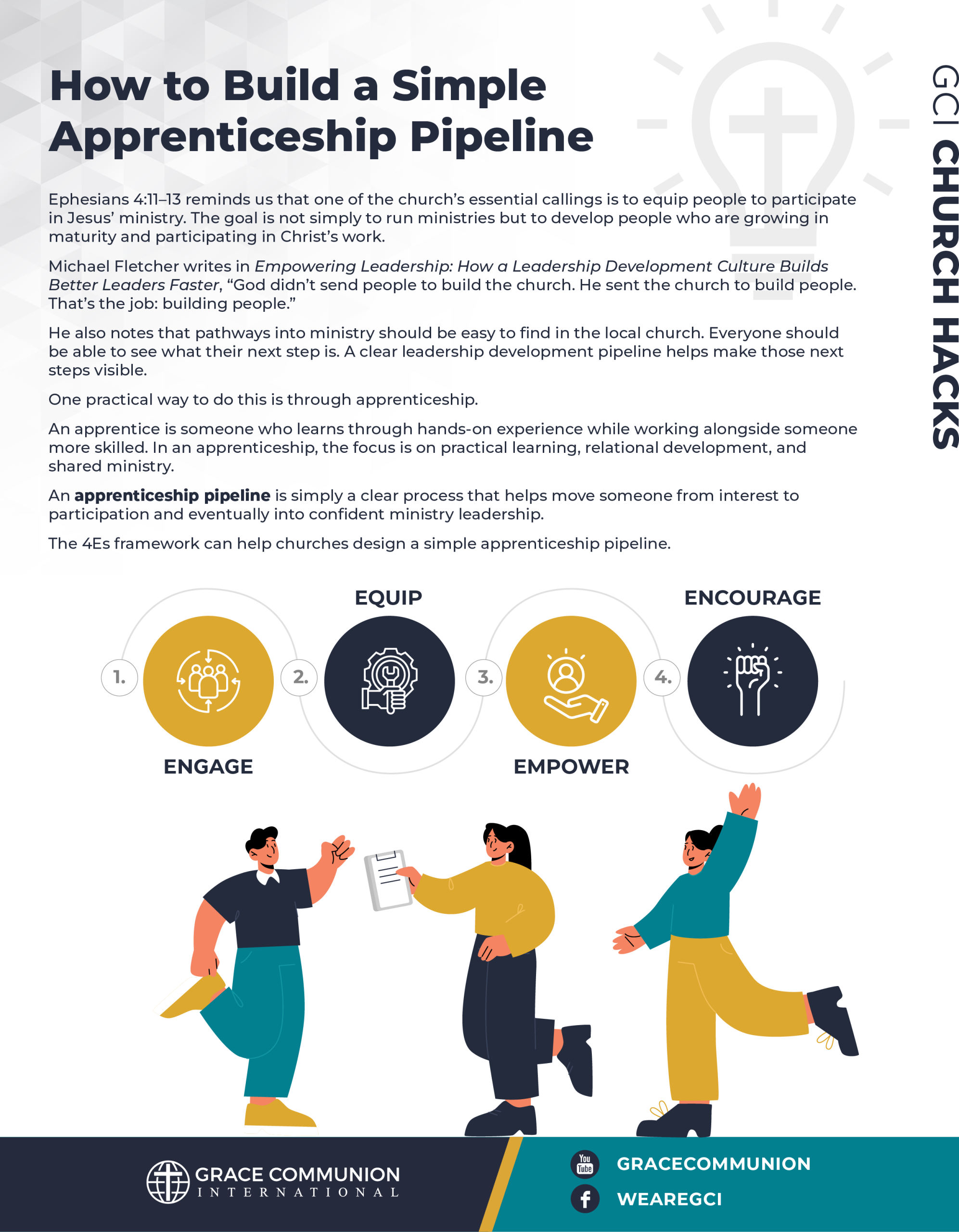
Church Hack—How to Build a Simple Apprenticeship Pipeline

The development of leaders starts with seeing people and inviting them into the journey. This Church Hack introduces a simple apprenticeship pipeline to help your church engage, equip, empower, and encourage. Take a step by identifying someone to walk alongside.

Read the full Church Hack here.

Formation—Pentecost

Jesus promised to send the Helper who will be with us forever

Pentecost is the day on which we move from spectators in the gospel story to active participants in Jesus’ mission. It is the day the Church, the Body of Christ, was born. Meditate on this GCI “Sixty Second Sermon” about Pentecost before moving to this following practice.

Spiritual Practice: Come, Holy Spirit

Purpose: To move from spectators to participants by intentionally welcoming the Spirit’s presence and guidance.

Practice (5 minutes):

    1. Be Still
      Sit quietly and take a few slow breaths. Become aware that the Holy Spirit is present with you.
    2. Pray Simply
      Pray slowly, either aloud or silently: “Come, Holy Spirit.”
      Repeat this prayer three times, allowing space between each repetition.
    3. Listen
      Ask: “Holy Spirit, how are you inviting me to participate in what God is doing today?”
      Sit in silence for one or two minutes. Don’t force an answer — simply notice any word, thought, or nudge.
    4. Respond
      End by offering a simple response:
      “Here I am. Send me.”

Closing Encouragement:
Pentecost reminds us that the same Spirit who filled the early church is at work in us — speaking, sending, and empowering us for everyday participation in God’s mission.

Kingdom Living (Part 4): Transformational w/ Walter Kim

Kingdom Living (Part 4): Transformational w/ Walter Kim

Kingdom Living is not only relational, participatory, and missional. It is also deeply transformational. In this final episode of our 2026 mini-series, host Cara Garrity concludes her conversation with Dr. Walter Kim, President of the National Association of Evangelicals, by exploring what it means to be formed into the image of Christ. Transformational Kingdom Living reshapes our priorities, reorders our values, and redirects the way we live each day.

Together, they reflect on how discipleship is not behavior modification but Spirit-led formation. As we follow Jesus, we are continually changed from the inside out, learning to love what he loves and to live in ways that reflect his heart. This episode brings the series full circle, reminding us that Kingdom Living ultimately means becoming more like the King.

“Our ability to be on mission, [Jesus’] mission — that’s also a part of the transformation that he calls us to. But it’s also the impact that we would have in the world as God’s people, the conduit of God’s grace that continues to work in this world. There should be a leavening influence in society as well. And so, to grow in Christ’s likeness really means all three things: to be like Jesus in character, to be like Jesus in mission, to be like Jesus in terms of the impact and transformation that we would have in broader society.” — Rev. Dr. Walter Kim

Main Points:

  • What does it mean to become more like Christ? 01:27
  • What might transformational Kingdom Living ask of us – personally and corporately? 05:28
  • Transformation, a becoming something new, often require dramatic change. Can you speak to both the fears and freedoms surrounding transformational change? 10:36
  • How do we cultivate spaces and communities that welcome transformation? 21:59

Resources:

Program Transcript


Cara: In 2026, the GC Podcast is shifting to a new format with too miniseries released throughout the year rather than monthly episodes. This change is going to allow us to go deeper into meaningful conversations that support our shared journey of Kingdom Living. In the first half of the year, we’re excited to launch the series with Reverend Dr. Walter Kim, president of the National Association of Evangelicals, and the keynote speaker for the 2026 denominational celebration. In this series, Dr. Kim joins me to explore what it means to live as citizens of God’s kingdom in today’s world — faithful to Christ, formed in community, and engaged in mission. So, stay tuned for this rich and timely series.

[00:00:53] Cara: Hello friends, and welcome to this episode of GC Podcast. This podcast is devoted to exploring best ministry practices in the context of Grace Communion International churches. I’m your host, Cara Garrity, and today we are concluding our miniseries on Kingdom Living with Reverend Dr. Walter Kim. We’re exploring what it means to live as citizens of God’s kingdom in today’s world. What does it look like to live faithfully in Christ, formed in community, and engaged in mission? So, Walter, thank you for joining us today,

[00:01:24] Walter: Cara, it’s always great to have these conversations with you.

[00:01:27] Cara: Thank you. So, for our final episode of this miniseries, we’re going to be exploring the transformational aspect of Kingdom Living. So, becoming more like Christ as we follow him, and allowing discipleship to change our priorities, values, lives as we’re continually formed into Jesus’ image. And so, I want to begin with, what does it mean to become more like Christ?

[00:01:52] Walter: Yeah, I think that’s obviously the central question for the Christian life — growing in Christ’s likeness, bearing the fruit of the Spirit that is reflected not only in Christ’s life, but the ongoing work of Christ. He said an extraordinary thing, that it’s better that I leave and the Spirit come, than I remain.

I mean, to me, it’s crazy, right? How, could that be? And yet, it is the case that Jesus, as always, lives up to his word, that his departure and the gift of the Spirit mean that the very presence of God has moved from a place. At one point, God’s Spirit descends another temple, and then Jesus said, destroy this temple in three days, I’ll raise it up again.

So, clearly the Spirit descended and resided in a special way and in Jesus as God the Son. And now God sent this forwarding address as Jesus returned to his heavenly abode. The forwarding address of the Spirit is, well, to us, the Church. And God’s Spirit now is moved from a place to the person of Jesus, to the people of God — the people of Jesus who reflect Christlikeness in our character, certainly reflect Christ’s likeness in our mission, reflect the character of Christ in the ways that we are salt and light in the world. And it’s in all these ways. It’s not just in personal transformation and character development — love, joy, peace, patience, the fruit of the Spirit.

[00:04:22] Cara: And I really appreciate that. I think that connects back to the earlier conversations we’ve had about it not being living a kingdom life and being a disciple of Jesus is not about just me, myself, and I. But it’s about how are we living in community relationally and also participating in his mission and what he’s doing, not just what we ourselves would choose to be about doing. What is he doing in the world? And so, it’s not just this individualistic pursuit, but it’s very collective.

And it’s very grounded in what is, he already doing? And coming back to I loved what you said. He’s doing so many things even beyond the scope of what we might be looking at in any particular moment. So, I think that’s a really helpful place for us to ground ourselves in. What does it mean to become Christlike? It’s not maybe as one dimensional as we might be tempted to regard it as.

[00:05:28] Walter: Absolutely. Yeah.

[00:05:28] Cara: And so, what when we think about that what might this transformational Kingdom Living ask of us personally, corporately as we are made more and more into his likeness.

[00:05:46] Walter: Yeah. So, you think about the mission of Jesus that he came into this world to proclaim good news, of course, but he proclaimed good news to the poor, right? Freedom for the prisoner, sight for the blind, release for the captives, the year of the Lord’s favor — this mission that he describes picks up on all the aspirations of the Old Testament but also the transformational work of the good news in the New Testament people of God.

And so, yes, it is this personal transformation, but it’s also, we have to ask question, is the community a better place because of the presence of the church? If the church, if you and your local community disappeared, would the church be missed? Because people would go and realize, wow, we didn’t realize just how much the church was instrumental in addressing education issues or in addressing issues of homelessness, but also in providing a place for youth to be. And equipping people to be good faith presence in all aspects of society. Whether it’s how you handle your work, the ways you go about your work in all the different places that God might have people in your church serving and working — that presence of Jesus and it being missed, I think, is a real test.

There have been different seasons in the life and vitality of the church in America and certainly globally, where it’s uncontestable that Jesus and Jesus’ people made a difference, that they were a powerful influence of education. Again, I think of the Sunday school movement and the way that as it was arising in the 1800s as a response to the Great Awakenings and the movement of God’s Spirit and individual transformations, people come from saving faith, but also in corporate transformation as communities were asking, what can we do to be a leavening influence in society?

This was an opportunity for the church to rise up and say, here are all these children working in factories, not getting an education. Why don’t we provide a Sunday school to teach children how to read, how to do math, how to get an education, basically get an education, and of course to teach the truth of who Jesus is.

But it was not just a narrowly defined understanding of what we are doing in Sunday school to build up a church internally or to make sure we have good Christian kids. But it really was this incredibly innovative, creative influence, and offering to society, I think at its best. The church empowered by the Spirit has that kind of creative redemptive influence internally in the shaping of its people, but externally in the transformation of communities.

And yeah, is the community, would the community miss your church’s presence? That’s a really compelling question to ask.

[00:09:36] Cara: Yes. I really like that as a reflective question. I think it helps us to come together and think about, are we living this within our community? Are we doing the things that transformation might ask of us beyond that kind of individualistic thinking about just ourselves and our little corner?

And even just thinking beyond the walls of the church or the already gathering church community. I think that’s a really helpful, and challenging, but also empowering question for us to ask ourselves. And I think that can open a lot of that opportunity, like, that you say, for creativity, even in that — what does that redemptive work look like for us to join into? Because it can look a lot of different ways. Absolutely.

And so, I’m thinking, like, when we think about things like that, like the Sunday school movement or asking ourselves that question about would our neighborhood, would our community miss us If we went away, when we think about becoming transformed or becoming something new in these different kind of creative senses or joining in that redemptive work, it often requires some kind of a change, right? Like transformation is experiencing a change and usually a very dramatic change. And we are usually more comfortable with what we’re familiar with and what we know. So, that can be one of the challenges with allowing ourselves to be transformed. And so, I’m wondering, can you speak a little bit to both the fears, but also the freedoms surrounding transformative change for us as a church?

[00:11:24] Walter: Yeah. Cara, that’s an interesting chicken and an egg challenge, right? In some ways, we need to be transformed first by the Spirit in order to be able to offer anything to the world of substance, of meaning, of truly a different way of living, and life, and a connection to God that speaks to the transcendent power of Jesus Christ. So, on the one hand, it seems like we need to be changed first. And yes, that there is truth to that before we can offer, we need to be transformed, be before we can offer transformation to others.

But in another sense, when we pray, Lord, I’m a little bit stuck in my faith. I’ve read these things and I want to grow. It’s very rarely the case that God’s response would be, “Oh, I had this latest book that you need to read off of the Christian top 10 sellers.” Now that’s a part of the process — of reading, an education.

But oftentimes the Lord throws us into a life-stretching situation that is beyond the transformation that we have experienced, that demands a deeper transformation. How many of us know that it’s when we got a really adverse health situation that all of a sudden, we found ourselves praying? Maybe you read a book on prayer and that really helped your prayer life, and you improved prayer. And again, those things are important. Educate, of course. But there’s nothing like being thrown into a situation where you are desperate because of your circumstances. A lost job, a health diagnosis, something’s going on with kids, a tragedy in your community, a shooting — you name it — natural disaster. These things have a way of expanding and exposing the limits of our faith so that we actually seek a deeper transformation.

So, in some ways it’s a chicken and an egg. Yes, of course, we need to be transformed before we offer transformation. But sometimes the transformation that we offer actually helps us to become transformed, sometimes by going into a community, a neighborhood that you rarely go to in your city. Sometimes it’s building a relationship across a social boundary that makes you uncomfortable. Sometimes it’s having your church try something in the neighborhood that it’s never done before, that actually makes you pray like crazy, search the Scriptures to see is this, really biblical way.

What, how. How can we grow and how can we offer something? That’s a moment in which, if we want to grow in our faith, even from a self-focused point of view, if you want to grow in your faith, putting yourself in these faith-stretching moments are absolutely transformational.

And so, I look at this as the virtuous cycle of Spirit-filled ministry. Yes, we need to be changed in order to offer some something to the world. But sometimes when we step into the world and are stretched beyond our boundaries, we become changed ourselves. What was the way that the disciples began to learn the worldwide mission of Jesus? They saw Jesus talking to a Samaritan woman. It completely stretched their boundaries, put them in a completely, incredibly uncomfortable place as they went back to the Samaritan village and interacted with the Samaritan villagers. That’s exactly, at times I think, the kind of places we need to go if we want to grow in our faith.

[00:15:31] Cara: Yeah. And, as you describe that, I think about even some, again, some of the themes we’ve been talking about, this transformation and Kingdom Living. It’s embodied, right? It’s an experiential thing.

And so, as we’re stepping out in the community, as we’re stepping out into living and discipleship in real time, that part of the process of being transformed is going out and living in the flesh and grappling with some of these things that we’re learning within relationships out in the world, in our communities and figuring out beyond maybe just concepts. What does that look like?

And I like even that example of the Samaritan woman, right? Like you can sit there and maybe read theologies or do bible studies for like weeks and weeks. But until you’re sitting across the table from somebody that you never thought to love that that’s only knowledge in your head. It’s not real. It’s not embodied. It’s not transformation.

And I think that, like, when knowledge becomes lived, that’s when we really step into that kind of area of transformation. And one of the ways I like to think about, too, when we step into those situations where it’s like we’re really stretched is, oh, I’ve hit the end of myself, right? This is very clearly beyond what I know, what I can handle, what I can understand. And so, like, I have to step into this, newness. Because there’s nowhere else. There’s nowhere else to go. And I think those are two ways that going out and living in community can be part of that transformation.

You find the end of yourself, and you find yourself in situations where like knowledge becomes live. And I like what you say too about the chicken and the egg, because I do think. sometimes. we get a little bit in our heads about, okay, we have to be transformed first. And then we can go out. And I think that stops us a little bit from going in and doing the things. But even neuroscience, right, tells us that sometimes it’s in doing the things that we become change. that our minds change. The renewing of the mind and sometimes in that physical embodied participation is, like, part of the process of becoming new.

[00:18:19] Walter: Yeah, absolutely. There is, yeah. I think about how much Jesus in his training of the 12, just threw his disciples out into situations. He sent them out two by two and told them only take your staff and your cloak and go and ask for lodging. These are, like, incredibly faith-stretching moments. And he sent them out before they were even fully able to understand who Jesus is and his full mission.

And so, there is a way in which, again, we perhaps need to trust that as we put people in faith-stretching moments they actually become more engaged as disciples. They learn to embody and live out, but they also learn the limits so that they come back and say I actually discovered, I don’t really know how to answer these questions.

Cara: Yeah.

Walter: I remember when I was working in campus ministry in early parts of my ministry, one of the things that we would do is we would go out with students and share our faith. And there was only so much training that you can do. You can give all the worksheets on how do you answer this question about the Bible, or did Jesus really rise from the dead? Or, what happens to those people who have never heard about Jesus? And you have all these kind of training opportunities, but there is nothing that can replace an actual conversation where you’re unfolding these lessons and then you realize, I remember reading about this, but I actually don’t remember what I read, or that’s a question I’ve never encountered before, or asked in a way that I gave an answer and it really wasn’t satisfactory. And you go back and you realize, I actually need to search the Scriptures even more deeply.

And so, once again, there are ways in which we need to be changed and sent out. There are ways in which, as we repeat and like an athlete make good habits, that we get this more deeply ingrained. But there are also ways in which when we go out to serve the Lord in a variety of faith-searching context, we actually learn our ignorance.

And we become incentivized to say, I really need a better answer. This answer I thought was a good answer. It was satisfactory to me, but actually, it’s not a very convincing answer to a lot of other people that I’m interacting with. I actually need to search the Scriptures some more. I need to find this resource. I need to pray more deeply. I need to fast because this thing is not going to happen unless I engage more deeply in the spiritual battle. There are all sorts of ways that I think we become aware of our need to grow when we’re in these situations.

And, of course, there’s an issue of wisdom here. You don’t want to throw people into situations that they’re going be overwhelmed and completely unprepared for, and you know that’s not responsible leadership. But on the other hand, there’s a little bit of life and courage that we need to have in just going and doing and trusting that the Lord is present and in that will grow us.

[00:21:59] Cara: Thank you. Yeah, that’s very helpful. And those are, I think meaningful insights for us and to challenge how we think about even, like, what does it look like to be disciples in community with one another and in our community? And so, I think as we start wrapping up this conversation. How do we cultivate these spaces and communities that welcome in this kind of transformation that you’ve been suggesting to us and describing for us?

[00:22:38] Walter: Yeah. I think we can take any given issue and find a way to turn that into an opportunity for a corporate, not just an individual, but for a corporate way of faith steps.

So, for instance, it might be a personal evangelism. What would it look like for a church to say together, all of us, whether it’s a hundred or a thousand people attending your church, all of us are going to think of three people and in our small groups or with someone else, we’re going to actually share the name of three people that we in this coming year are praying actively to have a conversation of faith about. And we’re going to name that and we’re going to pray together and hold each other accountable.

I think of a beautiful story that really hits home for me. We did this in our church when I was pastoring back in Boston. My wife and I were both serving as pastors, and we led something called the Lenten Discipleship Institute. So, during the season of Lent, we in invited the church to gather together to go through a specifically designed series of lessons on some aspect of discipleship. And that particular year it was on faith and evangelism and sharing our faith in a holistic way. One of the exercises was to do this very thing, name someone and in your small group share that name.

My wife selected her mom, and we had been praying and seeking to diligently share our faith with her mom for decades. And the Lent and Discipleship Institute gave her a chance to name this person publicly, to talk with a group of people who would have the commitment to be praying for one another during, specifically during this season of Lent.

And then out of the blue during Lent, her mom calls her. My wife’s mom calls her and says, I’ve been thinking, I’ve been thinking about Christianity. And she started asking all sorts of questions.

Cara: Wow.

Walter: Do you need to read the whole Bible before you become a Christian? I heard about this thing about tithing. And the only framework she had — this is what I mean, of sometimes you don’t even know how people think about the Gospel until you actually end these conversations. She thought that that was a membership fee. So, do I have to tithe that in order to become a Christian — it’s like a country club thing where you pay a membership fee and then you can join the club? Is giving to the church like that, a membership fee, so I can’t become a Christian until I become a member, and I can’t become a member until I pay this fee? Is that what you know, Christians are doing? Like, it would’ve never dawned on our mind that anyone would think of tithing as a membership fee, like a country club.

But if you grew up in a world where you don’t have any other frame of reference of what, where else do you join things? Country clubs, and you pay interest. All that is to say sometimes we can take a specific issue, name it, join together corporately, pray for one another, and to see what the Lord might do.

And you can take this on any issue: poverty alleviation, challenging with the whole issues of the homelessness, choosing to volunteer together, being involved with the public education system.  What does it look like for us to provide backpacks for students?

Our church, we also sought to run the first science fair for a local public school.

Cara: Wow.

Walter: Because our church had a number of people in the world of science and technology, we partnered with this local public school who had never had a science fair. So, we said, you know what? What if we brought over, like, 50 of our people to run booths and experiments and everything from here’s the very program that Pixar uses to make animation and show that; had aerospace person talk about building the most optimized paper airplane and running experiments. It’s just an amazing opportunity to build relationships.

I would say you could just pick an issue and as a church take a step of faith and try something and see where the Lord might lead you.

[00:27:40] Cara: Thank you. That is, I think, a really beautiful insight and a great place for us to wrap up this series and to have an invitation and exhortation for us to live in a way that embodies the liveliness, the beauty, the mission-drivenness of the kingdom. So, I want to thank you so much, Walter, for joining us for these conversations and for sharing your insights and your life experience, and just your words of wisdom with us.

And so, as we wrap up, I would just ask, would you pray for us one last time and for our members and our community members and leaders and just everyone that our folks and listeners will come in contact with?

[00:28:32] Walter: Yeah.

Lord, we give you praise that the mission is yours and we get to participate in it; that you have created us to be renewed in Christ, made in his image, and sent on his mission; that you have moved your Spirit’s presence from a place to a person now to a people. And that even now your Spirit is working beyond this people and you’re inviting us to participate in that.

Thank you that we know how the story ends. We know that there will be a new heavens and a new earth, and every aspect of the cosmos will be redeemed, renewed for your purpose and your glory. And as we labor imperfectly, as we labor with hope and fits and starts, help us to trust that our labor is not in vain, and that it will find and bear its fruit in due time, and that above all things, the love of Jesus means that we can serve you with great confidence and courage and not a spirit of fear or timidity. And we pray all this in the name of Jesus. Amen.

[00:29:55] Cara: Amen.

So, as we wrap up this series, just a reminder for you all that Kingdom Living is participatory, it’s relational, missional, and transformational. And Jesus said, as the Father has sent me, I am sending you. As citizens of the kingdom and co-laborers with Christ, we’re sent into the world to reflect his light.

Kingdom living requires awareness of our calling and our context, seeing our neighbors’ vocation, and even our sufferings as places where Jesus reigns and sends us. Kingdom Living is not passive. It is a bold proclamation and a tangible demonstration. We not only speak of the reign of God, we show it. Our words align with our works. As image bearers, our relationships become a visible witness to the reality of the kingdom being ushered in. And so, till next time, folks, keep on living and sharing the Gospel.

Thanks for listening. We would love to hear from you. Email us at info@gci.org.

Matt Pandel—Year A Proper 5–8

Matt Pandel—Year A Proper 5–Proper 8

Romans 4:13-25 ♦ Romans 5:1-8 ♦ Romans 6:1b-11 ♦ Romans 6:12-23

The host of Gospel Reverb, Anthony Mullins, welcomes Dr. Matt Pandel to discuss the June 2026 RCL pericopes. Matt is the President of Global Grace Seminary where he is also Professor of Trinitarian Theology, Counseling and Spiritual Direction. He is a trained behavioral psychologist and theologian but is first and foremost a communicator. He holds terminal degrees in Theology and Psychology, as well as undergraduate and graduate work in education, ministry, and family therapy. Matt is the author of Living in the In-Between: Developing the Character That Unveils Destiny.



Sunday, June 7, 2026 — Proper 5
Romans 4:13–25 NRSVUE

Sunday, June 14, 2026 — Proper 6
Romans 5:1–8 NRSVUE

Sunday, June 21, 2026 — Proper 7
Romans 6:1b–11 NRSVUE

Sunday, June 28, 2026 — Proper 8
Romans 6:12–23 NRSVUE


If you get a chance to rate and review the show, that helps a lot. And invite your fellow preachers and Bible lovers to join us!

Follow us on Spotify and Apple Podcast.

Program Transcript


Transcript coming soon!

Offering and Communion Starters | June

Last year, we introduced a new resource to help you prepare for the time of giving and taking communion in your Hope Avenue. These are meaningful formational practices that we can plan with care and intentionality.

The Communion and Offering Starters are posted a month ahead, like the sermon resources. Below are the June starters. In case you missed it: May Starters are here.

How to Use This Resource

An outline is provided for you to use as a guide, followed by a sample script. Both the offering moment and communion can be presented as a short reflection before the congregation participates. Here’s how to use it effectively:

  • Scripture Reflection: Include the relevant Scripture to root the offering and communion in biblical teaching.
  • Key Point and Invitation: Briefly highlight the theme’s key point and offer an invitation that connects the theme to the practice.
  • Prayer: Include a short prayer that aligns with the theme. Invite God to bless the gifts and the givers. Ask God to bless the bread and the wine and the partakers.
  • Logistics: Explain the process; this helps everyone know how they can participate. For giving, indicate whether baskets will be passed, if there are designated offering boxes, or if digital options like text-to-give or web giving are available. Clearly explain how the communion elements will be shared and that participation is voluntary.
  • Encouragement: For the giving moment, invite congregants to reflect on their role in supporting the church’s mission, reminding them that their gifts impact both local and global ministry. For communion, encourage congregants to express gratitude for Jesus’ love poured out for us and the unity present in the body of Christ.

For more information, see Church Hack: Offering and Church Hack: Communion


Offering

June Theme: Spiritual Boasting

Scripture Focus: Romans 5:1–2 NRSVUE

Key Point: Giving is one way we boast of the goodness of God who gave us access to his grace.

Invitation: May our offerings be a reflection of the hope we have living in the abundant grace of the Father, Son, and Spirit. May it also be a way to praise God (even boast) in his faithfulness to us at all times.

Sample Script

Most of us look at boasting as a bad thing. And it’s not healthy when the boasting is a focus on the self. Boasting in God’s goodness, however, not only keeps us focused on him. It’s a way to help others understand that God is good and trustworthy. A good example of this is when we tell someone what God has done and is doing in our life. When we boast in God, we recognize our own weakness and our reliance on God. We can brag about the way God is transforming us. Our boast in God is a strong encouragement to those who don’t yet know him.

Therefore, since we are justified by faith, we have peace with God through our Lord Jesus Christ, through whom we have obtained access to this grace in which we stand, and we boast in our hope of sharing the glory of God. Romans 5:1–2 NRSVUE

We have peace with God through Jesus Christ because we have been justified by faith. This gives us reason to boast — not in our faith, or in ourselves, but in Jesus and his faith. Through him, we have obtained access to grace. Because of Jesus, we know he lives in us and we live in him. Because of Jesus we are in the Father, and the Father is in us through the Spirit. Because of Jesus we can boast in the hope he gives us. Our offerings help the Church to share that hope with others. We want others to experience his peace, to live in his grace, so they, too, can boast about God and his goodness.

Prayer


Communion

June Theme: Death and Life

Scripture Focus: Romans 6:6–11 NRSVUE

Key Point: Communion reminds us we are dead to sin and alive to Christ.

Invitation: May the bread remind us that our life is in Christ. He lives and we live. May the cup remind us we live in him because our death in him frees us from sin.

Sample Script

Every gardener knows that life comes from death. While some say a seed never really dies, we do know that when a seed is planted, a new life has to break free from the seed and sprout into something new. Gardeners often refer to this as the seed dying.

Death also proceeds our new life.

We know that our old self was crucified with him so that the body of sin might be destroyed, so we might no longer be enslaved to sin. For whoever has died is freed from sin. But if we died with Christ, we believe that we will also live with him. We know that Christ, being raised from the dead, will never die again; death no longer has dominion over him. 10 The death he died, he died to sin once for all, but the life he lives, he lives to God. 11 So you also must consider yourselves dead to sin and alive to God in Christ Jesus. Romans 6:6–11 NRSVUE

When we die with Christ, we are transformed into something new. We are a new creation. This new creation is no longer enslaved to sin.

This is our hope. We died to sin when we were made alive in him, and though we will all face the temporary cessation of this physical life, death no longer rules us. We will be transferred into something better, a body fully alive in Christ.

The physical bread of communion reminds us that our physical bodies, which decay and die, are temporary. The bread reminds us that we are part of the body of Christ, which is eternal. The cup reminds us that we are dead to the enslavement of sin, and we are free to live in him as new creations.

Prayer.


Sermon for June 7, 2026 — Proper 5

Program Transcript


Romans: New Life Through Christ

Most people know what it feels like to wrestle with change. We recognize the gap between the life we hope for and the life we often experience. We try to do better, try to grow, try to move forward. Yet sometimes the struggle itself reminds us how much we need help beyond our own strength.

In Romans, the apostle Paul speaks directly into that human experience. He reminds us that our relationship with God does not begin with our effort, but with God’s grace received through faith. Through Jesus, the Father draws humanity into a relationship of grace and transformation by the Spirit.

Long before laws, rituals, or systems of religious performance, there was a man who simply trusted the promise of God. Abraham believed that the God who gives life to the dead and calls things into existence could fulfill what he had promised.

This trust became the foundation of his relationship with God. Abraham’s story reminds us that faith is not about perfect certainty or flawless obedience. It is about trusting the

faithfulness of the One who makes the promise.

From this foundation of faith, Paul unfolds the larger story of salvation. Through Jesus Christ, humanity is brought into peace with God. What was once broken has been reconciled. What was once marked by fear now stands within grace.

Salvation is not a single moment but a living story with depth and movement. We have been welcomed into peace with God. We are being shaped and renewed through the work of the Spirit. And we look forward with hope to the fullness of life God is preparing.

Even our hardships can become places where hope grows. Perseverance shapes character, and character deepens hope, until we discover that God’s love has already been poured into our hearts.

Paul then turns to one of the most powerful truths in the gospel. Through Christ’s death and resurrection, we are invited into a new way of living. The old patterns that once held us

captive no longer define who we are. We are called to live as people who belong to a different kingdom.

This does not mean perfection overnight. Instead, it means that our lives are now shaped by a new allegiance. Where sin once held authority, grace now leads us toward righteousness and life.

Yet Paul does not pretend that the journey is easy. In one of the most honest reflections in all of Scripture, he describes the struggle many believers recognize within themselves. The desire to do what is good meets the persistent pull of old habits and broken patterns.

This tension reveals something important. The law can name what is good, but it cannot give the power to live it. The struggle itself reminds us that our hope does not rest in our own strength, but in the grace of God at work within us.

Romans reminds us that the Christian life is not a straight path of effortless progress. It is a journey shaped by trust, grace, struggle, and hope.

From Abraham’s faith, to Christ’s reconciling work, to the Spirit’s transforming presence, the message echoes again and again:

These words lead us to the heart of Paul’s message in Romans. In the passage that follows, we hear how faith in Christ brings peace with God and fills our lives with a hope that does not disappoint.

1 Therefore, since we have been justified through faith, we have peace with God through our Lord Jesus Christ, through whom we have gained access by faith into this grace in which we now stand. And we boast in the hope of the glory of God. Not only so, but we also glory in our sufferings, because we know that suffering produces perseverance; perseverance, character; and character, hope. And hope does not put us to shame, because God’s love has been poured out into our hearts through the Holy Spirit, who has been given to us.

Romans 5:1–5

As we explore the book of Romans, may we rest in the assurance that our lives are held within God’s grace. The one who began this work in us is faithful to carry it forward.


Psalm 33:1–12 • Genesis 12:1–9 • Romans 4:13–25 • Matthew 9:9–13, 18–26

Today’s theme is God keeps his promises. Our call to worship psalm celebrates the righteousness and faithfulness of the Lord who called into existence all that came to be. Our Old Testament reading from Genesis recounts the calling of Abraham that marks the beginning of God’s work of salvation for the whole world. The epistolary reading from Romans revisits the call of Abraham with a focus on God’s promise of inheriting the world to those who trust in the Lord. The Gospel text in Matthew positions Jesus’ calling of tax collectors and his healing of a woman along with his raising of a young girl between his statement that he did not come to call the righteous but sinners.

Reminder: This introductory paragraph is intended to show how the four RCL selections for this week are connected and to assist the preacher prepare the sermon. It is not intended to be included in the sermon.

How to use this sermon resource.

God Keeps His Promises

Romans 4:13–25 NIV

Don’t we all long for healthy relationships — for secure relationships with people we can trust? Have you ever had someone break a promise to you? Probably all of us have. [Consider making this personal. Share an example from your life.] We know the pain of broken trust. We also fall short of keeping our promises.

But here’s good news: God is not like us in this way. God keeps his promises. Always.

This promise-keeping faithfulness is at the heart of the passage we’re looking at today, which speaks about righteousness. Many people associate righteousness with rule-following or simply being a good person. Biblically, however, righteousness is first and foremost about relationship — about being in a right relationship with God.

And here’s more good news: “the righteousness of God is given through faith in Jesus to all who believe” (Romans 3:21 NIV). In other words, right relationship with God is not something we achieve; it is something we receive as a gift.

That is why Scripture speaks so often about faith. God calls us to faith, to believe in him, which is another way of saying that he calls us to trust him. And this call to trust makes sense because God has shown himself to be completely trustworthy. Right relationship always depends on trust.

Crucially, this trust is grounded in who God is. God is a triune God — Father, Son, and Spirit. God is not a solitary or distant deity, but three-in-one. God is in himself a righteous relationship trust. There is never a hint of doubt or suspicion between Father, Son, Spirit.

And that is the very relationship we are called into by our loving Father. The right relationship the Son has with his Father, by the Spirit, is the very relationship the Son shares with us. He includes us in this relationship of perfect trust — the relationship we long for and our hearts were made for.


So, let’s read our passage by Paul, who was a key early Christian leader and missionary who spread the message of Jesus and wrote many letters in the New Testament. The book of Romans is one of those letters.

13 It was not through the law that Abraham and his offspring received the promise that he would be heir of the world, but through the righteousness that comes by faith. 14 For if those who depend on the law are heirs, faith means nothing and the promise is worthless, 15 because the law brings wrath. And where there is no law there is no transgression.

16 Therefore, the promise comes by faith, so that it may be by grace and may be guaranteed to all Abraham’s offspring—not only to those who are of the law but also to those who have the faith of Abraham. He is the father of us all. 17 As it is written: “I have made you a father of many nations.” He is our father in the sight of God, in whom he believed—the God who gives life to the dead and calls into being things that were not.

18 Against all hope, Abraham in hope believed and so became the father of many nations, just as it had been said to him, “So shall your offspring be.” 19 Without weakening in his faith, he faced the fact that his body was as good as dead—since he was about a hundred years old—and that Sarah’s womb was also dead. 20 Yet he did not waver through unbelief regarding the promise of God, but was strengthened in his faith and gave glory to God, 21 being fully persuaded that God had power to do what he had promised. 22 This is why “it was credited to him as righteousness.” 23 The words “it was credited to him” were written not for him alone, 24 but also for us, to whom God will credit righteousness—for us who believe in him who raised Jesus our Lord from the dead. 25 He was delivered over to death for our sins and was raised to life for our justification. Romans 4:13–25 NIV

Before we understand Romans 4, we need to understand the story behind it, because the apostle Paul is talking about Abraham who lived two thousand years before Jesus was born. He’s considered the ancestor of the Jewish people, but more importantly, he’s someone to whom God made a promise.

And God keeps his promises.

God promised him three things — a land for his descendants, a family, and a blessing. Abraham’s family would grow into a nation and through his family, all nations would be blessed.

This week is a great time to read the story beginning in Genesis 12. Why not read it together with others?

Years passed after that promise, and nothing happened. There was still no child, no family, no land, and no nation. In Genesis 15, Abraham said, “Lord, you promised me descendants, but I still have no child.” God told him to look up at the sky and count the stars if he could. Then God said, “So shall your offspring be.” And “Abraham believed the Lord, and it was credited to him as righteousness.” Abraham trusted God — not because the situation made sense, but because he believed that God keeps his promises.

Eventually Abraham and his wife, Sarah, did have a son named Isaac. Over time their family grew into a nation called Israel. Centuries later God rescued Israel from slavery in Egypt, and through their leader, Moses, God gave them something called the Law. The Law was a set of instructions showing people what life with God should look like. It shaped Israel’s worship, their ethics, their justice, and their daily life. But the Law also revealed something difficult about the human condition. Even when we know what is right, we struggle to live the way God designed us to live.

Now we come to Paul’s letter to the Romans. The church in Rome included two different groups of people. Some were Jewish followers of Jesus who had grown up with the Law of Moses. Others were Gentiles — non-Jewish people who had no background in the Law at all. This created tension in the church, and a question emerged: What about Abraham? Surely Abraham stands as the supreme example of righteousness before God. Paul agrees — but not in the way some might expect.

Long before the law was given, Abraham trusted God’s promise, and “it was credited to him as righteousness” (verse 22, quoting Genesis 15:6). Paul’s understanding of faith is trust that leads to righteousness or right-relationship. And Paul is using Abraham as his strongest evidence for his argument.

See, earlier in the letter, Paul established that Abraham was declared righteous by faith, not by following the law. Now he explores further the nature of that promise given to Abraham and the kind of faith which enables him to receive it.

As he does so, he draws Abraham’s story into direct connection with our own. In this way, he is reminding us of God’s call and promise to us to trust in him for righteousness. God is inviting us today to receive and have part in the very relationship Jesus has with the Father by the Spirit. And answering that call requires faith, trust. God has proven his faithfulness in the Lord Jesus, and we can trust his call to us, and we can trust his promises.

Let’s go back to verse 13: “It was not through the law that Abraham and his offspring received the promise that he would be heir of the world, but through the righteousness that comes by faith.” In Genesis, the promise is spoken in terms of land, offspring, and blessing. Paul interprets it in light of God’s unfolding purposes and dares to say that Abraham was promised inheritance of “the world.” The promise to Abraham always pointed toward God’s intention to bless all creation.

However, what matters most for Paul is not the scope of the promise but the means by which it was given. The promise did not come through the law. Abraham naturally did not earn it by obedience to commandments that had not yet been given. The law of Moses would come centuries later. The promise came “through the righteousness of faith.” Notice Paul’s choice of words here. He could have said simply “through faith,” but he specifies “through the righteousness of faith.”

Faith is not some psychological attitude or a religious feeling. Faith is how we receive what God gives. When we understand faith as trust, that makes perfect sense. We cannot receive from one we do not trust unless it is under coercion or force. And God does neither. He calls us to know him, and in coming to know him we come to see that he is trustworthy.

God is not building a relationship with you based on your performance. God builds it on his promise.

“For if those who depend on the law are heirs, faith means nothing and the promise is worthless,” (verse 14).

If inheritance depends on law-keeping, then faith has no role to play, and the promise itself collapses under the weight of human failure. Relationship with God becomes contractual, not built on trust. Verse 15: “because the law brings wrath. And where there is no law there is no transgression.” The law, good and holy as it is, exposes sin and reveals humanity’s inability to secure righteousness on our own. It shows us what is required, but it cannot give us the power to fulfill it. The law can name what is good, but it cannot give the power to live it. If the promise depended on the law, there would be no relationship, only a contract we could not uphold.

Verse 16: “Therefore, the promise comes by faith, so that it may be by grace and may be guaranteed to all Abraham’s offspring …” Faith and grace belong together. Faith receives what grace gives. And because the promise rests on grace, it is secure — not only for those who live under the law, but also for those who share the faith of Abraham. Here Paul expands the family of Abraham beyond ethnic or legal boundaries. Abraham is “the father of us all. As it is written, ‘I have made you the father of many nations’” (verse 16–17).

This is a radical claim. Abraham, the ancestor of Israel, is also the ancestor of all who believe. Not by blood, but by faith, by trust in God’s promise. The people of God are defined not by ancestry or achievement, but by faith in the God who makes promises and keeps them.

Abraham believed in God “… who gives life to the dead and calls into being things that were not” (verse 17). God brings into existence what does not exist! This is not an abstract theological statement. It is rooted in Abraham’s own experience, an experience written down for our benefit. Abraham and Sarah were old. The promise of descendants as numerous as the stars seemed absurd. And yet Abraham believed.

“Against all hope, Abraham in hope believed and so became the father of many nations …” (verse 18). This is not blind optimism or denial of reality. Paul is clear: Abraham did not ignore the facts. Abraham and Sarah’s bodies were, as Paul says, “as good as dead” when it came to producing children (verse 19). Faith does not pretend that circumstances are different than they are.

Faith faces reality honestly — and then trusts God anyway. That can be a word of encouragement for us today. As God calls us to himself, we grow to realize that he is stronger than all that opposes us. He is also wiser than all we think we know. So, we can trust him even when things do not seem to add up, as they did not add up for Abraham. But in time, we come to see that God is faithful even with the odds are stacked against us. Ultimately, we see this played out most dramatically in his relationship with his own Son. God is faithful to Jesus even when he dies on a cross.

Let’s continue. “Yet he did not waver through unbelief regarding the promise of God, but was strengthened in his faith and gave glory to God, being fully persuaded that God had power to do what he had promised” (verse 20–21).

Here we see the heart of biblical faith. Faith is not confidence in oneself; it is confidence in God. It is being fully convinced that God is able to do what God has promised. That is why his faith was “credited to him as righteousness” (verse 22). Abraham was rightly related to God, not because he was flawless or heroic, but because he trusted the God who gives life to the dead. And that undoubtedly nods in the direction of Jesus’ resurrection.

The words “it was credited to him” were written not for him alone, 24 but also for us, to whom God will credit righteousness—for us who believe in him who raised Jesus our Lord from the dead. Romans 4:23–24 NIV

This is our story. Abraham trusted God to bring life where there was none — a son in his old age. And Christians trust God for something even greater — God’s Son.

Jesus “was delivered over to death for our sins and was raised to life for our justification” ( verse 25). Jesus was put to death for our sin, for the wrong we have done. He was betrayed, arrested, and executed — but this was not a meaningless tragedy. His death, his crucifixion took seriously the harm, brokenness, and failure that mark human life.

And Jesus did not stay dead. God raised him back to life to show that sin and death do not have the final word. The resurrection is God’s way of saying, “This work is finished.” The resurrection declares that God keeps his promises faithfully.

A restored relationship with God is now open to everyone who trusts him. Together, we are being invited into a new family, a new life, a new way of being and moving through the world. This new collective vocation, new purpose is shared. Because God keeps his promises to us, we can become a community where promises are kept, where trust is rebuilt, and where people are safe. Faith and trusting God are now a part of our shared life as the Body of Christ.

God keeps his promises.

At its heart, the letter to the Romans is the good news of what God has done in Jesus Christ for the salvation of the world. Righteousness does not come through following the law, human achievement, or moral performance. It comes as a gift of grace, received through faith. The righteousness that makes us right with God is not achieved; it is received. And it is received through faith, a trust in the God who raises the dead.

We are invited to face the truth about ourselves alongside the truth about who God is. Like Abraham, we look honestly at reality — our limits, our weakness, our tendency to rely on ourselves. And yet we are also called to see something more solid: God is more faithful than we are and he will never let us down. God meets us in the truth about ourselves and does for us what we cannot do.

Because this is a gift, faith — understood as trust — stands at the center. It challenges our pride and self‑reliance. We are not called to trust ourselves, but our heavenly Father. In this way, we all stand on the same ground before God.

The promise made to Abraham eventually led to Jesus. Jesus was born into Abraham’s family line, but he was far more than just another descendant. In Jesus, God himself entered human history. God stepped into our world as Jesus. Jesus trusted the Father perfectly for us. Jesus lived the faithful life we could not live. Jesus died the death we deserved. Jesus shares his relationship with the Father with us through the Spirit.

Because God keeps his promises to us, we can become a community where promises are kept, where trust is built , and where people are safe. God is not just saving individuals. God is saving and forming us together into a loving community that reflects his mission to restore the world. And God includes us in that mission — because Jesus has already done the work.

When we step back, we can see that the whole Trinity is involved in this story of salvation. The Father makes the promise. The Son fulfills it. The Spirit brings it to life in us.

God keeps his promises.


Sunday, June 7, 2026 — Proper 5
Romans 4:13–25 NRSVUE

CLICK HERE to listen to the whole podcast.


If you get a chance to rate and review the show, that helps a lot. And invite your fellow preachers and Bible lovers to join us!

Follow us on Spotify and Apple Podcast.

Program Transcript


Transcript coming soon!


Small Group Discussion Questions

  1. How have experiences of broken trust — either as the one hurt or the one who failed — shaped the way you find it difficult or easy to trust others? How might those experiences affect the way you trust God?
  2. Where in your own life do you find it hardest to trust God right now? What might it mean to “hope against hope” without denying reality?
  3. What difference does it make to know we are invited into Jesus’ own relationship of trust with the Father?
  4. The sermon concludes by saying that because God keeps his promises, we are called to become a community where promises are kept and trust is built. What might that look like practically in your congregation this week?

Sermon for June 14, 2026 — Proper 6

Speaking of Life 5030 | Calling 911

This week we’re sharing a Speaking of Life message from our archive as a supplemental resource. We encourage you to use this for reflection and preparation, or small group discussion. For your worship gathering, consider how a call to worship from a local voice or contextualized introduction to the theme might serve your congregation well.

Just as we rely on an emergency number like 9-1-1 for immediate help in serious situations, we depend on the Lord to answer our cries for help. The Psalmist expresses this trust, reminding us that we can call on the Lord in times of trouble and be confident that He hears us and responds with the right answer at the right time.

Program Transcript


Speaking of Life 5030 | Calling 911
Greg Williams

Have you ever had to call 9-1-1? I hope not, but if you have, it was probably because you were in a serious situation that needed an immediate response. That’s why we call 9-1-1 here in the US. It’s the one number we know will be answered immediately and we will get a quick response to our needs. Could you imagine calling 9-1-1 and getting a recording or being put on hold? Hopefully, that will never happen to you. When an emergency occurs, there is a bit of peace knowing we can depend on someone answering us when we dial 9-1-1.

For those who have grown to know the Lord, 9-1-1 is likely the second call we make because our first cry for help is to the Lord himself. Like so many other believers, we have learned that the Lord is even more reliable than 9-1-1. He is always there to answer our call for help. Experience teaches us we can always turn to the Lord with our troubles, great or small because he has proven to be faithful to hear our call time and time again. Here is the beginning of a Psalm that expresses this trust:

I love the LORD, for he heard my voice;
He heard my cry for mercy.
Because he turned his ear to me,
I will call on him as long as I live.
Psalm 116:1-2 (ESV)

If you are watching this video, you probably don’t need to call 9-1-1. But I’m guessing many of you are facing troubles and trials. I encourage you to follow the wisdom of the one who wrote this psalm. Know and be confident in the truth that whatever troubles you are facing, either now or later, you can call on the Lord. Even when it seems he hasn’t answered, or answers in a way different than you desired, you can be sure you are not getting a recording or being put on hold. He hears you and always responds with the right answer at the right time.

I’m Greg Williams, Speaking of Life.


Psalm 116:1–2, 12–19 • Genesis 18:1–15, (21:1–7) • Romans 5:1–8 • Matthew 9:35–10:8, (9–23)

Today’s theme is God proves his love for us. Our call to worship psalm is a response of abundant gratitude to the Lord who hears our cries and rescues us from trouble. The Old Testament reading from Genesis presents the promise given to Abraham and Sarah of having a child in their old age, a promise so outlandish that Sarah laughs; however, the Lord is faithful in keeping his promise. The epistolary reading from Romans highlights God’s love poured out through Christ, who died for us not when we were strong or righteous, but precisely when we were weak and unworthy. The Gospel text in Matthew shows Jesus’ compassion for the crowds and his sending of the disciples to proclaim good news, heal, and restore, revealing a God who entrusts ordinary people with extraordinary work.

Reminder: This introductory paragraph is intended to show how the four RCL selections for this week are connected and to assist the preacher prepare the sermon. It is not intended to be included in the sermon.

How to use this sermon resource.

God Proves His Love for Us

Romans 5:1–8 NRSVUE

Last Sunday, we heard the good news that God keeps his promises by giving us right relationship with himself. We do not earn or achieve a right-relationship with God but we receive it as a gift. Our relationship with God is grounded firmly on grace, as a gift; it is not something we earn. Grace is God’s generous love that gives forgiveness, new life, and strength — before we deserve it and apart from our performance. And grace is grounded in what Jesus has already done for us in his life, death, and resurrection. We saw that we are drawn into trusting the God who brings life out of death, as the Father fulfills his promise in the Son and makes it real in us by the Spirit.

God has already shown himself to be trustworthy — and you can trust him today.

Today’s passage will describe what this life in grace looks like. And we will see how God proves his love for us.

Therefore, since we are justified by faith, we have peace with God through our Lord Jesus Christ, through whom we have obtained access to this grace in which we stand, and we boast in our hope of sharing the glory of God. And not only that, but we also boast in our afflictions, knowing that affliction produces endurance, and endurance produces character, and character produces hope, and hope does not put us to shame, because God’s love has been poured into our hearts through the Holy Spirit that has been given to us.

For while we were still weak, at the right time Christ died for the ungodly. Indeed, rarely will anyone die for a righteous person—though perhaps for a good person someone might actually dare to die. But God proves his love for us in that while we still were sinners Christ died for us. Romans 5:1–8 NRSVUE

There are three things you already have in Christ — three things or realities that “we have” on account of Jesus Christ. It is important to note that the three things are not presented as three things we must achieve or acquire on our own merit. Rather, they are three statements of reality that believers already have.

The first thing we already have is “justification.” “… we have been justified by faith …” You have already been made right with God. It may be hard to grasp the reality of the words “we have been.” This means that we have already been made righteous. How can this be in light of the fact that we so often fall again into sin or do not choose right relationship with God or others?

Sin is not merely the bad things we do that cause harm; it is the deep, twisted condition that bends us away from God and from one another. During our daily lives, we become painfully aware of our great need as sinners to be made righteous. We may conclude that we are not yet righteous and our justification, our being made right, still lies in the future. We are easily convinced that righteousness is a goal to pursue rather than a present reality to receive.

But this is not merely a potential or a possible, future justification. It is a justification that is already accomplished and real. And we have been justified “by faith.” That’s important. It does not mean, though, that our faith is what justifies us or saves us.

Rather, faith is trusting in Jesus for our salvation. It is only in him that we have justification. The righteousness we have is the very righteousness of Christ that he gives to us through the work of the Spirit. Christ Jesus has perfect right relationship with the Father. And because of our union with Christ, he shares his righteousness, his right relationship with us, by the Spirit.

In this way, faith is a means of receiving, not a means of achieving. We do not work up our own faith in order to accomplish something towards our own justification. Rather, in trusting Jesus, we receive what he has already accomplished on our behalf. And even faith is a gift that is strengthened the more we come to know who God is in Jesus Christ. There is nothing we do that makes ourselves righteous.

So, knowing that God has provided our justification produces faith. God proves his love for us, so we can trust in him.

Today we are reminded and encouraged to once again live in the faith of Jesus Christ who is ever faithful to us. We are reminded and encouraged to turn once again from other competing objects of our faith. We do not put our trust in any other person, thing, or ideology to justify us. It is only in Christ who is faithful to give us his righteousness that we can place our whole trust and allegiance.

The second thing we have as a gift of this justification is peace with God. Again, we “have peace with God,” not that we must attain it on our own. Although we seek and pursue peace ( Psalm 34:14), our efforts will not achieve reconciliation with God. But the God of grace revealed in Jesus Christ takes our sin and guilt and overcomes it. He overrides its consequences of death and alienation from God in order to bring us into a right relationship with himself. This is all done “through our Lord Jesus Christ” our High Priest, the one who mediates our peace with God by cleansing us of our sins and clothing us with his righteousness.

Again, this is a reality to receive by faith, not works. We do not have to work ourselves into the Father’s good favor. How might this change how we go about our day? We are not called to cower in fear of a god who is angry at us and seeking to catch us in some sin in order to blast us on the spot. We have peace with the Father. His thoughts towards us are only for our good.

Peace, biblically understood, is an active peace. It seeks the good of others. It is not merely a cease fire or the absence or end of conflict. It is a dynamic, intentional, and active relationship aimed at the good of the other. This will mean that the Father will not ignore our sins and shortcomings. On the contrary — that would not be a loving Father who has our best interest in mind. That would be a god who is disinterested in us or does not care if we destroy ourselves.

No, the Father is intimately concerned with our life choices. Why? Is it because if we are not “good,” God will not love us? Our choices can either cause harm or love, bring peace or conflict. We belong to one another and our choices have an effect on those around us. We already have right relationship with God and with others — live in that reality. Trust it.

Our choices reflect what we are putting our trust in. God is continually calling us to trust him. He is not a God of neglect. God proves his love for us.

Let’s move to verse 2 to see the third thing we “have” by faith:

… through whom we have obtained access to this grace in which we stand, and we boast in our hope of sharing the glory of God. Romans 5:2 NRSVUE

Not only does Jesus bring us into a life of peace with the Father but he also brings the Father’s life of grace to us. And again, this is a life that we already have. In addition, “we have also obtained” grace in such a fashion that it can be said that we “stand” in it — we are established in it, we live in it. Our “standing” with the Father is secured by his grace.

Like God’s peace, his grace is also active toward our good. God’s grace is not some exception or pass, but rather a committed and determined will to bring us fully into the righteous life he has for us. That’s why Paul can go on to say, “and we rejoice in hope of the glory of God” (ESV). God’s glory is our destination.

Hope is a fruit God produces in us. And this is not the type of hope a child may have of getting dessert. He may or he may not, hope has nothing to do with it. The hope we have in Christ is a sure hope, a guaranteed reality that we know is here now and is coming fully in the future. Living in this kind of hope grounds all our thoughts and actions on the sure foundation of who God is and what he has done to bring us into “the glory of God.” That’s where we are going, and we have absolute assurance he will get us there.

We read on:

And not only that, but we also boast in our afflictions, knowing that affliction produces endurance, and endurance produces character, and character produces hope, Romans 5:3–4 NRSVUE

This sounds strange at first. Why would anyone boast or celebrate afflictions or suffering? This is not saying suffering is good. It is not saying God sends or causes our suffering. But because God is so very loving and faithful, he can produce something meaningful and beneficial even out of suffering. So, suffering does not have the final word. God is at work even there.

For Christians, we know that all our suffering is gathered up in Christ’s sufferings. In fact, what we see on the cross is Jesus entering into our very sufferings. He has made them his own. He suffered for us to transform suffering. And because we are united with Jesus, when we suffer, he is with us, in us.

Because of what Christ has done on the cross, even our sufferings now serve the good purpose of bringing us into the life of glory the Father intends for us. As Paul puts it, our sufferings now “produce” something. They add up to “endurance” which is a patient waiting upon the Lord. We can endure with confidence because we know Jesus is faithful to us, despite the fact that our circumstances may scream otherwise.

Through this dynamic our sufferings produce character which in turn adds up to more hope. In this way hope becomes the way the believer orients their life regardless of what they are experiencing in this life. All the while, God proves his love for us by conforming us to his image.

Let’s read more about hope:

… and hope does not put us to shame, because God’s love has been poured into our hearts through the Holy Spirit who has been given to us. Romans 5:5 NRSVUE

This hope is a resurrection hope that “does not put us to shame.” We will not be shamed or embarrassed or disappointed for putting our hope in Jesus. Jesus was vindicated through his resurrection; we will not be left hanging by the Father either. Suffering will end in glory.

And we have assurance of this because of another reality that has already happened. Namely, that the Holy Spirit has already come to us and poured God’s love into our hearts. The Holy Spirit is a sign and seal that what he is presently giving us is what we will eternally be receiving in the future.

Love is also a fruit that God produces in us. As we come to know more and more who God is for us, we will be receiving his love more and more, enabling us to love others with the same love we receive. We do not need to manufacture our own love to the world. The Father’s love is not kept at a distance for us to try and copy. It is given to us through the Holy Spirit to participate in with all our heart, mind, soul, and strength.

Now we turn our attention to the cross for a fuller revelation of God’s love.

For while we were still weak, at the right time Christ died for the ungodly. Indeed, rarely will anyone die for a righteous person—though perhaps for a good person someone might actually dare to die. But God proves his love for us in that while we still were sinners Christ died for us. Romans 5:6–8 NRSVUE

In these verses, we see the extreme radical nature of God’s love. This is not a love that comes to the strong or perfect. Rather it has come and continues to come to weak ungodly sinners.

These verses confront us with two realities. First, we cannot earn God’s love. Our pride may resist the stark reality of our sinfulness that is captured with the words “weak,” “ungodly,” and “sinners.” Not only are we ungodly sinners but we are too weak to do anything about it. There is no room to justify ourselves or better our situation.

To turn to the Lord, one must realize there is something to turn from. There is no life gained by holding onto our miserable state. Remember we said that sin is the deep, twisted condition that bends us toward ways that bring death and destruction.

God’s love is demonstrated in the very thick of that bent condition. Jesus is the very coming of God’s love to us, even in our sinfulness.

God proves his love for us. God initiates the first steps toward his beloved children while we are weak, bent toward harm, and unable to fix ourselves. We are given in Christ a revelation of God who is love all the way down. He loves us because that is who he is.

And it may be important to mention God does not love our sin. His love moves to remove our sins and not leave us in our weak, godless, and sinful state. His love aims to perfect us and bring us into his glory. The Bible is proclaiming God’s love when it warns against the many sins that stand against us. Our loving Father knows we are not created for sin. He acts to remove everything that harms us.

It all rests on grace. This is a grace we can trust to never let us down or sell us short. It is a grace that springs from God’s faithfulness to us. From our perspective, it is tempting to resist God’s grace on account of sounding too good to be true. But the Lord is no liar. He has truly come to give us an abundant life, the very life he shares with his Father in the Spirit. It’s a life we will not be disappointed in. In the end, we will not be ashamed of our choice to trust and follow Jesus.

So, today, we are encouraged to receive all the Lord has for us. We are reminded that we stand in the grace God gives us. Live in the faith, peace, and hope that flows from God’s life in us. The Lord is still calling you to himself. He is continually seeking by the Spirit to reveal himself to you. He wants you to know that his Father is the One who is surprisingly faithful with a love that will never leave you ashamed, disappointed, or unsatisfied.

God proves his love for us.


Sunday, June 14, 2026 — Proper 6
Romans 5:1–8 NRSVUE

CLICK HERE to listen to the whole podcast.


If you get a chance to rate and review the show, that helps a lot. And invite your fellow preachers and Bible lovers to join us!

Follow us on Spotify and Apple Podcast.

Program Transcript


Transcript coming soon!


Small Group Discussion Questions

  1. The sermon emphasizes that justification, peace with God, and grace are realities we already have, not things we must earn or achieve. Where do you most struggle to receive what God has already given, and where do you still feel pressure to “prove yourself” — to God or to others?
  2. The phrase “God proves his love for us” is repeated throughout the sermon as the foundation for trusting God. What makes trusting God difficult for you right now, and how does the cross reframe or challenge those doubts?
  3. Romans 5 describes suffering as something God works through to produce endurance, character, and hope — not something God causes for our harm. What would it look like to trust that God is still at work even when circumstances seem overwhelming?
  4. How have you experienced God’s love poured into your heart, and how might the Spirit be inviting you to extend that same love to others right now?

Sermon for June 21, 2026 — Proper 7

Speaking Of Life 5031 │ Dead to Me

This week we’re sharing a Speaking of Life message from our archive as a supplemental resource. We encourage you to use this for reflection and preparation, or small group discussion. For your worship gathering, consider how a call to worship from a local voice or contextualized introduction to the theme might serve your congregation well.

When Christ died on the cross, our old sinful nature died with him. This means we are free from the captivity of sin and can live a new life in Christ. We can live a life of love by helping, loving the people around us, and seeing the world through Jesus’ eyes.

Program Transcript


Speaking Of Life 5031 Dead to Me
Cara Garrity

The phrase “dead to me” has unknown origins but saying that someone is “dead to me” communicates that you no longer want to speak or have any kind of contact with that person. This can be a harsh statement to make, especially if we consider that forgiveness benefits us as well as the person we think wronged us. But what if we use the phrase “dead to me” differently and apply it to the shadow side of ourselves? You know, the parts of ourselves that we wish we could change, like acting selfishly, thinking ourselves better than others, or feeling abandoned by God and other people.

The truth is, you and I should consider ourselves dead to these negative behaviors and thought patterns and be alive for something bigger and more life-giving.

The apostle Paul has written about this idea of considering certain aspects of ourselves as being “dead”, especially in the way our baptism mirrors Christ’s death and resurrection. Let’s take a look at what he says in Romans 6:

For if we have been united with him in a death like his, we will certainly be united with him in a resurrection like his. We know that our old self was crucified with him so that the body of sin might be destroyed, so we might no longer be enslaved to sin. For whoever has died is freed from sin.
Romans 6:5-7 (NRSVUE)

We learn that when Christ was crucified, our “old self,” our shadow side, was crucified with him. Why? So we would no longer be enslaved to sin. When we are in him, we are “dead” to those behaviors and thoughts that make us cringe and think, “Why did I do that? What was I thinking?” Christ’s death frees us from the power of sin and gives us another alternative.

The old self, now dead to us, was preoccupied with egoic concerns, like personal preferences and opinions. If sin is dead to us, then we can be alive for something else. We’re free to be alive in Christ. Let’s continue this passage:

But if we died with Christ, we believe that we will also live with him. We know that Christ, being raised from the dead, will never die again; death no longer has dominion over him. The death he died, he died to sin once for all, but the life he lives, he lives to God. So you also must consider yourselves dead to sin and alive to God in Christ Jesus.
Romans 6:8-11 (NRSVUE)

Notice that Christ’s resurrected life is lived to God, and Paul is encouraging us to remember that we, too, are “alive to God in Christ Jesus.” We are freed from our compulsion to egoic concerns and our feelings of unworthiness or separation from God. Instead, we are liberated to live a life of radical love, using our skills and resources to help those who are in need.

Being alive to God means we view the world through Jesus’ eyes and view others through his eyes as well. He often noticed tax collectors, women, and children – those who were judged by their culture. As we live to God, no longer slaves to sin, we allow him to bring to our attention the God-given dignity of all people.

May you realize that sin is dead to you and no longer holds you in its grasp, thanks to our Savior Jesus. May you know the freedom of being “alive to God in Christ Jesus.” And may you always join Jesus in looking for ways to lift up and bless others who need his radical love.

I’m Cara Garrity, Speaking of Life.


Psalm 69:7–10, (11–15), 16–18 • Jeremiah 20:7–13 • Romans 6:1b–11 • Matthew 10:24–39

Today’s theme is God has freed us from sin. The scriptures show us that God’s love meets people in real struggle and real pain and then draws them into the freedom found in Christ. Psalm 69 gives voice to someone who feels alone and overwhelmed yet still trusts that God sees them and holds them. The psalm is not just a cry of pain; it is a prayer of trust in a faithful God. In Jeremiah 20, the prophet feels worn down and rejected, yet God’s word lives within him,  as a fire that gives him strength and purpose. In Matthew 10, Jesus speaks honestly about the cost of following him, but he also reveals a deeper truth: that robust life is found in belonging to him and sharing in his love. In Romans 6, Paul proclaims that through Jesus we are joined to his death and his new life, not by effort, but by grace. Together, these scriptures show us that God gives us strength, courage, hope, and new life, not as something we earn, but as a gift we are invited to live from.

Reminder: This introductory paragraph is intended to show how the four RCL selections for this week are connected and to assist the preacher prepare the sermon. It is not intended to be included in the sermon.

How to use this sermon resource.

God Has Freed Us from Sin

Romans 6:1b–11 NRSVUE

Have you ever wondered: If God already loves and forgives us, does it really matter how we live? Today we’ll hear Paul ask that same question, and his answer is better news than we might expect.

Last week, we talked about grace — about the love of God that meets us exactly where we are. This week, Romans 6 invites us to ask what that grace actually does in a real human life.

We know what it’s like to want change but feel stuck in old patterns. Romans 6 speaks directly into that tension with an announcement about what God has already done for us in Christ Jesus.

We’ll hear the good news of what the Father accomplished through the Son and is making real in us by the Holy Spirit. This is a story about being brought into a new life we did not create.

Romans 6, as God’s word to us, is not a self-help plan or instructions for how to make ourselves new. This passage is a declaration that, in Christ Jesus, we already are new.

Let’s read Romans 6:1b–11:

Should we continue in sin in order that grace may increase? By no means! How can we who died to sin go on living in it? Do you not know that all of us who were baptized into Christ Jesus were baptized into his death? Therefore we were buried with him by baptism into death, so that, just as Christ was raised from the dead by the glory of the Father, so we also might walk in newness of life.

For if we have been united with him in a death like his, we will certainly be united with him in a resurrection like his. We know that our old self was crucified with him so that the body of sin might be destroyed, so we might no longer be enslaved to sin. For whoever has died is freed from sin. But if we died with Christ, we believe that we will also live with him. We know that Christ, being raised from the dead, will never die again; death no longer has dominion over him. 10 The death he died, he died to sin once for all, but the life he lives, he lives to God. 11 So you also must consider yourselves dead to sin and alive to God in Christ Jesus. Romans 6:1b–11 NRSVUE


Who Is God

When reading the Bible, a good place to begin is to ask, what does this passage tell us about God? And understanding who God is shows us who we are.

Unfortunately, some people hold this narrow view of God:

    • God has a list of rules.
    • Breaking those rules is called sin.
    • God commands us not to sin.
    • God punishes us when we sin.

And worse yet, some believe the “rules” are as random and arbitrary as opening a bag of candy and saying, you can eat the red ones but not the yellow ones.

No. This is not who God is. And Romans 6 helps us see that’s not true.

God has shown us what will lead to death. God has shown us which ways of living lead away from wholeness and flourishing life, and he calls that sin. But God did not leave us there! God dealt with sin for us. In Jesus, God broke the power of sin once for all.

God has freed us from sin.

As we’ve already said, our sermons this month have discussed grace. We are justified, made right with God, by his grace as a gift. Grace is God giving us love, forgiveness, and new life as a gift.

In a sense, verse 1 is asking: if we are already forgiven and have been given grace, does it matter how we live? Are our choices and actions even important?

Should we continue in sin in order that grace may increase? Romans 6:1b NRSVUE

The answer is “By no means” should we continue in sin! Sin destroys. See, sin is any way of living that pull us — and others — away from the love, healing, and harmony God wants for us. We recognize sin when we see harm, selfishness, or brokenness.

Grace is not a free pass to keep doing damage to ourselves or others. Grace is not God saying, “Your sin does not matter.” Grace is God saying, “I am rescuing you from what is ruining you.”

So, we do not continue in sin — not because we must prove ourselves to God or avoid punishment, but because something has already happened to us in Christ Jesus. We have died to sin.

How can we who died to sin go on living in it? Romans 6:2 NRSVUE

It does not mean Christians never struggle again. It means sin no longer controls us. Our relationship to sin has changed. We do not belong to that old life anymore.

God has freed us from sin.

Now Paul explains why believers have died to sin: because they have been joined to Jesus. Verse 3-4:

Do you not know that all of us who were baptized into Christ Jesus were baptized into his death? Therefore we were buried with him by baptism into death, so that, just as Christ was raised from the dead by the glory of the Father, so we also might walk in newness of life. Romans 6:3–4 NRSVUE

How is it we died and were buried with Christ Jesus? And how is it we were raised from the dead with Christ?

Because we have been joined to Jesus. In Jesus, God has united humanity to himself. And in a stunning mystery, that’s all of humanity — past, present, and future. That is how we can be included in Jesus’ death, burial, and resurrection, even though it happened before we were even born.

This inclusion, this union is grounded in the Incarnation. So, when God became human in Jesus, he assumed our humanity. And he healed and renewed it from the inside.

This means union with Christ is not just spiritual or symbolic. Union changed the very nature of our being. (We call this an ontological union.)

Baptism

In this letter to the church in Rome, Paul relates our inclusion in Christ Jesus’ death to baptism. Baptism is a practice where we use water to show this reality — that we are joined to Jesus. Baptism does not create or activate the union, but it points to that reality. Going under the water is a symbol of dying and being buried with Christ. That’s why we sometimes refer to baptism as a “watery grave.” Coming up out of the water is a symbol of rising with Christ.

For if we have been united with him in a death like his, we will certainly be united with him in a resurrection like his. Romans 6:5 NRSVUE

Baptism is a picture of dying and being resurrected united with Christ.

Perhaps you are curious about baptism. Baptism is for everyone. If you would like to be baptized or learn more about baptism, we would love to support you. Baptism is a visible way of saying: I belong to Jesus, and his story is now my story.

What Christ Jesus has done, counts for us. His cross becomes our cross. His burial becomes our burial. His resurrection becomes our resurrection.

Baptism is a symbol of new life in Christ and freedom from sin.

God has freed us from sin.

In Christ, we walk in the newness of life. By this new life, we participate in love and bear the fruit of the Holy Spirit. The “fruit of the Holy Spirit” are the qualities that God, by the Spirit, grows or produces in us — traits like love, patience, kindness, peace, and self‑control. They’re the visible signs that God is transforming us and creating wholeness on the inside.

Why not read about it this week? You’ll find it in Galatians 5. You can also read a list of deficient or malformed qualities that are the opposite of what the Holy Spirit produces in us.

We do not continue in the old habits and old thinking that do not reflect our new life in Christ. Verse 6 calls it the old self. Why would we continue? It’s not who we are any longer. The old self is dead.

We know that our old self was crucified with him so that the body of sin might be destroyed, so we might no longer be enslaved to sin. For whoever has died is freed from sin. Romans 6:6–7 NRSVUE

The old self was crucified with Christ. Not slowly improved. Not trained. Not managed. Crucified. Put to death. Finished. This means sin no longer owns us. Shame no longer defines us. Fear no longer rules us. The past no longer controls us. Not because we became strong, but because Christ was strong for us.

God has freed us from sin.

In Jesus, God became human and he did not come to manage our sin. He carried it in our place. He did not come to guide us around death. He entered death for us. He absorbed the brokenness of the world into his own body.

This is what God has already done in Christ. This is what the cross has accomplished and what the empty tomb has made true. This is what baptism declares: you are joined to Jesus, and his story is now your story.

God calls us to participate in the loving freedom of a new life in Christ. It is like a prison door that has already been opened. The chains have already been broken. There are no guards to stop you from leaving. The door is open. Freedom is already yours. But some people still sit in the cell because they do not trust that the door is really open. Paul is telling the church: you are not trapped anymore. You are not owned by sin anymore. You are not ruled by death anymore. You are not defined by your past anymore. You belong to Christ.

Christ gives us his life. He shares his breath with us. He shares his future with us. He shares his freedom with us.

We are united with Christ in his resurrection. That means the power that raised Jesus from the grave is the same power that works in us. Not because we earned it. Not because we deserve it. But because God is generous and faithful.

It is like a lamp sitting in your living room. The lamp may be beautiful. It may be new. It may even have a good light bulb. But no matter how hard the lamp tries, it cannot shine on its own. A lamp has no power by itself. The lamp does not create electricity. It receives it. The light flows from the source.

We do not create new life. God gives it. We do not produce holiness. God grows it. We do not save ourselves. Christ saves us. We do not raise ourselves. God raises us. We do not rise into new life because we are strong or disciplined. We rise because God is strong.

The Holy Spirit is God with us and in us, empowering us live this new life. This is what the Holy Spirit is producing in us: new desires, new hopes, new courage, new love, new peace, new patience. This is what God is growing in us: trust, kindness, mercy, forgiveness, faith. Not because we are faithful, but because God is faithful.

If we have died with Christ, we believe we will also live with him. Romans 6:8 NRSVUE

We still struggle. We still fail. We still fall. But we no longer fall alone. We no longer rise alone. We belong to Christ. Romans 6 reminds us that real life comes from our union with Christ. The life of the Father, Son, and Holy Spirit flows into us. Our actions do not make it true, but we experience our union with God by trusting, showing up, by receiving, and participating in it.

Perhaps you are thinking: “I cannot show up and participate. I still struggle with old habits; I have doubts and questions. There’s so much I do not fully understand.”

Here’s the good news: Jesus does not just die for us. He also believes, obeys, prays, and worships for us.

Our weak faith is held within his perfect faith. Our failure to always avoid sin is gathered into his perfect, sinless life. Jesus has already lived the perfect human life for God — and we share in it.

So, you are welcome in the Jesus’ Body, the Church, and in this congregation with all your questions, doubts, and struggles. We rarely grow in isolation. We are changed and formed together. As we share life together, God is transforming us into his people who reflect his love to the world. Community is where grace becomes tangible.

Consider Yourself

This passage ends with powerful words:

Consider yourselves dead to sin and alive to God in Christ Jesus. Romans 6:11 NRSVUE

Count yourself. Deem yourself. See yourself dead to sin and alive to God. It’s as if Paul is holding up a mirror, “See! This. This is who you really are.”

God has already deemed you, counted you dead to sin and alive in Christ. Now wake up to this reality! See it about yourself!

Do you know someone who needs to hear that? Is there someone this week who needs you to hold up a mirror and say, “Look, this is who you are … made new in Christ”? As Jesus’ Body, we can live this good news in our neighborhood. Let’s join Jesus in his ongoing mission to make all things new.

God has freed us from sin. It’s reality. May we see it as true about ourselves.

The Father, Son, and Holy Spirit offer us this simple and holy invitation:

Come and rest in what Christ has done. Come and trust that the cross was enough. Come and believe that the tomb was and is empty. Come and participate in the life Christ gives. Come and live like someone who is already free. Come and live in the love that cannot fail.

The gospel simply means good news — good news about what God has done for us in Jesus. And here is the gospel of Romans 6: Christ died for you. Christ rose for you. Christ lives for you. Christ reigns for you. And Christ shares his life with you.

The old self, held captive to sin, is dead! You are free. By the Spirit, you are alive in Christ. Remember who you are and live from that new reality.

God has freed us from sin.


Sunday, June 21, 2026 — Proper 7
Romans 6:1b–11 NRSVUE

CLICK HERE to listen to the whole podcast.


If you get a chance to rate and review the show, that helps a lot. And invite your fellow preachers and Bible lovers to join us!

Follow us on Spotify and Apple Podcast.

Program Transcript


Transcript coming soon!


Small Group Discussion Questions

  1. What are some ways people misunderstand grace, and how does this sermon challenge those assumptions?
  2. What might it look like, practically, to “live like someone who is already free from sin”? What makes that hard?
  3. How has community (or the lack of it) shaped your faith, growth, or healing — positively or negatively?
  4. Verse 11 invites us to “consider ourselves dead to sin and alive to God.”
    What would change this week if together, you and your congregation actually believed that this is already true about you?

Sermon for June 28, 2026 — Proper 8

Speaking of Life 5032 | Therefore…

This week we’re sharing a Speaking of Life message from our archive as a supplemental resource. We encourage you to use this for reflection and preparation, or small group discussion. For your worship gathering, consider how a call to worship from a local voice or contextualized introduction to the theme might serve your congregation well.

The word “therefore” in the Bible indicates that God’s commands are rooted in important truths or promises, and are for our good and based on his love for us. In Romans, Paul reminds us not to let sin dominate our bodies because of our union with Christ, which frees us from sin’s bondage and allows us to live in righteousness.

Program Transcript


Speaking of Life 5032 | Therefore…
Greg Williams

Have you ever noticed how many times the word “therefore” appears in the Bible? One rule of thumb that has been given to help understand a passage in scripture, is that when you see the word “therefore” you need to look to see what it is there for.

That’s a clever reminder that the author has previously told us something significant that will have implications for our lives. The “therefore” means that what follows will be the implications of what the author shared. As a silly example, if I told you that your house was on fire, I may choose to add, “Therefore, get out.” I hope I would not have to tell you that, but I think you get the point. Because your house is on fire, you will want to respond in a fitting way, like getting out of the house or calling the fire department.

The use of the word “therefore” reminds us that when God gives us a command or some instruction, it springs out of an important truth or promise. Sometimes the actual word “therefore” may not be written, but whenever you read a command or instruction, you don’t have to look far to see what the command or instruction is there for. It may be in the immediate passage before or it may be embedded in several chapters leading up to it.

In the book of Romans, we see an example where Paul has been talking about the reality of our union in Christ. On that basis, he then gives some implications of that wonderful truth with a “Therefore.”

Therefore, do not let sin exercise dominion in your mortal bodies, to make you obey their passions. No longer present your members to sin as instruments of wickedness, but present yourselves to God as those who have been brought from death to life, and present your members to God as instruments of righteousness. For sin will have no dominion over you, since you are not under law but under grace.
Romans 6:12-14 (NRSV)

If we read that passage and never looked to see what the “Therefore” was there for, the words may come across as burdensome and even impossible. But, because Paul has been talking about our union in Christ, these commands are fitting implications to the wonderfully good news that we have been freed from the bondage of sin to receive and live in his righteousness.

The recurring “Therefore” in scripture is letting us know that the triune God is not in love with raw and arbitrary commands. Rather, he loves us. Everything he tells us flows from that love, and from his good purposes for us. In short, there is nothing God tells us to do that is not for our good or that we must do apart from him. That’s what the “therefores” are there for.

I’m Greg Williams, Speaking of Life.


Psalm 89:1–4, 15–18 • Jeremiah 28:5–9 • Romans 6:12–23 • Matthew 10:40–42

Our theme today is Christ Jesus obeys on our behalf and shares his life with us. Each Bible reading shows us what it means to trust God and how God responds with love, strength, and blessing. In Psalm 89:1–4, 15–18, we hear a song of praise about God’s love and promises. The psalmist says that those who walk in God’s light are blessed. God is their strength, their shield, and their joy. This shows us that faithfulness is not only about duty; it also brings deep happiness and a sense of being loved and protected. The prophet Jeremiah stands firm even when others speak messages that are false but comfortable to hear in Jeremiah 28:5–9. Jeremiah reminds the people that true faithfulness means listening to God, not just to words that sound nice or that confirm our own opinions. He teaches us that following God may not always be simple, but it is always right. In Matthew 10:40–42, Jesus says that even small acts of kindness done in his name matter to God. When we welcome, serve, or care for others, we are not unnoticed. God is present in those moments. In Romans 6:12–23, Paul reminds us that when we belong to God, we belong to life. We are no longer on our own. Serving God leads to freedom, purpose, and hope. Together, these Scriptures tell us that the Father, Son, and Holy Spirit do not leave us to figure things out by ourselves. They walk with us, support us, and have our backs every step of the way.

Reminder: This introductory paragraph is intended to show how the four RCL selections for this week are connected and to assist the preacher prepare the sermon. It is not intended to be included in the sermon.

How to use this sermon resource.

Christ Jesus Obeys on Our Behalf
and Shares His Life With Us

Romans 6:12–23 NRSVUE

[Read or ask someone to read the passage.]

12 Therefore do not let sin reign in your mortal bodies, so that you obey their desires. 13 No longer present your members to sin as instruments of unrighteousness, but present yourselves to God as those who have been brought from death to life, and present your members to God as instruments of righteousness. 14 For sin will have no dominion over you, since you are not under law but under grace.

15 What then? Should we sin because we are not under law but under grace? By no means! 16 Do you not know that, if you present yourselves to anyone as obedient slaves, you are slaves of the one whom you obey, either of sin, which leads to death, or of obedience, which leads to righteousness? 17 But thanks be to God that you who were slaves of sin have become obedient from the heart to the form of teaching to which you were entrusted 18 and that you, having been set free from sin, have become enslaved to righteousness. 19 I am speaking in human terms because of your limitations. For just as you once presented your members as slaves to impurity and lawlessness, leading to even more lawlessness, so now present your members as slaves to righteousness, leading to sanctification.

20 When you were slaves of sin, you were free in regard to righteousness. 21 So what fruit did you then gain from the things of which you now are ashamed? The end of those things is death. 22 But now that you have been freed from sin and enslaved to God, the fruit you have leads to sanctification, and the end is eternal life. 23 For the wages of sin is death, but the free gift of God is eternal life in Christ Jesus our Lord. Romans 6:12–23 NRSVUE

Last week, we read the first half of Romans 6. We heard the good news that in Christ, God has already freed us from sin. Through our union with Jesus — proclaimed in baptism — we have died with him and been raised into newness of life. Sin no longer owns us, defines us, or rules us. Our old self has been crucified, and we are now alive to God in Christ Jesus.

The passage ended with an invitation to consider or to view ourselves dead to sin and alive in Christ. And that brings us to today’s question. If this is true of us, that Jesus has freed us from sin, how do we live from that reality now?

Well, there’s only one way we can live this reality: Christ Jesus obeys on our behalf and shares his life with us.

Our obedience, as you’ll see in this passage, is important. Our choices and actions matter. But our obedience is only possible because it’s happening inside of the reality of Jesus’ obedience. In the Incarnation, God became human in Jesus and lived the life we could not. He wholly relied on and listened to his Father, and empowered by the Holy Spirit, Jesus lived a life without sin. He lived in perfect obedience.

And because God, in Christ Jesus, has united himself to humanity, we are included in his obedience. We are joined to Jesus, and he shares his life with us. We call this the vicarious work of Christ, meaning what he did on our behalf.


So, let’s talk about how we live in light of this reality.

Tools of love or tools of harm

Verse 12–14 contrasts two different ways of living.

You can bring your whole self to sin and be a tool of unrighteousness. Or you can bring your whole self to God and be a tool of righteousness.

Biblically, righteousness is first and foremost about relationship — about being in a right relationship with God and with others. In this sense, unrighteousness is that which leads to brokenness and harm in a relationship. Sin here means the patterns and powers that pull you away from love and into harm.

Earlier in this letter, Paul declares the good news that we have been freed from sin. Now Paul moves from what God has done to how we live because of this. He says: do not let sin rule your life anymore.

And here’s the key: You are not under law (trying to earn your way). You are under grace (living from what God has already given). That’s why change is possible.

Verse 15:

Should we sin because we are not under law but under grace? By no means!

Paul asks this question for a second time: If grace is free, does that mean sin does not matter? Again: No. It makes no sense. This is not who you are any longer.

The life we now live is lived by trust in the Father, and Christ lives in us by the Spirit.

Christ Jesus obeys on our behalf and shares his life with us.

Let’s hear verse 16 again:

Do you not know that, if you present yourselves to anyone as obedient slaves, you are slaves of the one whom you obey, either of sin, which leads to death, or of obedience, which leads to righteousness?

Basically, do you want to obey or be controlled by harm, or controlled by love and right relationships?

Obedience is not about rule-keeping or earning God’s approval. It flows from relationship. We love because God first loved us, and our obedience becomes an expression of that love.

When Jesus was asked about the greatest commandment, he pointed to love. Love for God and love for neighbor are at the center of our response to him (Matthew 22:37–39).

Verse 17–18:

 17 But thanks be to God that you who were slaves of sin have become obedient from the heart to the form of teaching to which you were entrusted 18 and that you, having been set free from sin, have become enslaved to righteousness.

Paul reminds them of what has already changed. They used to be controlled by sin.

They’ve been set free from sin and are now living in a new direction. This does not mean perfection. It means their core allegiance has shifted.

Christ Jesus obeys on our behalf and shares his life with us.

Verse 19:

I am speaking in human terms because of your limitations. For just as you once presented your members as slaves to impurity and lawlessness, leading to even more lawlessness, so now present your members as slaves to righteousness, leading to sanctification.

Paul makes it very practical. Before, people used their lives (their bodies, choices, habits) in ways that led to harm. Now, he says: use those same parts of your life in ways that lead to goodness, healing, and love.

In plain language: Live out with your actions what God has already done in you.

Now it can be difficult to nearly impossible to engage with this imagery of slavery. People have caused unspeakable harm by enslaving others. Paul admits he is using human language because of our limits. Perhaps he is trying to make a comparison or analogy that the readers of his letter will understand, but he knows metaphors and images are never perfect and fall short.

Here’s what we do know. The Bible, taken as a whole, teaches us that God is love who lays down his life for his children. So, when we hear “slaves to righteousness” or (later in verse 22) “enslaved to God,” it does not refer to oppressive, coercive, destructive ownership, as in the world’s form of enslaving people. We are not possessions; we are children of God. And we are “bound” to God because we are his and he is ours. We belong to God. We are united to the Father, in Jesus, by the Spirit.

In short, once we were controlled and ruled by behaviors that lead to harm. But in Christ, love rules in our hearts. This very good news.

Christ Jesus obeys on our behalf and shares his life with us.

Verses 20—21:

When you were slaves of sin, you were free in regard to righteousness. 21 So what fruit did you then gain from the things of which you now are ashamed? The end of those things is death.”

Paul asks them to reflect. When you lived in those old ways: What did it actually produce? What were the consequences? Was it life-giving?

His answer is implied: it led to things that now bring shame and ultimately lead to death — not just physical death, but a kind of broken, empty life.

Sin never truly gives life.

Verse 22:

But now that you have been freed from sin and enslaved to God, the fruit you have leads to sanctification, and the end is eternal life.

Because of what God has done: You are freed from sin. You now belong to God.

Jesus has freed you from sin. And you still sin.

We could say this is one of the paradoxes of following Jesus. A paradox is when two truths seem like they should contradict each other, but instead they both remain true. Rather than canceling out, they actually deepen and reinforce one another.

Like: already / not yet. We are already free of sin. We are not yet fully obedient to love. This paradox helps reveal what sanctification means.

You belong to God; now “the fruit you have leads to sanctification” (verse 22).

The Holy Spirit produces fruit in us that leads to us being conformed to the image of God. Sanctification is our movement and life with God over time. It is God setting us apart and forming us into a life shaped by Christ’s love. Sanctification is not about becoming acceptable to God; it is about living out what God has already made true of us in Christ.

Jesus has already freed you from sin. And the Spirit is leading and forming us to choose and act in ways that move away from harm to be obedient to God’s love. Sanctification holds the tension of these two truths that appear to oppose one another. Instead of negating each other, they draw out a deeper reality.

Are paradoxes and sanctification difficult to explain? Yes. Some of the realities of God are difficult to explain with words. This does not mean that God’s truth is abstract or distant. It does not mean that God is unknowable.

God’s truths have to be lived out; God’s way needs to be experienced. We come to discover and experience what’s true about God along the way, in the middle of the real lives we’re actually living. It unfolds within the concrete realities of our lived experiences.

Sanctification and obedience are actively joining Jesus in his mission of love in the world. It is in our participating that God changes us and our understanding unfolds. As we wake up to the truth and actively live inside this reality, our minds and hearts are shaped and transformed.

And it becomes much less about running from sin and much more about running toward love. In this way, obedience is not a burden; it’s freedom.

Christ Jesus obeys on our behalf and shares his life with us.

Verse 23:

For the wages of sin is death, but the free gift of God is eternal life in Christ Jesus our Lord.

Paul ends with a clear summary. Sin pays wages — what it gives you is death (a life that falls apart). Death is not a fine that God charges for sin; death is the outcome. Death is what sin produces.

God gives a gift — eternal life — real, lasting life with him. Eternal life here does not merely mean lasting forever. It’s not about how much life; it’s about what kind of life — the quality of life. It describes a flourishing life full of right relationship with God and others, experiencing peace, love, hope, joy, and all the wonderful traits the Spirit produces in us.

The key difference: Sin gives you what you earn. God gives you what you could not earn. And that unearned gift is life in Jesus Christ.

Collective Obedience in a Divided World

Obedience is our faithful response to God’s love. This is expressed by our trust and participation in what God is doing. Faithful obedience is empowered by the Father, through the Son, in the Spirit.

And we are not left to obey on our own.
The Father calls us into relationship and reveals his will in love.
The Son has perfectly obeyed on our behalf and invites us to share in his life.
The Spirit lives in us, transforming our hearts and empowering us to respond.

Obedience is a work of grace from beginning to end. We have been freed from sin. We now belong to God. We share in Christ’s life and obedience.

Because God has already set you free in Christ, you do not have to live under old patterns anymore. You can live a new life shaped by God’s love.

This is good news that needs to be shared with one another in the Church. We should not neglect building up one another.

May we encourage one another with this truth. May we hold up mirrors to one another, declaring: This is who we are! We are dead to sin and bound to love. We walk in newness of life. We are held in the tender love of the Father, Son, and Spirit who enjoys sharing life with us and sanctifying us. The triune God is producing in us love, joy, peace, patience, kindness, goodness, faithfulness, gentleness, and self-control.

By the Spirit’s sanctifying work in us, we join Jesus’ mission in the world to renew, redeem, and restore all things. The Spirit empowers us to live inside the Father’s love for the world. We’re empowered to reflect and demonstrate that love to our neighbors by …

    • Choosing love in our relationships
    • Acting with honesty and integrity
    • Serving others with humility
    • Responding with forgiveness and grace

As we grow in love for God and neighbor, our obedience becomes a reflection of who we already are in Christ. Together, we become a church that lives out the love of God in the world.

And the Church, at its best, is not merely a place you attend. The Church is what collective obedience looks like — unity and love in a divided world.

So, consider yourself dead to choices and actions that lead to harm and destructive relationships. Bring your whole self to be bound to, to be attached to right relationships, leading to sanctification.

Christ Jesus obeys on our behalf and shares his life with us.


Sunday, June 28, 2026 — Proper 8
Romans 6:12–23 NRSVUE

CLICK HERE to listen to the whole podcast.


If you get a chance to rate and review the show, that helps a lot. And invite your fellow preachers and Bible lovers to join us!

Follow us on Spotify and Apple Podcast.

Program Transcript


Transcript coming soon!


Small Group Discussion Questions

  1. “Christ Jesus obeys on our behalf and shares his life with us.” How does this statement challenge or reshape the way you think about obedience?
  2. Romans 6 contrasts being bound to sin and being bound to righteousness. What are some everyday “choices, habits, or patterns” that feel like instruments of harm, and what might it look like for those same parts of your life to become instruments of love?
  3. The sermon names the paradox: already free from sin, not yet fully obedient to love. How does viewing it as sanctification (maturing in Christ rather than failure) change how you respond?
  4. The sermon ends by framing the Church as “collective obedience in a divided world.” What might collective obedience look like in your church right now? Where is God inviting us together to choose love over harm?