Rhythms of Leadership Development w/ Mako Nagasawa
Welcome to the GC Podcast, a podcast to help you develop into the healthiest ministry leader you can be by sharing practical ministry experience.
Cara: Hello friends, and welcome to today’s episode of GC Podcast. This episode is devoted to exploring best ministry practices in the context of Grace Communion International churches.
I’m your host, Cara Garrity, and today I am blessed to interview Mako Nagasawa. Mako is an elder team member at Neighborhood Church of Dorchester in Massachusetts and director of The Anastasis Center for Christian Education and Ministry. He’s been married to Ming for 24 years and together they have adult children, John and Zoe and teenage foster daughter, Madison.
Now Mako is enthusiastic about theology and cultural context, so he has YouTube videos now on the Lord of the Rings, the Theology of Lord of the Rings and the Theology of Black Panther. So, check those out and go on ahead and check out www.anastasiscenter.org to explore more of the resources of the Center for Christian Education and Ministry.
Mako, thank you so much for joining the pod today. It’s great to have you.
[00:01:22] Mako: Cara, thanks for having me on. It’s great to be with you here.
[00:01:27] Cara: Yes. And the focus of our time together is going to be on rhythms of leadership and people development. So, before we get started, I’d love to know what first drew you into the teaching and training, Christian education, kind of niche of ministry.
[00:01:43] Mako: Sure. I grew up in not a Christian home. My parents are first- and second-generation Japanese Americans. I grew up in California, but I did come to Jesus as a result of three good friends in high school caring about me, loving on me. And so that I did commit my life to Christ my junior year of high school.
I grew the most though in college. And maybe because I’m an inquisitive person, a pretty curious person also, I wanted to get involved in education. I was at one point thinking I’d be a teacher and then a principal, and then a policymaker in the US educational system.
I was very interested in why have Christians or how have Christians used power for better and for worse. Obviously, I think we’re more familiar with just stereotypes and maybe some specifics about how Christians have abused power in the past, and that’s certainly true.
So, I wanted to ask a lot more questions about, so when have we done things well or relatively well? And also, what were the conditions that allowed for that? What was the kind of teaching that was present? What was the spiritual formation and leadership development rhythms that happened there?
And I think that’s how that started. I would say a lot of other things converged. I was a competitive swimmer. And so, when you’re in sports, I think you—and I also loved coaching other people in swimming, in water polo—and so any time you take a developmental approach to one thing, you start to develop a developmental approach to another.
And I think it was really fun for me to transfer that over to the life of faith, the life of following Jesus. How did Jesus develop people? Can we discern that? And then in 2000 to 2014, I worked for Intervarsity Christian Fellowship doing college ministry. And Cara, I think we should be fully honest and disclose that we knew each other before from that time. And after I started the Anastasis Center and mentoring other college students, that you worked for me.
[00:04:30] Cara: Yes, I sure did.
[00:04:31] Mako: So, you know a little bit about that and how I approached things. But it was real fun to work with you and obviously in the context of developing college students. It was great to partner with you and share that context because there’s a lot of development that goes on there.
So, I would say those are my primary experiences and influences that I could identify that I bring to the conversation here.
[00:05:05] Cara: Yes. Thank you for sharing, and I’m excited to see what we can learn from those experiences that you bring to the table. So, the first question that I do have for you is, how does leadership development contribute to the rhythms of a healthy local church?
[00:05:27] Mako: I think that to start off with, we really need to think about leadership development, broadly defined, as how do we invite other people into leadership roles of any sort? And how do we help? How do we call people into partnership and deeper partnership over time?
Because if we don’t, then I think you and I will start to run everything and operate as if we will live forever or as if we will be here forever in one place. And heaven forbid if something unexpected happens, then what will the community do?
So, I think it’s incumbent on us to be doing leadership development all the time and to be thinking about how do we integrate that into healthy church rhythms? Just the rhythm of Sabbath rest is important. We need to be thinking about our own rest and not burning out ourselves.
And that means in most cases we’ll need to ask for help. And that requires a basic level of self-awareness and community awareness of this is what needs to be done. This is the minimum. And what can I ask other people to do and help me with? And things like that.
I think the other thing, the way that leadership development contributes to healthy church rhythms is that we think about people’s development in some kind of cycle, and it’s easiest to think about it in terms of a calendar year. We ask someone to sign up to help out with kids church. For instance, at my church, for the worship team or set up or something like that, we ask for a yearlong commitment. And then we say we would like you to then be free to not do that and may hopefully to do something else. But I think that’s healthy because I think people might be afraid of saying yes to a volunteer commitment if they don’t know when it would end.
You know what I mean? How long do you want me to do this? I think that obviously it could be shorter than a year, but I think that’s really a good starting point. And then in the interim, we’re asking people what are you learning as you do this? Especially, what are you learning about yourself and others?
When I was young in ministry, I really appreciated the opportunity to preach, for instance, or to help lead worship, to be on the worship team. And periodically, especially with regards to preaching, my mentors would ask me before and afterwards, how did that feel? How did preparing go? They laid out templates for me to use. And then afterwards they asked so how did you feel like you experienced God in the preparation? In the delivery? As you thought about people, prayed for them, what was that like? And there were really good rhythms of preparation and then debriefing that happened.
And the same is true—maybe less often—but the same is true in terms of being on the worship team. Because it was more about, how do I sense the Spirit moving at any given point in time?
How much of it is preparation and forethought? How much of it is spontaneous in the moment? And questions like that. And how do I grow as a worship leader, whether that be exposure to songs or especially exposure to new streams or traditions of worship music that I had not been exposed to before.
Those things are really helpful.
[00:10:09] Cara: Absolutely. And two things really stick out to me from what you said. The first is we can’t do it alone. We really do need to be bringing more people into ways of participating in leadership and participating in ministry.
And then second, as we do that it’s not just about getting tasks done so that things keep happening, the mechanics of the church as church ministry keeps going, but who are we becoming in that process? What are we learning about? How are we growing? And I think that’s excellent.
[00:10:46] Mako: That’s right. And I think especially now that we’ve lived through the Covid pandemic era and maybe we’re never totally free of it, but perhaps it’s endemic. I think we have to be mindful [that] people get sick. They may not be able to come in person or something like that. And so, what do we do?
The other thing I would say is when I started to feel responsible for the life of a group or feel responsible for the experiences of other people, something else kicked in or something about my natural personality could be shown or came up.
Also, things about my family and whether my family of origin and whether we handled expectations well, whether we handled communication and conflict well. All of that starts coming up. And so, I think that’s a really important thing then to keep bringing to Jesus, and also to help other people to recognize about themselves.
Because when we ask people to do things, then they’ll start to see other people through a new lens, right? And even, for example, people on the setup team at my church, they’ll start to see other people who are not on the setup team.
Do they come on time? Why or why not? Are they responsible? Can we ask them to help? And that can be a good experience. We can handle those questions well, but we can also handle those questions poorly. And judgmentally, right?
And then you start to see, okay some people are self-critical, some people are other-critical; some people have high expectations, other people have low expectations. And that all needs talking through. And we always need Jesus to inform us about generally how do we approach this work and how do we build community? How do we help people see the importance of taking responsibility but not feel judgmental towards those who aren’t at the time?
All these things come up and it is a wonderful and mysterious and sometimes confusing process, and sometimes messy, but it’s so important because that is what leaders need to do.
[00:13:51] Cara: Yes. And that’s a really excellent point that I think is important for us not to miss.
I’m glad that you highlighted that because when we talk about leadership development, it’s more than just the skills or the knowledge that we need to have to do that task. And that’s where leadership development and discipleship really come hand in hand or they overlap and, in some sense, they’re one and the same.
How we see other people, those things about us, those things that need to be talked through and brought to Jesus, those are part of that journey of development. It’s not just, oh, I know where this thing goes to set up. And those are things that we need to consider.
That’s excellent. And that actually gets into my next question that I have for you. When you are thinking about the development of leaders, what are some of the things that you take into consideration?
[00:14:50] Mako: I think the first thing is the framework that I’m working in.
And I’ll try to boil this down in a simple sense. The framework that I work in is a little bit of a merger between Jesus in the Gospels and a little bit of what I can discern in Acts and the Epistles, of how did the apostles mentor other people. But it’s primarily drawn from the Gospels and a tool called—now you’re going to laugh, but it’s John Wooden’s Pyramid of Success.
And John Wooden was the winningest coach in NC2A [NCAA–National Collegiate Athletics Association] basketball history. He coached UCLA [University of California Los Angeles] for years. And I forget how many NC2A championships he won. But I think the greatest gift to the sport and his players was he drew a pyramid and he said there’s some foundational building blocks on the bottom, things related to character.
For instance, humility. And the first time I went to a basketball camp, and I thought, Humility? Why is that important and why is it so foundational? And the explanation was look, if you don’t have humility, then you’re probably not going to be a good defensive player, right?
You might have a lot of arrogance and therefore be motivated to develop your jump shot or have a great offensive game. But defensive games require more teamwork, communication, and humility to do things that aren’t necessarily the showiest things in basketball. You could see then how skills build on top of character qualities and that was part of his point.
So, I took this pyramid and said, okay, at the bottom the foundational level is really our faith in Jesus. What is our understanding of him? And what’s our experience of him built on top of that are our desires. What’s the state of our desires? Do we want more of him? Do we want to see more of the kingdom?
Unfortunately, we, on some level, always probably want to rebel or resist. What’s that like? How am I prone to do that? And on top of that is character, like proven character. How reliable am I? How honest am I? How good am I at conflict and communication? And handling that with integrity.
On top of that is skills. Like can I lead a Bible study, or can I have this type of conversation? Or whatever. And then on top of that, at the top—the pointy top—is really the Great Commission, right? And that’s the heaviest thing that sits on top.
And it leads us into the world, and it leads us into Jesus’ love for the world, respect for other people’s cultures and languages and so forth. And so, I look at, for example, the Gospel of Matthew. Jesus is developing his disciples. He calls them, he nurtures them. He looks at all these elements.
Like their faith, their understanding of him, an experience of him, their desires. What do you want? And their character, obviously, like the Sermon on the Mount is all about character, their skills. So, he takes them into gentile lands, and he helps them to explore their own, let’s say, biases or limits or things like that.
And then in the end, he gives them the Great Commission, right? And when he dies and rises again, he’s saying, look I have a new humanity for all humanity. And I’ve called you to, I’ve prepared you to walk in that. You’re never done growing, but this is a basic paradigm.
When I look at developing leaders, I look at all these things in people, and I try to give people opportunities to show these things to me. Of course, I’m looking at different people’s strengths and weaknesses or areas of development. I am looking at what have they experienced of Jesus before?
And how can I come along and supplement that? Because we’re always growing. And then many people haven’t really looked at the state of their desires. Maybe because they’re used to Christian faith being a series of ideas, right? I just need to know this kind of stuff, like these creeds. Or I just need to memorize some Bible verses and then I quote them, and I think things will be fine.
Actually no, there’s a lot more underneath us and in Jesus about how he shapes our desires. And then of course, character skills. And those are things that can be talked about a little more easily.
And then I look at what this particular church needs or what is the college fellowship? (For example, when I was doing that work.) What are some things, needs, and opportunities that come out that are just realities? Some natural rhythms I know would be graduation dates. I know that or I hope that every freshman I meet will one day graduate from the university that they’re at. And so, I only have a limited time.
Now churches have a different timetable. Some people would like to say they have a womb to tomb type of approach. I suppose that may still be true, but I meet fewer and fewer people who think that. I think it’s more the case that people do move around to take a new job or for whatever reason.
And so, I think it’s a little more helpful to think in terms of blocks of time or ages and stages.
[00:22:10] Cara: Yeah, that’s good. That’s good. And I find that really helpful. I did chuckle a little bit thinking about that tool coming from basketball, but that is important, right? When we skip those foundational steps, we do find ourselves in a little bit of trouble down the road.
And so, I even thinking about that as a visual, I think that’s something that can be really helpful for us who are coming alongside those who are developing and even thinking about our own personal development, right? Where have we started in our development? Where do we want to start?
Do we want to start way up at the skills, or do we really want to start at the foundation?
[00:22:55] Mako: And I’m not saying that’s just necessarily a chronological path to take with people in developing them, but it is a somewhat logical structure. So, for instance when I ask folks, who are the people in your life who don’t know Jesus? And what questions did they ask you about your faith and your life with Christ?
There’re some people [who] might say, I study the sciences, or I work in the sciences or in a technical field and I just don’t know how to answer questions about, let’s say evolution and creation. Or what does Genesis really say about these kinds of things? That would be a skills type of question. Meaning underneath that they have a real faith, and their life with Jesus is rich. They have the desire to share their life with Christ, with other people. They have a character that is has enough integrity where non-Christians would find them credible.
And it’s just a matter of skills, however. And so, I’m glad to work on that with people. But at the same time, there are other people who say maybe not quite as bluntly as this, I don’t have non-Christian friends and I don’t want any. That’s a different issue.
And that could be a character question. It could be a faith question. It goes deeper down. And so, when you ask people questions like this, hey who are the folks around you in your life that don’t know Jesus? And how do you engage with them? And where do you see him working in them drawing them to himself?
I think a whole lot of levels then become apparent. And that’s just one of the questions, but it is significant, and it is helpful. There’re just some people who say, that’s a good question. I do have folks who don’t know Jesus in my life, but come to think of it, I don’t know if I really know Jesus because I don’t know how to explain him or talk about his role in my life with other people.
And I say that not as a judgmental question, or not judgmentally. But it’s more okay, then you’ve just helped me know how to encourage you, how to develop you.
[00:25:53] Cara: Yeah. And maybe in even clarification that it’s not necessarily chronological because I suppose we’re always growing in all of those aspects, but it helps to identify where that on-ramp is for that particular question or in that particular moment in terms of development.
Yeah, that’s really helpful. And I talk a lot about in development, thinking about bringing the right kind of resources at the right time to the right person for the right thing at hand that God has for them, or just lining those things up.
But I think that’s what I see, that this kind of framework could be helpful for [it]. Because if it is an issue just of skill, then that’s that. But if it is something that’s deeper, addressing just the layer of skill is not really what’s going to be helpful. And so, to have some kind of a framework that can help us one with another to explore that I think is really powerful.
[00:27:06] Mako: I really like how you said that the right skill or the right approach for the right need for the right moment, for the right person. Because it is hard to take a one-size-fits-all approach. I think that is the challenge of Sundays, right?
Sunday services and whenever we gather but we have to recognize it. It’s not going to serve everyone in the same way. And we do rely on these rhythms like weekly meetings, but we have to also be aware, like we’re going to have to come alongside people in unique ways, in deeply personal ways.
At times, we may need other counselors or specialists to come alongside people and lend a hand. So, the question of I’ve heard it described as just-in-time or just-in-case type of training. There are some people who respond better to just-in-time training.
They’re already in the need and in the situation. And so, it’s, give me the answer. There are other people who are more like me, who are, I need it just in case. Give me the training because I would prefer to feel some competence before I get into the situation. Otherwise, it’s overwhelming. Even that kind of difference between people necessitates different approaches.
[00:28:58] Cara: Yes. That’s a good observation. And that in some way this development is relational and personalized. That’s good. That’s good. You did mention, Mako, that you’ve done work with Christian Fellowships on campus and with college students.
And so, I’m wondering how has your work, specifically with college students informed how you approach development or even what how you think about development?
[00:29:34] Mako: Yeah. I feel very privileged to have done 14 years of campus ministry at mostly residential schools. There were schools in the Boston area where I lived that, and where I’ve served that were not residential, but they were commuter.
But the reason I say residential schools is because it’s just so easy to see people’s lives when they live there, and you see their friendships. It’s easy for them to invite friends to things. When you live in an urban or suburban or rural community, it’s much harder just to get a deeper sense of who is this person in relation to their neighbors, for instance.
So, you know, that was really easy to do. And one of the ways that I did in campus ministry was I would set up public displays every now and then, and they were conversation starters on a topic like the Bible or evil in the world or technology or race or how much of an atheist are you?
And we would ask questions on these artistic displays and people would just come around. They would be passing by either in the cafeteria or in the common area. And it would be really easy just to say, hey, do you want to take our survey? And then start up conversations. And then when the students, the Christian students came by they would often bring their friends because they knew, or they had enough experience of me to know that, hey I’m going to handle their questions thoughtfully sensitively, not dismissively.
This is how I approach these types of topics. And so, they, they would become part of this conversation, or they would allow me to be part of the conversation that they were already having with their friends or maybe they weren’t yet having those conversations with their friends, but they wanted to.
That was part of it. And that’s how I thought about, okay, how do I engage with Jesus’ Great Commission and invite students into it and also observe them. So sometimes I would listen to them start these conversations and they, at different points would say, Mako, I didn’t have an answer to that question.
How do we know Jesus cares about the marginalized or how do we know about evolution and creation? Or how do we know about the problem of evil and suffering like these, what do we say? What are the best Christian answers to these things? And we would talk about that. So that was a lot of fun.
And I would say that also then fed into a general sense that I had about what scriptures were most important for college students to become really deeply familiar with. And again, because I only had them for usually four years, maybe less if they went abroad, maybe more, if they took some time and stretched that out.
But to make a long story short, I came to think that the most important scriptures for college students to know was the Gospel of Matthew, the book of Genesis, and 1 Corinthians and Ephesians. And if I could cover those books with students in a four-year time period—which we did—that some of the most important things about Christian life and faith, we would be talking about.
And just briefly why those. The Gospel of Matthew is because you get to see the Jewishness of Jesus, I think the most clearly. And so, Matthew is very explicit about weaving in the Old Testament background, the Jewish background of Jesus. So, he retells Israel’s story when he goes into the red the water and the wilderness for 40 days, right?
He’s retelling Israel’s story of going into the water and the wilderness for 40 years coming to a mountain. Jesus comes to a mountain; he talks about God’s commandments at this mountain. So, what’s Jesus doing? He’s setting the expectation that he will retell our stories when he comes into our lives, and he’s also handling the problem of human evil in human nature, that the problem of human evil is not abstract.
It’s not intellectual, it’s existential, experiential. It is in us. And so, we need a God who is 100% good, who’s going to take our humanity upon his own shoulders and purify that human nature and perfect it and give it back to us. So that way we have a really good connection between Jesus and his Jewish context.
We have an answer to the problem of evil, and we are also setting expectations for discipleship, which is: Jesus will come to retell your story. So, he’s very personal. He will do it with you. So there maybe, there will be things that in your life that he will want to redo with you in partnership because you messed up last time and we need to set that relationship straight, for instance.
And there are just lots of things like that and the timing of covering certain topics in Matthew matched the timing of important conversations that people needed to have. You cover the Sermon on the Mount next, soon afterwards, and you’re already covering really important issues about how do you handle anger?
When freshmen get onto campus, they need to figure out who they want to room with, like within a matter of months. And making a commitment like that to people is scary. So, it’s a really good time to talk about what is your relationship with anger, and give me some examples of reconciliation, of conflict resolution. That’s there in Matthew 5.
Just lots of good stuff and that’s just one book. Genesis covers what is God’s purpose from creation is to spread the garden. And also, God relates to people in surprising ways, because it’s before the Sinai Covenant. And in the Sinai Covenant, I think God accelerates dynamics of sin leads to death.
And that is serious. But I think people then develop this idea that God’s justice is a retributive justice because of that relationship. In reality, God’s justice is a restorative justice, and you can see that very clearly before God initiates the Sinai covenant with Israel because all throughout Genesis people screw up all the time.
And God doesn’t respond with the thunderbolts. When he protects the Israelites, like in the flood or in Sodom and Gomorrah or with Egypt. He’s protecting their future because if there’s no Israel, then there’s going to be no Jesus. And if there’s no Jesus, then there’s no redemption of human nature. So, we can’t have that.
So unfortunately, yes, God does have to protect Israel in order to protect his restorative purposes. But see that’s a different paradigm than most people understand. And certainly, when non-Christians ask us, what about the angry God of the Old Testament? Then we need to have answers.
And then 1 Corinthians and Ephesians are really important because they talk about union with Christ from different angles. So, 1 Corinthians talks about the body and the corporate body and our personal body and how to handle those things in light of Jesus’ resurrection body. And then Ephesians talks about being the body of Christ as in dwelt by him as a new temple.
And I think those things feed my sense of development of students. And when students started to see, oh, there’s actually real connections between all this material. And it was really fun and eye-opening for them.
[00:39:00] Cara: No, that is absolutely fantastic because the two things that I really want to highlight for our listeners is with those on campus, when you had those engaging surveys, one of the things that you were able to do in that time, or really the two things you were able to do out of that activity is to provide that space of hands-on mentoring with your students and either through, the I’m going to listen and then you can come back and ask me the questions that you weren’t sure about. Or to be alongside them and starting the conversations and engaging of the conversations. I mean that hands-on opportunity to be engaged in those spaces of ministry of the having conversations with their friends who aren’t Christian, of being engaged on campus in that way, is so good.
And in GCI we talk a lot about mentoring and especially the apprenticeship square and it sounds a lot, in some ways like that. I do, you watch is one of the stages and then you do, I watch. And to do that when you’re really hands on, in the midst of the spaces of real-life ministry, I think is an excellent way that we experienced development.
And I think the second thing out of that was so important that shouldn’t be lost by our listeners is that from that, you learned a lot about the context of the college students that better informed how you came alongside them in development. You really stepped into their context and their lives because you could have chosen anything as their campus staff member to come alongside them, whatever, Bible studies, whatever skillsets, whatever.
But you chose things that were actually relevant to what they were encountering day-to-day. The conversations that they were having, the questions they were being asked, the questions they were asking them themselves. And I think that is really important for effective development is understanding, coming into the context of the people that we’re coming alongside to develop.
And we talk a lot about in GCI place-sharing and incarnational ministry. And I think that’s just an excellent example of that because, how can we develop appropriately for the context God has placed us in for a particular season if we have no familiarity with what that particular context is?
That’s really good. I appreciate you sharing those examples, Mako.
[00:41:46] Mako: You were part of that story, so that was a lot of fun. And I think that it’s, in some ways, harder to do campus ministry, in some ways easier. It’s harder because you have so many more ideas.
So, people of every religious background are present on campus; the whole world is represented on a college campus. And not only that, but people are sometimes they’re free from their parents for the first time. So, they’re really enjoying that freedom. So yeah, there are things that are hard about that particular age group and context.
But on the other hand, it’s easier because—and I know we’ll get into this—but at the local church, you have to be concerned about a much wider span of age groups. You have to be concerned about the particular location that people are in their jobs, their neighborhoods.
It’s harder to bring people together, certainly. And you have to think about things like childcare. Or a handicap ramp, right? And things have to be present in order to make meeting possible even with college students. There’re those things that—there aren’t usually children at least on a residential college campus. And if you do need a wheelchair ramp, most colleges nowadays provide that for you. So that may not be true. And some of our buildings and things like that. So yeah. New challenges.
[00:44:02] Cara: Absolutely. Absolutely. And this is a good time then to segue into that with your experience both in your local church, but also the work that you do with the Anastasis Center. How has that work with people who are either new in church leadership or have maybe even been longtime church leaders, how has that kind of spoken into your approach to development?
[00:44:30] Mako: Great question. So fundamentally I still use the same development pyramid that I described. And I find it to be helpful. Now, we talk about having a developmental approach to people on our leadership, within our elder team of four other people. And so, we’re always looking for ways to help people develop and take on at least a challenge or some kind of responsibility.
Now, with regards to evangelism, I still think that’s really important. So, I try to make it a point to visit people at their offices, because I want to get to know not only what they do—because that’s useful too and that’s personal—but it’s also a place where they spend most of their time. I want to see or have some sense for who are the people that they’re working with.
Is this an organization that does really, really interesting work or how’s that going to challenge the people? And how easy is it to have personal conversations with folks? Maybe it’s not always. I’ve known plenty of people who have been Amazon delivery drivers and you just don’t have a lot of opportunities. A lot of folks in my church congregation are teachers. Oh, my goodness. And so, the Covid Pandemic has been so hard on them. They are frontline workers. Not only that, but many of them were young parents, so they had to manage kids at home and a classroom through Zoom.
So, knowing those things about them is really important and being able to pray for them. But similar things I learned, what might conversations about faith and Jesus be like in the workplace? And sometimes I understand it’s not always easy.
Sometimes it’s quite hard to do that. Sure. Nevertheless, people are people and you’re always going to tell personal stories, so we figure that out together. And at other times, when I have done things with the youth of my church, like I did the “Theology of Marvel’s Black Panther.” Or nowadays we invest a lot of our time in a park. And during part of the year, we actually meet in that park; it’s called Elmhurst Park on Sundays. And we do set up some of those public displays, and you know what one of them was called? Is God a liberator or an oppressor?
We set up outside and we just talked to people who passed by, and it was really good. And the youth especially started to see, I don’t need to be afraid of that question. There are answers. There are things that I’ll need to be mindful of as a Christian about Christian history, but yeah, it’s really important.
So, I continue to do that. And I think that then when we gather on Sundays, it gives the opportunity to highlight how has God worked in some of those connections. And one quick example of this would be actually, just this past year what happened is that there’s a young lady, 18 years old senior in high school and she helps out on the worship team.
She’s wonderful. Her name is Destiny. And she invited everyone in church to cheer her on at her basketball games because she’s huge into basketball. I actually went and brought my foster daughter who was 13 at the time. This was late last year in the wintertime. As a result of seeing Destiny play, my foster daughter wrote an email to her teachers and the coach saying, can you give me a second chance, please to be on the team? Because she had one too many behavioral incidents at school.
She’s in eighth grade, and I understood the policy. I am totally supportive of it. But she advocated for herself. And they let her on. Long story short, she did a great job on the team and even scored the winning basket of the last game of the season.
It was so great. But more importantly, she did not have any behavioral incidents at school. Because basketball season, right? Like she didn’t want to risk not playing. And this was really the second time that I saw her really push herself and work hard to the point of suffering for something that she loved.
And the previous school year it was track. She did run on the track team, and that was really great because as a young person with some trauma in her background, I understand that kids with trauma find it harder to eat food that they’re not familiar with or challenge themselves physically because there’s a deeper desire to have comfort in their body, do things that make them feel comfortable, which I totally understand.
However, at the same time, it’s really important to learn how to push yourself and to care about something that you’re really willing to work hard at and to suffer for. And I, again, played competitive sports, but I also have been into music and art and the life of faith as well.
And I think that every aspect of life has this hurdle, where you hit this level where you can’t rely on just being naturally good at something. You have to really work hard. And when you push through it, there’s a lot of tears and soreness and humility, but when you push through it on the other side, you feel a new sense of joy.
And you enjoy the feeling of growth. I wanted her to have that. And now she has a touchpoint to that. So, it was an incredible moment. And I just shared that on this past Sunday because there was another young man who is about 30 now who has invested in young people, youth, especially for years now.
And he invested directly in Destiny. There are other people who have invested in her family and her neighborhood. And so there was a whole web of connections, and it was just a magical moment where you could see sometimes the way God works. It comes through, like working hard at relationships and that is true and that’s important, but other times it’s as simple as, hey, you want to come to my basketball game?
And just being willing to share space with people and invite people into your life just a little bit. It’s huge. And the intergenerational nature of the church community then really comes into play, because you do have high schoolers serving as role models for middle schoolers or junior high folks and then elementary school kids you totally have that. And sometimes there’s a lot of intentionality that goes into those relationships. And at other times it is just a matter of being around and it’s wonderful. So that’s how I’ve approached development as well.
I could tell some more stories about using a book and a paradigm called Emotionally Healthy Spirituality, which is a book by Pete and Geri Scazzero. They live in New York, and they engaged very deeply with spiritual disciplines and spiritual formation and rhythms of spiritual practices that help people open up to one another and have a common life. But most importantly, open up to God and be reminded of Jesus’ presence.
So, we practice a slowed down spirituality where we’re regularly encouraging people to stop, breathe, feel what their body is feeling. So, every Sunday, before we enter into our worship songs, we take a moment of silence, and we say let your mind and your emotions catch up with where your body is because we want to be present here. We want to be present to one another and especially to the Lord. And we bring all these things with us. But we also need to be attentive and expectant to hear from him, to see him reflected in stories that people share about when they can or from the word.
And it’s really wonderful. Because we live in a black community and our pastor Valerie Copeland is a 60-year-old African-American woman who was president of her labor union, the SEIU, I think, we are also concerned about issues of race, justice, and citizenship, right?
So, there are ways that we really want people to know, hey this is what’s happening with gun violence in our community. This is what youth are dealing with. This is the level of trauma that’s out there at the same time. Let’s talk about police brutality. Let’s talk about housing and inequalities and barriers that this country has put in the way of black and brown people paying off debt and moving into asset building and home ownership.
So, lots of things like that. We talk about, why is it that there’s all these private universities? This is Boston, so Harvard, Northeastern, they are technically nonprofit companies, so they don’t have to pay property taxes, but there are hedge funds in the back of their operations.
And they’re buying up more and more of Boston. Their students and faculty and staff use all kinds of resources like the subway, the buses, the roads, but they don’t pay for it. So, it’s just a question of fair taxation. So, we bring this before our people all the time, and our church is more diverse than the neighborhood.
It’s about just a little over half our congregation is black—either Black American or Haitian, other Caribbean immigrant, Cape Veridian and then the other part of our church, White, Asian, Latino. And so, it’s really important for us to be connected to a rhythm of reflection on the neighborhood and the community that we are in.
And so, we actually take February as Black History Month and recognize Black church leaders in history, obviously Dr. Martin Luther King, but Fannie Lou Hamer and others who have played a huge role in the development of not just Boston, but the US. And then we are we take Memorial Day as, yes, it’s Memorial Day, but it’s also the anniversary of the murder of George Floyd.
And those Sundays, four Sundays up to Juneteenth, which is now a national holiday, celebrating the end of slavery as it was announced in the South, in Texas on June 19th many years ago. So, the rhythms that we use in our church reflect a way of staying engaged, a way of keeping up to date with current events and casting forth a vision of what it means to be a Christian citizen in our communities. And trying as a person and a community that’s trying to bring shalom, God, shalom into our lives, into our neighborhoods. This is really important.
So do we do Advent and Lent. We do all these things, but on top of that, we layer in a liturgical rhythm that really rests on the historic black church in the US.
I think that is unusual as far as I can tell, especially for a diverse church. But I think it’s been so powerful, and I would really encourage this audience to consider things like that. How do we build in rhythms that help us maintain a vision of engagement with our neighbors and a sense of citizenship?
[01:00:53] Cara: Yeah. There’s so much richness in all that you just shared. Going back to a couple of things that really spoke to me is the communal aspect of development. You said something about a web that is being weaved and how sometimes it’s the intentionality and sometimes it’s just inviting into your life a little bit and how that’s intergenerational as well.
I think that’s really key because development starts at all stages, development is generational. We can all participate in the development of one another to a certain extent because we are part of the body together. And I think that was a really beautiful example of that a story that you shared.
And so, I really thank you for sharing that. And I pray that’s something that we continue to see more and more in our church, is a vibrancy of the body of Christ coming together.
And then even in what you just shared, I think that is something that develops us as a community when we have rhythms that do connect us to engagement in our neighborhood. That’s something that develops us missionally, develops us in connection, and develops us in that way.
And so, I think that’s a really important thing that you’ve put out there for us to consider.
[01:02:24] Mako: Glad it was helpful. Yeah, it’s a great reminder to me of the things that can happen and the ways that the Lord can work.
[01:02:32] Cara: Absolutely. And in that vein the next thing that I was wondering about, I know that this is one of the things that I and others especially see in you as a particular gifting that God has given you—the gift of evangelism and having that kind of missional posture and mindset.
So how do you approach developing either new members in a church community, those who are new Christians? Those who aren’t Christians? How do you approach development in that sense?
[01:03:14] Mako: That’s a great question. In our church we do have an exploring membership class that is three or four sessions long, and we are regularly doing that now, like at least once a year. Last year we did it twice based on people’s availability and interest. And for new Christian members who are looking to really be part of the community, I think that we just try to be as (number one) transparent as possible about how the church works in our particular church. Here’s our budget. Here’s the commitments that we have made and the help that we need to carry out what we think God has laid on our hearts in terms of our special mission and our context.
So, we talk a lot about partnership. We read the book of Philippians together, and we talk about that because there Paul talks a lot about partnership in the gospel, partnership with one another, and what does that look like? Briefly that is how we introduced folks.
I think that our church rhythm says a lot already about us, which is nice because then we don’t have to just keep repeating ourselves. This is not a matter of just rhetoric. It’s a matter of our church structure. So, there’s that.
We do have periodic training, or discussions. How do we share the gospel and how do we answer this tough question or that tough question? We have a Facebook group that I’m sure most churches do, but as a forum for bouncing ideas around and a whole bunch of other things, like just friendly messages and things like that.
But yeah, that is how we develop new members. I think it’s pretty important to say, the way we understand Jesus is as a reflection of the Father, right? And I know GCI is huge on this point, and I so love the folks, the leadership, and the organization of GCI for that.
I think what we as a church also have landed on is we say God’s justice is restorative, not retributive. And we’re comfortable saying that; it sometimes makes people ask more questions, but that helps us set expectations for we are always called into partnership with God to restore things—restore ourselves, restore relationships, restore the shalom that God wants for our community for the world. So that’s important just to set expectations with new believers folks who are new to Christ.
We do have a baptism class. We talk about what it means to be a new believer. We have some literature on that. We are often doing book discussions. And it’s not as simple as studying the gospel of Matthew, which is what I would really like to do, but because people are coming in at all ages.
I think the basic paradigm is still there. And our heart is there. It’s woven into our preaching and so on. So, I’m encouraged by that.
And then of course, there are folks who are not yet believers and they may not have made a commitment to Jesus, but they’re, for one reason or another, they’ve become part of our community.
And I think it has a lot to do with how we develop them comes out of our understanding of Genesis and our understanding of the creation and being made in the image of God. What it means is, yes even though we wrestle with sin and brokenness, there is still the image of God that we’re made in.
And that means that our desires, at least originally, are good. Now, we may not handle all those desires well or appropriately but fundamentally they’re good. And our desire for community, our desire for love, our desire for justice, meaning beauty those are good. And that it comes from God.
And so, as people enter into our community, they are also hopefully reflecting a little bit on themselves. They’re getting to know themselves in a context where we hope that they will see that Jesus is the full revelation of goodness, beauty, justice, meaning, and so on. It’s less a structure and more something that is caught.
It’s in the air we breathe. But that language, that common language is very important. And I will say that I’ll just paint the contrast. People who are overly influenced by the tradition—Augustine to Luther and Calvin that emphasized only sin and only depravity in human beings, I think have done us a disservice because then Christians get really suspicious of non-Christians. Hey, there’s no good in you. And I’m more suspicious and afraid of my neighbor than curious and expecting to actually have a valuable friendship here. If all you think of other people who are not following Jesus is they’re just evil, it’s not a recipe for a good conversation or a good friendship. Then what evangelism is going to look like in that paradigm is: I’m going to just tell you stuff and I want to hear your response. And Jesus did this and that, and how do you respond?
It’s always important to be able to say what Jesus did and what Jesus’ love is but to not listen as part of evangelism is awful.
You, and I’m sure everyone hearing this podcast, know what it’s like to be in the presence of someone who really doesn’t listen to much of what you say and is not curious about your life. But if God is working in people’s hearts, their consciences, as Paul says in Romans 2, then we would expect that there is something that we would connect to in the lives of non-Christians. And yeah, that’s part of what is the ethos at our church.
[01:11:42] Cara: No, that’s really helpful, Mako.
And unfortunately, we’re coming up towards the end of our time, so I have just one final question for you. What words of encouragement would you leave with our listeners when it comes to the development of people and leaders in the local church?
[01:12:07] Mako: Great question. I think I would just continue on that theme, which is God is always at work. And we are never the initiators of God’s work in other people’s lives. We get the privilege of coming alongside the work of Jesus by his Spirit in other people, regardless of where they are in relation to him.
Because God is always doing things to draw people towards Jesus and towards more and more Christlikeness. We need to cultivate good listening skills. We need to have spiritual ears and eyes to discern what God is doing in other people. And I think that makes leadership development a lot of fun! That makes evangelism a lot of fun because it’s not just a two-way conversation that we’re having with ourselves and myself and another person. It’s really a three-way conversation at least. And we’re asking questions, what God, what are you doing here? What is this opportunity before us? And if there is something that you’re laying on other people’s hearts, or if you’re nudging them in a certain direction, then just help me to see it.
I would say enjoy the book of Philippians, especially Philippians 2:13: For it is God who is at work in you to will and to want or to do and to desire to do his good work. That is just great stuff.
[01:14:01] Cara: That is such a great word to end us on. Thank you, Mako, so much for your time with us today. But I’m not finished with you just yet. I do have a number of fun and random questions for you, so if you’re ready.
The first thing that comes to mind, and we will rapid-fire question. All right. Okay. Good to go? So, I know you like cooking. This first question, what is your favorite seasoning?
[01:14:35] Mako: Ooh. Ooh. Chipotle peppers.
[01:14:42] Cara: Oh, okay. Yeah, that’s a good one. That’s a good one.
What is something that always gives you childlike joy?
[01:14:53]Mako: Reading some of my favorite books. These days it would be like Tolkien’s Lord of the Rings, a little bit of Harry Potter, some Narnia, that kind of thing.
[01:14:42] Cara: Oh, that’s excellent, because my next question was, what is your favorite Lord of the Rings quote?
[01:15:16] Mako: Ooh I gosh, that’s so hard.
[01:15:23] Cara: I know.
[01:15:23] Mako: In the past few months I would say it’s been—because I lost my mom in October—so it’s been Gandalf saying to the Hobbits at the very end of the book before he and Frodo and the elves sail away from Middle Earth, and they go to the undying lands. He says, “I will not say, do not weep. For not all tears are an evil.” Oh, it just gets me.
[01:15:59] Cara: That is beautiful. Oh, that is a beautiful one. Yeah. Let’s see. What would the title of your autobiography be, Mako?
[01:16:17] Mako: Yeah, that’s a really good question. How about, He Tried?
[01:16:26] Cara: I love it. No, I really like that. Okay.
If you could invent a holiday, what would it be and what would you call it?
[01:16:39] Mako: Oh man. I would invent a holiday that somehow honors Irenaeus and Athanasius. My two favorite church fathers, either something about them, their life, their leadership. Irenaeus was martyred so we can pick a day to honor that, or Athanasius suffered five times in exile to defend the deity of Jesus.
I don’t know. Something like that.
[01:17:09] Cara: That’s good. That would be so cool. Yeah. I like it. I like it.
[01:17:13] Mako: We need to celebrate the saints. Do you know what I mean?
[01:17:09] Cara: Yeah. I do. I do. All right. And then final question. What is your biggest pet peeve?
[01:17:13] Mako: My biggest pet peeve? Oh boy.
[01:17:34] Cara: Now you have to expose yourself.
[01:17:35] Mako: I know. Okay, in this season of life, it’s when I discover that my son has slept on the couch, instead of going to his room, he has a bed. It’s just laziness. It’s just laziness.
[01:18:01] Cara: Oh, that’s too funny. That’s too funny. I laugh, especially because I do that more than I should as well. Oh, I feel you, John. I feel you.
[01:17:35] Mako: We got to make sleep a priority. Sleep is a choice, right? It’s not just something that happens to you while you’re watching your videos.
[01:18:01] Cara: We agree to disagree, Mako.
Oh. But on that lovely note, I so appreciate you taking the time to join us today. It was a wonderful, enriching conversation and I’m sure that our listeners will take much away to ponder and, I pray, put into practice.
And it is our practice, to end our episodes with prayer. And so Mako, would you be willing to pray for our churches and pastors and ministry leaders in GCI?
[01:18:53] Mako: Absolutely. And Cara, it’s great to reconnect with you and to be with you in this GCI context. It’s an honor to be on the podcast. So, let’s pray.
Heavenly Father, thank you so much that you are always at work developing us. And a great deal of our development has to do with discerning other people’s development, being an encouragement to them, teaching them, role modeling things to them, being mindful of them.
And I pray that you would give all of these GCI leaders joy in doing that. May you open up the broad horizons of your love in front of them, in front of the people for whom they cast vision and hold vision in place. And I pray that you would, by your Spirit, bring new things to life, new fruit, new opportunities, and a new life of, in the garden of sorts, as best we can have it here. In your name, Amen.
[01:20:09] Cara: Amen. Until next time folks, keep on living and sharing the gospel.
We want to thank you for listening to this episode of the GC Podcast. We hope you have found value in it to become a healthier leader. We would love to hear from you. If you have a suggestion on a topic, or if there is someone who you think we should interview, email us at info@gci.org. Remember, Healthy Churches start with healthy leaders; invest in yourself and your leaders.



 By Tim Sitterley, Regional Director US West
 By Marty Davey, Pastor, GCI Jacksonville
 By Cara Garrity, Development Coordinator
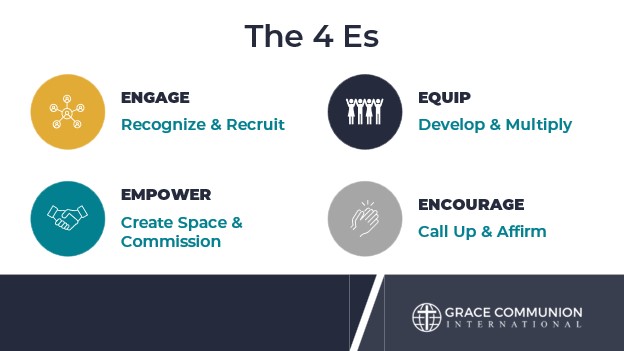 To encourage in GCI ministry is both to call up and affirm. Encouragement provides support, confidence, or hope for another. It can include providing fuel for another to keep going or the challenge needed to start going. Encouragement is more than a generic, half-hearted “good job, kid.” It is not empty platitudes. It is personal, it is specific, it is purposeful. In other words, it is intentional.
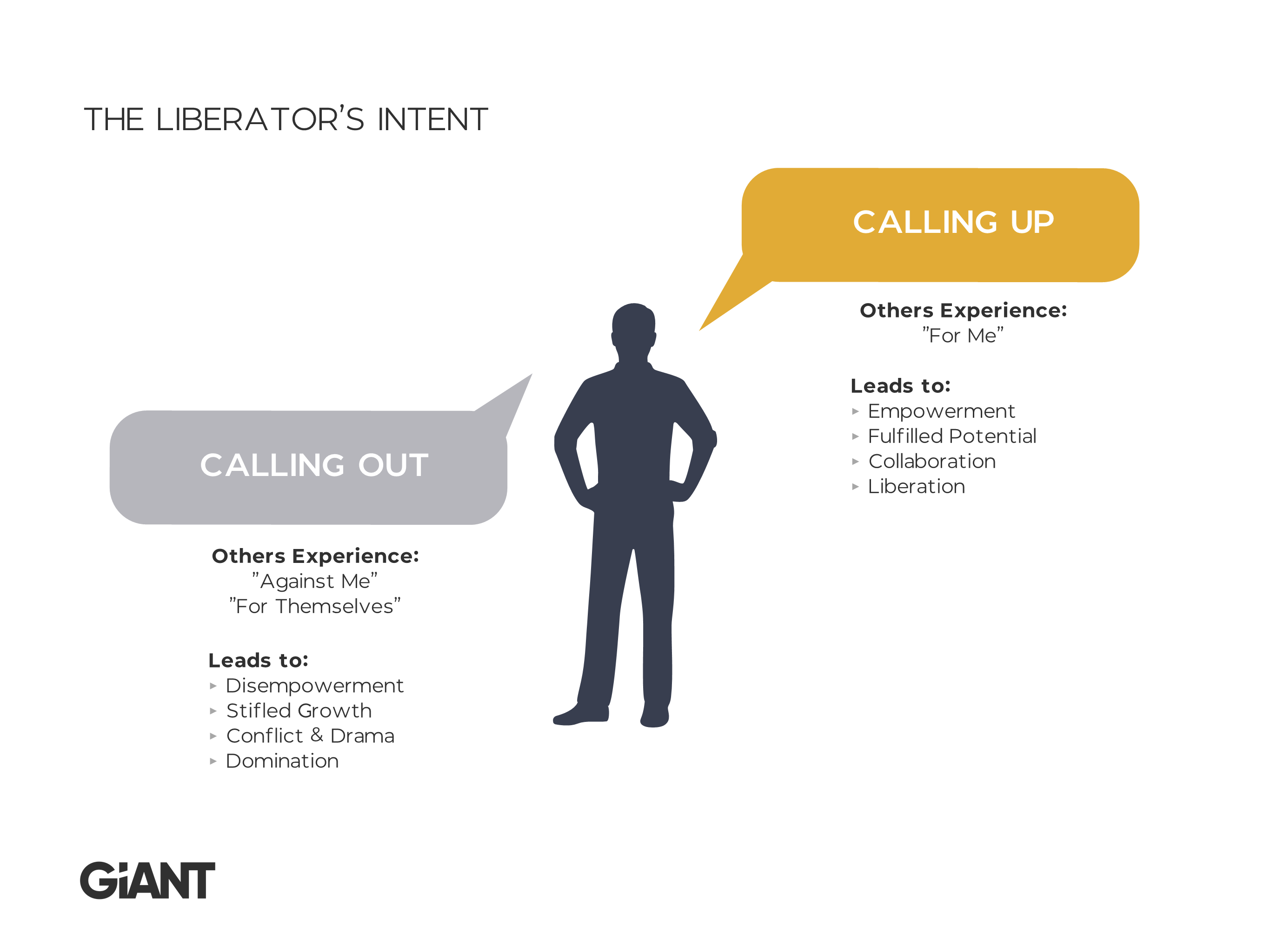 Another important piece of encouragement is to call up. This is the side of encouragement that can provide fuel to keep going or the challenge needed to grow in a new way. These practices include: providing constructive feedback, challenging someone to take the next step in their ministry development, or drawing out someone’s fuller potential. Note that the intent, posture, and even delivery of this form of encouragement affects the impact. It can determine whether a person feels “called up” or “called out.” I think we can all agree that being “called out” is not an encouraging feeling.
 By Bill Hall, National Director, Canada


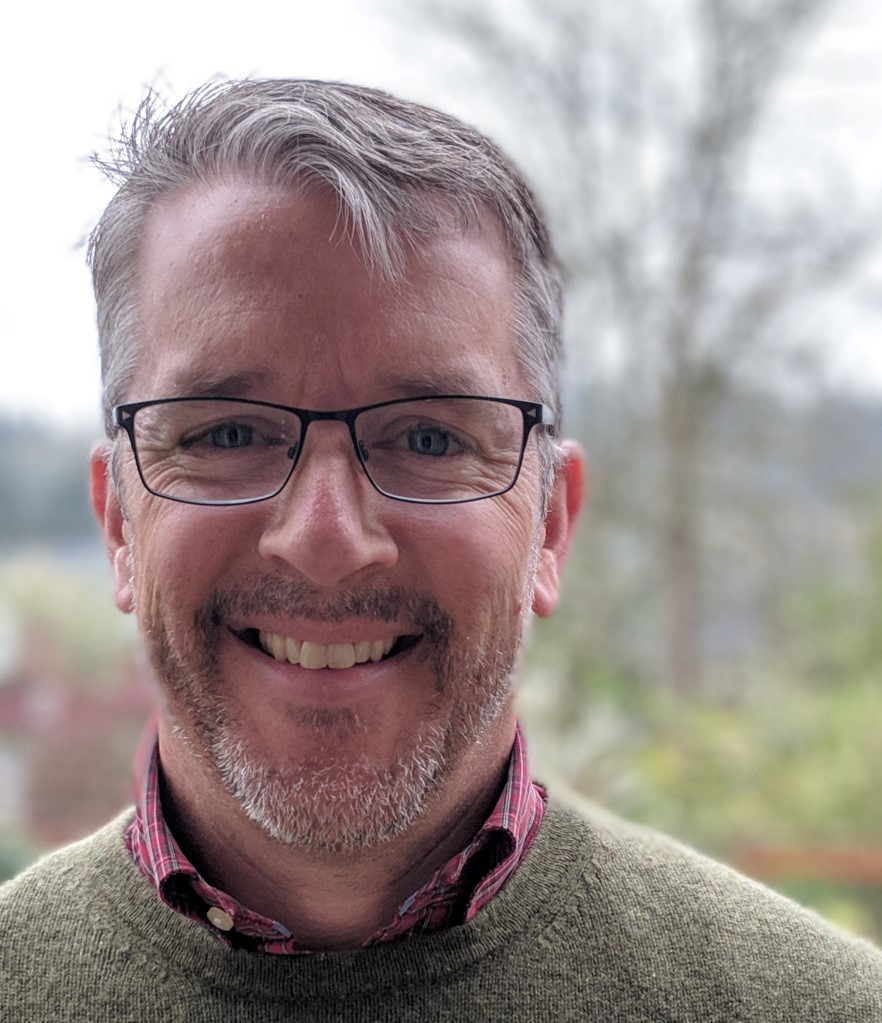
 “God is always at work. And we are never the initiators of God’s work in other people’s lives. We get the privilege of coming alongside the work of Jesus by his Spirit in other people, regardless of where they are in relation to him, because God is always doing things to draw people towards Jesus and towards more and more Christlikeness. We need to cultivate good listening skills. We need to have spiritual ears and eyes to discern what God is doing in other people. And I think that makes leadership development a lot of fun! That makes evangelism a lot of fun because it’s not just a two-way conversation that we’re having with another person. It’s really a three-way conversation. And we’re asking questions, God, what are you doing here?” —Mako Nagasawa