GCI Equipper

Christ Who Conforms

Christ works in his followers, by the power of his Spirit,
to conform us to his image.

She was in her 90s. Though unsteady on her feet, she never missed a weekly church service. She had a hug waiting for all who would greet her. She believed that the privilege of being loved by God must flow out of her to touch others — most often in the simplest ways. She wanted others to know that they are also loved by God. She has since passed, but her generous expressions of love remain etched in our memory. She was a member of GCI Hyderabad.

Santosh Noah was her name. In her we had a powerful example of how Christ works in his followers, by the power of his Spirit, to conform them to his image. This dynamic process results in revealing a God who loves and receives our love for neighbour as to himself (Matthew 25:40).

Paul reminds us, “For those God foreknew he also predestined to be conformed to the image of his Son, that he might be the firstborn among many brothers and sisters” (Romans 8:29 NIV). God is actively shaping us to mirror the character and holiness of his Son.

God’s work in us accomplishes a deep transformation, not just a cosmetic makeover. His sovereign purpose is embedded in his marvelous plan of foreknowing and predestining us into the very likeness of his Son, mirroring the original paradigm of creation (Gen 1:26–27).

Introducing GCI’s Updated Pastoral Liturgy Guide

May this resource enhance our collective effectiveness
of making Jesus known and lifted high in worship.

Greg Williams, GCI President
Steele Creek, NC, US

I am thrilled to introduce our updated “Pastoral Liturgy Guide” (formerly called the Ceremony Book). This updated version includes sacraments, ceremonies, seasonal worship directions, and templates.

The writing and editing were done by a collection of GCI staff and pastors. And as I read the drafts, it was evident to me that the Holy Spirit was guiding the process.

Why the update? Our last update was in 2011, and at that time we were focused on our theological emphasis. This was appropriate as we wanted to be true to our Incarnational Trinitarian theological position.

Over the past 15 years, many of our leaders have suggested that we could use a refreshed set of ceremonies to add a relational tone that is “more user-friendly.” Leaders also asked us to add worship events that were missing. And we needed to fill out our worship calendar more fully with worship aspects of Holy Week and Advent season.

You can download the updated guide here. 

Relational Kingdom Living

Kingdom Culture involves keeping discipleship at the forefront. Below are some key ideas for your leadership to discuss. They are summarized from Dr. Walter Kim’s interview, Part 1. Listen to the full GC Podcast here.

1) Kingdom living begins with relationship because God is relational

      • Relationship is not merely a ministry strategy; it is rooted in God’s own nature.
      • Human beings were created for community from the very beginning.
      • The church exists as a family, not a collection of independent individuals.
      • Kingdom living cannot be separated from life together.
      • Discipleship is inherently communal because God’s kingdom is relational.

2) Calling is discovered in community

      • Gifts often emerge through serving, experimenting, and receiving feedback.
      • The church community plays an essential role in affirming and refining calling.
      • Faithful participation feeds discernment.

3) We never outgrow dependence on God

      • Spiritual maturity does not eliminate dependence; it deepens it.
      • Competence can become a subtle temptation if it replaces trust in God.
      • Growth in skills should be accompanied by growth in humility.
      • Ministry should be designed around multiplication, not individual accomplishment.

4) We need Nathans, Barnabases, and the body of Christ

      • We need Nathans to challenge us, and we need Barnabases to bless us and encourage us.
      • Mentoring and apprenticeship are central kingdom practices.
      • No leader should minister without accountability.
      • Feedback is not a threat to calling; it is part of God’s formation process.
      • Christian leadership flourishes within networks of mutual support and truth-telling.

5) The slow-burn ministries may be the most important

      • Ministry is often more ordinary than dramatic.
      • Long-term faithfulness may be more transformative than highly visible success.
      • Relational kingdom living requires intentional practices.
      • Caring for people over years and decades reflects the heart of Jesus.

6) Ministry is people — and people are messy

      • Kingdom ministry cannot be separated from the complexity of human relationships.
      • Frustration with people can reveal unrealistic expectations.
      • Messiness is not evidence that ministry is failing; it is evidence that ministry involves real people.
      • Healthy leaders embrace relational complexity rather than avoiding it.

Reflection Questions

    1. Who has helped affirm, shape, or redirect my calling, and am I still allowing others to speak into my life today?
    2. Have I begun to trust my expertise more than my dependence on Christ? What would renewed dependence look like?
    3. Who are my Nathans, Barnabases, and fellow laborers? Do I have people who encourage me, challenge me, and walk alongside me?
    4. What “slow-burn” relationship or ministry might God be inviting me to faithfully invest in over the long haul?

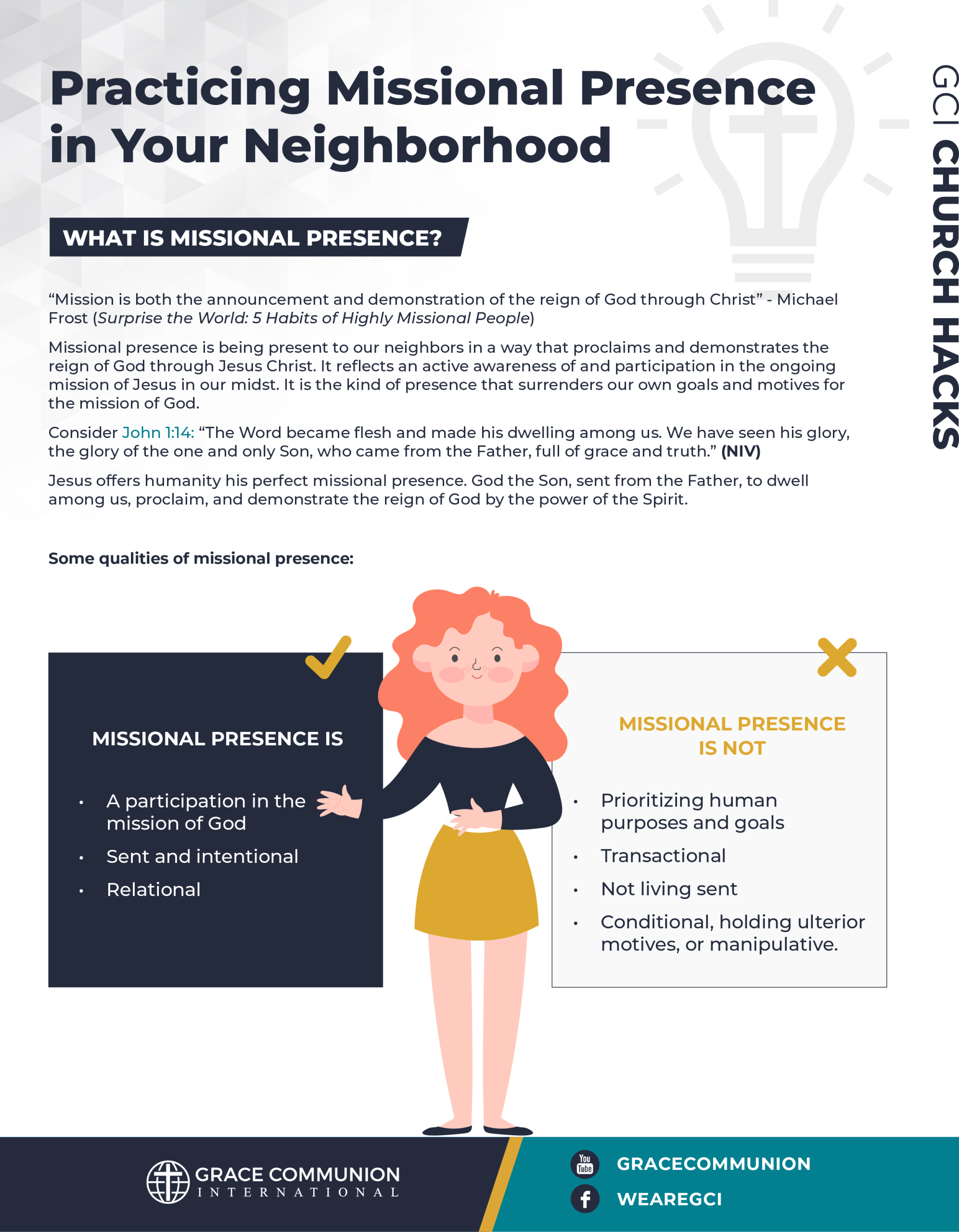
Church Hack—Practicing Missional Presence in Your Neighborhood

Jesus invites us to participate in his ongoing mission through missional presence. This Church Hack explores how being intentionally present with our neighbors can proclaim and demonstrate the reign of God. Consider one place where God may be inviting you to be present this week.

See the full Church Hack here.

Approaching Young People

We show the love of Christ through our actions and intentions.

Dominique Fun
Klang, Selangor, Malaysia

Malaysia is a multi-racial, multi-cultural country, composed of Malay, Chinese, Indian, and the aborigines. The Malays are the majority, and Islam is the religion of the Federation. It is not easy to share and preach the gospel openly.

One of our main challenges is the influence of Islamic laws in the Constitution. It is illegal for other religions to preach to the Muslims. We have to be careful of that to keep peace and freedom of religion here. With that being a major filter, we are mostly left with the Chinese and Indians. But there are exceptions.

I still remember those days back in college. Everyone was doing their best to achieve their goals, studying hard, and rushing for deadlines. It is during such a high-pressure environment that we reveal our character. And it was also the best opportunity to reveal Christ’s character in me.

With the grace of God, he blessed me with passion and purpose in the study of sports and exercise science. I was able to learn well and score well. I was able to grasp complex ideas about human physiology as well as unfamiliar scientific terms. My classmates then approached me for extra tutorials after class, and I gladly said yes with a serving heart. God blessed me with the gift of learning not just for me to score good grades, but to help me lift up the friends around me.

Now Hiring—Digital Content Developer

Grace Communion International is seeking a Digital Content Developer to serve on our Media Team. This full-time, non-exempt position is based in Charlotte, NC, and reports to the Media Coordinator.

The Digital Content Developer helps tell the story of what God is doing through Grace Communion International by creating thoughtful, engaging digital content including video, podcasts, and graphics. This role collaborates closely with the Media Team to develop projects from concept through completion.

We are looking for someone who values creative excellence, collaboration, and lifelong learning, and who resonates with GCI’s commitment to sharing the gospel and participating in the love and life of the triune God.

Applicants should have relevant education or experience in digital media production and be aligned with GCI’s mission and theological commitments. See the job description here.

If you would like further details on the position or would like a GCI job application, please contact Human Resources at humanresources@gci.org or 980-495-3960.

Please share this announcement with qualified candidates who may be gifted for this position at the Home Office.

GCPodcast

In 2026, the GC Podcast introduced a new format. Instead of monthly episodes, the podcast will feature two miniseries. This shift allows us to go deeper into meaningful conversations that support our shared journey of Kingdom Living. 

The first series featured Rev. Dr. Walter Kim, president of the National Association of Evangelicals (NAE) and keynote speaker for the 2026 Denominational Celebration. With host Cara Garrity, Dr. Kim explored what it means to live as citizens of God’s kingdom in today’s world. 

Stay tuned for the second series that begins in September.

In the meantime, why not revisit these popular episodes?

Kingdom Living (Part 1): Relational w/ Walter Kim | Grace Communion International Resources

Kingdom Living (Part 2): Participatory w/ Walter Kim | Grace Communion International Resources

Cherith Fee Nordling—Year A Propers 18–21

Cherith Fee Nordling—Year A Propers 18–21

Exodus 12:1–14 ♦ Exodus 14:19–31 ♦ Exodus 16:2–15 ♦ Exodus 17:1–7

The host of Gospel Reverb, Anthony Mullins, welcomes Dr. Cherith Fee Nordling to discuss the September 2026 RCL pericopes. Cherith has taught at a number of institutions, including Calvin College, Northern Seminary, and Regent College. She is currently Adjunct Professor of Theology & Scripture at St. Stephen’s University. Cherith earned a PhD from the University of St. Andrews. And she is now an ordained Anglican priest in the Diocese of St. Anthony, enjoying life together around the table of the Lord.

Sunday, September 6, 2026 — Proper 18
Exodus 12:1–14 NRSVUE

Sunday, September 13, 2026 — Proper 19
Exodus 14:19–31 NRSVUE

Sunday, September 20, 2026 — Proper 20
Exodus 16:2–15 NRSVUE

Sunday, September 27, 2026 — Proper 21
Exodus 17:1–7 NRSVUE


If you get a chance to rate and review the show, that helps a lot. And invite your fellow preachers and Bible lovers to join us!

Follow us on Spotify and Apple Podcast.

Program Transcript


Cherith Fee Nordling—Year A Propers 18–21

Welcome to the Gospel Reverb podcast. Gospel Reverb is an audio gathering for preachers, teachers, and Bible thrill seekers. Each month our host, Anthony Mullins, will interview a new guest to gain insights and preaching nuggets mined from select passages of Scripture in that month’s Revised Common Lectionary. The podcast’s passion is to proclaim and boast in Jesus Christ, the one who reveals the heart of God, Father, Son, and Holy Spirit. And now onto the episode.


Anthony: Hello friends, and welcome to the latest episode of Gospel Reverb. Gospel Reverb is a podcast devoted to bringing you insights from Scripture found in the Revised Common Lectionary and sharing commentary from a Christocentric and Trinitarian view.

I’m your host, Anthony Mullins, and it’s my delight to welcome our guest, Dr. Cherith Fee Nordling. Cherith has taught at a number of institutions, including Calvin College, Northern Seminary, and Regent College. She’s currently adjunct professor of theology and Scripture at Saint Stephen’s University.

Cherith earned a PhD from the University of St. Andrews, and now she is an ordained Anglican priest at the Diocese of St. Anthony, enjoying life together around the table of the Lord. Hallelujah.

Cherith, thanks for being with us, and welcome back to the podcast. This is your third time. That’s a record, so congratulations. You get the prize.

And we’d love to know how you’re doing and especially what has you experiencing delight these days.

[00:01:33] Cherith: Oh, I’m doing so well. I am delighted actually to be with you. This is such fun to just have the chance to love Jesus together by listening to him in the company of two or three gathered, and suddenly here he is, right in our midst and revealing himself. So, really fun, and I’m honored to get to do it.

I am also just finding such delight in being a new priest. Boy, I was a cranky priest at the beginning because I just didn’t expect to be one. I just thought I was leading into a leadership position with our other church, and it turned into ordination, and I found myself there.

But God has just given us a people who are very hungry to be a people of God, and so I know what my role is among them, but I am really just among them. And so, there’s just so much joy in that space. I’m also just loving turning 67. My body is old and creaky, but it just means I get to be the grandmother of three amazing little people who are teaching me so much more as I get older to grow down into childlikeness, as my bishop likes to say. And there’s just nothing like watching and being part of the trust of their lives and also just the openness of their lives. And so, besides just the gift of my husband coming through a really serious illness and God giving him back his life, literally, and all the good things that we are enjoying in the life of our family. I just feel particularly grateful to be the grandmother to these little people in my life.

[00:03:21] Anthony: It’s the best. I only have one grandchild, but man, it’s whooh, what a sweet season of life it is. And I’m just … I celebrate the fact that you’re an ordained priest, and I can only imagine just the joy and communion that you’re experiencing there, which kind of leads me to a question I’m curious about your thoughts on.

And there’s been a recent kerfuffle about women in pastoral leadership teaching men. And of course, that’s been around forever. It’s an old conversation, and I imagine on some level it’s got to be exhausting for women like yourself who are gifted, called, and equipped to lead, to pastor, to shepherd, to preach, to proclaim.

So, I’m just curious; any thoughts that you’d like to share about what’s this kind of conversation going on?

[00:04:09] Cherith: Yeah, just very briefly. I think one of the things that I am reminded regularly is that where we see the humility that it is necessary to recognize the Spirit of God really being poured out, especially in places where we don’t anticipate it, because we look for sort of big signs and wonders.

One of the evidences of seeing those signs of renewal that have come historically, but also just in the small ways through the Church, there’s always a resurgence of women. Suddenly, the Lord just levels the playing field in the best way and says, “This is my field, and it’s my play. And I invite any and all to serve me, to love my world.”

And so, I just have to keep rejoicing in the fact that he keeps doing that. And to just also accept that part of my calling at this stage of my life is to read these headlines, watch these stories, weep many tears, see the faces of so many women who have suffered, and to realize that part of the intercession at this stage of my life is just be faithful and not embittered.

And that just means knowing that the witness to the beautiful gospel is the same witness, right? It’s not our entitlement to anything except to be participants in the fellowship of suffering and glory with Jesus, and that the glory of God is right there, where he is willing to stand with those in the midst.

So, I just think He’s standing in the midst of all of us in all of that. And one other quick aside is just so interesting to me. A number of years ago now, probably, I don’t know, 10, I was asked to do a talk at a gathering which was predominantly going to be made up of men who were serving in spaces that did not allow women to lead.

But the leaders of that institution did ask me. And even though I was meeting in a church that actually did not allow for women, and I had done a wedding there years before and was very limited in what I was allowed to do because of that. And so, I was back there, and it was a beautiful time. God made a beautiful opportunity in the lives of many people.

And at the end, one of these gentlemen who’s actually serving on the church, who’s an African American teacher at an institution in Chicago, and was also on staff, and he just came up to me in tears and was waiting and waiting to catch his breath and to both hear a peace in his own heart to talk to me and the ability to talk to me.

And just said, “I’ve been teaching in this place. Women are not allowed to preach. Women aren’t allowed to go into ministry. But I have had a young woman student who’s the best I’ve ever had, who I had to say yes to coming and watching her preach because she took a preaching class. And I came from this denomination in the Southern Baptist Convention that did not allow for that.”

But he said, “I was like, ‘Lord, what do I do? Do I not go? Do I go?'” And he said, “I couldn’t imagine hurting her by not listening to her.” And he said, “It was probably one of the most powerful sermons I’d ever heard.” And he said, “While you were speaking, Cherith,” he said, “I texted her and said, ‘Hannah, I have seen your future, and she’s standing on the stage, and so will you be.'”

And in those 10 years, Eric and I have had the opportunity to be involved in anti-racism work together, in the work of the church together. And just two weeks ago, it was just like, here’s a picture of me standing on this stage with all of my leaders 20 years ago, and here I am standing on the stage of my current position in this institution with these women.

And God just transforming his heart and making room for him to make room for these women. You just realize those small faithfulnesses, you do not know what the results will be. But God is just opening so many doors by those kinds of obediences. And so, I just want us to keep leaning into going where Jesus is asking us and not trying to save the world or any denomination or a cause.

[00:08:33] Anthony: Ah, that’s so well said. And I give thanks to God that you have gone from cranky ordained priest to a joyful priest … and that Hannah’s voice is being heard. And it is … a joy to be the priesthood of all believers. So, thank you, Cherith.

Let’s do this. Let’s move to the lectionary passages of the month. Our first text is going to be Exodus 12:1–14. I’ll be reading from the New Revised Standard Version, the updated edition. It is the Revised Common Lectionary passage for Proper 18 in Ordinary Time on September 6.

The Lord said to Moses and Aaron in the land of Egypt, 2 “This month shall mark for you the beginning of months; it shall be the first month of the year for you. 3 Tell the whole congregation of Israel that on the tenth of this month they are to take a lamb for each family, a lamb for each household. 4 If a household is too small for a whole lamb, it shall join its closest neighbor in obtaining one; the lamb shall be divided in proportion to the number of people who eat of it. 5 Your lamb shall be without blemish, a year-old male; you may take it from the sheep or from the goats. 6 You shall keep it until the fourteenth day of this month; then the whole assembled congregation of Israel shall slaughter it at twilight. 7 They shall take some of the blood and put it on the two doorposts and the lintel of the houses in which they eat it. 8 They shall eat the lamb that same night; they shall eat it roasted over the fire with unleavened bread and bitter herbs. 9 Do not eat any of it raw or boiled in water but roasted over the fire, with its head, legs, and inner organs. 10 You shall let none of it remain until the morning; anything that remains until the morning you shall burn with fire. 11 This is how you shall eat it: your loins girded, your sandals on your feet, and your staff in your hand, and you shall eat it hurriedly. It is the Passover of the Lord. 12 I will pass through the land of Egypt that night, and I will strike down every firstborn in the land of Egypt, from human to animal, and on all the gods of Egypt I will execute judgments: I am the Lord. 13 The blood shall be a sign for you on the houses where you live: when I see the blood, I will pass over you, and no plague shall destroy you when I strike the land of Egypt. 14 “This day shall be a day of remembrance for you. You shall celebrate it as a festival to the Lord; throughout your generations you shall observe it as a perpetual ordinance.*

So Cherith, what does this text reveal about the God of Israel, and how could a preacher proclaim this text in a Christocentric way?

[00:11:12] Cherith: I think one of the first things that we always have to be recalled to is that there is only one God, and that God is the Father of our Lord Jesus Christ, who looks exactly like his self-revealing Son and the Spirit of the Father and the Son, and that we look to him revealed in Jesus, incarnate forever.

And in that revelation, we not only see God, but we see what is true about what it means to be a human being in his resurrected image. Everything begins and ends with him. And so. when we read his scriptures, which ― these are his ― it’s to imagine, like our friend Bradley Jersak invites us to do, it’s to sit down and read them in the company of Jesus, as he would read them in the company of his disciples on the road to Emmaus, and let him tell us what it is that is true about God in these scriptures as that truth will finally be revealed in Jesus.

So, we ask him, “Where are you here?” And that would mean we have to look for him in the dying, and the suffering, and the promise, and the presence, and the humility, and the response to the crankiness, and look for how he will gather up everything that’s happening in these people that isn’t of God and will cleanse it.

And to watch for that through here, the consuming fire of his ascension. So, we just have to orient ourselves there, right? And then suddenly we go, oh, the God of Israel is the one who Jesus says you may call him Abba, because he is your Abba, and he is not just the God of Israel, he is the God of Abraham, Isaac, and Jacob.

But that covenant with them is the God who will bring every nation to himself and every tongue and tribe to proclaim. And so, it just stops us reading the othering that we do, and the retribution and vengeance as if these are God’s ways of being God instead of the ways that we want to construct an orientation.

So, that’s just my very big overview for reading all of these Old Testament texts. We just can never read them apart from the gospel. I guess that’s the simplest way to say it, is read them as on-ramps to the gospel of our Lord Jesus Christ, and then ask your questions from there.

[00:13:44] Anthony: Yeah, it’s like seeing the end of a movie, so once you know how it ends, then that reshapes, if you go back and watch it, everything.

Cherith: Yep.

Anthony: There are all the clues all along, like this is pointing toward an end, to tell us it’s going somewhere, and now we know.

Cherith: Yep.

Anthony: And that going somewhere is the person and work of Jesus.

I don’t know that this question’s really as much about the calendar, though I’m curious, God does establish a new calendar for Israel in connection with Passover. But really what I want to get to: tell us about redemption and how it reshapes Israel’s identity, history, and understanding of time.  And I think in some ways you’ve already answered it, but help us to understand Israel’s redemption.

[00:14:28] Cherith: Yeah. I think this passage, and certainly the section leading up to it and then the section that will lead up to the next one and the next one that we don’t get to read in the weeks. And so, hopefully people are reading through the week to catch them.

But I’m always amazed at how reluctant we are to be the people of God’s redemption. And then …

Anthony: Tell me more.

Cherith: When I think about, like almost every single passage where God is going to do something that actually really reveals the goodness of God in ways that cannot be mistaken for anybody or anything else, or just the ways that we would manage our own salvation and redemption and get ourselves out of our own trouble, because he knows we really can’t except to keep doing it in the ways that got us into the trouble in the first place, every time we resist and say, “God, it would’ve just been better to be back in Egypt,” with what we were familiar with. And we would control our lives or complain about our situation and put the blame where it goes and blah, blah, blah.

And so, I just think there’s something to be marked about the fact that God’s redemption is never based on our readiness. It’s never based on, or at least our awareness of our readiness, or our bringing ourselves or our doing something in order for God to respond with salvation. It is God from first to last. And to watch him in this, as your initial questions are even around time, is watch him, enter this time ― which is all his, because he is all and in all ― but to mark it as a way that reorients them and us as part of them, to see that it is God who makes time for us, and he makes the time that we need to work on us to help us become who we are in relationship.

And without that time, and the ways that he helps us remember it and mark it and see it, and get it into all of our senses so that we actually enact it, instead of coming to church and thinking it for 20 minutes, and then going about our lives and enacting completely different narratives all the time.

Anthony: Yeah, come on.

Cherith: When God says, like you can have something that enacts, which is what the liturgy is doing, or ways that we can create liturgies in the lives that may not be part of the formal tradition, that help us enact, because God knows we need our bodies will hold the memory, and keep the score and taste and see and smell, and remember that God is good, that we need this kind of liturgy, like do this, and I am doing this in this big overarching way, and I will be moving through all of these pieces.

And they don’t love it, but I do love that, like going through the text really quickly, is that the simple like obvious things, like it’s available to everybody, right? And equally you’re going to share it, and if somebody can’t afford it, then the neighbor next door, you get that sheep together. And it’s both for quickness and ease and necessity, but it’s also, man, it’s your next-door neighbor, and they might be the person who you really trust, and it might be the person who drives you nuts. But God’s like, this is who you’re going to be entrusted with so that it’s not just Egypt who is the other. Your neighbor doesn’t get to be your other. This, I am making up people for my name, like boom.

And then, oh, by the way, you don’t even get to just privatize this. Everybody’s offering is going to be consumed together so that you receive this as gift from me, right? This is a communal act. It’s not a privatized act. It’s not a privilege act. It’s not an earned act, and it leaves nobody out, right? They get, everybody gets marked by the blood of the lamb as a testimony, not to their obedience, but to God’s action, and it’s God’s prior …

[00:18:53] Anthony: Wow.

[00:18:54] Cherith: … and promised action. And suddenly they become witnesses to the presence of Jesus already, right? If you do this, it doesn’t just save you from this moment, but the Son of God will be recognized, because when he comes, he will tell this story with himself as the blood on that doorpost, and as the blood at this table and this Passover meal. And if you do this, it will mark the world, right? It will mark time for a new world.

And so, just seeing how many beautiful ways that he creates our Eucharistic Thanksgiving table of the Lord, communion, Lord’s supper, all the ways that he’s like, “I want you to remember,” reconnect as members of the body of Christ, not just memory looking back.

I don’t think this is a memory exercise. If in fact in time, all time is God’s time now, that he makes time for us to move through to grow. But for God, everything is already finished. He’s seen us finished, so he’s not stressed. And our becoming at the same time is the place where we learn how beloved we are, and we learn what trust looks like, and we learn how to be his witnesses in the world because we have seen him and know him, right?

And so, to say that God loves both to make our time and to remark our time is then to also go, oh man, he is going to execute judgment as the Passover lamb, but that means every Egyptian Hebrew among us, which is every one of us, as both every Egyptian heart and every Hebrew heart is our heart. And he will become the judgment that actually says, “I will burn up in that consuming fire as the lamb everything that is not of God, and make something new that is neither Egyptian nor Hebrew in you, but that is Christ in you.”

And to make these waters, the waters of our baptism, into his death, I’m like, okay, every single thing that is the redemptive story is going to be this story if we’re just paying attention. And he’s going to do it in the company of our Abba. So, lest we think God is against Egypt and for Israel, as if we aren’t both the grumblers and the oppressors …

Anthony: Right. Right.

Cherith: … he’s like, “No, I’m just for my beloved children, and I will redeem all of them,” because the one who is the first and the last holds the keys of Hades. And that means whatever has to die, his last word is life, right? So, we’re going to see that in the next section, so I shouldn’t go too far ahead. But it’s a big gospel, and we are very reluctant to let him have his way in it most of the time. But it’s his story, and he’s graciously let it be our own

[00:21:53] Anthony: Wow. Have your way, Lord. That is brilliant what you just said. Ah, I want to package that up and share it with the world, that all in all, our Lord.

Well, let’s transition to the next text. It’s Exodus 14:19–31. It’s a Revised Common Lectionary passage for Proper 19 in Ordinary Time, September 13. Cherith, would you read it for us, please?

[00:22:22] Cherith: Happily.

19 The angel of God who was going before the Israelite army moved and went behind them, and the pillar of cloud moved from in front of them and took its place behind them. 20 It came between the army of Egypt and the army of Israel. And so the cloud was there with the darkness, and it lit up the night; one did not come near the other all night.

21 Then Moses stretched out his hand over the sea. The Lord drove the sea back by a strong east wind all night and turned the sea into dry land, and the waters were divided. 22 The Israelites went into the sea on dry ground, the waters forming a wall for them on their right and on their left. 23 The Egyptians pursued and went into the sea after them, all of Pharaoh’s horses, chariots, and chariot drivers. 24 At the morning watch the Lord, in the pillar of fire and cloud, looked down on the Egyptian army and threw the Egyptian army into a panic. 25 He clogged their chariot wheels so that they turned with difficulty. The Egyptians said, “Let us flee from the Israelites, for the Lord is fighting for them against Egypt.”

26 Then the Lord said to Moses, “Stretch out your hand over the sea, so that the water may come back upon the Egyptians, upon their chariots and chariot drivers.” 27 So Moses stretched out his hand over the sea, and at dawn the sea returned to its normal depth. As the Egyptians fled before it, the Lord tossed the Egyptians into the sea. 28 The waters returned and covered the chariots and the chariot drivers, the entire army of Pharaoh that had followed them into the sea; not one of them remained. 29 But the Israelites walked on dry ground through the sea, the waters forming a wall for them on their right and on their left.

30 Thus the Lord saved Israel that day from the Egyptians, and Israel saw the Egyptians dead on the seashore. 31 Israel saw the great work that the Lord did against the Egyptians. So the people feared the Lord and believed in the Lord and in his servant Moses.

[00:24:31] Anthony: I could listen to you read scripture all day. Maybe that’s a new profession for you someday, Cherith.

So, Moses tells the people, “The Lord will fight for you,” yet God commands Israel to move forward into the sea. And I’m curious, how does this passage hold together God’s sovereign action and Israel’s responsive obedience?

[00:24:55] Cherith: Lest we forget the reluctance …

[00:25:00] Anthony: There it is.

[00:25:00] Cherith: It says The Lord will fight for you.” They’re saying to Moses, “Was it because there were no graves in Egypt that you brought us into the desert to die,” right? “Didn’t we say to you,” ― I love this ― “Didn’t we say to you in Egypt, ‘Leave us alone. Let us serve the Egyptians. It would be better to serve them than to die in the desert’?”

And I also find it’s fascinating that right before this passage and the promise of the Lord fighting for them at the water, as he pulls them out of Egypt, there’s a shorter way. There’s a way straight into the Philistine land of Canaan, and the Lord says, “I’m not going to bring them the shorter way, because they’ll face the Philistines immediately, and they’ll turn back. They are going to be afraid of war. And so, I’m going to take them a different way. Literally, “I’m going to make a way where there seems to be no way so that I can create a barrier of protection for them, but they will absolutely have to trust Me.”

And I was like, “Oh no, we want the shorter way.” We always want the shorter way. And then we feel so betrayed when it’s hard. And so, when the Lord’s like, “How about I give you my way?” But it really looks impossible. The Lord has to fight for them, right? Because he’s basically set them up for death from their own perspective. They’re trapped on the one side by the sea and the army that’s coming.

So, only he can move them through and into a space that isn’t just rescue, but it is precisely to give them, after 400 years, like imagine, that’s like the length of the time that people have conquered this continent, right? And lived upon it. That’s how long they lived in that nation state under these pharaohs who thought they were divine, and every corner you’re on has a different god.

That they would remember the God of Abraham, Isaac, and Jacob, or Joseph who brought them into Egypt for safety, like, God has to basically reintroduce himself to them, and to grow them into relationship with him. And so, to allow the ways that he makes to not just be a submission to obedience to something he wants to do, as if…

So, offending all the people who use this language, I apologize in advance. But I’ve really just come to find myself cringe a little bit around the language of God giving us assignments and having plans that we have to act out. I think God is just good, and relationally always with us, and growing us into his life as our life is hidden with him in Christ.

And so, if in fact, he’s doing something here and he wants Israel to respond, these Hebrew people to respond, he must be doing it to make a space for them, a way for them, that brings them into relationship with him, and the manifestation of his love and life. And so, I think it’s always us living in response to something God is doing, even if we can’t figure out what that doing is.

If he has said, “Trust me,” which is what he’s, Jesus is just always saying, “This is your life, is that you just trust me and do with me what I am doing in the world, that you trust my love for you and come with, to be part of what I am doing,” then that’s what we do. We don’t trust him once we’ve stood with him in the war room and seen the game plan and say, “Okay, that’s a good plan,” right?

But that’s such a different way. And so, I think there’s both providence and obedience at play, but I also think it’s always just call and response in relationship. That’s really, maybe, the deeper categories of which to consider what this is really about.

[00:29:02] Anthony: That’s … I’m going to ponder that: call and response in relationship.

So, as you think about this particular pericope, and you think about your own faith community, what else would you herald? You’ve given me a lot to think about, and I’m sure our listeners to think about already, but is there anything else that you would want to glean from this text that, that points us to our Lord?

[00:29:25] Cherith: Yeah, I think there’s just that deep reminder that God is not for some and against others. God is just for us, for all, all of his children have been made in his image, and all of his children are called to stand before and see face to face the one whose image has been finally made what it will be forever, as the resurrected, ascended Son of God who sits as a human being upon the throne of God.

And I think we just have to keep holding the fact that in Christ, everything is reconciled. Death, in the form of the Egyptians, putting to death everything that is untrue about God and about what it means to be human, that we are not to be oppressor or oppressed, or to build up gods in our own image so that we feel like we are in control of the world, or that we can make excuses for the ways that things happen instead of trusting a God who may be doing things in ways we do not understand. All of that, lets this picture of dying in the waters of baptism, that we die with Christ in our Egyptian life, with Christ.

And we are raised with Christ as God’s people, not because we’ve done anything except the goodness of God has brought us through those waters with Christ and everyone else into ― we just happen to know the name of our Father right now, and we happen to know the name of our Lord. But I keep becoming more and more aware of how these first centuries of the Church don’t talk about hell. They see Jesus as entering Hades, and the icons are always pulling up Adam and Eve and everyone else in their train from these deep waters. And sometimes you see the icons from these waters of the Red Sea that everyone is being pulled up. What could the resurrection not cover?

And does that depend on people knowing or not knowing what story they’re in? So, I think, actually, it’s holding so much more mystery to me, and just saying, “If you want to make it smaller, and you want to try to decide who’s in and who’s out, then let’s go back and just pray Ephesians 1 prayer with Paul, and just watch how big that story is, and how lavish the love of God is, and how he is, in fact, reconciling all things to himself in Jesus Christ.”

And I’d just say, where is he inviting me to die, to the ways that I keep people away or judge instead of letting God be the one who takes that judgment upon himself? And then where does he want me to live into the real life of God instead of the things I’m very petty about and small life about, and then want to run back to Egypt and say, “That feels like enough life for me.”

Because that isn’t the life of God. So yeah, I think there’s just a lot here to, to just sit with Jesus in and say, “How would you have me know you better, and myself in it.”

[00:32:41] Anthony: Yeah, this, this whole business of othering keeps us from looking at ourselves with honesty and seeing that there’s an Egyptian in me that will die, that has died and I think ultimately will be burned away. Hallelujah that the liar in me won’t inherit the kingdom of God. That the oppressor in me won’t inherit the kingdom of God. That has been covered in Christ’s death and resurrection. There’s just so much to chew on here. Thank you for making my mind wander to thoughts of other things I’d want to say from this text I didn’t see before. That’s part of the beauty of having this conversation.

Let’s move on to our next text. It’s Exodus 16:2–15. It’s the Revised Common Lectionary passage for Proper 20 in Ordinary Time, September 20. And it reads:

2 The whole congregation of the Israelites complained against Moses and Aaron in the wilderness. 3 The Israelites said to them, “If only we had died by the hand of the Lord in the land of Egypt, when we sat by the pots of meat and ate our fill of bread, for you have brought us out into this wilderness to kill this whole assembly with hunger.”

4 Then the Lord said to Moses, “I am going to rain bread from heaven for you, and each day the people shall go out and gather enough for that day. In that way I will test them, whether they will follow my instruction or not. 5 On the sixth day, when they prepare what they bring in, it will be twice as much as they gather on other days.” 6 So Moses and Aaron said to all the Israelites, “In the evening you shall know that it was the Lord who brought you out of the land of Egypt, 7 and in the morning you shall see the glory of the Lord, because he has heard your complaining against the Lord. For what are we, that you complain against us?” 8 And Moses said, “When the Lord gives you meat to eat in the evening and your fill of bread in the morning, because the Lord has heard the complaining that you utter against him—what are we? Your complaining is not against us but against the Lord.”

9 Then Moses said to Aaron, “Say to the whole congregation of the Israelites: ‘Draw near to the Lord, for he has heard your complaining.’ ” 10 And as Aaron spoke to the whole congregation of the Israelites, they looked toward the wilderness, and the glory of the Lord appeared in the cloud. 11 The Lord spoke to Moses, 12 “I have heard the complaining of the Israelites; say to them, ‘At twilight you shall eat meat, and in the morning you shall have your fill of bread; then you shall know that I am the Lord your God.’”

13 In the evening quails came up and covered the camp, and in the morning there was a layer of dew around the camp. 14 When the layer of dew lifted, there on the surface of the wilderness was a fine flaky substance, as fine as frost on the ground. 15 When the Israelites saw it, they said to one another, “What is it?” For they did not know what it was. Moses said to them, “It is the bread that the Lord has given you to eat.

So, Israel’s complaint against Moses and Aaron reflects a longing for Egypt despite their deliverance. What, if anything, does this reveal to modern people about the challenges of living between redemption and the fulfillment of God’s promises?

[00:36:02] Cherith: Oh, boy. It reveals, if anything, and there’s so much, right? So, we’ll pick one thing. Two things. Again, as we’re reading this and hearing this with Jesus, I’m amazed that in the, I’m thinking of John’s Gospel in particular right now, of all the ways that Jesus is going to put in his own mouth the I Am, right? That everything that we’re reading of the Lord, capital L-O-R-D, as you and I are seeing it in this translation, is the unspeakable name, right? The name they won’t say at the point that Jesus is alive and hearing these read in the synagogue. But it’s the name of Yahweh who is the Lord of Hosts, is the transcendent one, and the I Am That I Am who has met Moses.

And Jesus starts putting the I Am in his own mouth, and one of the I Ams that says, “This is, if you really want to know God, you do not keep his laws and think he is a taskmaster who will give you a good report card and keep you alive and bless you. You find out by my life what your Abba, who is the Lord,” the unspeakable name looks, “and he is your bread. I am your bread from heaven,” right? “And I will be the one who feeds you.”

And yet the only prayer that Jesus gives us for being the one who seems to be praying more than anybody in the New Testament, certainly in the Gospels, even though they are, you know, their daily rituals of prayer ― Jesus gives us only one prayer, and in the middle of that prayer is himself, right? Again, which is, “Ask me for your daily bread.”

[00:37:50] Anthony: Yes.

[00:37:50] Cherith: Don’t ask me to give you enough to store up in your barn, because then you will stop looking at our Father in heaven and ask what his will is.

Anthony: Come on.

Cherith: And walk in it, and find your delight by walking in his will and knowing his ways, right? You will not look for the intersection of heaven and in earth, which is actually where you live, because the Spirit has birthed you into this new covenant in my blood, and that is the space that you just asked about, right? It’s the place between redemption and telos, which is already, you have been marked by the Spirit of resurrection, who is the one who raised Jesus from the dead. So, when you want to know how this turns out, you look at the one who is the one who makes himself your daily bread to feed a world that he loves, to see if by you partaking of him, you might be strengthened enough and look enough like him to actually be able to recognize his voice and to go with him in your day, where he would invite you to come alongside him in where he would want you to be the bread of the world, right?

Because you are his body. We are one body, one loaf, to be given for the world. So, I think in some ways it’s like if we cannot keep our eyes on him, who is the host of our table, who lays himself down as the host of what we eat at the table, by which we are fed and made into his image at the table, empowered to go into the world by the Spirit, having partaken of him at this table, if we are not people of his presence who see his face across the table, and those of our neighbor, and everybody sitting next to us as our neighbor, and we’re like, “How the hell did they get there?”

And Jesus is like, ” everybody gets the same invitation,” and so that he might ask you, “How did you get here,” right? “Everybody just gets here because I am here, and everyone comes with me.” And somehow everything about what it means to live the life in between is to say Jesus is, like, “Ask me how I did this, in the power of the Spirit, knowing my Father in heaven as Abba, and also the creator and ruler of the universe, as I am,” right?

“But I am revealing to you that God is humble, and with the marginalized, and with the weak, and with the ones who cannot store up great barns for themselves, and usually doing it on the backs of others,” right? At the expense of others.

But also, he just doesn’t do that. He’s, like, “No, I am enough. I am more than enough for every day. And then what would happen if you actually took that bread and gave it away, and trust that I could multiply it so that there would not just be enough for you and your neighbor? It’s not that I want you to go hungry at your neighbor’s expense, it’s that I have … I am bread. Could you go be that and see miracles happen in your midst in the most ordinary and extraordinary ways?”

So, I just feel like even the manna story, if we just sit with him as the revelation of that, it reorders us into that already-not-yet space that says, “Oh, I am tempted to move out of the storyline, but there is no other story. There is no other story. I’ve got a lot of fake stories that I could act out, but they’re not true and they’re killing me,” right? “And there isn’t bread there. It’s temporary snack, and I’m willing to let it satisfy me for the moment. But it is not life, and I’m dying if I just have that diet.” So, yeah, there’s just so much there.

[00:41:53] Anthony: There is. And the imagery, the way I sometimes think of it is, this daily bread notion, is we really want our bread from Sam’s Club or Costco, don’t we, in bulk …

Cherith: Yep.

Anthony: … where we can store it up and have enough for our people, my people, that we’ll eat well for weeks and weeks. But it is relationship, so it is dependence. It is trust. And there’s something about recognizing our need every day in a way that we don’t live often, here in the States anyway. That’s really powerful. Give us this day our daily bread, Lord.

So, God responds ― speaking of bread ― to Israel’s grumbling, not with punishment, but with provision. So, that’ll preach. So, tell us more of how this points us to the ultimate provision in Jesus Christ, beyond what you’ve already said.

[00:42:48] Cherith: I just think the Lord is just gracious. I used to read these texts. I remember sitting as a girl in church and just being like, “What is their deal?” “What does God have to do?” And then I would re-preach the sermon on the way home. My parents would tell me this, too, “You would sit your brothers in the backseat, and then you would say all the things you thought the pastor should have also said.”

And he said, “And then by lunchtime, little Pharisee that you were, knowing the Scriptures oh so well, but you were just brutal on your little brothers and I would just be like, ‘Oh, yeah.’” There’s this way of kind of knowing but not knowing and I just think it’s so funny that I was that person who could read these things and be like, ” I would not be like that.” And my parents were like, “Oh, honey, we’re all like that, and you were like that within about 35 minutes after church.”

And I think I have to just, at this stage of my life, laugh at how many seasons of my life I have grumbled or been …

[00:44:00] Anthony: Yeah

[00:44:01] Cherith: … pissed off, or reluctant priest, or the whatever.

Anthony: Yeah.

Cherith. And just have to have Jesus really sit me down and almost look at me face-to-face so that I can see how hard he is trying hard not to laugh. But really not at me …

[00:44:18] Anthony: Sure, sure.

[00:44:19] Cherith: … but just, like the older I get, the more kind of childish and childlike all at the same time. And then at the same time, the humor in those eyes, there’s so much compassion that is part of that, because whatever laughter of God is at the ground of the world’s being, because there’s just joy, there also just has to be so much compassion. And I just keep recognizing that actually there is a difference between my daily orneriness and tiredness or whatever else is, and the places where I’m like, “Why can’t I just…”

And instead of being ashamed of that, I just hear his compassion saying, “Cherith, I know the answer to that question. You don’t know the answer, if at all, but I do know. I know what has formed you. I know all the influences that have been on your life. I know the things that have shaped you. I know the country that you live in, the time in history in which you live, in the country in which you live, that is different than had you been born in another country at the same time, let alone a different time. That this time in which you live, people died all the time 100 years ago. People didn’t have enough to eat all the time in your country 100 years ago. But right now, that is not normal for you. And so, even your very framework has been shaped by a sense of ease and entitlement and privilege that assumes so much. And I understand that, and I have compassion on you for being someone formed in convenience instead of hardship. And I have compassion on those who have been formed in hardship. I know what brings you to these moments.”

And so, I think the invitation is always there, and then the invitation becomes one of, “Would you like to see more? Would you like to know what is troubling your heart really?”

And come into a place that confesses that, to just acknowledge, “Oh, this is the sin working on me, that I didn’t even know exists in my deep heart. And you, Lord, are always the Lord whose character is to have mercy and to have compassion. And so, how do you help me realize that what you really provide for me is the love and the mercy that I need to keep entering into the promise of life with you, and not become afraid of you, or not trust that you are one who keeps a record of wrong, or all the stuff?” There’s just a deep call to who he really is as the Lord of compassion and mercy, which he’s been before I ever met him, right? And before I ever recognized him. Yes.

[00:47:08] Anthony: Amen and amen. Yeah. Thank you.

Hey, we’re in the home stretch. We just got one more to go. So, we’ll pick up there. All right, friends, we have one more text. It’s Exodus 17:1–7. It is a Revised Common Lectionary passage for Proper 21 in Ordinary Time, September 27. Cherith, could I hear you read it one more time, please?

[00:47:34] Cherith: Absolutely.

From the wilderness of Sin the whole congregation of the Israelites journeyed by stages, as the Lord commanded. They camped at Rephidim, but there was no water for the people to drink. 2 The people quarreled with Moses and said, “Give us water to drink.” Moses said to them, “Why do you quarrel with me? Why do you test the Lord?” 3 But the people thirsted there for water, and the people complained against Moses and said, “Why did you bring us out of Egypt, to kill us and our children and livestock with thirst?” 4 So Moses cried out to the Lord, “What shall I do for this people? They are almost ready to stone me.” 5 The Lord said to Moses, “Go on ahead of the people and take some of the elders of Israel with you; take in your hand the staff with which you struck the Nile and go. 6 I will be standing there in front of you on the rock at Horeb. Strike the rock, and water will come out of it, so that the people may drink.” Moses did so, in the sight of the elders of Israel. 7 He called the place Massah and Meribah, because the Israelites quarreled and tested the Lord, saying, “Is the Lord among us or not?”

[00:48:42] Anthony: “What shall I do for these people?” Man, you can almost feel it’s in Moses’s heart.

[00:48:49] Cherith: And I’m about to get killed right here, so maybe you can do something.

[00:48:55] Anthony: That’s right. Come on, my Lord. So, the people ask, “Is the Lord among us or not?” And I’m curious, how does this question expose maybe the deeper issue beneath their thirst? And what might we learn from their doubt in the Lord’s presence, even after multiple demonstrations of God’s faithfulness?

[00:49:18] Cherith: I think the deeper issue is maybe, “I will be standing there in front of you on the rock at Horeb,” and that he lets them, he lets Moses strike it. Now, that’s Exodus, so Numbers is like, “No. You just speak to me. We are in conversation with one another. We know each other. You speak to the rock, and the water will come forward. And because I listened, and you don’t need to twist my arm to care. I don’t need to be strong-armed or beaten into caring.”

But Moses struck him twice, right? And that becomes the sign of the end of all things there. But I think at the same time, that striking is exactly the where did we strike him? And go, I think we see a cross, and we see a spear, out of which flows water, right? And from the side of God.

And again, to always keep going, what is it about God, and what is it about ourselves that will not allow us to trust him? And we always seem to use the words, like the New Testament uses the words out of Jesus’ mouth and then into the Epistles. But it talks about, he says, “Believe in me,” right? So, Paul will obviously believe in him. But he doesn’t mean assent mentally to these things and then he will be your Lord and Savior, right? If you just say the secret code.

But it’s to, really, “I believe in my husband. I trust him, because I know him. And when he says something to me, I can trust him.” Now, there are days when I’m like, “Are you sure?” because I’m still wrestling out how I would imagine something happening. Or the way I trusted him, I’m speaking of my husband now, is I might be trusting him to have done something the way I would do it.

And then I realize that actually, why I’m annoyed with him is that he’s done something that isn’t what I expected, because it wasn’t how I would have done it myself. And how often that becomes the way that we simply turn back onto God our projections of our own inadequacies, our own insecurities …

Anthony: Yeah.

Cherith: … our own ways of trying to secure our own lives. Our own perceptions of what is good for us, our own attempts at our own provision, and we’re right back in Genesis 3, right? Which is the narrative of all narratives, which just says, “Can you trust the Lord that what is good for you is his good for you?”

And it’s not even that tree isn’t a good tree. It’s just not for your good. And, because God doesn’t make anything bad, it’s not like he put an evil tree in the middle …

Anthony: That’s right.

Cherith: … of the Garden of Good and Evil. … it’s like, no.

Anthony: That’s right.

Cherith: He made a tree and said, “Will you trust me for what is good for you?” and then the evil one comes along and says, “You cannot trust God,” right? “Don’t trust him. Did he really tell you? Because he is a liar and you cannot trust him. He must be withholding something from you, that you would do better for yourself, and so you should trust yourself more than him.” And it’s the lie that’s at the heart of every single lie that we believe and live all the time, right?

So, here we are again in this scenario, just watching a people who ― God is our water, too, right? Jesus is like …

Anthony: Yes.

Cherith: “I am your living water. It is not that I do not know that the ones who I have made, who are very frail and creaturely, and also are the very temples of the living God, must receive life through water and bread, and that this festive, feasting, bread of heaven, water that turns to wine, like all the things are all the way to the end of the Revelation.”

It’s always a table. It’s always a party. It’s always God taking the very basic needs that we have and making them so much more than we know. They become the very food of heaven, right? And so, I think, when we come to places where we’re like, “you brought us here, but I don’t see a stream flowing,” right? “I don’t see you laying me down in the green pasture. But you promised,” right? “That when the travel brochure said you would take care of me, this is how it looks in my imagination, is there would be a stream here, or there would be a lake here. There would be the provision that I imagine would be for my good.”

Instead of God going, “But I want to be your good. I am your good, and everything that is good comes from me.” That’s what you pray at the beginning of the Eucharist, that, “You only bring to me those things which have come from me.” So, there’s just this no pause for trust, right?

That’s why I was, like, the reluctant priest early on, a year and a half ago. I was like, “Lord, how did I get here? I feel like I’m in the wilderness in front of a rock, and I didn’t necessarily want to be the priest of a church. I just wanted to serve your people where I was.” And he’s like, “No, but I made you a priest, Cherith. And can you just take a deep breath, please, and trust that it actually isn’t just about you, that if I can give you this gift of your priesthood, that then you can set the table of my presence for people who I want to partake of me, who will come to a table that you would lay. So, would you just take a deep breath and watch what I would do?”

And to let him be the one where I just think, oh man, like next week’s texts, Elijah is at Horeb, right? And can’t see God again, all the big displays.

Anthony: Yes. Yes.

Cherith: And somehow there’s going to be like that sound of silence that is so loud and so quiet all at the same time that, that Elijah can hear him, right? That speaks, “Let’s have a conversation here. Why are you here?” And I just realized, oh, this is that incredible thing where we need to stop holding God accountable to not being the provider of our sense of entitlement, or our provision, or hold God accountable to feeling like we feel betrayed by the ways that we thought God would look and the things that we thought God would do in the way that he would do them.

And we do that not just because it’s for our good, but it really is for our good because we will miss out and we will grow malformed and we will hold resentment and distrust because we don’t trust that we are loved beyond description, that God’s joy is to be the Lord for all of creation and to be the gift giver, to be involved, to manifest his character, to invite us into life with him, that all of this, his good is literally to give us himself.

And he just needs us to keep being invited into that invitation all the time, because he knows that we’re just children who break and are partial and partial, but he knows why, and he’s putting to death all of the whys and giving himself in it until we are made whole.

[00:56:58] Anthony: Cherith, you’re amazing. I’m so grateful for you. And I mean that from the depths of who I am. I love being at your feet to hear you teach because like you talked about trusting your spouse there are voices in my life that I just trust, that are going to point me where I need to be looking.

And so, thank you for doing that for us here today. You’re just, you’re fantastic.

Cherith: Thanks.

Anthony: And I want to thank the team of people that help make this podcast possible. You know who you are. Elizabeth, Dids, Michelle, you’re great. Love working with you. Thank you for all that you do. And Cherith I didn’t mention this to you before, but it’s our tradition here on Gospel Reverb to end with prayer. I’d be so grateful if you’d share a word of prayer with all of us as we close up.

[00:57:46] Cherith: It would be my privilege.

Our Lord Jesus Christ, firstborn over all creation, firstborn from among the dead, Son of our Father in heaven, who’s with our Father, pours out your Spirit, to make God’s children, to make us the people of the living God upon the earth. Make us heirs of an inheritance of eternal glory that is also familiar with and ready and acquainted with grief and co-suffering love. We bless you that you have been the last and the first, that you have been our end from before the beginning, that you who are the first and the last hold everything that we are in between and make it all our present.

So, thank you for being present to us, that these are not stories that we go back and read as past histories, that this is your life with your people, your communion of saints, that we are currently living with them. So, I pray that you would let us be people who live this life with you, same challenges, same questions, but with the power of your Spirit to walk in a way that knows you and sees you and draws your people from all around the world in every way, every day, to yourself through our lives. We ask this in the name of the Father, and the Son, and the Holy Spirit. Amen.


Thank you for being a guest of Gospel Reverb. If you like what you heard, give us a high rating, and review us on iTunes, Spotify, or wherever you get your podcast content. Share this episode with a friend. It really does help us get the word out as we are just getting started. Join us next month for a new show and insights from the RCL. Until then, peace be with you!


 

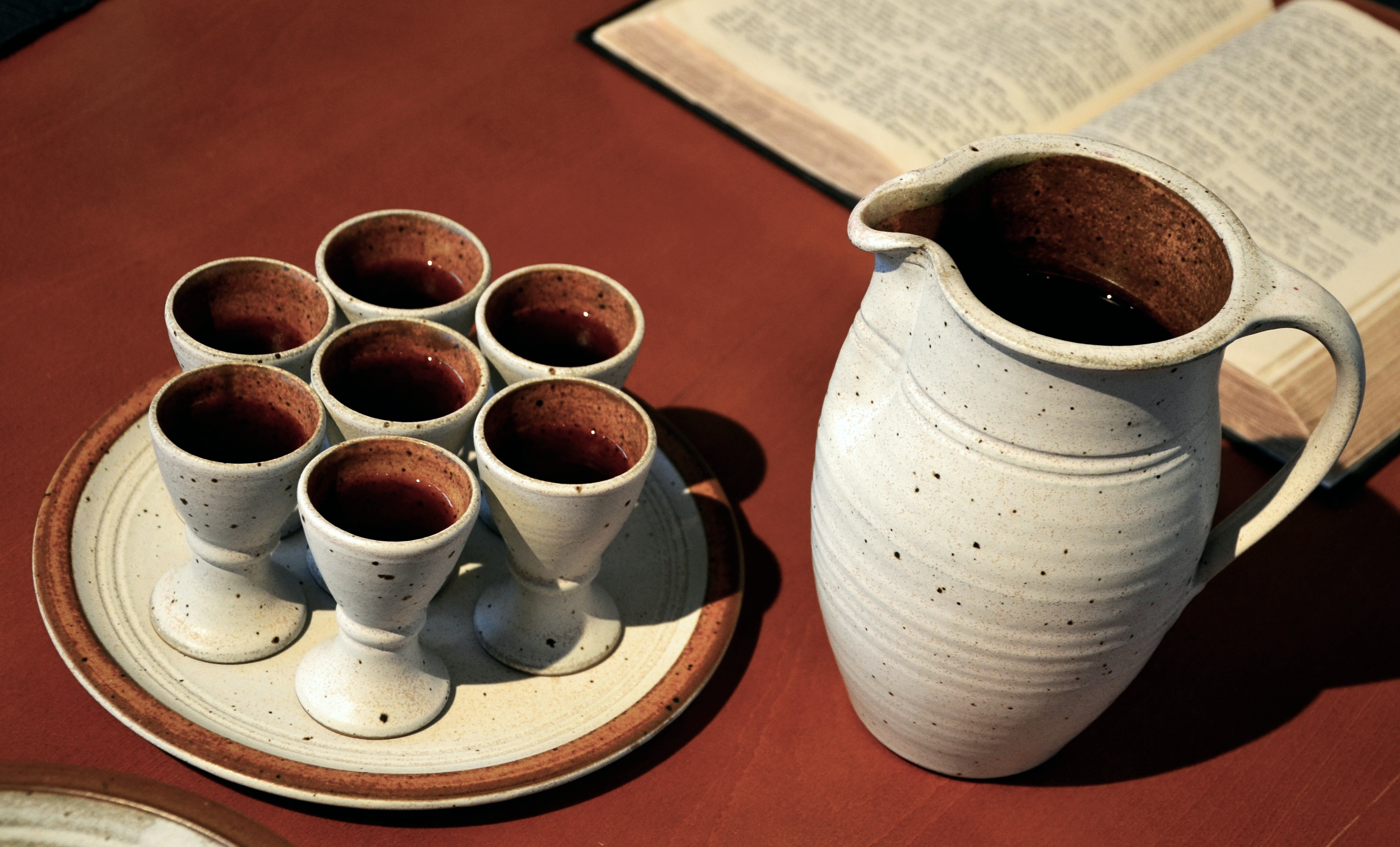
Offering and Communion Starters | September

Last year, we introduced a new resource to help you prepare for the time of giving and taking communion in your Hope Avenue. These are meaningful formational practices that we can plan with care and intentionality.

The Communion and Offering Starters are posted a month ahead, like the sermon resources. Below are the September starters. In case you missed it: August Starters are here.

How to Use This Resource

An outline is provided for you to use as a guide, followed by a sample script. Both the offering moment and communion can be presented as a short reflection before the congregation participates. Here’s how to use it effectively:

  • Scripture Reflection: Include the relevant Scripture to root the offering and communion in biblical teaching.
  • Key Point and Invitation: Briefly highlight the theme’s key point and offer an invitation that connects the theme to the practice.
  • Prayer: Include a short prayer that aligns with the theme. Invite God to bless the gifts and the givers. Ask God to bless the bread and the wine and the partakers.
  • Logistics: Explain the process; this helps everyone know how they can participate. For giving, indicate whether baskets will be passed, if there are designated offering boxes, or if digital options like text-to-give or web giving are available. Clearly explain how the communion elements will be shared and that participation is voluntary.
  • Encouragement: For the giving moment, invite congregants to reflect on their role in supporting the church’s mission, reminding them that their gifts impact both local and global ministry. For communion, encourage congregants to express gratitude for Jesus’ love poured out for us and the unity present in the body of Christ.

For more information, see Church Hack: Offering and Church Hack: Communion


September Offering Theme: The Heart of Giving

Scripture Focus: Matthew 20:8–10

Key Point: We don’t give to receive more reward; we give because we want all to come to trust that God saves.

Invitation: A heart of giving is a heart of love for others. We want our family, neighbors, friends, and community members to all respond to the gift of salvation.

Sample Script

Matthew 20:8–10 says:

When evening came, the owner of the vineyard said to his manager, ‘Call the laborers and give them their pay, beginning with the last and then going to the first.’ When those hired about five o’clock came, each of them received a denarius. 10 Now when the first came, they thought they would receive more; but each of them also received a denarius.  Matthew 20:8–10 NRSVUE

Some believe if you give more, you receive more. It’s a misinterpretation of God’s heart. Jesus addresses this in his parable of laborers in the vineyard. They all received the same wage — whether they worked all day, or for just an hour or so.

Salvation is a gift, whether you’ve followed Jesus all your life, or you call out to him while on your death bed, as did the thief on the cross. There is no greater reward than eternity in communion with Father, Son, and Spirit, and with one another. We want all to have that reward, that gift. We want all to live in God’s grace, to know the truth about who he is and who we are in him.

We give because we love our family, neighbors, and co-workers. The heart of giving is a heart of love for others. Kingdom living is sharing God’s love and life with others because we believe so strongly in the good news of God’s kingdom, that we want everyone there to share in its goodness.

May our giving reflect this heart of love for others. May our missions and ministries find new and effective ways to share the good news of Jesus with as many as we can.

Prayer.


September Communion Theme: Joining Tax collectors and Prostitutes

Scripture Focus: Matthew 21:31b–32

Key Point: Communion reminds us that all who believe are welcomed by grace, regardless of their past.

Invitation: As we receive the bread, may we truly believe it represents the body of Christ. It was broken for us so that we may receive eternal life. As we receive the cup, may we believe the shed blood of our Savior forgives us from all sin.

Sample Script

Jesus said to [the Pharisees], “Truly I tell you, the tax collectors and the prostitutes are going into the kingdom of God ahead of you. 32 For John came to you in the way of righteousness, and you did not believe him, but the tax collectors and the prostitutes believed him, and even after you saw it you did not change your minds and believe him. Matthew 21:31b–32 NRSVUE

You can only imagine what was going through the minds of the Pharisees when Jesus said that to them. Tax collectors? Those who worked with Rome, and took advantage of the average Jew? Prostitutes? Come on, Jesus, look at our faithfulness to the law. Look at how well we tithe and give offerings. Look at our dedication to the temple.

But Jesus said that they did not believe John the Baptist. What did John preach? That Jesus was the Messiah. Just like the thief on the cross, tax collectors and prostitutes believed and were saved.

We don’t enter the kingdom because of what we know, but because of who we know. We aren’t forgiven because of what we’ve done, but because of what Jesus did. It’s not our works that save us, it’s his grace — grace given to all who believe.

As we come to the table, we can rejoice that we are joining tax collectors, thieves, prostitutes, and all kinds of people with all kinds of backgrounds who believe.

As we receive the bread, may we truly believe it represents the body of Christ. It was broken for us so that we may receive eternal life. As we receive the cup, may we believe the shed blood of our Savior forgives us from all sin.

Prayer.


Sermon for September 6, 2026 — Proper 18

Speaking of Life 5042 | Jesus Heals Relationships

This week we’re sharing a Speaking of Life message from our archive as a supplemental resource. We encourage you to use this for reflection and preparation, or small group discussion. For your worship gathering, consider how a call to worship from a local voice or contextualized introduction to the theme might serve your congregation well.

When our world feels divided, it’s good news that Jesus can help us in our relationships, especially when we argue or hold grudges. He can be with us when we try to make peace with someone who hurt us, and with God’s help, we can see others as Jesus does, treat them kindly, and heal our broken relationships.

Program Transcript


Speaking of Life 5042 | Jesus Heals Relationships
Greg Williams

Human beings were created and designed for relationships. God made us not only with the capacity to relate to him and each other but with the need to connect to thrive. Despite these truths, human beings often do things that disrupt our relationships. Even when we have the best intentions, we can hurt each other. And we respond to that hurt in different ways. Some of those ways are healthy, and some of those ways can perpetuate a cycle of harm. It is no wonder that Jesus instructed his followers on how we are to respond when fellow believers cause harm. Let’s read from Matthew 18:

If another member of the church sins against you, go and point out the fault when the two of you are alone. If the member listens to you, you have regained that one. But if you are not listened to, take one or two others along with you, so that every word may be confirmed by the evidence of two or three witnesses. If the member refuses to listen to them, tell it to the church; and if the offender refuses to listen even to the church, let such a one be to you as a Gentile and a tax collector. Truly I tell you, whatever you bind on earth will be bound in heaven, and whatever you loose on earth will be loosed in heaven. Again, truly I tell you, if two of you agree on earth about anything you ask, it will be done for you by my Father in heaven. For where two or three are gathered in my name, I am there among them.”
Matthew 18:15-20 (NRSV)

Jesus outlined a step-by-step process for how to deal with relational conflict that is very helpful from a practical standpoint. Additionally, Jesus’ teaching provides two spiritually important truths about God. First, person-to-person relationships are important to him. He is concerned about how we connect to each other. Second, God wants to see disrupted relationships restored and he takes an active role in healing our relational wounds. This does not mean that believers can expect every hurt to be healed and every broken relationship mended in this life. However, we can expect God to help us do our part to be at peace with all people.

This is good news for those of us who live in a world that often seems so divided. If we create room for him in our relationships, Jesus will show up in our squabbles, grudges, and estrangements and provide healing. He desires to be in our midst when we sit down to reconcile with a neighbor who has harmed us. In fact, when we prayerfully seek God’s help, the Holy Spirit will help us see our neighbor as Christ would see that person and treat that person as Jesus would treat them. This changes the dynamic of the relationship and puts the relational conflict in perspective. Jesus is the restorer of all things — even broken relationships.

I’m Greg Williams, Speaking of Life.


Psalm 149:1–9 • Exodus 12:1–14 • Romans 13:8–14 • Matthew 18:15–20

Today’s theme is God gave us a way to remember that he saves us. Our call to worship psalm reminds us to praise the Lord who takes pleasure in his people and executes judgement against their enemies. Our Old Testament reading from Exodus contains the instructions from the Lord to Moses on how to prepare and keep the Passover of the LORD, a day set apart as a day of remembrance of God saving Israel while executing judgement on Egypt. The epistolary reading from Romans speaks of the implications of salvation in terms of departing from works of darkness while putting on the armor of light. In the Gospel reading from Matthew Jesus speaks to seeking reconciliation with those who sin against you.

Reminder: This introductory paragraph is intended to show how the four RCL selections for this week are connected and to assist the preacher prepare the sermon. It is not intended to be included in the sermon.

How to use this sermon resource.


God Gave Us a Way to Remember That He Saves Us

Exodus 12:1–14 ESV

Over the last two Sundays, we’ve been watching God’s rescue story unfold in Exodus. First, we saw that even when God seemed absent, he was already at work. While Israel suffered under slavery and oppression, God was preserving life and preparing a deliverer through acts of courage and faithfulness. Then last week, we met Moses at the burning bush and discovered that the God who seemed silent had not forgotten his people. God saw their suffering, heard their cries, and came down to rescue them.

Together, these passages remind us that even when we cannot see him, God is at work to rescue us. God comes down. God does not abandon us. God keeps his promises.

Today we come to a turning point in the story of Exodus. So far, we have met Moses, the man God called to lead his people out of slavery in Egypt. We read of Moses’ birth and upbringing and his calling by God at the burning bush. That was chapter 3. Today we pick up the story in chapter 12. This week is a great time to read Exodus 4–11, the chapters in between.

If you do, you will meet Aaron, Moses’ brother. God gave Aaron to help Moses speak to Pharaoh and to the people of Israel. Together they deliver God’s message to Pharaoh again and again: “Let my people go.”

Pharaoh refuses. As a result, Egypt experiences a series of nine devastating plagues. Now the story reaches its most dramatic moment. One final judgment, one final plague is coming: the killing of all the firstborn in the land, humans and animals.

We’re on the edge of our seats; we want to know what will happen next.

Instead, God pauses the action and gives detailed instructions for a meal called Passover. At first, this may seem like an interruption. But we will see just how important this “pause” is.

As we listen to these ancient instructions, we are not simply studying an old religious ceremony. We are being reminded that we all need salvation, and it is God alone who saves. Salvation is God’s rescue from sin and death and their effects. Salvation is deliverance from evil and freedom to new life in him. God gave us a way to remember that he saves us.

Let’s read it.

1 The Lord said to Moses and Aaron in the land of Egypt, “This month shall be for you the beginning of months. It shall be the first month of the year for you. Tell all the congregation of Israel that on the tenth day of this month every man shall take a lamb according to their fathers’ houses, a lamb for a household. And if the household is too small for a lamb, then he and his nearest neighbor shall take according to the number of persons; according to what each can eat you shall make your count for the lamb. Your lamb shall be without blemish, a male a year old. You may take it from the sheep or from the goats, and you shall keep it until the fourteenth day of this month, when the whole assembly of the congregation of Israel shall kill their lambs at twilight.

“Then they shall take some of the blood and put it on the two doorposts and the lintel of the houses in which they eat it. They shall eat the flesh that night, roasted on the fire; with unleavened bread and bitter herbs they shall eat it. Do not eat any of it raw or boiled in water, but roasted, its head with its legs and its inner parts. 10 And you shall let none of it remain until the morning; anything that remains until the morning you shall burn. 11 In this manner you shall eat it: with your belt fastened, your sandals on your feet, and your staff in your hand. And you shall eat it in haste. It is the Lord‘s Passover. 12 For I will pass through the land of Egypt that night, and I will strike all the firstborn in the land of Egypt, both man and beast; and on all the gods of Egypt I will execute judgments: I am the Lord. 13 The blood shall be a sign for you, on the houses where you are. And when I see the blood, I will pass over you, and no plague will befall you to destroy you, when I strike the land of Egypt.

14 “This day shall be for you a memorial day, and you shall keep it as a feast to the Lord; throughout your generations, as a statute forever, you shall keep it as a feast. Exodus 12:1–14 ESV

Here God gives Moses and Aaron detailed instructions for keeping the Passover. It is meant to be a memorial day so the Israelites will remember how God rescued them from slavery in Egypt. In short, Passover is God’s way of reminding his people of his salvation and calling them to pass that memory on to future generations. Future generations will need to know that their freedom came from God. God gave us a way to remember that he saves us.

Now here we are, not as Israelites, but as Christians. What do these instructions have to do with us? We may be tempted to pass over (pun intended) this section and resume the narrative to see how the story turns out. However, this section is actually packed with meaning for us today as well.

We are not living under slavery in Egypt, but we know what it is like to be trapped. We know what it’s like to feel enslaved to shame, guilt, selfishness, striving, self-hatred, and isolation.

We need that reminder too: God frees us.

The Passover points forward to Jesus Christ. What God began to reveal in Exodus would find its fulfillment in Jesus. We will see as we go on.

The Living Lord Speaks

God gives such detailed instructions for the Passover — down to the timing, the lamb, and how it is prepared and eaten. God speaks clearly and does not leave us guessing. The Living Lord reveals who he is and what he wants. He let the Israelites know exactly what he expected.

We are given a stark contrast between the Living God and the false gods of Egypt. The Living God speaks. He did not leave it up to Israel to figure out how to keep the Passover. This is a God of grace speaking in a land where people worshiped false, man-made gods. Of course, these unreal idols could not speak.

So, people were left in the dark, trying to please gods they did not understand, often through fear and harmful practices. It also gave an opening for evil rulers to control empires through deception and fear. And worshippers needed to trust false priests or magicians to tell them what the gods demanded.

Ultimately, this usually escalated to child sacrifice. Many believed giving a firstborn child would appease the gods. The firstborn is the first child in a family, often given a special status or importance.

The first nine plagues were a direct judgement on the many gods the Egyptians worshiped. Each plague was God’s announcement that he was the one true God. God is speaking and acting to reveal to Israel who he is and what he expects. He is moving them to trust him so they will be free to worship him. He is moving to save them from the slavery they and Pharaoh are in.

All other gods, one by one, were exposed as empty and powerless idols. There is only one God, and all other gods will be cast down. This gives us a partial picture of what salvation entails. It involves casting out all that is evil and all that enslaves.

We also need to be delivered from the false gods we are enslaved to, and we need to come to know the true God who speaks to us. God has chosen us for himself; God loves us and wants to be in relationship with us. If we do not know this, then we will never be able to trust him or free to obey him. We will always be wondering if we have done enough or done it right. We will still be in slavery.

The Lord speaks instructions to Moses and Aaron, who will then go and speak God’s words to the people. This pattern gets repeated throughout the Book of Exodus. It’s a pattern carried out for us today as we go and share the good news of God’s salvation to others. We are merely passing on the message that was shared with us. God is not some detached ideal, value system, or projection of our imagination. God is real, he speaks to us, and he acts first to save us. Furthermore, God invites us to participate in sharing that good news with others.

A Communal Meal

What else do these instructions show us about God? Did you notice how the lamb was to be shared? It was to be consumed by a household. And if the household was too small to consume the whole lamb, then they were to join in with another household. The Passover was to be a communal memorial. Communal means something shared and experienced together as a group.

The God who was revealing himself to Israel is the triune God revealed in Jesus Christ. Triune means consisting of three; Father, Son, Spirit have existed for eternity as a relationship, sharing all things together. It shouldn’t be surprising then that this central ceremony for Israel would be observed as an exercise in sharing. It was to be a reminder that they were saved to be a community. Ultimately, this points to the fact that we are saved to share in the communion, the shared life and union, between the Father and Son in the Spirit. Salvation is to be free to belong to another and not enslaved to ourselves.

Blood of the Lamb

The Israelites are also instructed to put the blood of the lamb on the two doorposts and the beam over the door. Notice Israel is not exempt from the destruction coming, but they are given a way to be spared. The blood-soaked door is the way Israel is saved from the death angel.

Notice God provides a way for his people to be spared from judgment. And God provides the rescue. God gave us a way to remember that he saves us.

We see the double reference to Jesus in this picture. Jesus himself tells us he is the Door (John 10:9), and it is by his blood we are saved (Ephesians 1:7). There is no other provision made for salvation and that is true for us as well. However, Jesus is still the blood-soaked door open for all to enter. He is calling us to enter and to dine with him.

Passover Meal

More about this special meal: Israel was instructed to eat the meal of roasted lamb with unleavened bread and with bitter herbs. They were told to eat the meal in haste. They didn’t have time to wait for the leavening in bread to rise and bitter herbs did not need preparation. They were told to eat with their belt fastened, shoes on, and staff in hand. They needed to be ready to leave Egypt without delay.

When salvation comes to us, we are not to delay. When the Lord provides a way of deliverance, we do not linger. We get moving in the direction of freedom. If you are only beginning to see who the Lord is, there is no reason to wait. The Lord provides for salvation, a deliverance from evil and a freedom to new life in him. The Lord is calling you to himself and the sooner the better. There are life and communion on the other side of that blood-soaked door.

If you have been walking with the Lord for a long time, you too may need the reminder to be in haste to receive the salvation given to us. Sometimes we may be tempted to loosen our belts and remove our shoes to recline back into slavery. But freedom is found in running to the Lord, day in and day out.

Firstborn

The instructions in our passage for today conclude with the theme of the “firstborn.” First, in ancient Egypt, people believed the firstborn child belonged to the gods, and the gods could take that child whenever they wanted. So, the evil practice of child sacrifice was common.

Second, Israel was chosen by God as his own firstborn (Exodus 4:22). And finally, in the New Testament, it is Jesus who bears the title of “Firstborn.” Under the rule of evil, like Pharaoh, being a firstborn lead to death. However, being claimed by God as his firstborn leads to life.

Jesus is the true Firstborn who belongs to the Father. When Jesus gives his life for the sake of the world, he is fulfilling the role of the firstborn by doing his Father’s will. His sacrifice on the blood-soaked wood of the cross provides salvation for all. He stands in for us all who are destined for death under the rulership of evil. And he shares his firstborn status with us, making us all sons of glory.

Now, as firstborns of our Father in heaven, we too are free to serve him, free to do his will, and free to worship him. Notice Israel was not freed from Pharaoh to roam the desert in an attempt to serve themselves. No, they now had a new ruler, the Lord God Almighty, the one who reached down in grace and saved them. These instructions and all the forward-looking signs pointing to Jesus serve for us the same as they did for Israel — God’s reminder of his salvation.

Passover Lamb

On the night before his crucifixion, Jesus shared a Passover meal with his disciples. During that meal, he took bread and wine and gave them new meaning. This was the occasion Jesus instituted the Lord’s Supper. He showed them that he himself is the Passover Lamb, what we also call the Pascal Lamb.

Jesus is the true Passover Lamb. He lived the faithful human life that we could never live. He entered our broken world. He carried our sin. He faced our death. On the cross he took upon himself everything that enslaves humanity. And through his resurrection he opened the way into new life.

Jesus does not merely show us the way to freedom. He becomes our freedom.

The blood on the doorposts pointed forward to him. The lamb pointed forward to him. The meal pointed forward to him. Everything in this story is directing our attention to Jesus. And the wine, bread, lamb, and blood in the Passover are reflected in the Lord’s Supper.

The Passover was given so that God’s people would never forget what he had done. The Lord’s Supper, also called Communion, serves the same purpose for us today.

God gave us a way to remember that he saves us.

The bread reminds us of Jesus’ body, given for us. The wine (or grape juice) reminds us of Jesus’ blood, poured out for us. Communion is a sacrament that reminds us that Jesus is the slain lamb who has delivered us from the slavery and tyranny of sin, evil, and death. He has saved us for new life in him.

On the night before the cross, listen to how Jesus connects it all to himself in Luke 22:

And [Jesus] took bread, and when he had given thanks, he broke it and gave it to them, saying, “This is my body, which is given for you. Do this in remembrance of me.” And likewise the cup after they had eaten, saying, “This cup that is poured out for you is the new covenant in my blood. Luke 22:19–20 ESV

Again and again, we come to the table in remembrance of Jesus. We remember that God saves. We remember that Jesus is our Passover Lamb. We remember that death does not have the final word.

We remember that we belong to the Father through the Son in the power of the Holy Spirit. And we remember that the God who rescued the Israelites from Egypt is still rescuing us now.

Thanks be to God that God gave us a way to remember that he saves us.


Cherith Fee Nordling—Year A Proper 18

Sunday, Sep 6, 2026 — Proper 18
Exodus 12:1–14

CLICK HERE to listen to the whole podcast.


If you get a chance to rate and review the show, that helps a lot. And invite your fellow preachers and Bible lovers to join us!

Follow us on Spotify and Apple Podcast.

Program Transcript


Cherith Fee Nordling—Year A Proper 18

Anthony: Let’s do this. Let’s move to the lectionary passages of the month. Our first text is going to be Exodus 12:1–14. I’ll be reading from the New Revised Standard Version, the updated edition. It is the Revised Common Lectionary passage for Proper 18 in Ordinary Time on September 6.

The Lord said to Moses and Aaron in the land of Egypt, 2 “This month shall mark for you the beginning of months; it shall be the first month of the year for you. 3 Tell the whole congregation of Israel that on the tenth of this month they are to take a lamb for each family, a lamb for each household. 4 If a household is too small for a whole lamb, it shall join its closest neighbor in obtaining one; the lamb shall be divided in proportion to the number of people who eat of it. 5 Your lamb shall be without blemish, a year-old male; you may take it from the sheep or from the goats. 6 You shall keep it until the fourteenth day of this month; then the whole assembled congregation of Israel shall slaughter it at twilight. 7 They shall take some of the blood and put it on the two doorposts and the lintel of the houses in which they eat it. 8 They shall eat the lamb that same night; they shall eat it roasted over the fire with unleavened bread and bitter herbs. 9 Do not eat any of it raw or boiled in water but roasted over the fire, with its head, legs, and inner organs. 10 You shall let none of it remain until the morning; anything that remains until the morning you shall burn with fire. 11 This is how you shall eat it: your loins girded, your sandals on your feet, and your staff in your hand, and you shall eat it hurriedly. It is the Passover of the Lord. 12 I will pass through the land of Egypt that night, and I will strike down every firstborn in the land of Egypt, from human to animal, and on all the gods of Egypt I will execute judgments: I am the Lord. 13 The blood shall be a sign for you on the houses where you live: when I see the blood, I will pass over you, and no plague shall destroy you when I strike the land of Egypt. 14 “This day shall be a day of remembrance for you. You shall celebrate it as a festival to the Lord; throughout your generations you shall observe it as a perpetual ordinance.*

So Cherith, what does this text reveal about the God of Israel, and how could a preacher proclaim this text in a Christocentric way?

Cherith: I think one of the first things that we always have to be recalled to is that there is only one God, and that God is the Father of our Lord Jesus Christ, who looks exactly like his self-revealing Son and the Spirit of the Father and the Son, and that we look to him revealed in Jesus, incarnate forever.

And in that revelation, we not only see God, but we see what is true about what it means to be a human being in his resurrected image. Everything begins and ends with him. And so. when we read his scriptures, which ― these are his ― it’s to imagine, like our friend Bradley Jersak invites us to do, it’s to sit down and read them in the company of Jesus, as he would read them in the company of his disciples on the road to Emmaus, and let him tell us what it is that is true about God in these scriptures as that truth will finally be revealed in Jesus.

So, we ask him, “Where are you here?” And that would mean we have to look for him in the dying, and the suffering, and the promise, and the presence, and the humility, and the response to the crankiness, and look for how he will gather up everything that’s happening in these people that isn’t of God and will cleanse it.

And to watch for that through here, the consuming fire of his ascension. So, we just have to orient ourselves there, right? And then suddenly we go, oh, the God of Israel is the one who Jesus says you may call him Abba, because he is your Abba, and he is not just the God of Israel, he is the God of Abraham, Isaac, and Jacob.

But that covenant with them is the God who will bring every nation to himself and every tongue and tribe to proclaim. And so, it just stops us reading the othering that we do, and the retribution and vengeance as if these are God’s ways of being God instead of the ways that we want to construct an orientation.

So, that’s just my very big overview for reading all of these Old Testament texts. We just can never read them apart from the gospel. I guess that’s the simplest way to say it, is read them as on-ramps to the gospel of our Lord Jesus Christ, and then ask your questions from there.

Anthony: Yeah, it’s like seeing the end of a movie, so once you know how it ends, then that reshapes, if you go back and watch it, everything.

Cherith: Yep.

Anthony: There are all the clues all along, like this is pointing toward an end, to tell us it’s going somewhere, and now we know.

Cherith: Yep.

Anthony: And that going somewhere is the person and work of Jesus.

I don’t know that this question’s really as much about the calendar, though I’m curious, God does establish a new calendar for Israel in connection with Passover. But really what I want to get to: tell us about redemption and how it reshapes Israel’s identity, history, and understanding of time.  And I think in some ways you’ve already answered it, but help us to understand Israel’s redemption.

Cherith: Yeah. I think this passage, and certainly the section leading up to it and then the section that will lead up to the next one and the next one that we don’t get to read in the weeks. And so, hopefully people are reading through the week to catch them.

But I’m always amazed at how reluctant we are to be the people of God’s redemption. And then …

Anthony: Tell me more.

Cherith: When I think about, like almost every single passage where God is going to do something that actually really reveals the goodness of God in ways that cannot be mistaken for anybody or anything else, or just the ways that we would manage our own salvation and redemption and get ourselves out of our own trouble, because he knows we really can’t except to keep doing it in the ways that got us into the trouble in the first place, every time we resist and say, “God, it would’ve just been better to be back in Egypt,” with what we were familiar with. And we would control our lives or complain about our situation and put the blame where it goes and blah, blah, blah.

And so, I just think there’s something to be marked about the fact that God’s redemption is never based on our readiness. It’s never based on, or at least our awareness of our readiness, or our bringing ourselves or our doing something in order for God to respond with salvation. It is God from first to last. And to watch him in this, as your initial questions are even around time, is watch him, enter this time ― which is all his, because he is all and in all ― but to mark it as a way that reorients them and us as part of them, to see that it is God who makes time for us, and he makes the time that we need to work on us to help us become who we are in relationship.

And without that time, and the ways that he helps us remember it and mark it and see it, and get it into all of our senses so that we actually enact it, instead of coming to church and thinking it for 20 minutes, and then going about our lives and enacting completely different narratives all the time.

Anthony: Yeah, come on.

Cherith: When God says, like you can have something that enacts, which is what the liturgy is doing, or ways that we can create liturgies in the lives that may not be part of the formal tradition, that help us enact, because God knows we need our bodies will hold the memory, and keep the score and taste and see and smell, and remember that God is good, that we need this kind of liturgy, like do this, and I am doing this in this big overarching way, and I will be moving through all of these pieces.

And they don’t love it, but I do love that, like going through the text really quickly, is that the simple like obvious things, like it’s available to everybody, right? And equally you’re going to share it, and if somebody can’t afford it, then the neighbor next door, you get that sheep together. And it’s both for quickness and ease and necessity, but it’s also, man, it’s your next-door neighbor, and they might be the person who you really trust, and it might be the person who drives you nuts. But God’s like, this is who you’re going to be entrusted with so that it’s not just Egypt who is the other. Your neighbor doesn’t get to be your other. This, I am making up people for my name, like boom.

And then, oh, by the way, you don’t even get to just privatize this. Everybody’s offering is going to be consumed together so that you receive this as gift from me, right? This is a communal act. It’s not a privatized act. It’s not a privilege act. It’s not an earned act, and it leaves nobody out, right? They get, everybody gets marked by the blood of the lamb as a testimony, not to their obedience, but to God’s action, and it’s God’s prior …

Anthony: Wow.

Cherith: … and promised action. And suddenly they become witnesses to the presence of Jesus already, right? If you do this, it doesn’t just save you from this moment, but the Son of God will be recognized, because when he comes, he will tell this story with himself as the blood on that doorpost, and as the blood at this table and this Passover meal. And if you do this, it will mark the world, right? It will mark time for a new world.

And so, just seeing how many beautiful ways that he creates our Eucharistic Thanksgiving table of the Lord, communion, Lord’s supper, all the ways that he’s like, “I want you to remember,” reconnect as members of the body of Christ, not just memory looking back.

I don’t think this is a memory exercise. If in fact in time, all time is God’s time now, that he makes time for us to move through to grow. But for God, everything is already finished. He’s seen us finished, so he’s not stressed. And our becoming at the same time is the place where we learn how beloved we are, and we learn what trust looks like, and we learn how to be his witnesses in the world because we have seen him and know him, right?

And so, to say that God loves both to make our time and to remark our time is then to also go, oh man, he is going to execute judgment as the Passover lamb, but that means every Egyptian Hebrew among us, which is every one of us, as both every Egyptian heart and every Hebrew heart is our heart. And he will become the judgment that actually says, “I will burn up in that consuming fire as the lamb everything that is not of God, and make something new that is neither Egyptian nor Hebrew in you, but that is Christ in you.”

And to make these waters, the waters of our baptism, into his death, I’m like, okay, every single thing that is the redemptive story is going to be this story if we’re just paying attention. And he’s going to do it in the company of our Abba. So, lest we think God is against Egypt and for Israel, as if we aren’t both the grumblers and the oppressors …

Anthony: Right. Right.

Cherith: … he’s like, “No, I’m just for my beloved children, and I will redeem all of them,” because the one who is the first and the last holds the keys of Hades. And that means whatever has to die, his last word is life, right? So, we’re going to see that in the next section, so I shouldn’t go too far ahead. But it’s a big gospel, and we are very reluctant to let him have his way in it most of the time. But it’s his story, and he’s graciously let it be our own

Anthony: Wow. Have your way, Lord. That is brilliant what you just said. Ah, I want to package that up and share it with the world, that all in all, our Lord.


Small Group Discussion Questions

  1. Why do you think God wanted his people to have a regular way (like Passover) to remember what he had done? What are some ways you currently remember what God has done for you?
  2. Where do you see “forms of slavery” in your own life or in the world where you long for God’s freedom?
  3. How does seeing Jesus as the true Passover Lamb change the way you understand his death and what it means for you?
  4. Why do you think God designed both Passover and Communion to be shared meals? What does that say about how we are meant to live as Christians?

Sermon for September 13, 2026 — Proper 19

Speaking of Life 5043│Too Good to Be True

This week we’re sharing a Speaking of Life message from our archive as a supplemental resource. We encourage you to use this for reflection and preparation, or small group discussion. For your worship gathering, consider how a call to worship from a local voice or contextualized introduction to the theme might serve your congregation well.

This story of the merciful king and the unforgiving slave, shared by Jesus, illustrates the nature of God’s forgiveness. It shows that despite our human doubts and fears, we can trust in the reality of God’s grace and love, which Jesus came to reveal to humanity. This revelation empowers us to extend forgiveness and love to others, just as we have received it from God, without doubting that such goodness is too good to be true.

Program Transcript


Speaking of Life 5043Too Good to Be True
Jeff Broadnax

You’ve probably experienced a situation that just didn’t make sense to you. It was too good to be true, and you weren’t sure if you should believe it. Well, you’re in good company because Jesus shared a parable in Matthew 18 about God’s way of moving in the world that definitely sounds too good to be true.

The story begins with a slave in debt to a king for a lot of money, and he couldn’t pay it back. When the slave acknowledged his inability to repay and asked for more time, the king had a surprising response. Let’s read it together:

The kingdom of heaven may be compared to a king who wished to settle accounts with his slaves. When he began the reckoning, one who owed him ten thousand talents was brought to him, and, as he could not pay, the lord ordered him to be sold, together with his wife and children and all his possessions and payment to be made. So the slave fell on his knees before him, saying, ‘Have patience with me, and I will pay you everything.’ And out of pity for him, the lord of that slave released him and forgave him the debt. But that same slave, as he went out, came upon one of his fellow slaves who owed him a hundred denarii, and seizing him by the throat he said, ‘Pay what you owe.’ Then his fellow slave fell down and pleaded with him, ‘Have patience with me, and I will pay you.’ But he refused; then he went and threw him into prison until he would pay the debt.
Matthew 18:23-30 (NRSVUE)

If we look at the context of this parable, we see it’s a response to Peter’s question about how many times he was required to forgive someone. Though we don’t know why the first slave behaved as he did, we might speculate that his reaction was selfish human nature, accepting the forgiveness of his own debt, but being unwilling to do that for others.

We also could speculate that the first slave was afraid and didn’t trust the king. The slave couldn’t believe the forgiveness was true, and so he reacted out of fear. He terrorized those who owed him money because he didn’t believe the king would treat him so graciously.           

From this story, we might deduce that this slave didn’t know the king’s character, and as a result, he didn’t trust him. He wasn’t sure the king would keep his word about the forgiven debt. As a result, he transmitted his fear about his financial matters to those who owed him money, and he behaved as if his debt was not taken care of.

This parable from Jesus gives us a chance to consider how we feel about forgiveness. Do we believe we’re forgiven for our sins and brought into a loving relationship with the Father, Son, and Holy Spirit? If we do, then that belief will inform our relationships with others.

When we grasp that we’re known and loved despite our shortcomings, we’re more willing to love and accept others despite their shortcomings. Instead of acting selfishly or transmitting fear and behaving as if we have to earn the right to be forgiven, loved, and included, we can relax into the loving arms of God.

It might seem too good to be true, but if we believe Jesus came to show us God’s heart for humanity, we know we can trust that we’re forgiven and in the right relationship with God. And when something is that good, we have to pass it on to others. Rather than transmitting fear, we lovingly extend grace and forgiveness to others, trusting that there are some things that aren’t too good to be true. This helps them understand that they are also under the Father’s forgiveness.

May we believe in God’s goodness and love, trusting that it’s not too good to be true, knowing we’re forgiven, and extending the same grace to others.

I’m Jeff Broadnax, Speaking of Life.


Psalm 114:1–8 • Exodus 14:19–31 • Romans 14:1–12 • Matthew 18:21–35

Today’s theme is God makes himself known. Our call to worship psalm recalls God’s mighty triumph over Egypt in delivering Israel from its grip. The Old Testament reading from Exodus tells the story of Israel’s deliverance from Egypt involving a pillar of fire and cloud, a dividing of the Red Sea, and the destruction of an empire’s army. The epistolary reading from Romans presents Paul’s discussion on how the Christian community, in light of God’s universal reign, should regard relationships between the “weak” and the “strong.” The Gospel text in Matthew presents Jesus’ parable of the unforgiving servant in response to a question couched with limits on forgiveness.

Reminder: This introductory paragraph is intended to show how the four RCL selections for this week are connected and to assist the preacher prepare the sermon. It is not intended to be included in the sermon.

How to use this sermon resource.


God Makes Himself Known

Exodus 14:19–31 ESV

Last Sunday, as we followed the story of Exodus, the tension paused for a moment. Pharaoh, who has enslaved the Israelites, refuses to let them go, But God is already working to set the Israelites free. We read last week how God gave Moses and Aaron instructions about the Passover, a meal meant to remember how he rescued Israel from Egypt. Today’s story is where that rescue reaches its dramatic peak.

Pharaoh keeps opposing God, but it’s a losing battle because no one can stand against God’s power and might. The tension builds to its highest point, and the Israelites — and really the whole world — see an incredible act of rescue.

In fact, the event is so spectacular, the story is intentionally told in a way to reflect the Genesis account of creation. What takes place at the Red Sea is unlike anything that had happened before. So, we can say that it is a pointer or signpost to new creation. It is not just another story to tell. The Israelites passing thru the Red Sea from slavery to freedom points forward to God’s ultimate rescue and the finished work of Christ that brings new creation.

New creation is not God throwing this world away and starting over. The Creator became part of creation in order to rescue us from our own sinfulness, to make his broken creation new. New creation is God renewing, restoring, redeeming his creation from the inside out through his Son.

For Israel, all things are about to become new. However, before we read the account, let’s be clear as to what is becoming new. The story is not about God becoming “new” or changing in some way. God does not change. God has always had the same heart, character, and purpose toward us.

The God we see in this story is the same God we see in Jesus Christ. The God of the Old Testament is the same God of the New Testament. What’s new is that both Israel and Egypt will come to know God. They will come to know who God is through what he does.

God makes himself known. He makes himself known through his mighty acts for the whole world to see. God reveals himself through his words and actions — what’s new is Israel’s and Egypt’s knowledge and understanding of God. With that in mind, let’s brace ourselves for this incredible story about who God is.

Then the angel of God who was going before the host of Israel moved and went behind them, and the pillar of cloud moved from before them and stood behind them, 20 coming between the host of Egypt and the host of Israel. And there was the cloud and the darkness. And it lit up the night without one coming near the other all night.

21 Then Moses stretched out his hand over the sea, and the Lord drove the sea back by a strong east wind all night and made the sea dry land, and the waters were divided. 22 And the people of Israel went into the midst of the sea on dry ground, the waters being a wall to them on their right hand and on their left. 23 The Egyptians pursued and went in after them into the midst of the sea, all Pharaoh’s horses, his chariots, and his horsemen. 24 And in the morning watch the Lord in the pillar of fire and of cloud looked down on the Egyptian forces and threw the Egyptian forces into a panic, 25 clogging their chariot wheels so that they drove heavily. And the Egyptians said, “Let us flee from before Israel, for the Lord fights for them against the Egyptians.”

26 Then the Lord said to Moses, “Stretch out your hand over the sea, that the water may come back upon the Egyptians, upon their chariots, and upon their horsemen.” 27 So Moses stretched out his hand over the sea, and the sea returned to its normal course when the morning appeared. And as the Egyptians fled into it, the Lord threw the Egyptians into the midst of the sea. 28 The waters returned and covered the chariots and the horsemen; of all the host of Pharaoh that had followed them into the sea, not one of them remained. 29 But the people of Israel walked on dry ground through the sea, the waters being a wall to them on their right hand and on their left.

30 Thus the Lord saved Israel that day from the hand of the Egyptians, and Israel saw the Egyptians dead on the seashore. 31 Israel saw the great power that the Lord used against the Egyptians, so the people feared the Lord, and they believed in the Lord and in his servant Moses. Exodus 14:19–31 ESV

Like we said, there are similarities in this story to the creation account at the beginning of the Bible in Genesis. For starters, in Genesis (1:2b), God’s Spirit was hovering over the waters. Spirit (ruach) in this place means breath, wind, or spirit. While in Exodus, we have a mighty wind blowing over the waters of the Red Sea. We also see in both accounts light being created in a place of darkness. Both record water being divided from water. In both, God gathers water so dry land might appear. That’s too many connections to be coincidental. Why not read all of Genesis 1 today?

The Exodus author wants us to see that God’s deliverance of Israel is like God making a new creation. God is once again creating out of nothing. He is forming a people. God makes a slave nation into his own people who have been set free to serve him. They’re “nobodies” by anyone’s estimate. They’re oppressed and powerless. And never before on the world scene has a group of slaves been freed from a mighty empire. Great empires had slaves, and that was just how things were done. No one ever questioned it. None of Egypt’s false gods would free slaves. So, this is a massive revelation of who God is. A revelation is God showing us who he is.

God makes himself known.

Let’s look at the four verses that come before our text today:

The Lord said to Moses, “Why do you cry to me? Tell the people of Israel to go forward. Lift up your staff, and stretch out your hand over the sea and divide it, that the people of Israel may go through the sea on dry ground. And I will harden the hearts of the Egyptians so that they shall go in after them, and I will get glory over Pharaoh and all his host, his chariots, and his horsemen. And the Egyptians shall know that I am the Lord, when I have gotten glory over Pharaoh, his chariots, and his horsemen.” Exodus 14:15–18 ESV

God wasn’t just bringing Israel further into knowing him. He wanted their enemies to know him as well.

We shouldn’t think of God “hardening the hearts” of the Egyptians or Pharaoh as God making hearts hard that would have otherwise been soft. This is just a way of saying that God worked in such a way as to bring out what was already there. Pharoah had already chosen evil and pride; God simply allowed it to become fully visible.

As the story goes on, Pharaoh keeps refusing to listen to God or let the people go. Each time Pharoah does this, his heart becomes harder, showing a stubbornness that was already there.

We can think of Pharaoh as a stand-in for any evil ruler that refuses to acknowledge God and insists on his own rule. Pharaoh represents every power that sets itself against God, every force or pull on us that says, “I don’t need God. I will rule my own life.” Ultimately, we can see Pharaoh as a picture of sin and of Satan himself. The story is bigger than just one man.

The bigger picture is God desires to be known by his children. God makes himself known. And he does this by delivering his people and making judgement on their enemies. That revelation is so all people can see who God is and repent and turn to him. Knowing who God is becomes the first step into our experiencing the freedom he has for us.

Our freedom is secured in Christ. It is secured by what God in Jesus has done on our behalf, without any consent or action on our part. But how can we subjectively — in our real everyday lives — experience, participate in, and live in that freedom unless we know God? Faith is trusting God is who he says he is. How do we trust God if we do not know him?

Jesus is the true and final self-revelation of who God is. Jesus is also seeking to reveal the nature, character, heart, and purpose of the triune God to all. His aim is also to set us free in the knowledge of who he is. Perhaps that is one reason Jesus often pressed people to answer the question “who do you say that I am?”

God is not hiding. God makes himself known.

He is revealing himself. He created human beings for relationship with him, and the deepest purpose of salvation is not simply escaping danger. Salvation is God’s rescue from sin and death and participation in the new life in him.

When we look at Jesus, we see the Father’s heart. We see God’s compassion, holiness, forgiveness, and love. The Father draws us, the Son reveals the Father, and the Spirit opens our hearts to receive that revelation. This is the loving work of the triune God.

Let’s take a look at the story again. How is God making himself known through the parting of the Red Sea?

First, God reveals to us that he is truly God and has no rival. Pharaoh refused to even acknowledge that Yahweh (God’s name in the Old Testament) was a god worth responding to. Pharaoh repeatedly ignored God’s words. However, by the end of the story, after all of Egypt’s false gods are laid waste and Pharaoh’s army is destroyed, even Pharaoh came to know that Israel’s God cannot be overcome by evil.

This revelation gets shown again in the life and ministry of Jesus in the New Testament. Many of Jesus’ actions revealed that he was God and nothing was able to stop him from delivering his people, not even death. In fact, death was not a mere obstacle to get passed. It was through death that Jesus delivered us.

Second, God shows us that he protects and provides. Imagine what Israel felt that night: children crying, parents afraid, the sound of chariots drawing near, the sea in front of them, and no escape. Yet before God opened a path through the sea, he placed himself between his people and their enemy. The pillar of cloud stood guard. Israel could not save themselves; God protected them. Then he provided a way where there was no way.

Jesus, during his life and ministry, also provided in miraculous ways the needs of many. It was Jesus who stood between an angry mob and a defenseless woman caught in adultery. How often did Jesus act in ways that revealed that God provides and protects?

In Jesus, God has placed himself between us and our enemy. And after his death on the cross, the great enemy was forever defeated, never again to enslave God’s children.

Third, God reveals that he is judge over all that stands against his people. God would not let Pharaoh, his army, or his supposed gods have final say over his people. God acted against all the Egyptians who pursued Israel until “not one of them remained.” This is a God who will not allow even one threat to his people to remain.

We see the same revelation again in the actions of Jesus. All that stands against God’s children — sin, death, and evil — was judged on the cross and will not have the final say.

Fourth, God shows us that he wants to be known. His patient dealings with Israel and his sustained resistance to Pharaoh both show that our God will go to any length to reveal himself to us. He has made us for himself, and he will not let up until we come to know him for who he is.

God does not remain hidden and unknown. He doesn’t want his children to have a false knowledge of who he is. He seeks to be known in order to have the relationship with us that he created us for.

And this was the heartbeat of Jesus throughout his entire life and ministry. He sought to reveal his Father to us, the same Father we see saving Israel at the Red Sea. It is this God who has come down to us in Jesus Christ to reconcile us to his Father who we did not know.

Jesus tells us in John 17:3:

Now this is eternal life: that they know you, the only true God, and Jesus Christ, whom you have sent. John 17:3 NIV

That is why we see in this story and in the life and ministry of Jesus, the triune God’s unyielding heart toward bringing us to know him for who he is.

You could go back through Exodus and find more actions that reveal who God is. For Israel, these revelations led to this response recorded in the last verse of our reading:

Israel saw the great power that the Lord used against the Egyptians, so the people feared the Lord, and they believed in the Lord and in his servant Moses. Exodus 14:31 ESV

Everything the Lord did for Israel brought them to a place of trusting in the Lord. This trust would be tested in the rest of the book. We will come to see that Israel, and all humanity, will ultimately need a fuller revelation of God for their faith and worship. This fuller revelation comes to us in the Person of his Son, Jesus Christ.

Jesus becomes the perfect self-revelation of God. He knows his Father, and by the Spirit, shares his perfect knowing with us. Jesus tells us that “no one knows the Father except the Son and anyone to whom the Son chooses to reveal him” (Matthew 11:27 ESV). Jesus is continuing to reveal himself and his Father through his word by the Spirit. He seeks to make of us all a new creation, a creation that is set on a new basis of being children who know the Father and worship him in faith, hope, and love.

As we come to know who God is as revealed in Jesus Christ, we can respond much like the Israelites did after finding themselves safe on the other side of the Red Sea. Chapter 15 records that their first response is a song of joyful praise and thanksgiving. They celebrated not only the amazing rescue they just experienced but also what this event showed them about who God is.

God makes himself known.

On the other side of the sea, they no longer had to ask who is God?

Who is like you, O LORD, among the gods? Who is like you, majestic in holiness, awesome in glorious deeds, doing wonders? Exodus 15:11 ESV

Of course, no one is like our God. And because Jesus Christ has revealed to us who the Father is, we are enabled to discern all the competing, false gods made by human hands. That discernment protects us from falling for the deceit and destruction that comes by worshiping gods that are no gods at all. In this way, Jesus’ revelation of the Father is also another way he provides and protects us, just like he did the Israelites at the crossing of the Red Sea.

Even when we cannot see him, God is at work to rescue us. God comes down. God does not abandon us. God keeps his promises.

When God makes himself known, we are called to respond. When we come to know God in all his glory, we share that knowledge with those who do not know him. We remind one another of who God has revealed himself to be.

Father is still drawing people to himself, the Son is still revealing the Father, and the Spirit is still at work in human hearts.

This is the continuing work of Jesus by the Spirit that the Church is privileged to participate in. To share with one another, by way of worship, the reminder of who God is. And by way of witness, to worship our Lord by sharing him with others who have yet come to know him. In so doing, we join all the freed Israelites on the shore of freedom, singing songs of praise and thanksgiving. Amen!


Cherith Fee Nordling—Year A Proper 19

Sunday, Sep 13, 2026 — Proper 19
Exodus 14:19–31

CLICK HERE to listen to the whole podcast.


If you get a chance to rate and review the show, that helps a lot. And invite your fellow preachers and Bible lovers to join us!

Follow us on Spotify and Apple Podcast.

Program Transcript


Cherith Fee Nordling—Year A Proper 19

Anthony: Well, let’s transition to the next text. It’s Exodus 14:19–31. It’s a Revised Common Lectionary passage for Proper 19 in Ordinary Time, September 13. Cherith, would you read it for us, please?

Cherith: Happily.

19 The angel of God who was going before the Israelite army moved and went behind them, and the pillar of cloud moved from in front of them and took its place behind them. 20 It came between the army of Egypt and the army of Israel. And so the cloud was there with the darkness, and it lit up the night; one did not come near the other all night.

21 Then Moses stretched out his hand over the sea. The Lord drove the sea back by a strong east wind all night and turned the sea into dry land, and the waters were divided. 22 The Israelites went into the sea on dry ground, the waters forming a wall for them on their right and on their left. 23 The Egyptians pursued and went into the sea after them, all of Pharaoh’s horses, chariots, and chariot drivers. 24 At the morning watch the Lord, in the pillar of fire and cloud, looked down on the Egyptian army and threw the Egyptian army into a panic. 25 He clogged their chariot wheels so that they turned with difficulty. The Egyptians said, “Let us flee from the Israelites, for the Lord is fighting for them against Egypt.”

26 Then the Lord said to Moses, “Stretch out your hand over the sea, so that the water may come back upon the Egyptians, upon their chariots and chariot drivers.” 27 So Moses stretched out his hand over the sea, and at dawn the sea returned to its normal depth. As the Egyptians fled before it, the Lord tossed the Egyptians into the sea. 28 The waters returned and covered the chariots and the chariot drivers, the entire army of Pharaoh that had followed them into the sea; not one of them remained. 29 But the Israelites walked on dry ground through the sea, the waters forming a wall for them on their right and on their left.

30 Thus the Lord saved Israel that day from the Egyptians, and Israel saw the Egyptians dead on the seashore. 31 Israel saw the great work that the Lord did against the Egyptians. So the people feared the Lord and believed in the Lord and in his servant Moses.

Anthony: I could listen to you read scripture all day. Maybe that’s a new profession for you someday, Cherith.

So, Moses tells the people, “The Lord will fight for you,” yet God commands Israel to move forward into the sea. And I’m curious, how does this passage hold together God’s sovereign action and Israel’s responsive obedience?

Cherith: Lest we forget the reluctance …

Anthony: There it is.

Cherith: It says The Lord will fight for you.” They’re saying to Moses, “Was it because there were no graves in Egypt that you brought us into the desert to die,” right? “Didn’t we say to you,” ― I love this ― “Didn’t we say to you in Egypt, ‘Leave us alone. Let us serve the Egyptians. It would be better to serve them than to die in the desert’?”

And I also find it’s fascinating that right before this passage and the promise of the Lord fighting for them at the water, as he pulls them out of Egypt, there’s a shorter way. There’s a way straight into the Philistine land of Canaan, and the Lord says, “I’m not going to bring them the shorter way, because they’ll face the Philistines immediately, and they’ll turn back. They are going to be afraid of war. And so, I’m going to take them a different way. Literally, “I’m going to make a way where there seems to be no way so that I can create a barrier of protection for them, but they will absolutely have to trust Me.”

And I was like, “Oh no, we want the shorter way.” We always want the shorter way. And then we feel so betrayed when it’s hard. And so, when the Lord’s like, “How about I give you my way?” But it really looks impossible. The Lord has to fight for them, right? Because he’s basically set them up for death from their own perspective. They’re trapped on the one side by the sea and the army that’s coming.

So, only he can move them through and into a space that isn’t just rescue, but it is precisely to give them, after 400 years, like imagine, that’s like the length of the time that people have conquered this continent, right? And lived upon it. That’s how long they lived in that nation state under these pharaohs who thought they were divine, and every corner you’re on has a different god.

That they would remember the God of Abraham, Isaac, and Jacob, or Joseph who brought them into Egypt for safety, like, God has to basically reintroduce himself to them, and to grow them into relationship with him. And so, to allow the ways that he makes to not just be a submission to obedience to something he wants to do, as if…

So, offending all the people who use this language, I apologize in advance. But I’ve really just come to find myself cringe a little bit around the language of God giving us assignments and having plans that we have to act out. I think God is just good, and relationally always with us, and growing us into his life as our life is hidden with him in Christ.

And so, if in fact, he’s doing something here and he wants Israel to respond, these Hebrew people to respond, he must be doing it to make a space for them, a way for them, that brings them into relationship with him, and the manifestation of his love and life. And so, I think it’s always us living in response to something God is doing, even if we can’t figure out what that doing is.

If he has said, “Trust me,” which is what he’s, Jesus is just always saying, “This is your life, is that you just trust me and do with me what I am doing in the world, that you trust my love for you and come with, to be part of what I am doing,” then that’s what we do. We don’t trust him once we’ve stood with him in the war room and seen the game plan and say, “Okay, that’s a good plan,” right?

But that’s such a different way. And so, I think there’s both providence and obedience at play, but I also think it’s always just call and response in relationship. That’s really, maybe, the deeper categories of which to consider what this is really about.

Anthony: That’s … I’m going to ponder that: call and response in relationship.

So, as you think about this particular pericope, and you think about your own faith community, what else would you herald? You’ve given me a lot to think about, and I’m sure our listeners to think about already, but is there anything else that you would want to glean from this text that, that points us to our Lord?

Cherith: Yeah, I think there’s just that deep reminder that God is not for some and against others. God is just for us, for all, all of his children have been made in his image, and all of his children are called to stand before and see face to face the one whose image has been finally made what it will be forever, as the resurrected, ascended Son of God who sits as a human being upon the throne of God.

And I think we just have to keep holding the fact that in Christ, everything is reconciled. Death, in the form of the Egyptians, putting to death everything that is untrue about God and about what it means to be human, that we are not to be oppressor or oppressed, or to build up gods in our own image so that we feel like we are in control of the world, or that we can make excuses for the ways that things happen instead of trusting a God who may be doing things in ways we do not understand. All of that, lets this picture of dying in the waters of baptism, that we die with Christ in our Egyptian life, with Christ.

And we are raised with Christ as God’s people, not because we’ve done anything except the goodness of God has brought us through those waters with Christ and everyone else into ― we just happen to know the name of our Father right now, and we happen to know the name of our Lord. But I keep becoming more and more aware of how these first centuries of the Church don’t talk about hell. They see Jesus as entering Hades, and the icons are always pulling up Adam and Eve and everyone else in their train from these deep waters. And sometimes you see the icons from these waters of the Red Sea that everyone is being pulled up. What could the resurrection not cover?

And does that depend on people knowing or not knowing what story they’re in? So, I think, actually, it’s holding so much more mystery to me, and just saying, “If you want to make it smaller, and you want to try to decide who’s in and who’s out, then let’s go back and just pray Ephesians 1 prayer with Paul, and just watch how big that story is, and how lavish the love of God is, and how he is, in fact, reconciling all things to himself in Jesus Christ.”

And I’d just say, where is he inviting me to die, to the ways that I keep people away or judge instead of letting God be the one who takes that judgment upon himself? And then where does he want me to live into the real life of God instead of the things I’m very petty about and small life about, and then want to run back to Egypt and say, “That feels like enough life for me.”

Because that isn’t the life of God. So yeah, I think there’s just a lot here to, to just sit with Jesus in and say, “How would you have me know you better, and myself in it.”

Anthony: Yeah, this, this whole business of othering keeps us from looking at ourselves with honesty and seeing that there’s an Egyptian in me that will die, that has died and I think ultimately will be burned away. Hallelujah that the liar in me won’t inherit the kingdom of God. That the oppressor in me won’t inherit the kingdom of God. That has been covered in Christ’s death and resurrection. There’s just so much to chew on here. Thank you for making my mind wander to thoughts of other things I’d want to say from this text I didn’t see before. That’s part of the beauty of having this conversation.


Small Group Discussion Questions

  1. Why do you think the story of the crossing of the Red Sea has so many allusions to the creation account in Genesis?
  2. The sermon said God made himself known to Israel and their enemies, the Egyptians. Who would you say the revelation of God in Jesus Christ is for?
  3. How has God made himself known to you through this Exodus story? In other ways?
  4. God makes himself known. In what ways can we participate in sharing who God is with others?

Sermon for September 20, 2026 — Proper 20

Speaking of Life 5044 | God’s Generosity

This week we’re sharing a Speaking of Life message from our archive as a supplemental resource. We encourage you to use this for reflection and preparation, or small group discussion. For your worship gathering, consider how a call to worship from a local voice or contextualized introduction to the theme might serve your congregation well.

In the parable of the landowner and the laborers, Jesus reveals the generous and all-encompassing nature of God. The story challenges the concept of human fairness and highlights God’s boundless love for all his servants, emphasizing that his grace and love are offered equally to all, regardless of the amount of work done.

Program Transcript


Speaking of Life 5044 | God’s Generosity
Greg Williams

I grew up in apple country. My grandparents and my parents owned apple orchards, and each year we would hire laborers during harvest time to pick and pack apples. We paid a fair wage, and we rarely had trouble finding laborers. Sometimes a worker had to leave early or start late for some unforeseen reason, and I sometimes saw my dad or my grandfather pay them a full day’s wage anyway. Still, I’m not sure I ever saw them do the practice we read about in the book of Matthew.

In chapter 20, Jesus tells an interesting parable to illuminate the kingdom of God. He spoke about a landowner who sought to hire workers to labor in his vineyard. Similar to when I was young, day laborers at that time would gather at a central location and wait to be hired. The landowner hired his first batch of apple-pickers early in the morning, around 6:00, and agreed to pay them a denarius, which was the typical daily wage for work like this. He went out and hired workers at 9:00, 12:00, 3:00, and 5:00. When evening came, the landowner decided to pay all of the workers, starting with the last hired. Seeing that the landowner paid those hired at 5:00 a denarius, those hired first expected to be paid more. When they also received a denarius, they began to complain. Those hired at 5:00 only worked one hour yet were paid the same wage as those who worked for 12 hours in the hot sun. In Matthew 20, we read the interesting response of the landowner in Jesus’ story: 

But he answered one of them, “I am not being unfair to you, friend. Didn’t you agree to work for a denarius? Take your pay and go. I want to give the one who was hired last the same as I gave you. Don’t I have the right to do what I want with my own money? Or are you envious because I am generous?”
So the last will be first, and the first will be last.
Matthew 20:13-16

A lot is going on in this story. The one central lesson is that God, the landowner is good, gracious, and generous to all of his servants. This is the triune God’s nature, all the time.

The concept of human fairness is brought into question. How can a laborer who worked just one hour get the same pay as a laborer who worked 12 hours? The story is not really about labor laws and fair wages. It is about a personal God who offers grace and salvation to all.

Let me ask a strange question – “Are grace and salvation better for me than they are for you?” There are no degrees of separation, and Jesus’ teachings always deflate the notion of a competition or contest.

The landowner has space and rewards for all. As Jesus assured his followers, “In my house are many mansions.”

I’m Greg Williams, Speaking of Life.


Psalm 105:1–6, 37–45 • Exodus 16:2–15 • Philippians 1:21–30 • Matthew 20:1–16

Today’s theme is God’s grace is greater than we can imagine. Our call to worship psalm recalls God’s faithfulness in delivering and providing for his people,  according to his covenant love. The reading from Exodus tells of God’s provision of manna in the wilderness, where God’s grace meets daily needs despite human grumbling. The epistolary reading from Philippians presents Paul’s reflection on life and death, showing in suffering and service the believer can rest in the surpassing grace of Christ even at the expense of personal gain. The Gospel text in Matthew offers Jesus’ parable of the laborers in the vineyard, where God’s generosity overturns human expectations based on comparisons.

Reminder: This introductory paragraph is intended to show how the four RCL selections for this week are connected and to assist the preacher prepare the sermon. It is not intended to be included in the sermon.

How to use this sermon resource.


God’s Grace Is Greater Than We Can Imagine

Exodus 16:2–15 ESV

Over the past four Sundays, we’ve been following Israel’s journey from slavery toward freedom. We’ve seen God hear the cries of his people, confront Pharaoh with his power, and protect Israel through the Passover. At every step, God has been revealing who he is — the God who is at work to rescue us even when we cannot see him, the God who comes down, who keeps his promises, and does not abandon his children. God’s grace is greater than we can imagine.

Last Sunday, we saw a spectacular rescue from slavery. God led Israel out of Egypt through the Red Sea. But now the celebration has faded, and the wilderness lies ahead. Today’s passage asks an important question: What happens when God’s rescued people begin to doubt the God who rescued them?

Let’s read Exodus 16:2–15.

And the whole congregation of the people of Israel grumbled against Moses and Aaron in the wilderness, and the people of Israel said to them, “Would that we had died by the hand of the Lord in the land of Egypt, when we sat by the meat pots and ate bread to the full, for you have brought us out into this wilderness to kill this whole assembly with hunger.”

Then the Lord said to Moses, “Behold, I am about to rain bread from heaven for you, and the people shall go out and gather a day’s portion every day, that I may test them, whether they will walk in my law or not. On the sixth day, when they prepare what they bring in, it will be twice as much as they gather daily.” So Moses and Aaron said to all the people of Israel, “At evening you shall know that it was the Lord who brought you out of the land of Egypt, and in the morning you shall see the glory of the Lord, because he has heard your grumbling against the Lord. For what are we, that you grumble against us?” And Moses said, “When the Lord gives you in the evening meat to eat and in the morning bread to the full, because the Lord has heard your grumbling that you grumble against him—what are we? Your grumbling is not against us but against the Lord.”

Then Moses said to Aaron, “Say to the whole congregation of the people of Israel, ‘Come near before the Lord, for he has heard your grumbling.’” 10 And as soon as Aaron spoke to the whole congregation of the people of Israel, they looked toward the wilderness, and behold, the glory of the Lord appeared in the cloud. 11 And the Lord said to Moses, 12 “I have heard the grumbling of the people of Israel. Say to them, ‘At twilight you shall eat meat, and in the morning you shall be filled with bread. Then you shall know that I am the Lord your God.’”

13 In the evening quail came up and covered the camp, and in the morning dew lay around the camp. 14 And when the dew had gone up, there was on the face of the wilderness a fine, flake-like thing, fine as frost on the ground. 15 When the people of Israel saw it, they said to one another, “What is it?” For they did not know what it was. And Moses said to them, “It is the bread that the Lord has given you to eat. Exodus 16:2–15 ESV

If Israel’s story ended with crossing the Red Sea, it would read like a fairy tale classic that concludes with “and they lived happily ever after.” However, today we see how it is going for the Israelites beyond the Red Sea.

In the wilderness, it becomes clear why God instructed Moses and the people to observe the Passover before their deliverance from Egypt — not after (as we discussed two Sundays ago). Passover was given as a built-in reminder. It was meant to help Israel remember what God had done for them when their natural tendency would be to forget.

But it was more than a personal reminder. It was also a way of preserving the story for future generations — so that even those who had never experienced the exodus firsthand would know that God is the one who rescues, provides, and keeps his promises.

God knows us well. He knows how quickly celebration fades into forgetfulness. When the music stops, we forget the song; when the dancing ends, we lose the rhythm that once filled us with joy. So, in his mercy, God gives us reminders — practices, stories, and signs — to keep us moving forward when the journey becomes difficult.

Because the journey rarely feels like “milk and honey.”

That phrase, “a land flowing with milk and honey,” was God’s way of describing the Promised Land — the land God promised to their ancestor Abraham. Speaking to Moses at the burning bush, God said:

So I have come down to rescue [the Israelites] from the hand of the Egyptians and to bring them up out of that land into a good and spacious land, a land flowing with milk and honey. Exodus 3:8 NIV

After being enslaved, what an abundant blessing to have a land of their own! “Milk” points to ongoing provision, the daily nourishment of flocks and herds. “Honey” points to sweetness, delight, and the richness of life as God intended it. Together, they paint a picture of fullness — of life not just surviving but flourishing in the presence of God.

But Israel was not there yet.

They were living in between — between the Red Sea, where God had already rescued them from slavery, and the Promised Land, where they would one day experience the fullness of God’s promises. God had already determined to make them his own, providing and protecting them and setting them free for relationship with him. But their current circumstance was the wilderness: uncertain, uncomfortable, and often disappointing. And it was precisely in that in-between space that their faith was tested.

And that is where we live, too. We sometimes call this the “already / not yet.”

Through Jesus Christ, we have already been delivered from bondage to sin and death. We are redeemed and reconciled to God. We belong to God, and our future is secure. We have not yet fully arrived at the “Promised Land.” We are still waiting for the fullness of God’s kingdom, when Christ returns and all things are made new.

So, we live in the wilderness of the present age — where we’ve been saved but evil still exists. That is why we need reminders.

Now, with that framework in mind, let’s return to our passage.

As we listen to this story, we need to be careful about where we place our focus. It would be easy to focus only on Israel’s poor response and miss the far more important response — the Lord’s response. It would also be easy to keep Israel’s grumbling at a distance, as if we would never do that. But their grumbling is a mirror held up to us as well.

And with humility, we can admit that we often respond in similar ways when our own wilderness becomes difficult. This story is not given to leave us wallowing in self-condemnation. It is given to show us how the Lord responds to his people in their weakness, and to encourage us to keep moving forward. God’s grace is greater than we can imagine.

The passage begins by telling us that the “whole congregation” grumbled against Moses and Aaron. This will become a repeated pattern throughout Israel’s wilderness journey. And it is a shocking response, especially so soon after their deliverance through the Red Sea. How soon they forget, we may think. And what’s worse, they are not just forgetting what the Lord did for them, but they are remembering wrongly what it was like in Egypt.

They focus their grumbling by fixating on food. They say they sat by the meat pots and ate bread to the full. But was slavery really so abundant? Was life under Pharaoh truly better than life with God? Their complaint suggests that Pharaoh treated them better than the Lord. They are looking back to their former life of slavery and thinking it was not so bad after all. They have become so distracted by the hardship of the wilderness that they have lost sight of the promise of God.

Ultimately, they have forgotten that God revealed to them that he can be trusted. Now that the journey has got a little rocky, they start to think that God is not who he says he is.

At the heart of their grumbling is a misjudgment of their circumstances. But worse yet, they have misjudged God’s character. Instead of seeing him as the God who delivered them from slavery into life, they begin to believe that he has brought them into the wilderness to die.

Their circumstances have become louder than God’s promise. And if we are honest, we know this temptation as well. When our own lives become dry and rocky, we can begin to wonder whether God is truly good, whether he is truly for us, whether he really intends to give us life. We hear again the old whisper of doubt: “Can I believe what God says?” We begin to believe the lie that God is withholding life from us, rather than leading us into it.

So, we should ask ourselves: what are we allowing to feed our understanding of life? Are we measuring life by the diet of this present evil age? Are we tempted to prefer what the old tyrants once fed us, forgetting that every morsel came with chains attached? The world offers many things that promise fullness, but they cannot nourish the soul. Only God’s living Word gives life. Israel’s story warns us not to confuse bondage with blessing simply because the wilderness feels hard.

Yet this temptation is real, especially in the wilderness, and we all face it. So, what do God’s people need when fear, hunger, and disappointment begin to distort their vision? The answer is found in the Lord’s response. As surprising as Israel’s grumbling may be, God’s response is even more surprising. He does not abandon them. He does not send them back to Egypt. He does not answer their complaint with rejection.

He plans to feed them. Because God’s grace is greater than we can imagine.

That is not how we usually respond to unjustified grumbling and complaint. But there is hardly a pause in the passage between Israel’s grumbling and the Lord’s provision. There is no word of disdain, disappointment, or dismissal in God’s response. He simply tells Moses what he is about to do.

Once again, God reveals his heart and character through his actions toward his people. God hears the cries of his people. God is rescuing us, even when we cannot see him. God comes down, keeps his promises, and does not abandon his children.

Now notice how he feeds them. The bread from heaven will come one day at a time, with enough for each day and twice as much on the sixth day so they can rest on the Sabbath. In other words, God’s provision will also train their trust. They will have to learn, day after day, that the Lord is faithful to his word. The test in the wilderness is not simply about food; it is about faith. God is feeding their bodies, but he is also feeding their trust in him.

God gives them a daily reminder of his provision in the wilderness. And we can ask: has God provided for us in similar ways? Maybe not in dramatic abundance, like the lottery, but has he not given us daily bread? More importantly, when we see Jesus as the Bread of Life, we can say that every day we wake on this earth, we are met by the One who came down from heaven for us. Even when we grumble and complain, we find that his mercies are new. His grace covers the ground we walk on. He provides not only what we need, but also what strengthens our faith along the journey.

Regardless of our unfaithful responses, this is the grace God gives. God’s grace is greater than we can imagine. And thankfully, Jesus shares his perfect faith in his Father with us!

God’s greatest provision in this story is not the manna or the meat. It is his presence. After Aaron speaks to the people, they look toward the wilderness, and “the glory of the Lord appeared in the cloud.” That is what they needed most in the wilderness. They needed to know that God was with them, that he had not abandoned them, and that he would see them through to the end. He is the same God in a cloud who stood between them and the Egyptians at the Red Sea.

That is what we need most as well. Living in this present evil age does not always feel like a land flowing with milk and honey. It often leaves us thirsty, hungry, weary, and longing for more. The journey includes disappointment, suffering, and sometimes great loss.

Yet when we recall our Lord Jesus on the cross, we are reminded that he entered our wilderness to restore it and bring us into his new creation. And by the Spirit, he continues to be present with us in the wilderness. So, no matter what wilderness you may be walking through today, look up. The God who brought us out will bring us home. And until the fullness of his kingdom comes, we can keep moving forward in hope.

Finally, at the end of the passage, God is faithful to his word. He gives Israel meat in the evening and bread in the morning. The quail and the manna both come from above. This is a picture of God’s grace that comes down to us. Ultimately, it is Jesus who was sent down to us as God’s grace. It is Jesus who is our Bread of Life who sends his Spirit to descend on us like a bird.

Israel’s story points us to the greater story — the final deliverance from every form of bondage and oppression, secured for us in Jesus Christ our Lord. In him, we see the full and perfect self-revelation of God. Through Jesus’ words and actions, we come to know the God who is holy, righteous, and relational — the God who is more committed to us than we are even to ourselves. Jesus shows us the Father that we are unable to see because sin has blinded us.

When we read Exodus in the light of Jesus, the two testaments stand together as one witness to the Almighty God we know as Father, Son, and Spirit. This is the God of love — the God who will not abandon his creation or surrender it to anything that stands against his children. God heals what is broken, reconciles what is estranged, and makes us into a new creation. God’s grace is greater than we can imagine.


Cherith Fee Nordling—Year A Proper 20

Sunday, Sep 20, 2026 — Proper 20
Exodus 16:2–15

CLICK HERE to listen to the whole podcast.


If you get a chance to rate and review the show, that helps a lot. And invite your fellow preachers and Bible lovers to join us!

Follow us on Spotify and Apple Podcast.

Program Transcript


Cherith Fee Nordling—Year A Proper 20

Anthony: Let’s move on to our next text. It’s Exodus 16:2–15. It’s the Revised Common Lectionary passage for Proper 20 in Ordinary Time, September 20. And it reads:

2 The whole congregation of the Israelites complained against Moses and Aaron in the wilderness. 3 The Israelites said to them, “If only we had died by the hand of the Lord in the land of Egypt, when we sat by the pots of meat and ate our fill of bread, for you have brought us out into this wilderness to kill this whole assembly with hunger.”

4 Then the Lord said to Moses, “I am going to rain bread from heaven for you, and each day the people shall go out and gather enough for that day. In that way I will test them, whether they will follow my instruction or not. 5 On the sixth day, when they prepare what they bring in, it will be twice as much as they gather on other days.” 6 So Moses and Aaron said to all the Israelites, “In the evening you shall know that it was the Lord who brought you out of the land of Egypt, 7 and in the morning you shall see the glory of the Lord, because he has heard your complaining against the Lord. For what are we, that you complain against us?” 8 And Moses said, “When the Lord gives you meat to eat in the evening and your fill of bread in the morning, because the Lord has heard the complaining that you utter against him—what are we? Your complaining is not against us but against the Lord.”

9 Then Moses said to Aaron, “Say to the whole congregation of the Israelites: ‘Draw near to the Lord, for he has heard your complaining.’ ” 10 And as Aaron spoke to the whole congregation of the Israelites, they looked toward the wilderness, and the glory of the Lord appeared in the cloud. 11 The Lord spoke to Moses, 12 “I have heard the complaining of the Israelites; say to them, ‘At twilight you shall eat meat, and in the morning you shall have your fill of bread; then you shall know that I am the Lord your God.’”

13 In the evening quails came up and covered the camp, and in the morning there was a layer of dew around the camp. 14 When the layer of dew lifted, there on the surface of the wilderness was a fine flaky substance, as fine as frost on the ground. 15 When the Israelites saw it, they said to one another, “What is it?” For they did not know what it was. Moses said to them, “It is the bread that the Lord has given you to eat.

So, Israel’s complaint against Moses and Aaron reflects a longing for Egypt despite their deliverance. What, if anything, does this reveal to modern people about the challenges of living between redemption and the fulfillment of God’s promises?

Cherith: Oh, boy. It reveals, if anything, and there’s so much, right? So, we’ll pick one thing. Two things. Again, as we’re reading this and hearing this with Jesus, I’m amazed that in the, I’m thinking of John’s Gospel in particular right now, of all the ways that Jesus is going to put in his own mouth the I Am, right? That everything that we’re reading of the Lord, capital L-O-R-D, as you and I are seeing it in this translation, is the unspeakable name, right? The name they won’t say at the point that Jesus is alive and hearing these read in the synagogue. But it’s the name of Yahweh who is the Lord of Hosts, is the transcendent one, and the I Am That I Am who has met Moses.

And Jesus starts putting the I Am in his own mouth, and one of the I Ams that says, “This is, if you really want to know God, you do not keep his laws and think he is a taskmaster who will give you a good report card and keep you alive and bless you. You find out by my life what your Abba, who is the Lord,” the unspeakable name looks, “and he is your bread. I am your bread from heaven,” right? “And I will be the one who feeds you.”

And yet the only prayer that Jesus gives us for being the one who seems to be praying more than anybody in the New Testament, certainly in the Gospels, even though they are, you know, their daily rituals of prayer ― Jesus gives us only one prayer, and in the middle of that prayer is himself, right? Again, which is, “Ask me for your daily bread.”

Anthony: Yes.

Cherith: Don’t ask me to give you enough to store up in your barn, because then you will stop looking at our Father in heaven and ask what his will is.

Anthony: Come on.

Cherith: And walk in it, and find your delight by walking in his will and knowing his ways, right? You will not look for the intersection of heaven and in earth, which is actually where you live, because the Spirit has birthed you into this new covenant in my blood, and that is the space that you just asked about, right? It’s the place between redemption and telos, which is already, you have been marked by the Spirit of resurrection, who is the one who raised Jesus from the dead. So, when you want to know how this turns out, you look at the one who is the one who makes himself your daily bread to feed a world that he loves, to see if by you partaking of him, you might be strengthened enough and look enough like him to actually be able to recognize his voice and to go with him in your day, where he would invite you to come alongside him in where he would want you to be the bread of the world, right?

Because you are his body. We are one body, one loaf, to be given for the world. So, I think in some ways it’s like if we cannot keep our eyes on him, who is the host of our table, who lays himself down as the host of what we eat at the table, by which we are fed and made into his image at the table, empowered to go into the world by the Spirit, having partaken of him at this table, if we are not people of his presence who see his face across the table, and those of our neighbor, and everybody sitting next to us as our neighbor, and we’re like, “How the hell did they get there?”

And Jesus is like, ” everybody gets the same invitation,” and so that he might ask you, “How did you get here,” right? “Everybody just gets here because I am here, and everyone comes with me.” And somehow everything about what it means to live the life in between is to say Jesus is, like, “Ask me how I did this, in the power of the Spirit, knowing my Father in heaven as Abba, and also the creator and ruler of the universe, as I am,” right?

“But I am revealing to you that God is humble, and with the marginalized, and with the weak, and with the ones who cannot store up great barns for themselves, and usually doing it on the backs of others,” right? At the expense of others.

But also, he just doesn’t do that. He’s, like, “No, I am enough. I am more than enough for every day. And then what would happen if you actually took that bread and gave it away, and trust that I could multiply it so that there would not just be enough for you and your neighbor? It’s not that I want you to go hungry at your neighbor’s expense, it’s that I have … I am bread. Could you go be that and see miracles happen in your midst in the most ordinary and extraordinary ways?”

So, I just feel like even the manna story, if we just sit with him as the revelation of that, it reorders us into that already-not-yet space that says, “Oh, I am tempted to move out of the storyline, but there is no other story. There is no other story. I’ve got a lot of fake stories that I could act out, but they’re not true and they’re killing me,” right? “And there isn’t bread there. It’s temporary snack, and I’m willing to let it satisfy me for the moment. But it is not life, and I’m dying if I just have that diet.” So, yeah, there’s just so much there.

Anthony: There is. And the imagery, the way I sometimes think of it is, this daily bread notion, is we really want our bread from Sam’s Club or Costco, don’t we, in bulk …

Cherith: Yep.

Anthony: … where we can store it up and have enough for our people, my people, that we’ll eat well for weeks and weeks. But it is relationship, so it is dependence. It is trust. And there’s something about recognizing our need every day in a way that we don’t live often, here in the States anyway. That’s really powerful. Give us this day our daily bread, Lord.

So, God responds ― speaking of bread ― to Israel’s grumbling, not with punishment, but with provision. So, that’ll preach. So, tell us more of how this points us to the ultimate provision in Jesus Christ, beyond what you’ve already said.

Cherith: I just think the Lord is just gracious. I used to read these texts. I remember sitting as a girl in church and just being like, “What is their deal?” “What does God have to do?” And then I would re-preach the sermon on the way home. My parents would tell me this, too, “You would sit your brothers in the backseat, and then you would say all the things you thought the pastor should have also said.”

And he said, “And then by lunchtime, little Pharisee that you were, knowing the Scriptures oh so well, but you were just brutal on your little brothers and I would just be like, ‘Oh, yeah.’” There’s this way of kind of knowing but not knowing and I just think it’s so funny that I was that person who could read these things and be like, ” I would not be like that.” And my parents were like, “Oh, honey, we’re all like that, and you were like that within about 35 minutes after church.”

And I think I have to just, at this stage of my life, laugh at how many seasons of my life I have grumbled or been …

[00:44:00] Anthony: Yeah

Cherith: … pissed off, or reluctant priest, or the whatever.

Anthony: Yeah.

Cherith. And just have to have Jesus really sit me down and almost look at me face-to-face so that I can see how hard he is trying hard not to laugh. But really not at me …

Anthony: Sure, sure.

Cherith: … but just, like the older I get, the more kind of childish and childlike all at the same time. And then at the same time, the humor in those eyes, there’s so much compassion that is part of that, because whatever laughter of God is at the ground of the world’s being, because there’s just joy, there also just has to be so much compassion. And I just keep recognizing that actually there is a difference between my daily orneriness and tiredness or whatever else is, and the places where I’m like, “Why can’t I just…”

And instead of being ashamed of that, I just hear his compassion saying, “Cherith, I know the answer to that question. You don’t know the answer, if at all, but I do know. I know what has formed you. I know all the influences that have been on your life. I know the things that have shaped you. I know the country that you live in, the time in history in which you live, in the country in which you live, that is different than had you been born in another country at the same time, let alone a different time. That this time in which you live, people died all the time 100 years ago. People didn’t have enough to eat all the time in your country 100 years ago. But right now, that is not normal for you. And so, even your very framework has been shaped by a sense of ease and entitlement and privilege that assumes so much. And I understand that, and I have compassion on you for being someone formed in convenience instead of hardship. And I have compassion on those who have been formed in hardship. I know what brings you to these moments.”

And so, I think the invitation is always there, and then the invitation becomes one of, “Would you like to see more? Would you like to know what is troubling your heart really?”

And come into a place that confesses that, to just acknowledge, “Oh, this is the sin working on me, that I didn’t even know exists in my deep heart. And you, Lord, are always the Lord whose character is to have mercy and to have compassion. And so, how do you help me realize that what you really provide for me is the love and the mercy that I need to keep entering into the promise of life with you, and not become afraid of you, or not trust that you are one who keeps a record of wrong, or all the stuff?” There’s just a deep call to who he really is as the Lord of compassion and mercy, which he’s been before I ever met him, right? And before I ever recognized him. Yes.

Anthony: Amen and amen. Yeah. Thank you.


Small Group Discussion Questions

  1. Can you think of times you responded with grumbling like the people of Israel did in this story? Did you see God’s grace in his response to it?
  2. God responded to Israel’s grumbling immediately, by feeding them and without scolding them. What does that teach us about his character and his grace?
  3. Israel’s circumstances became louder than God’s promise. What reminders or “daily bread” help you remember God’s faithfulness?
  4. The Israelites lived between the Red Sea and the Promised Land, and we live in the “already/not yet” between Christ’s victory and the fullness of God’s kingdom. How does that perspective change the way we understand hardship, waiting, or disappointment?

Sermon for September 27, 2026 — Proper 21

Speaking of Life 5045 │ Undercover Jesus

This week we’re sharing a Speaking of Life message from our archive as a supplemental resource. We encourage you to use this for reflection and preparation, or small group discussion. For your worship gathering, consider how a call to worship from a local voice or contextualized introduction to the theme might serve your congregation well.

Like an undercover boss on a TV show, Jesus surprised everyone by coming in a way people didn’t expect. Some leaders even tried to figure out his secret. But Jesus showed that God’s ways are different from what we think, and sometimes we need to let go of our ideas to find happiness and peace in God’s plan.

Program Transcript


Speaking of Life 5045 Undercover Jesus
Michelle Fleming

There’s a TV show called Undercover Boss.  Maybe you’ve watched it before. The show revolves around a high-ranking executive or business owner who goes undercover as an entry-level employee in their own company, taking an alias, changing their appearance, and making up a back story. These undercover bosses work in different locations with their unsuspecting employees, and they learn a lot about their own business and their employees.

If we think about Jesus’ incarnation, we might compare it to God showing up in an unexpected way. No one would suspect a craftsman from Nazareth with his questionable parentage and birth story. In Matthew 21, an altercation between the chief priests, elders, and Jesus shows us  that they almost blew his cover:

When he entered the temple, the chief priests and the elders of the people came to him as he was teaching and said, “By what authority are you doing these things, and who gave you this authority?”  Jesus said to them, “I will also ask you one question; if you tell me the answer, then I will also tell you by what authority I do these things.  Did the baptism of John come from heaven, or was it of human origin?” And they argued with one another, “If we say, ‘From heaven,’ he will say to us, ‘Why, then, did you not believe him?’  But if we say, ‘Of human origin,’ we are afraid of the crowd, for all regard John as a prophet.”  So they answered Jesus, “We do not know.” And he said to them, “Neither will I tell you by what authority I am doing these things.”
Matthew 21:23-27 (NRSVUE)

It might be more accurate to say that they did figure out he was the Son of God undercover, but if they acknowledged that, they might lose their power and authority over the people. Undercover Jesus was not the Messiah they had expected. He didn’t look rich or powerful, and he certainly didn’t exert his authority over the common person as they did. Jesus went out of his way to disrupt their authority. So when Jesus asked them where John got his authority to baptize, they lied and said they didn’t know.

Jesus learned a lot about his people that day, just like undercover bosses learn what it is like to walk a day in their employees’ shoes – their joys and their struggles. The chief priests and elders let their expectations blind them to the Son of God standing right in front of them. Jesus taught that those who repented and turned back toward their Father would be first in the Kingdom of God, while those who stubbornly resisted divine love wouldn’t understand the peace and joy that was theirs all along.

Think about the expectations we have for the way God shows up in the world. Do we resist the peace God wants us to have because we think God should show up in our lives in a certain way? Holding fast to expectations doesn’t allow for the mystery of God to unfold in our lives in the way God deems best. We need to let God do his work in our lives because we can trust that whatever he is doing is for our good. God may be working undercover in ways that are far beyond anything we could imagine.

May we let go of expectations that keep us captive to unhelpful thoughts about the Father, Son, and Holy Spirit. Instead, may we be open to the mystery, love, joy, and peace of God.        

I’m Michelle Fleming, Speaking of Life.


Psalm 78:1–4, 12–16 • Exodus 17:1–7 • Philippians 2:1–13 • Matthew 21:23–32

This week’s theme is God is with us. In Exodus 17:1–7 we encounter the Israelites on their journey from slavery in Egypt to the Promised Land. Along the way, they encounter hardships that cause them to cry out to God and complain against Moses. In God’s response to their cries, they (and we) are invited to encounter the truth that God is with them. In Psalm 78, the psalmist brings praise to God through the remembrance of his faithfulness to his people. In Philippians 2, Paul calls on the church to live their lives in light of their unity with Jesus, reminding them that he is at work in them to fulfill his good purpose. In Matthew 21, Jesus addresses the source of his authority, repentance, and participation in the kingdom of God.

Reminder: This introductory paragraph is intended to show how the four RCL selections for this week are connected and to assist the preacher prepare the sermon. It is not intended to be included in the sermon.

How to use this sermon resource.


God is with Us

Exodus 17:1–7 NIV

[Read or ask someone to read the scripture passage.]

The whole Israelite community set out from the Desert of Sin, traveling from place to place as the Lord commanded. They camped at Rephidim, but there was no water for the people to drink. 2 So they quarreled with Moses and said, “Give us water to drink.”

Moses replied, “Why do you quarrel with me? Why do you put the Lord to the test?”

3 But the people were thirsty for water there, and they grumbled against Moses. They said, “Why did you bring us up out of Egypt to make us and our children and livestock die of thirst?”

4 Then Moses cried out to the Lord, “What am I to do with these people? They are almost ready to stone me.”

5 The Lord answered Moses, “Go out in front of the people. Take with you some of the elders of Israel and take in your hand the staff with which you struck the Nile, and go. 6 I will stand there before you by the rock at Horeb. Strike the rock, and water will come out of it for the people to drink.” So Moses did this in the sight of the elders of Israel. 7 And he called the place Massah and Meribah because the Israelites quarreled and because they tested the Lord saying, “Is the Lord among us or not?” Exodus 17:1–7 NIV

Over the past six Sundays, we’ve been watching God reveal more and more of who he is through the Exodus story. What have we learned about God?

God hears our suffering. God comes down. God saves us.

We learned that at the Red Sea, God makes himself known. When Israel was trapped between Pharaoh’s army and the sea, God did what only God could do. He made a way where there was no way. God separated the waters and rescued Israel from enslavement. This mighty act pointed forward to Jesus Christ. He is the Creator who entered his own creation to rescue us from the deeper slavery of sin and death and bring us into God’s new creation.

Last Sunday, the story continued into the wilderness. The people had been rescued from slavery, but now they are wandering in the desert. Hunger quickly replaced celebration, and fear began to drown out their memory of God’s faithfulness. Yet even when they grumbled, God answered with grace. He gave them bread from heaven and reminded them that he had not abandoned them. We discovered that God’s grace is greater than we can imagine.

Today, the wilderness journey continues. This time the problem isn’t hunger. It’s thirst. Once again, Israel finds itself in a place where there is no human solution. Once again, they begin to question whether God can really be trusted.

In our Scripture reading for today, we find the people of Israel in the middle of a very challenging journey.

Let’s imagine we’re novice hikers. Imagine we chose a hiking path because the view at the top is world famous for its beauty. But 3 hours into the rigorous hike we are hot, tired, thirsty, sore, and wondering what kind of view could be worth all this work. We set off on this hike with a promise of a beautiful view. But during the challenging journey, while the end is still far from sight, we begin to question if the view that was promised is worth all this trouble.

We begin wondering if we should just turn back. That is what this journey is like for Israel. They reach a place where there is no water.

The whole Israelite community set out from the Desert of Sin, traveling from place to place as the Lord commanded. They camped at Rephidim, but there was no water for the people to drink. 2 So they quarreled with Moses and said, “Give us water to drink.” Exodus 17:1–2a NIV

They are thirsty, scared, and frustrated.

Moses replied, “Why do you quarrel with me? Why do you put the Lord to the test?”

3 But the people were thirsty for water there, and they grumbled against Moses. They said, “Why did you bring us up out of Egypt to make us and our children and livestock die of thirst?”

4 Then Moses cried out to the Lord, “What am I to do with these people? They are almost ready to stone me.” Exodus 17:2b–4 NIV

It is easy to judge the Israelites for complaining. We might think, “They should trust God more.” But they are not just uncomfortable, they are in danger. Thirst in the desert can mean death.

And this is all new to them. They had lived for generations under harsh and abusive leaders. They are still discovering what kind of God was leading them.

They know he is the God of their ancestors. But their ideas about him were influenced by Egyptian culture, customs, and the false gods they worshipped.

So, when they see no water, they assume the worst: maybe God has left them. Maybe this is the kind of God that would deliver them just to leave them for dead. How were they to know differently?

See, God was forming them into his people. But they were at the beginning of the process.

Maybe we can have some patience with their questions and lack of trust. Trust grows out of relationship. They were just beginning to know God, to have a relationship with him.

It’s the same with many of our neighbors. Can we make room for their questions as their trust in God grows gradually? Today, God is still forming a people of his own and inviting new people all the time.

Israel’s wilderness journey is a place where God answers the questions of the people. God hears the cries of the people, tests the people. And in today’s passage, it is the first time that the people test God. God is revealing himself to his people, restoring and building relationship.

The Israelites aren’t just complaining about water. They are struggling to trust a promise they cannot yet see.

The promise begins with Abraham, generations before Moses. God promised that he would give Abraham’s descendants their own land. He would make them into a great nation. He would be their God and bless them.

Over time, this promise came to be centered on the land that was promised, called the Promised Land. It was a place where they would live in freedom with God and receive his blessings. But by the time Exodus begins, that promise looks very far away.

So, the central question of this encounter is whether God is with the people or not. Is God among us? (Exodus 17:7)

This question reveals something about what the Israelites did believe about God. They believed that if God was with them, then there would be water. They were in the process of learning to believe that God is powerful and capable of providing for them. God had already provided everything they needed to get to this point in their journey.

We could even say that they expected that he would provide water. If God was with them, he would give them water. There was no water, so where was God? Was God with them, or had they been abandoned? Did it indicate that instead of seeing the promise fulfilled that they would see death in the desert? As thirst and fear fill the Israelites hearts and minds, they are asked by Moses, “Why do you put the Lord to the test?”

Then in verses 5–6:

5 The Lord answered Moses, “Go out in front of the people. Take with you some of the elders of Israel and take in your hand the staff with which you struck the Nile, and go. 6 I will stand there before you by the rock at Horeb. Strike the rock, and water will come out of it for the people to drink.” So Moses did this in the sight of the elders of Israel. Exodus 17:5–6 NIV

In response to the pleas of the people, God tells Moses, “I will stand before you.” He provides a reminder of his presence with Israel.

God corrects their interpretation that no water might mean God had abandoned them. He reveals his presence. He teaches Israel that he is not a God that abandons his people. The Lord stands before Moses, and water is provided for the people.

In this test, we can wonder if the people of Israel begin to be stretched and learn not just what God can do but learn about who he is — that he is a God who is faithful. That God is the same yesterday, today, and forever. That he is trustworthy. In this hardship, they learn that God is with them, despite how bad their situation is.

This will not be the last time that Israel questions God, but they are learning that even in the wilderness God is with them. Even when they feel far from the promised being fulfilled, far from fulfillment, God is with them. In their thirst, God is with them. Even in their questioning and grumbling, God is with them. Even in their testing, God is with them.

In many ways, the journey through the wilderness proves to be a journey of transformation and preparation so that the Israelites can inhabit the fulfillment of the promise. Right now, the reality of the promise and its fulfillment is too grand, too foreign, too incomprehensible to inhabit. They are not ready to enjoy the goodness of the Promised Land after living for generations in slavery. They need to be prepared, to be formed. Their capacity to inhabit God’s promise needs to be expanded.

The Israelites are already free, but they are not yet in the Promised Land. They have been rescued, but they are still in the desert, wandering the wilderness. They are thirsty, scared, and unsure. That gap between what God has promised and what they are experiencing is where the tension comes from. We often refer to this as the “already / not yet.”

Does this “already / not yet” tension feel familiar? Does this experience of journeying through a desert, hungry and thirsty, unsure if God is with you reflect moments of your own experience?

This wilderness tension between promise and fulfillment is like the time in human history we are living in. The Kingdom of God is already here, but not yet in its fullness. Already / not yet. When Jesus has already given us the promise of salvation and yet we still journey towards the fulfillment of redemption in eternity.

In a way, we can think of ourselves as also living the exodus story, with all of humanity as the people of Israel, except Jesus is the perfect Moses. We live on our own sort of wilderness journey. A journey Jesus leads all of humanity from the oppression of sin into the promise of wholeness and redemption. A journey of transformation and preparation for his Kingdom. A journey where he reveals himself to us, teaches us about who he is, restores and builds relationships with us. A journey where he challenges our thinking and invites us into his truths.

In this tension between the promise and the fulfillment, do you find yourself asking “is the Lord among us or not?” We can look around and see matters of life and death. Thirst with no water in sight. We see suffering. We wonder when or if we are going to see the fulfillment of God’s promises. We begin to question the purpose of the journey. We begin to question our fate. We, the people of God, are dying. Is the Lord among us or not?

Just as he did for the Israelites in the desert, the Lord stands before us to declare yes — I am with you. This time, the Lord stands before us and rather than provide physical water to quench our physical thirst, he gives us Jesus Christ, the Son of God, living water, to quench the thirst of the soul. Jesus is the decisive declaration that God is with us.

The life, death, resurrection, and ascension of Jesus is the definitive answer to the age-old question: Is the Lord among us or not?

Jesus, the Son of God, became human — became one of us. That’s the Incarnation. He is Immanuel — God with us. In and through the power of the Holy Spirit, he lived a human life, died a human death, was raised to life in a redeemed human body, and ascended in this body to the right hand of God the Father in heaven. And he does not, cannot, abandon us any more than he can abandon himself. In becoming human and rising in a redeemed humanity, he has declared that he is among us as one of us for all eternity. He has joined himself to humanity — Jesus can be nowhere but with us.

Jesus is the promise, the fulfillment, and our guide in the wilderness journey in between. He is the first human to enter the Promised Land, the Kingdom of God, and experience the fullness of a redeemed humanity.

He redeems humanity on our behalf, making the journey that we could not make, and he takes us with him. He brings us into the very relationship of Father, Son, and Holy Spirit — a promise fulfilled beyond our wildest imaginations. God is with us and brings us to where he is. God’s grace is greater than we can imagine.

We will still find ourselves on wilderness journeys personally and corporately. We exist in the tension between promise and fulfillment, already but not yet, Kingdom at hand and not yet in its fullness. On this journey through the wilderness, we get hungry, tired, thirsty, face death and despair. Yes, we question our experiences, our beliefs about God, and whether he is even with us. But in Jesus Christ, we can be assured that even in the dryest of deserts, the harshest of wilderness, God is with us.

He is both the promise and the fulfillment — so he is trustworthy to resolve the tension of the already / not yet. He himself is the bridge between promise and fulfillment, so he inhabits every messy in-between moment with us. He will not abandon us. He cannot abandon us. Because he has chosen to become one of us in Jesus Christ.

The wilderness becomes a place where we can meet God, where he reveals himself, and teaches us who he is. The wilderness becomes a place of transformation and preparation rather than desolation. We are not abandoned for dead or left to figure it out on our own. God is faithful, even when we cannot be. It means that we already have the most beautiful part of the promise — God dwelling in relationship amongst his people. Even in the messy in between, we already have what matters most — God with us.

This assurance emboldens us to live as those with hope. We know that fullness is coming. He did not bring us here to die. It emboldens us to enter places of desperation and despair, declaring that God is already present and at work in this place. It emboldens us to cry out to God, knowing that he answers with his very presence. It emboldens us to acknowledge that God wants more for us than this, that we are on a journey towards fullness. It emboldens us to participate in the work of transformation that God is doing in, through, and around us. It challenges us to interpret our circumstances through the presence of God rather than interpret the presence of God by our circumstances.

Even in the wilderness, the most desperate and desolate of places, God is with us.


Go Deeper:

Book of Exodus | Guide with Key Information and Resources


Cherith Fee Nordling—Year A Proper 21

Sunday, Sep 13, 2026 — Proper 19
Exodus 17:1–7

CLICK HERE to listen to the whole podcast.


If you get a chance to rate and review the show, that helps a lot. And invite your fellow preachers and Bible lovers to join us!

Follow us on Spotify and Apple Podcast.

Program Transcript


Cherith Fee Nordling—Year A Proper 21

Anthony: Hey, we’re in the home stretch. We just got one more to go. So, we’ll pick up there. All right, friends, we have one more text. It’s Exodus 17:1–7. It is a Revised Common Lectionary passage for Proper 21 in Ordinary Time, September 27. Cherith, could I hear you read it one more time, please?

Cherith: Absolutely.

From the wilderness of Sin the whole congregation of the Israelites journeyed by stages, as the Lord commanded. They camped at Rephidim, but there was no water for the people to drink. 2 The people quarreled with Moses and said, “Give us water to drink.” Moses said to them, “Why do you quarrel with me? Why do you test the Lord?” 3 But the people thirsted there for water, and the people complained against Moses and said, “Why did you bring us out of Egypt, to kill us and our children and livestock with thirst?” 4 So Moses cried out to the Lord, “What shall I do for this people? They are almost ready to stone me.” 5 The Lord said to Moses, “Go on ahead of the people and take some of the elders of Israel with you; take in your hand the staff with which you struck the Nile and go. 6 I will be standing there in front of you on the rock at Horeb. Strike the rock, and water will come out of it, so that the people may drink.” Moses did so, in the sight of the elders of Israel. 7 He called the place Massah and Meribah, because the Israelites quarreled and tested the Lord, saying, “Is the Lord among us or not?”

Anthony: “What shall I do for these people?” Man, you can almost feel it’s in Moses’s heart.

Cherith: And I’m about to get killed right here, so maybe you can do something.

Anthony: That’s right. Come on, my Lord. So, the people ask, “Is the Lord among us or not?” And I’m curious, how does this question expose maybe the deeper issue beneath their thirst? And what might we learn from their doubt in the Lord’s presence, even after multiple demonstrations of God’s faithfulness?

Cherith: I think the deeper issue is maybe, “I will be standing there in front of you on the rock at Horeb,” and that he lets them, he lets Moses strike it. Now, that’s Exodus, so Numbers is like, “No. You just speak to me. We are in conversation with one another. We know each other. You speak to the rock, and the water will come forward. And because I listened, and you don’t need to twist my arm to care. I don’t need to be strong-armed or beaten into caring.”

But Moses struck him twice, right? And that becomes the sign of the end of all things there. But I think at the same time, that striking is exactly the where did we strike him? And go, I think we see a cross, and we see a spear, out of which flows water, right? And from the side of God.

And again, to always keep going, what is it about God, and what is it about ourselves that will not allow us to trust him? And we always seem to use the words, like the New Testament uses the words out of Jesus’ mouth and then into the Epistles. But it talks about, he says, “Believe in me,” right? So, Paul will obviously believe in him. But he doesn’t mean assent mentally to these things and then he will be your Lord and Savior, right? If you just say the secret code.

But it’s to, really, “I believe in my husband. I trust him, because I know him. And when he says something to me, I can trust him.” Now, there are days when I’m like, “Are you sure?” because I’m still wrestling out how I would imagine something happening. Or the way I trusted him, I’m speaking of my husband now, is I might be trusting him to have done something the way I would do it.

And then I realize that actually, why I’m annoyed with him is that he’s done something that isn’t what I expected, because it wasn’t how I would have done it myself. And how often that becomes the way that we simply turn back onto God our projections of our own inadequacies, our own insecurities …

Anthony: Yeah.

Cherith: … our own ways of trying to secure our own lives. Our own perceptions of what is good for us, our own attempts at our own provision, and we’re right back in Genesis 3, right? Which is the narrative of all narratives, which just says, “Can you trust the Lord that what is good for you is his good for you?”

And it’s not even that tree isn’t a good tree. It’s just not for your good. And, because God doesn’t make anything bad, it’s not like he put an evil tree in the middle …

Anthony: That’s right.

Cherith: … of the Garden of Good and Evil. … it’s like, no.

Anthony: That’s right.

Cherith: He made a tree and said, “Will you trust me for what is good for you?” and then the evil one comes along and says, “You cannot trust God,” right? “Don’t trust him. Did he really tell you? Because he is a liar and you cannot trust him. He must be withholding something from you, that you would do better for yourself, and so you should trust yourself more than him.” And it’s the lie that’s at the heart of every single lie that we believe and live all the time, right?

So, here we are again in this scenario, just watching a people who ― God is our water, too, right? Jesus is like …

Anthony: Yes.

Cherith: “I am your living water. It is not that I do not know that the ones who I have made, who are very frail and creaturely, and also are the very temples of the living God, must receive life through water and bread, and that this festive, feasting, bread of heaven, water that turns to wine, like all the things are all the way to the end of the Revelation.”

It’s always a table. It’s always a party. It’s always God taking the very basic needs that we have and making them so much more than we know. They become the very food of heaven, right? And so, I think, when we come to places where we’re like, “you brought us here, but I don’t see a stream flowing,” right? “I don’t see you laying me down in the green pasture. But you promised,” right? “That when the travel brochure said you would take care of me, this is how it looks in my imagination, is there would be a stream here, or there would be a lake here. There would be the provision that I imagine would be for my good.”

Instead of God going, “But I want to be your good. I am your good, and everything that is good comes from me.” That’s what you pray at the beginning of the Eucharist, that, “You only bring to me those things which have come from me.” So, there’s just this no pause for trust, right?

That’s why I was, like, the reluctant priest early on, a year and a half ago. I was like, “Lord, how did I get here? I feel like I’m in the wilderness in front of a rock, and I didn’t necessarily want to be the priest of a church. I just wanted to serve your people where I was.” And he’s like, “No, but I made you a priest, Cherith. And can you just take a deep breath, please, and trust that it actually isn’t just about you, that if I can give you this gift of your priesthood, that then you can set the table of my presence for people who I want to partake of me, who will come to a table that you would lay. So, would you just take a deep breath and watch what I would do?”

And to let him be the one where I just think, oh man, like next week’s texts, Elijah is at Horeb, right? And can’t see God again, all the big displays.

Anthony: Yes. Yes.

Cherith: And somehow there’s going to be like that sound of silence that is so loud and so quiet all at the same time that, that Elijah can hear him, right? That speaks, “Let’s have a conversation here. Why are you here?” And I just realized, oh, this is that incredible thing where we need to stop holding God accountable to not being the provider of our sense of entitlement, or our provision, or hold God accountable to feeling like we feel betrayed by the ways that we thought God would look and the things that we thought God would do in the way that he would do them.

And we do that not just because it’s for our good, but it really is for our good because we will miss out and we will grow malformed and we will hold resentment and distrust because we don’t trust that we are loved beyond description, that God’s joy is to be the Lord for all of creation and to be the gift giver, to be involved, to manifest his character, to invite us into life with him, that all of this, his good is literally to give us himself.

And he just needs us to keep being invited into that invitation all the time, because he knows that we’re just children who break and are partial and partial, but he knows why, and he’s putting to death all of the whys and giving himself in it until we are made whole.

Anthony: Cherith, you’re amazing. I’m so grateful for you. And I mean that from the depths of who I am. I love being at your feet to hear you teach because like you talked about trusting your spouse there are voices in my life that I just trust, that are going to point me where I need to be looking.

And so, thank you for doing that for us here today. You’re just, you’re fantastic.

Cherith: Thanks.

Anthony: And I want to thank the team of people that help make this podcast possible. You know who you are. Elizabeth, Dids, Michelle, you’re great. Love working with you. Thank you for all that you do. And Cherith I didn’t mention this to you before, but it’s our tradition here on Gospel Reverb to end with prayer. I’d be so grateful if you’d share a word of prayer with all of us as we close up.

Cherith: It would be my privilege.

Our Lord Jesus Christ, firstborn over all creation, firstborn from among the dead, Son of our Father in heaven, who’s with our Father, pours out your Spirit, to make God’s children, to make us the people of the living God upon the earth. Make us heirs of an inheritance of eternal glory that is also familiar with and ready and acquainted with grief and co-suffering love. We bless you that you have been the last and the first, that you have been our end from before the beginning, that you who are the first and the last hold everything that we are in between and make it all our present.

So, thank you for being present to us, that these are not stories that we go back and read as past histories, that this is your life with your people, your communion of saints, that we are currently living with them. So, I pray that you would let us be people who live this life with you, same challenges, same questions, but with the power of your Spirit to walk in a way that knows you and sees you and draws your people from all around the world in every way, every day, to yourself through our lives. We ask this in the name of the Father, and the Son, and the Holy Spirit. Amen.


Small Group Discussion Questions

  1. In what ways can you relate to the Israelites? What causes you to ask, “is the Lord among us or not?”
  2. How does knowing that we live in the “already / not yet” (already saved, not yet fully restored) shape the way we respond to suffering, disappointment, or waiting?
  3. How does it feel to know that God cannot forsake us because he has become one of us in Jesus Christ?
  4. What difference does it make that God is with us? What does God reveal about himself through his presence?