GCI Equipper

Jesus Is the Center

We do not make Christ central; we awaken
to the reality that our lives are already held together in him.

Our lives are not random, nor are our days empty of meaning. We confess that Jesus is the center of the center. So, we joyfully proclaim that all things find their origin, purpose, and destiny in him. From the first breath of creation to the final word of redemption, Christ stands at the center. He calls us into lives shaped by his purpose and motivated by his love.

Jesus does not simply offer ideas to believe, but a way to live. He says, “Follow me,” and invites us into a life where every moment matters. God gathers all our work, rest, joy, sorrow, faithfulness, and struggle into his redemptive story.

He meets us in the ordinary rhythms of daily life and leads us toward the fullness God intends. In Christ, our lives are no longer fragmented or aimless. Our work becomes an offering of service. Our relationships become places of grace. Our suffering is not wasted but held within the promise of resurrection.

Christ creates purpose not by removing us from the world, but by sending us into it as witnesses to his kingdom. We call this way of life Kingdom Living.

We follow Jesus in prayerful obedience, compassionate action, and quiet faithfulness. It is not as a way of placing Christ at the center, but as a response to the truth that he already is. We do not make Christ central to our lives; we awaken to the reality that our lives are already held together in him.

To follow Jesus is to attend to the Father’s voice. It’s to receive the Spirit’s leading. And it’s to allow Jesus to form us by his way of life, even when the path feels unclear or frightening.

As we step into this new year, I invite you to receive again the call of Jesus in your daily lives. Open your hearts to what God has already done and is still doing among us. Christ will shape your priorities, your hopes, your dreams, and your decisions. Our lives are caught up in something far greater than ourselves: the living purpose of God, revealed in Jesus Christ, for the life of the world.

Mike Rasmussen, Superintendent of North America and the Caribbean
Surrey Hills, Oklahoma, US

Naming Your Way Forward

Discernment rarely happens on demand;
purpose unfolds over time.

Michelle Hartman, Communications Director
Steele Creek, North Carolina, US

The turning of the calendar year offers a natural pause. It invites us to look back with gratitude and honesty, and to look ahead with hope and curiosity. But discernment rarely happens on demand, and it does not need to be finished by January 1. Purpose unfolds over time as we notice patterns, listen for God’s invitations, and reflect on where we have been and where we sense we are being led.

In The Path, Laurie Beth Jones reminds us that discovering our direction is less about rushing toward answers and more about paying attention to the journey itself. Discernment involves remembering the moments that shaped us and naming the values that guide us, then letting those insights inform a course that fits who we are becoming in Christ. The guided tool below is shaped by Jones’ insights and is designed to help you thoughtfully discern and develop a personal mission statement for 2026.


A Guided Tool for Writing Your Personal Mission Statement for 2026

Use the reflections below to discern where God is inviting you to live and lead in the coming year. Take time to reflect, pray, and revisit these questions as clarity unfolds. Don’t miss our Church Hack on prayer for discernment.

Step 1. Notice Where You Come Alive

Reflect on moments when your life and work felt aligned and life-giving.

    • What were moments in the past year when I felt most alive, grounded, or at peace?
    • In those moments, what was I …
      • Doing?
      • Serving?
      • Becoming?
    • What values or convictions were present in those moments?

Step 2. Name Your Gifts and Passions

Pay attention to what God has entrusted to you and how those gifts are expressed. Consider the following:

    • Gifts or strengths others consistently recognize in me
    • Activities or roles that give me energy and joy
    • Where I sense an invitation toward the intersection of my gifts and passions

Step 3. Reflect Through Your MAP

Your Ministry Action Plan offers important insight into this next season. Consider the following:

    • Themes or priorities that show up repeatedly in my MAP
    • Areas where I sense growth, focus, or stretching for 2026
    • Commitments or directions I want my mission statement to support

Step 4. Draft Your Mission Statement

Keep it simple, clear, and relational. This is a compass, not a contract.

Use the prompts below to shape your statement:

    • In 2026, my mission is to ______________
    • So that _________________
    • By _________________ (e.g., living with particular values, posture, rhythms, or way of being)

Draft your mission statement here.

In 2026, my mission is to _________________________

Example:

The what — In 2026, my mission is to equip disciples who nurture faith in everyday life …

The why — so that discipleship extends beyond church gatherings into day-to-day life …

The how — by encouraging leaders through regular connection and sharing faith practices throughout the year.

Step 5. Living Out Your Mission

A mission statement shapes daily decisions, not just long-term goals. Consider and answer the following:

    • What is one regular practice that will help me live this mission?
    • Who is one person or community who will help keep me grounded and accountable?
    • How is one way I will revisit and reflect on this mission throughout the year?

Let this mission statement guide your choices, shape your rhythms, and anchor you when decisions feel unclear. Return to it often, trusting God to meet you as you continue walking the path forward.

Jones, Laurie Beth, The Path: Creating Your Mission Statement for Work and for Life. (Hyperion, 1996).

Identity

Our true identity is this: we are children of God.

Greg Williams, President
Steele Creek, North Carolina, US

Identity comes from the combination of qualities, beliefs, personality, looks, and expressions that make a person — or a group — who they are. There are many forces that shape how identity is understood and defined. Os Guinness, in his book The Call, observes:

Only when we respond to Christ and follow his call do we become our real selves and come to have personalities of our own.

The Call is one of those classic books I return to from time to time. As I’ve been rereading it, I’ve felt moved to share some reflections — both Os’ and my own — on identity and calling.

There are many fluid forces at work that shape us throughout life. At each stage, we are formed and changed. Among these influences are responsibility, freedom, genetics, and ultimately, Jesus Christ.


Responsibility

From early childhood to adulthood, life places increasing demands upon us. Each stage brings new expectations. We often call this “the circle of life.” Over time, these experiences leave their mark and influence how we understand ourselves.

Our identity is shaped not by responsibility itself, but by how we respond to it. What we learn, how we grow, and how we endure challenges matters. As the saying goes, “What doesn’t kill you makes you stronger.”

Freedom

We live in a time that celebrates self-invention. The message is clear: be who you want to be — and expect others to affirm it. In the West, we enjoy enormous freedom of choice and expression. Yet no matter how much effort we invest in constructing a self-image, identity is ultimately more socially bestowed than self-made.

Perhaps what is said at our funeral is the most honest summary of who we were. While the call to freedom sounds liberating, it can easily lead us to live outside our true identity.

Genetics

Our DNA, family of origin, culture, and historical moment all shape us profoundly. While we may resist these influences, the combination of nature and nurture is powerful. At times, it can feel as though we have little say in who we become.

Jesus Christ

The true self is found in relationship with our Creator. The irony is striking — many are confident in themselves while remaining uncertain about God. What if the certainty of our identity was placed in the God revealed in Jesus? What if this was the starting point?

The apostle Paul addresses this clearly in Philippians 3. Though he had every reason to find his identity in lineage, achievement, and religious devotion, he counted it all as loss compared to knowing Christ. Being found in Jesus — not status, works, or causes — became his defining reality.

A common mistake that I have observed with well-meaning people is that they get impassioned with a cause and then attempt to attach Jesus to the cause, rather than start with Jesus and become aligned with his purposes. Better to join Jesus than to hijack him for our perceived priorities.

As Paul writes in Galatians 2:20, “It is no longer I who live, but Christ lives in me.”

Our true identity is this: we are children of God — God in us, through Christ, by the Spirit. When we live from that reality, everything else finds its proper place.

It is always me in Christ, and Christ in me.

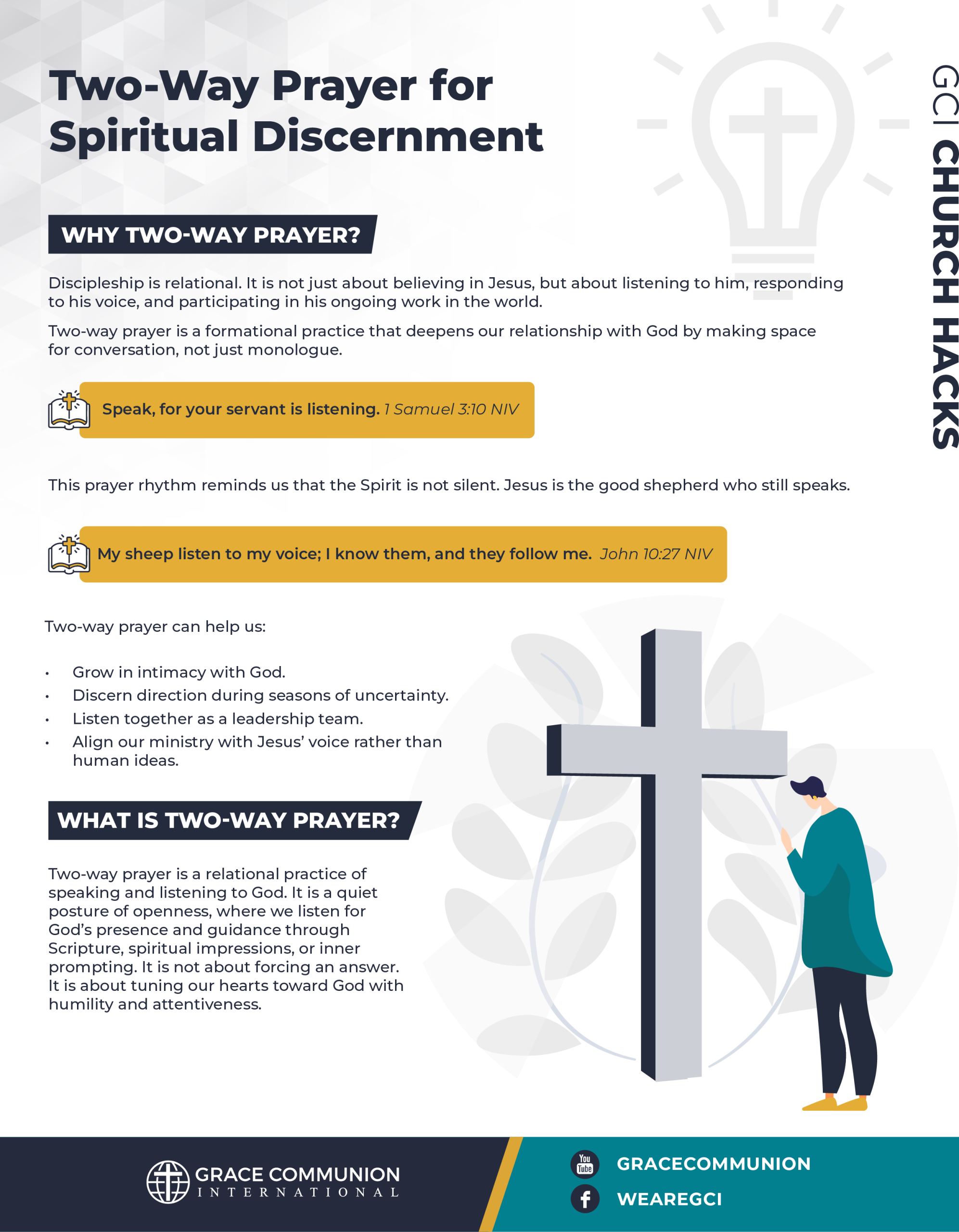
Church Hack—Two-Way Prayer for Spiritual Discernment

Discernment begins by slowing down and listening to the One who is always near. This Church Hack explores two-way prayer as a relational practice that deepens intimacy with God and helps teams listen together. Consider incorporating this rhythm into your leadership meetings, planning seasons, or personal prayer life.

Read the full Church Hack here.

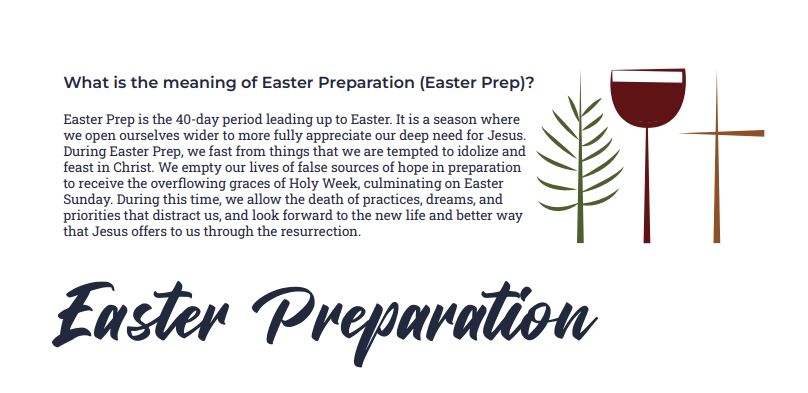
Formation—Easter Preparation

Easter Prep is the 40-day period leading up to Easter. It is a season where we open ourselves wider to appreciate our deep need more fully for Jesus. During Easter Prep, we fast from things that we are tempted to idolize, and we feast in Christ. We empty our lives of false sources of hope in preparation to receive the overflowing graces of Holy Week, culminating on Easter Sunday. During this time, we allow the death of practices, dreams, and priorities that distract us, and look forward to the new life and better way that Jesus offers to us through the resurrection.

Read the full guide for Easter Preparation practices for your congregation.


God’s Purpose in Teens’ Everyday Lives

Discipleship doesn’t end at youth group;
it continues in the classroom, at home, and online.

Joe Foister, Pastoral Resident
Surrey Hills, Oklahoma, US

Today’s teens are searching for meaning — asking who they are, where they belong, and how to live faithfully in a noisy, digital world. At GC Surrey Hills, our youth ministry exists to walk alongside them in that journey — to help them see that Jesus isn’t distant or abstract but present and personal, alive in every part of life.

Discipleship is not a class or a checklist — it’s a lifelong relationship with the Father, Son, and Holy Spirit. In Jesus, we see what God’s love looks like in human form. The Spirit continues his work in and through us today, shaping us into people who live, love, and serve as he did.

Jesus didn’t just lecture his followers; he lived with them, shared meals, told stories, invited questions, and sent them out to serve. That’s the rhythm we want to model: an incarnational way of life, where faith shows up in friendship, service, and everyday choices.

Discipleship happens through relationships: walking with others, asking honest questions, and learning to notice Christ’s presence in daily life. Jesus modeled this incarnational way of discipling — teaching by example, inviting participation, and sending his followers to serve. We aim to do the same: create spaces where young people experience belonging, discover their identity in Christ, and live out his purpose beyond the church walls.

Practices That Form Disciples

Here are key rhythms that shape our youth ministry and nurture lifelong discipleship:

    1. Mentoring that Mirrors Jesus’ Way
    • Pair teens with mature believers who listen, encourage, and walk beside them.
    • Help them see how God is already present in their friendships, choices, and struggles.
    • Build intergenerational bonds that reflect the relational love of the Trinity — Father, Son, and Spirit working together.
    1. Scripture that Transforms, Not Just Informs
    • Teach that the Bible isn’t a rulebook but a living conversation with God.
    • Explore diverse ways of reading and applying Scripture — storytelling, journaling, art, or group reflection.
    • Give weekly challenges that connect God’s Word to real-life questions and moments.
    1. Prayer that Draws Us into God’s Life
    • Begin gatherings with prayer — often led by the teens.
    • Encourage prayer that is honest, conversational, and grounded in God’s presence.
    • Remind them that discipleship is about being with Jesus, not just doing things for him.
    1. Community that Invites Questions
    • Create a culture of openness where teens can wrestle with doubts and wonder out loud.
    • Model grace and humility rather than easy answers.
    • Show that faith grows best in authentic relationships — just as Father, Son, and Spirit exist in eternal community.
    1. Service that Reflects God’s Heart
    • Involve youth in service projects, outreach, and participation in the Hope, Love, and Faith Avenues.
    • Help them see serving others not as an activity but as a way of joining Jesus in his ongoing mission of love.
    • Teach that when we serve, we embody the Incarnation — God’s love made visible in the world.

Walking with Christ Every Day

Discipleship doesn’t end at youth group — it continues in the classroom, at home, and online. Our calling is to form a community that helps young people live out Christ’s truth daily, trusting his promise:

I am with you always. Matthew 28:20 ESV

We walk this journey together — with Jesus leading, the Spirit empowering, and the Father welcoming us home at every step.

2026 Denominational Celebration

The Denominational Celebration
will be held
in Dallas, Texas, U.S.
on
July 23-26, 2026.

Registration for the 2026 Denominational Celebration is open!

We would love for you to participate in our time together. This gathering gives our fellowship time to worship, learn, and enjoy being together. The schedule offers steady rhythms of teaching, connection, and shared worship.

Our theme for this celebration is Kingdom Living. Throughout the event, we will explore how God invites us to participate in his life, reflect his goodness, and join his ongoing work in the world. The theme will guide our worship, breakout sessions, and main teachings. It will help us focus on the hope we share and the way we live it out in our daily lives.

Join us for:

      • Daily worship setting a hopeful tone each day
      • Breakouts that explore discipleship, calling, and mission
      • Messages from our leaders, including Greg Williams
      • Interviews with leaders who will share insights and stories
      • Communion that reminds us of our shared life in Jesus
      • Time for meals, fellowship, and personal reflection

Save your spot and register today!


New Member Management System

A New Giving and Member System Is Coming in 2026

Every year brings a sense of expectancy, and in 2026, our congregations will be stepping into something new. Grace Communion International will soon begin using an updated system to help congregations care for members and manage giving more effectively.

Our current online system (iMIS) has reached the end of its life, so we are transitioning to a new, modern system, Ministry Platform, which will better support both local congregations and the wider GCI fellowship.

What This Means for You

While much of this transition will happen behind the scenes, members can expect several benefits over time, including:

    • Easier and more flexible options for online giving
    • Improved communication from your local congregation
    • Better coordination of events, small groups, and ministry activities
    • Tools that help churches care well for members and guests

Change always takes time, and we are committed to moving at a thoughtful and measured pace. Pastors, treasurers, and ministry leaders will receive training and ongoing support as the new system is introduced. Additional features will be added gradually throughout the year to ensure a smooth transition for congregations and members alike.

Moving Forward Together

Whether you feel curious, excited, or cautious about this change, we are grateful to walk this journey together. We trust that this update will support our shared mission and help us continue living and sharing the gospel in our congregations and communities.

Robert Meade, GCI Comptroller
Charlotte, North Carolina, U.S.

Now Hiring—Digital Content Developer

Grace Communion International is seeking a Digital Content Developer to serve on our Media Team. This full-time, non-exempt position is based in Charlotte, NC, and reports to the Media Coordinator.

The Digital Content Developer helps tell the story of what God is doing through Grace Communion International by creating thoughtful, engaging digital content including video, podcasts, and graphics. This role collaborates closely with the Media Team to develop projects from concept through completion.

We are looking for someone who values creative excellence, collaboration, and lifelong learning, and who resonates with GCI’s commitment to sharing the gospel and participating in the love and life of the triune God.

Applicants should have relevant education or experience in digital media production and be aligned with GCI’s mission and theological commitments. See the job description here.

If you would like further details on the position or would like a GCI job application, please contact Human Resources at humanresources@gci.org or 980-495-3960.

Please share this announcement with qualified candidates who may be gifted for this position at the Home Office.

Kingdom Living (Part 1): Relational w/ Walter Kim

Kingdom Living (Part 1): Relational w/ Walter Kim

Welcome to the first episode of our 2026 GC Podcast season. This year, we’re diving deep into Kingdom Living through two focused mini-series. We’re honored to begin with Dr. Walter Kim, President of the National Association of Evangelicals (NAE) and keynote speaker for the upcoming GCI Denominational Celebration. 

In this episode, Dr. Kim joins our host, Cara Garrity, for a conversation on the relational nature of Kingdom Living. They discuss how we hear God’s voice and discover our calling. Dr. Kim also speaks about how we respond to God’s gifting through relationship with him and others. Together, they explore how calling is not just personal but communal, and how our response to God’s invitation is nurtured in the context of love, presence, and shared life. 

 “The last earthly night with his disciples, and what does [Jesus] do? He prays. He prays for them to be one, even as he’s one with the Father, that they would be one, so that the world would know. So, to recognize that this relational aspect of kingdom living is so important, that it was Jesus’ final thought and final prayer for us before he was crucified.” — Rev. Dr. Walter Kim

Main Points: 

  • What does it mean for Kingdom Living to be relational? 02:40 
  • What does it look like for calling and gifting to be discovered within relationship with God and with others? 05:46 
  • How can response to God’s calling and gifting be lived out relationally? 09:10 
  • What are practices that can help us nurture the relational nature of Kingdom Living? 23:26


Resources:

Discerning Gifting and Calling — a Church Hack that shares Biblical calling  

Pastoral Calling — an article explaining that God calls a pastor to serve, guide, and equip others to follow Jesus with humility, faith, and love 

Kingdom Living — a video introduction to our annual theme by President Greg Williams 

Program Transcript


Kingdom Living (Part 1): Relational w/ Walter Kim

Cara: In 2026, the GC Podcast is shifting to a new format with two miniseries released throughout the year rather than monthly episodes. This change is going to allow us to go deeper into meaningful conversations that support our shared journey of kingdom living. In the first half of the year, we’re excited to launch the series with Reverend Dr. Walter Kim, president of the National Association of Evangelicals and the keynote speaker for the 2026 denominational celebration. In this series, Dr. Kim joins me to explore what it means to live as citizens of God’s kingdom in today’s world: faithful to Christ, formed in community, and engaged in mission. So, stay tuned for this rich and timely series.


Hello friends, and welcome to this episode of GC Podcast. GC Podcast is created to support the best ministry practices in your own GCI context. I’m Cara Garrity, your host. And today we are beginning our miniseries to explore kingdom living and its elements as participatory, relational, missional, and transformational.

And today to help us do that, we have Reverend Dr. Walter Kim with us. Walter Kim is president of the National Association of Evangelicals. He earned his PhD at Harvard. Was chaplain at Yale and has served in diverse pastoral ministries. He’s on the Board of World Relief, Christianity Today, and Salvation Army, USA, he’s often sought out for theological and cultural commentary on issues facing the church and society.

And so, Walter, we thank you so much for joining us today to explore this really meaningful theme that we have for 2026, Kingdom Living.

[00:01:57] Walter: Cara, it’s a delight to be on this podcast with you.

[00:02:01] Cara: Yes. And so, I’m really excited for this theme and to explore these different elements of what kingdom living can look like.

For this miniseries, we’re really exploring what it means to live as citizens of God’s kingdom in today’s world, and what does it look like to live faithfully in Christ, to be formed in community, and engaged in a mission.

And so, our first element that we’re going to dive into is relational. What does it mean for us to live relationally? And so, that’s where I want to start. What does it mean for kingdom living to be relational, Walter?

[00:02:43] Walter: Yeah. I mean, that’s a great question and it’s a great place to start because, in fact, this is where Scripture starts. God sought to be in relationship, because in his very being God is relational as Father, Son and Holy Spirit, the triune God. Internally in the great mystery of God’s own being there is built-in relationship.

And even so, it is this deep desire of God to create other, to create humanity. And I love the fact that in the opening chapter of Genesis and the description of the creation of humans in the image of God, it was very clear that when God created humans, he had community in mind, because he didn’t just say, God created the individual in the image of God, it said God created humanity, male and female, in the image of God.

There’re all sorts of things and implications that we could draw from that. But one thing that I think is very essential is that this notion that we need others, that we are intended for community is built into creation itself, is built in what it means to be even human — that we need other.

And when we think about all the metaphors of the church: family, building.

We have this notion of not just individuals who have been saved into the kingdom. We have been saved into a family. We have been saved into a building where each brick has a role. And that itself I think, is deeply informative to how we think about at the foundation of creation, at the foundation of the recreation of God’s humanity in the church is essentially this deep commitment to relationship — relationship with God, relationship between humans.

And so, whatever kingdom living entails, whatever it means to be disciples, it’s not just a bunch of individuals following Jesus individually. We have been embedded in a community, in a relationship.

[00:05:07] Cara: Yes. And I love how you really start with, Scripture starts there, from creation, from the foundations, that relationship is there and even in whom God is.

So, at the end of the day, we can say there, there is really no version of kingdom living that isn’t relational. There has to be relationship. And life itself really is relational because it has been designed that way. I think that is really critical for us to be thinking about that and learning how do we live that out with one another.

And one of the things that we want to focus on and dive into in this aspect of relational kingdom living is the aspect of God’s calling and gifting to us and, how do we hear and discover and respond to his call in our lives. And so, I’m wondering what does it look like for calling and gifting to be discovered within relationship, both with God and with others?

[00:06:15] Walter: Yeah, I think so many cases, while it may be helpful to take a personality test or some vocational training, in the end, most of us, we experience a set of blessings and opportunities that help us discern what God’s call might be upon our lives.

It may be in a community where we’ve led a small group and we begin to discover, wow, other people are telling me that I’m really good at asking questions or I’m really good at listening to people. And all of a sudden you begin to have this growing sense of perhaps the Lord is calling me in this way.

Or maybe you’ve been able to lead some friends of yours to Christ, and you begin to have the community affirm that you have a knack for explaining Jesus and such winsome and compelling ways, or it could be a speaking gift that was given, or you just show up in hospitality.

Yeah. Okay. There are places for figuring out our personalities and taking tests and maybe even a spiritual gifts inventory, but by and large we often experience our way into seeing and understanding our call through the ways that we have lived it out in relationships, in community, and in fact, this is what we see in scriptures. We see God’s people saying, “Paul, Barnabas, we see something in you,” and in period of prayer and discernment that the leaders of the church in Antioch gather together and lay hands and send them out.

This happened in community as they were undoubtedly serving and living out their giftedness and having God’s people affirm it and then bless them and send them out. So, I think both our personal experience and, once again, Scripture gives us this convergence of affirmation that so much of the discovery and discernment of our call comes through trying and living and doing and having God’s people affirm and shape and redirect us.

[00:08:36] Cara: Yeah. And I really appreciate both those elements of what we’re experiencing, but also what others are speaking into our lives and what they’re noticing and discerning with us and the dynamics of that, that there’s this dynamic in relationship where it’s not just an equation of, well, X plus Y equals Z and so this is what my calling or spiritual gifting is.

But that’s something that happens within that community and relationship. And so, I wonder too, how then can our response to God’s calling and gifting, maybe once we’ve discerned it, once our community has affirmed it in us, maybe commissioned us in that, how can our response be lived out relationally?

[00:09:28] Walter: Yeah. So much of the Christian life is the realization that you’re always an amateur. So, one thing that I would put out — this is after decades of walking with the Lord and serving the Lord in a variety of context — is you never graduate beyond the common basic lesson that God loves me, that my identity is rooted in Christ and not in my performance. That it is always about dependence.

Of course, grow in wisdom, grow in expertise and skill. But as we do so, there is simultaneously the temptation as we grow in expertise to trust our expertise. And to lose that simple dependence upon the Lord.

And so there are a couple of things that I would once again put out there for us to consider and that is, as we serve the Lord, that we need to continue to put ourselves in context of constant feedback, of being able to receive the affirmations and the critiques of God’s people.

Good thing David had Nathan in his life, that even way into his kingship, Nathan was able to speak truth and confrontation to someone who began so incredibly well — slaying Goliath, delivering God’s people from the Philistines, being the model king that Jesus would be named son of David. And yet later, after all this success, he became arrogant and entitled and fell into sin. And it required someone to speak a word of truth.

So, we always need to put ourselves in a posture of dependence upon the Lord, of remembering and fostering our first love, of recognizing we might grow in expertise, but we never graduate beyond dependence, and that we always need people in our lives who will speak truth to us, who will guide us, who will encourage us. We need Nathans to challenge us. We need Barnabases to bless us and encourage us, and we need the body of Christ to constantly be working out with us our mutual calling.

I really think it’s important for us, particularly in such an individualized context and time where we’re always trying to figure out what is my calling. My calling has no real value apart from its communal impact. Each of us, according to Corinthians, have been given a gift for the common good. So, it’s not so much that we’re, “I need to be true to myself and true to my calling,” it is, “you need to be true to the community into which that calling gets exercised.”

And so that I, once again, I think is a profound challenge for us to always be working things out collaboratively in community, even if some of our gifting is one that often gets applied in a personal context. Like, you may be a counselor and you think, oh, it’s the personal wisdom that I might have.

But many, those in the counseling field, recognize they need those moments where they’re talking to colleagues and working out, “Give me some wisdom here. What can I be learning?” So, I would wish to affirm that we constantly need each other in the living out of our calling. This is not the individual saying, “I got my calling. I’m good. I’m just going to go do my thing for Jesus.” Your thing for Jesus comes in the context of community.

[00:13:40] Cara: There’s so much richness in what you just shared. I really appreciate that. A couple things that I want to pull out that really spoke to me: you can grow in expertise but not out of dependence. I think that that’s huge. What I want to get from that is we can’t exist and use our calling out of relationship in kind of any way, right? Because we don’t come out of dependence on God. And so, what does it mean to use our callings and our giftings outside of relationship with God? Is there even a reality in which that exists? Not really. But to be aware of that and to remember that I think is really incredible reminder.

And then I think also you’re speaking maybe to that temptation to live individually, that reminder that our giftings aren’t for us, at the end of the day, that we need to be living them out, using them in the context of community, because it’s not just well, like me in my little corner using my … what  uses that. I think that’s a really timely and helpful reminder.

[00:15:02] Walter: Yeah. Cara, I think there are a couple of things. Just even your reflecting back just reaffirms to me the challenge that we often think and confront when we confront the issue of calling in our particular day and age, and one is this notion that our calling is primarily about our fulfillment.

I have this need to use gifts. I have this desire to be fulfilled in ministry, and you look at Scripture and you think, of course, God is concerned with your happiness and fulfillment, but that’s actually very, very much not how calling is described, right? Paul looks at his calling: go to 2 Corinthians.

Instead, 1 Corinthians and he has this laundry list of three occasions: I’ve been persecuted, I’ve been shipwrecked. There’s sleepless nights. I have the burden of the church constantly upon me. And one time I was stoned and left the city and went back into the city.

There wasn’t so much about, “I’m called to be apostle because it’s so deeply satisfying and I find meaning in this and fulfillment, and this is why I’m an apostle.” It’s almost, “I am, I’m an apostle, and I actually don’t know how humanly fulfilling it actually is, other than deeply fulfilling in knowing that I serve the purposes of God, deeply fulfilling that even in the sacrifice there is an exceedingly great weight of glory that awaits for me, that makes all the afflictions of this lifetime feel light and momentary, and the opportunity to enter into a deeper understanding of the love of God and the deep satisfaction of the community of God.”

It’s like when we sacrifice deeply for those in our church, in our communities, when we’ve walked long roads of suffering with someone with a debilitating illness. I’m just going to get really personal here. We cared for my brother most of his adult life, 30 years. He lived with us in our family or lived near to us. You had a variety of challenges. He passed away not too long ago and I often thought about in this period of reflection, “What was the point of that? All those years?”

The point of it was the gift of walking with someone. It’s probably not something that most people will know about, though I’m mentioning it now, but I would look back and say, “Oh yeah, there’s my public ministry. There’re the things that people will know about and then there’s this long ministry, deeply personal of just loving it and caring for someone imperfectly.

But it was as much a call upon my life as anything public that I’ve ever done. And in the end to know that he went to be with the Lord and died in faith and that I had sensed deeply from the Lord, “Your race with him is finished. Thank you. Well done.” Again, not perfectly. Cara, I think about that and the kind of way in which we are often called to just faithfully walk with the Lord and in the end, was it deeply fulfilling?

Absolutely. But fulfilling in a way that was so surprising and unexpected. And so, to recognize that our call can be one that in our moment may not feel fulfilling at all except for fulfilling the purposes of God, except for walking with someone who might drive us nuts. But years, decades later, discovering the joy of having been invited to care or love or walk with you — you fill in the blank. And that’s the kind of slow burn ministry that is often not the attractive ministry. We want the bright flash. And yet the Lord will often make sure that even those of us who might have bright, flashy moments in our ministry, we’ll be called to be faithful in the slow burn of someone in our life, and that might be the greater test of our faithfulness in ministry.

[00:20:13] Cara: Walter, first I want to thank you for sharing that. That’s a beautiful testament to the ways God has called you and worked in and through and around you and your family in your life. So, thank you for sharing that personal story with us.

We’re blessed by that. And I think even opening that awareness to us, that calling really is bringing us into the fulfillment of God’s purposes and not just our own kind of sense of personal satisfaction, I think is huge. Because in that moment, maybe it doesn’t feel great, right?

But when we talk about calling, it’s not necessarily what do we want to do? What’s that big superhero ministry moment? But how are we being invited into just playing a part in God’s overall purposes. And sometimes playing that small part in what God is doing around us is costly, is the knit and grit, the good, bad, and the ugly.

And I think that is really important, especially in our context, for us personally and corporately, to wrestle with that because I think we like the good and the flashy a lot more than the bad and the ugly, right? We want to feel very good about our calling. We got called to this really great glamorous thing, or we want to latch onto this one task or this one ministry as a sense of calling, not necessarily as a way of being or walking with somebody. And so, I really appreciate that description of calling that you’ve offered to us as well. Thank you.

[00:22:07] Walter: Yeah. My first assignment you mentioned I was a campus minister, worked as a chaplain at Yale, and my director, this was fresh out of college, my first ministry assignment, and one of my earliest conversations with the director is, let me give you some perspective on ministry.

Ministry is people. People are messy. Therefore, ministry will be messy.

[00:22:35] Cara: Yes.

[00:22:35] Walter: That was like the first lesson of ministry showing up on campus. So eager to share my faith and love students and being told by my director, ministry is people, people are messy. Therefore, ministry is going to be messy. And I think life has proven that to be very, very true.

[00:22:58] Cara: Absolutely. Absolutely. Oh, what wise ways to start your ministry? And I think, as we’ve been discussing, you’ve shared a lot of really meaningful insights into why and how relationships are at the center of kingdom living and the riches and the beauty of that.

And so, I’m wondering maybe what are some practices or rhythms for us in our church communities and neighborhoods? What can we do to help us nurture that relational nature of kingdom living in our own contexts?

[00:23:40] Walter: Yeah. When Jesus sent people out, he sent them out in twos. When he was in the Garden of Gethsemane — this is the Son of God, right? He’s in the Garden of Gethsemane and he wants Peter, James, and John to be with him, to be praying with him — the intimacy of that. Again, Paul, Barnabas went out together and if you look at a lot of Paul’s letters, they were written with Silas or some other, someone else as well.

So, all throughout Scripture we get this deep sense that folks were sent in ministry teams. They were sent in context in which they were to share the joys and the sorrows of ministry with others. One practical thing is, “Who can I be doing this with?” Always asking the question. “Who, can I bring along as I am trying this?”

And then also to be thinking, again, as Paul often did, “Who are the people that I’m seeking to mentor?” The admonition to Timothy of finding faithful people who you would be able to teach and then they would be able to teach others as well. So, thinking about, “Who are folks that you could be building into?” And then of course, “Who are the folks that you can be learning from?”

And so, constantly asking those questions, just practically, “As I do this particular thing who can I be bringing along?” And it could be actually doing something together, co-leading something, but it also could be as simple as, “I’m working on this project and rather than just fulfilling this project, but on my own, just say, I want to pass this by you. Can you give me some advice?”

And to constantly be asking that, even if it’s like preparing your own sermon. Do we take the time to say before we actually get up on a Sunday to preach? “Did I vet this stuff with someone else? Did I invite someone else to gimme some feedback in my dialoguing with how this passage is working itself out?”

One is to constantly be asking, “Who can I bring along? Who could I be building into? Who can I be learning from?” And to have that corporate relational mentality with the type of ministry that I’m pursuing.

[00:26:17] Cara: Thank you. That’s a really practical place for us to … practical and I think really impactful place for us to really be intentional about bringing in these rhythms and practice of being relational in the ways that we live out the kingdom in our communities. So, I appreciate that. And I’m wondering, as we get ready to close up this first mini episode of our series: Any final words that you have for our listeners about the relational component of kingdom living?

[00:26:56] Walter: Yeah. I think, perhaps there’s no better way to end than Jesus’ prayer in John 17. What was on Jesus’ mind and heart the night before he was betrayed and he was going to die? You would think whatever’s of utmost importance. I’m going to emphasize that he thinks back to the years of ministry.

“This is my final chance to solidify a final lesson before I’m crucified.” So, the last earthly night with his disciples. And what does he do? He prays. He prays for them to be one, even as he’s one with the Father, that they would be one, so that the world would know. So, I think to recognize that this relational aspect of kingdom living is so important, that it was Jesus’ final thought and final prayer for us before he was crucified.

And to recognize that by putting in Scripture and by knowing that Jesus even now is constantly making intercession on our behalf. What is he praying? My guess is that he’s still praying John 17 for us. And so, to recognize that it’s not only important, but we actually have Jesus praying for us to live kingdom lives that are relational.

[00:28:42] Cara: Thank you. We love to have our guests close our episodes out with a word of prayer for our leaders, our members, our church neighbors. And so, would you be willing to say a word of prayer over our listeners and their people?

[00:29:07] Walter: Yeah, absolutely.

Heavenly Father, thank you that you yourself sent your beloved Son, and even now have given us fellowship with the Spirit, three in one. We praise you that you are relationship in being. And we recognize that our call is the call into this life of relationship. Your prayer was that we would be one with you, with one another, and that through that loving community give witness to the world of who Jesus is and the eternal life given to us in him. We pray that whatever the situation we may find ourselves in, whatever messiness of relationship that we may find ourselves in, that we trust your call upon our life to enter into it and fulfill your purposes through it. In the beautiful name of Jesus, we pray. Amen.

[00:30:15] Cara: Amen. Thank you.


And until next time, folks, keep on living and sharing the gospel. Thanks for listening. We would love to hear from you; email us info@gci.org. And we hope to see you at the 2026 Denominational Celebration in Texas from July 23 – July 26, 2026. Visit us at gci.org/dc26 for more information and to register.

Chris Breslin—Year A Lent 2–5

Chris Breslin—Year A Lent 2–5

John 3:1-17 ♦ John 4:5-42 ♦ John 9:1-41 ♦ John 11:1-45

In this episode, we welcome our guest, Chris Breslin, to discuss the March 2026 RCL pericopes. Chris is the founder/church planter and pastor of Oak Church in Durham, NC.

Sunday, March 1, 2026 — Second Sunday in Lent/Easter Preparation
John 3:1-17 (NRSVUE)

Sunday, March 8, 2026 — Third Sunday in Lent/Easter Preparation
John 4:5-42 (NRSVUE)

Sunday, March 15, 2026 — Fourth Sunday in Lent/Easter Preparation
John 9:1-41

Sunday, March 22, 2026 — Fifth Sunday in Lent/Easter Preparation
John 11:1-45 (NRSVUE)


If you get a chance to rate and review the show, that helps a lot. And invite your fellow preachers and Bible lovers to join us!

Follow us on Spotify and Apple Podcast.

Program Transcript


Chris Breslin—Year A Lent 2–5

Welcome to the Gospel Reverb podcast. Gospel Reverb is an audio gathering for preachers, teachers, and Bible thrill seekers. Each month our host, Anthony Mullins, will interview a new guest to gain insights and preaching nuggets mined from select passages of Scripture in that month’s Revised Common Lectionary. The podcast’s passion is to proclaim and boast in Jesus Christ, the one who reveals the heart of God, Father, Son, and Holy Spirit. And now onto the episode.


Anthony: Hello friends, and welcome to the latest episode of Gospel Reverb. Gospel Reverb is a podcast devoted to bringing you insights from Scripture found in the Revised Common Lectionary and sharing commentary from a Christ-centered and Trinitarian view.

I’m your host, Anthony Mullins, and it’s my delight to welcome our guest, Reverend Chris Breslin. Chris is the founding pastor of Oak Church in Durham, North Carolina. He earned a Master’s of Divinity from Duke Divinity School where he teaches or serves as a precept teaching assistant. He works to keep the church small, local, and weird. Chris, thanks for being with us. Welcome back to the podcast. It’s been a few years, so we would like to have our memories refreshed about you, your story, and especially what has you experiencing delight these days.

[00:01:27] Chris: Thanks Anthony. It’s so good to be with you and thankfully it hasn’t been a few years since I’ve seen you in person.

[00:01:34] Anthony: That’s right.

[00:01:36] Chris: Yeah, in terms of things that are giving me delight these days. This is the in-between time when we’re taping this, and so we are getting ready for a baseball season ahead. I coach two of my sons.

I am hand copying Matthew’s gospel as I work in a New Testament class. And this is a practice commended to me by a friend, JR Briggs. And it’s amazing how much more you soak in familiar words when you have to slow down enough to faithfully copy them. Also gives you some respect for earlier manuscript scribes.

And listening to records. I know if I’m, like, in a good place and joyful and healthy if I’m listening to music and not just podcasts. And especially if I’m listening in a way that I have to get up and flip the record every 20 minutes or whatever. So, I’m listening to Bob Dylan’s biography …

Anthony: Oh, come on.

Chris: … that I found at a thrift store in awesome shape. I’m listening to MJ Linderman. I’m on the Train, big indie record from last year; Getting Killed by Geese. Loving that. The band is Geese. The record is Getting Killed. So Getting Killed by Geese.

Anthony: I love it.

Chris: And Mavis Staples has an awesome covers record. Just awesome, beautiful stuff. So those are giving me delight right now.

[00:03:25] Anthony: As you write down Matthew, what’s been maybe the epiphany that you’ve had as you’ve been doing this?

[00:03:36] Chris: Yeah. It’s interesting doing it along teaching. I’m working with Professor Brittany Wilson in an interpretation of New Testament hybrid course, and so you’re reteaching kind of themes of the gospel, but to do it slow and to realize man, this teaching, Jesus as teacher, Jesus as new Moses is such a theme. And when you get into handwriting Matthew 5, 6, 7, you realize, man, this is a really long discourse and rich and beautiful, but just again, the practice is a little bit of an antidote to skimming or just grabbing little aphorisms or chunks. And so, it really does re-immerse you in some beautiful words.

[00:04:37] Anthony: We know each other, we’re friends, which I’m very grateful for you and especially your guidance as I’ve been in the throes of planting a church. And one of the things I’ve heard you talk about is seeing the church stay small, local, and weird. What does that mean and why does it matter so much to you?

[00:04:58] Chris: Those might be threatening words to a church planner who’s trying to grow a church. But yeah. This just became shorthand around Oak Church, where I serve. In some ways, it’s a little bit of a bar to see if people are on the same wavelength or have like consonant expectations, small, local, and weird.

Some people are like, I’m out. But I think they also represent the positive side of some key temptations to resist and overcome. Speed and scale and distance and control are all things that happen with corporate franchise restaurants, but in my opinion, not really like the body of Christ, faith communities, and real places with neighbors.

I don’t know. I always think it’s good to have little handles to remind us, little watch words that there are no shortcuts or magic bullets. And for us it’s been so important in our ministry that we don’t need to go somewhere else to experience God’s presence and God’s grace.

And you’re in an early phase of forming a faith community, but I think there can be some temptation to think when things are scrappy and ragged, especially at the beginning, that you’re like not there yet and we need to smooth out difference in some of the marks of our creatureliness and some of the things that are actually gifts to us — that they’re actually good, that differences are a fruit of Pentecost and the way the Spirit is still working with us. That’s the weird part.

Yeah, it’s been interesting working in this New Testament course and especially examining Paul as a pastor and I think that’s made me more deeply committed to this idea, like all of these communities that we have these extant letters are small communities, sometimes small enough, where a whole congregation is assembled in a, like, some supporter’s home. I know this is a novel idea for you, Anthony.

Each of these churches is named, not with like slick branding or like aspirational wish dream language, but just where they are. And each of them, each of these letters is like Paul reflecting on challenges and griefs and quirks and joys and thanksgiving for these people.

I think Pastor Paul is not wishing them out of these situations, but it’s pastoring them in and through them, and expressing tenderness and care and pride. And those are things that I that I aspire to and we share that ministry here.

[00:08:16] Anthony: Yeah. No, you’ve been quite helpful to me in that regard, just reminding me of the smallness and the slowness of developing a faith community. As I read the parables of the kingdom. It just seems to me that it’s slow, but it’s really good work. And God is faithful and I’m wired in such a way that I do want to sometimes jump ahead and smooth out the rough patches. And this is a good reminder that God is at work. And sometimes you go to sleep and you wake up and things grow and you don’t know how or why it happened, but it happens. So, I really do appreciate that.

Let’s dive into our lectionary text. That’s why we’re here. We have four passages that we’re going to look at this month. Our first passage of the month is John 3:1–17. I’ll be reading from the New Revised Standard Version, the updated edition. It is a Revised Common Lectionary passage for the second Sunday in Lent / Easter Preparation, March 1.

Now there was a Pharisee named Nicodemus, a leader of the Jews. 2 He came to Jesus by night and said to him, “Rabbi, we know that you are a teacher who has come from God, for no one can do these signs that you do unless God is with that person.” 3 Jesus answered him, “Very truly, I tell you, no one can see the kingdom of God without being born from above.” 4 Nicodemus said to him, “How can anyone be born after having grown old? Can one enter a second time into the mother’s womb and be born?” 5 Jesus answered, “Very truly, I tell you, no one can enter the kingdom of God without being born of water and Spirit. 6 What is born of the flesh is flesh, and what is born of the Spirit is spirit. 7 Do not be astonished that I said to you, ‘You must be born from above.’ 8 The wind blows where it chooses, and you hear the sound of it, but you do not know where it comes from or where it goes. So it is with everyone who is born of the Spirit.” 9 Nicodemus said to him, “How can these things be?” 10 Jesus answered him, “Are you the teacher of Israel, and yet you do not understand these things? 11 “Very truly, I tell you, we speak of what we know and testify to what we have seen, yet you do not receive our testimony. 12 If I have told you about earthly things and you do not believe, how can you believe if I tell you about heavenly things? 13 No one has ascended into heaven except the one who descended from heaven, the Son of Man. 14 And just as Moses lifted up the serpent in the wilderness, so must the Son of Man be lifted up, 15 that whoever believes in him may have eternal life. 16 “For God so loved the world that he gave his only Son, so that everyone who believes in him may not perish but may have eternal life. 17 “Indeed, God did not send the Son into the world to condemn the world but in order that the world might be saved through him.

So Chris, how would you herald the gospel if you were preaching this text to your congregation?

[00:11:41] Chris: I’m really struck by this scene because it features someone in Nicodemus that is so serious and also in some ways so staked to the status quo, but also is courageous and humble enough to ask Jesus to reveal something new to him.

Just think these days it can be really distressing. Maybe you feel this to live in a world, in a media environment where two people can. Receive the same data or receive the same video or hear the same words and interpret those things like drastically differently. And sometimes in host hostile opposition.

And this happens in our church community. Sometimes it’s happening around them and inside them. Putting aside for a second that we’re that we’re all sinful and our vision and our hearing are in some ways, like provisional, still seems like there’s always a subset of folks who can and want to see and hear with clarity.

There’s a subset who can’t maybe yet, and there’s a subset who won’t or don’t want to. And so, I think this is remarkable on a human level: the curiosity and the courage of Nicodemus here. Although he does meet at night with some level of concealment and caution.

Anthony: Sure, sure.

Chris: And also the patience and the creativity of Jesus in his response. So, that’s the lens I’m approaching this with. This is a fascinating scene of Jesus encountering someone who can’t see but wants to. Jesus, Flannery says, draws large and startling images, like the image, the main image, being born again.

But he doesn’t quite shout at Nicodemus here. Jesus is complicating. Nicodemus is closed, too small vision in the world, but also opening up a window so that he can begin to feel how the Spirit is blowing, where it comes or where it goes, you know. So, it seems like Jesus is like loosening Nicodemus’ grip, his control. We talked about a minute ago in likening the coming of God’s kingdom and Nicodemus’ participation in it as passing through a birth canal. This is so scandalous. I’m in a season of life where this seems like every two months is another kid coming up on the talk, and so, dropping birth canal language is — I’m sure that’s not what Nicodemus assumed was he was getting himself into, right?

[00:14:52] Anthony: Yeah.

[00:14:52] Chris: Like I also I wonder if there’s a little bit of a parallel, not directly, but this strikes me a little bit like the story of the rich young ruler and that story doesn’t show up in John’s gospel. All Nicodemus wanted was something to do, some takeaway, something to achieve, conquer, progress, know that he was right. And all Jesus gives him is an invitation to do less, to give it away, to take his hands off, to gain an innocence that is only able to receive from God like a newborn baby.

And the last thing I notice is that Jesus is fleshing out God’s word. And this is like the theme of John’s gospel, right? The Word made flesh.

[00:15:50] Anthony: Yeah.

[00:15:51] Chris: But the Word in our translations at the end in famous, like, stadium rainbow wig verse John 3:16, the Word is doing so much work. Most of my life, I considered that like a quantitative statement like, God loves the world so much, which of course is true that he would give his only Son. And maybe that, so muchness has some connections to certain ideas about atonement and, like, mismatch, and what God gives, and what we have.

But what if that so is also like qualitative, like God loves the world, just so. You know, just so. God loves the world by entering into it. The way God loves the world is by giving his Son. The gift of Jesus is a gift of God’s own presence and God’s unbreakable decision to have skin in our game.

Those are some of the things that jump out.

[00:17:09] Anthony: Yeah, you just reminded me. We have a mutual friend who likes to say God didn’t just write us a letter, he paid us a visit. And I like the way you said it, that he has skin in the game. You’d mentioned how two people could read the same social media post or watch the same video and come to polar opposite positions.

And in that often what is people condemning one another, that there’s such disdain for the other position that we condemn. But God, as we read in verse 17, did not send this Son who he loved and so loved the world into the world to condemn it. And it gets me thinking if Jesus wasn’t sent to condemn, I’m pretty sure we’re not called to do that either.

And yet, we just have this enormous capacity to do that, to condemn one another. Can you talk about it? What’s the way forward in this roux that we’re finding ourselves swimming in at this constant condemnation of one another?

[00:18:27] Chris: Yeah. I don’t know. I don’t know that I can speak generally, but when I feel most condemning of other people, that’s when I’m most insecure or when I feel most out of control or when it seems like, if I don’t lock this down, there’s not going to be enough.

I love that Nicodemus seeks out Jesus and gets this message of non-condemnation. I imagine him, Nicodemus, like, being glad that it’s at night so that Jesus can’t see him like writhing in his chair.

But what if this verse is true? I think it is. Like, what if God’s capital “YES” is so pronounced in our world that any “no” is lowercase and like only makes sense in light of God’s love and care and provision. Like, we don’t get that much about Nicodemus’ response or what happened after this encounter. Like the rich young rulers, he went away sad and we’re not really sure where that sadness is located or aimed. But we do get a story of Joseph, or of Nicodemus popping up later in the gospel alongside Joseph of Arimathea to help bury Jesus in John 19.

I think that’s like profoundly telling, that Jesus has this imaginative, non-condemning encounter with Nicodemus, and then somewhere along the line that turns him into a follower of Jesus, in the sort of person who used to only sidle up to Jesus in the shadows and in whisper tones, and is now out there with tenderness and sorrow tending to the body of a lynched dissident, who for all intents and purposes lost, was pulverized, was erased by the state and the church. People don’t know the bad news about themselves. There’s no need for the good news. Take a look at Nicodemus’ life of slow, steady unspectacular discipleship and the way he grew as a disciple. It’s really remarkable.

And it didn’t come from any condemnation of Jesus.

[00:21:48] Anthony: Yeah. I love what you said. What if it’s true? Because it is, and I’m convinced of that, and the Lord has said yes. And so, any response back to the Lord as a yes is contained within his larger objective yes to us, that he so loved us, that he sent his Son.

All right. Let’s transition to our next text of the month. It’s John 4:5–42. It’s a lengthy one, and so we have decided to spare you all of that reading. We’re going read a portion of that and then discuss it. It is the Revised Common Lectionary passage for the third Sunday in Lent / Easter preparation, which is March 8.

Chris, would you read it for us, please?

[00:22:10] Chris: Sure.

So he came to a Samaritan city called Sychar, near the plot of ground that Jacob had given to his son Joseph. 6 Jacob’s well was there, and Jesus, tired out by his journey, was sitting by the well. It was about noon. 7 A Samaritan woman came to draw water, and Jesus said to her, “Give me a drink.” 8 (His disciples had gone to the city to buy food.) 9 The Samaritan woman said to him, “How is it that you, a Jew, ask a drink of me, a woman of Samaria?” (Jews do not share things in common with Samaritans.) 10 Jesus answered her, “If you knew the gift of God and who it is that is saying to you, ‘Give me a drink,’ you would have asked him, and he would have given you living water.” 11 The woman said to him, “Sir, you have no bucket, and the well is deep. Where do you get that living water? 12 Are you greater than our ancestor Jacob, who gave us the well and with his sons and his flocks drank from it?” 13 Jesus said to her, “Everyone who drinks of this water will be thirsty again, 14 but those who drink of the water that I will give them will never be thirsty. The water that I will give will become in them a spring of water gushing up to eternal life.” 15 The woman said to him, “Sir, give me this water, so that I may never be thirsty or have to keep coming here to draw water.” 16 Jesus said to her, “Go, call your husband, and come back.” 17 The woman answered him, “I have no husband.” Jesus said to her, “You are right in saying, ‘I have no husband,’ 18 for you have had five husbands, and the one you have now is not your husband. What you have said is true!” 19 The woman said to him, “Sir, I see that you are a prophet. 20 Our ancestors worshiped on this mountain, but you say that the place where people must worship is in Jerusalem.” 21 Jesus said to her, “Woman, believe me, the hour is coming when you will worship the Father neither on this mountain nor in Jerusalem. 22 You[g] worship what you do not know; we worship what we know, for salvation is from the Jews. 23 But the hour is coming and is now here when the true worshipers will worship the Father in spirit and truth, for the Father seeks such as these to worship him. 24 God is spirit, and those who worship him must worship in spirit and truth.” 25 The woman said to him, “I know that Messiah is coming” (who is called Christ). “When he comes, he will proclaim all things to us.” 26 Jesus said to her, “I am he, the one who is speaking to you.” 27 Just then his disciples came. They were astonished that he was speaking with a woman, but no one said, “What do you want?” or, “Why are you speaking with her?” 28 Then the woman left her water jar and went back to the city. She said to the people, 29 “Come and see a man who told me everything I have ever done! He cannot be the Messiah, can he?” 30 They left the city and were on their way to him. 31 Meanwhile the disciples were urging him, “Rabbi, eat something.” 32 But he said to them, “I have food to eat that you do not know about.” 33 So the disciples said to one another, “Surely no one has brought him something to eat?” 34 Jesus said to them, “My food is to do the will of him who sent me and to complete his work. 35 Do you not say, ‘Four months more, then comes the harvest’? But I tell you, look around you, and see how the fields are ripe for harvesting. 36 The reaper is already receiving wages and is gathering fruit for eternal life, so that sower and reaper may rejoice together. 37 For here the saying holds true, ‘One sows and another reaps.’ 38 I sent you to reap that for which you did not labor. Others have labored, and you have entered into their labor.” 39 Many Samaritans from that city believed in him because of the woman’s testimony, “He told me everything I have ever done.” 40 So when the Samaritans came to him, they asked him to stay with them, and he stayed there two days. 41 And many more believed because of his word. 42 They said to the woman, “It is no longer because of what you said that we believe, for we have heard for ourselves, and we know that this is truly the Savior of the world.”

[00:24:45] Anthony: This is the lengthiest continuous conversation Jesus has with anyone recorded in Scripture. It’s a woman, and not just any woman, but a Samaritan woman. Chris, what might this tell us about the God revealed in Jesus Christ?

[00:25:07] Chris: Looking specifically at Jesus, sometimes it can be helpful to come up with kind of adjectives that are just like really particularly descriptive to the passage that you’re focusing on. And the two that I came up with were, this is the circuitous and exhausted Jesus. Okay.

[00:25:30] Anthony: Tell us.

[00:25:31] Chris: Yeah. I don’t think it is like a small detail that Jesus goes a really strange way along to go through Samaria in Sychar. One of the commentators, Dale Bruner, has a great John commentary, and he says, Jesus leaves “strategic Judea in Jerusalem in the south for a season away in seemingly less auspicious Samaria and Galilee in the north. Yet deep things happen in these externally out of the way, less impressive places. God is no more respecter of places than he is of persons. Wherever he is at work is a very significant place.”

And so, Jesus going this circuitous way that doesn’t seem at all accidental — surprising but not accidental, right? Samaritans, from what I can gather, are shady because they are synchronistic, they’re pluralistic. There is a history here. They sort of worship God, but also keep some of their own worship practices alongside of that. They’re not like pure in like a religious purity kind of thought purity sort of way.

I’m not sure there’s like a great analogy here, but I don’t know. I was trying to think what this could be like for a conservative Christian, someone who they might be like nervous and interfacing with — like maybe like a Mormon or a Rastafarian or like an indigenous American who like has some Christian thoughts and practice and worship, but also has a lot of other stuff going on, right? Maybe we can imagine as gaps widen in our world. Who is your theological outgroup, folks who are like a little bit exotic, but also a little bit dangerous, right? In some ways the theological commonalities of Jews and Samaritans are maybe more confusing in light of the theological and cultural differences.

And so, Jesus, it seems, despite the past in this present, sidles up to this woman at the well. And there’s a history of wells in Scripture, and particularly this well. Abraham meets Rebecca at the well — that’s Isaac’s future wife. Hagar is met by an angel of the Lord at a desert spring of water, which is basically a well. And this is Jacob’s well. So, I think that’s hinting that this is like the middle of God’s unfolding story. And that’s happening in a kind of a strange place that Jesus purposes to be.

So, the other word was exhausted. What the heck does it mean for a Christology that Jesus was exhausted?

Anthony: Yes.

Chris: And then the outpouring of that, like Jesus is exhausted. So, it seems like the disciples spring into action. They’re gone because they’re going to buy food to help him, and then he asks for help from someone who has no business helping him.

Anthony: Yeah.

Chris: Like, even if Jesus isn’t the Word made flesh, even if he’s just some random Jewish dude, like you shouldn’t be asking her for help. I also think like it’s an interesting contrast between this woman and our previous pericope with Nicodemus, like man, woman, Israelite, Pharisee, and a Samaritan, teacher, housewife, night. It says he met the woman at high noon, like in the middle of the day. Even how they respond. Like, Nicodemus refers to Jesus as teacher. She refers to Jesus as prophet and Messiah. This exhausted, out-of-the-way person. So, those are some of the things that I noticed. Those are some of the things that that I feel like I learn about the God revealed in Jesus from this story.

[00:30:16] Anthony: I’ve had the privilege of worshiping with Oak Church, where you pastor, and one of the things I’ve appreciated about you, you have a narrative way of preaching, and I know you value imagination, that we would spiritually imagine what’s happening and contextualizing that to our world. I’m going to ask you to do the same here.

We get brief insight on this woman’s testimony about Jesus, but what do you imagine she told her friends about Jesus and how she might’ve responded to this incredibly unexpected conversation?

[00:31:00] Chris: Yeah. Start with what she said, “I know that Messiah’s coming. He will proclaim all things. Come. See. He told me everything I’ve ever done.” And then she says, “He can’t be the Messiah, can he?” Yeah. And then, this human-divine Jesus goes and eats something. And after that, the Samaritans ask Jesus to stay with them and he does. So, in the process of that hospitality and that intimacy more come to trust in Jesus, and I think this is all because of this incarnation ministry move of Jesus.

Some initially trust what the woman said, but more were coming to trust in Jesus because of what he said, what they saw, and that he was with them. This again, like in light of the Nicodemus encounter, that idea that some can’t and some willfully won’t see in here, I think it’s remarkable that when Jesus comes close to these theological Creole folk, they are opened up and included in the very life of God.

So, in a lot of ways her testimony is opening them up to an encounter and experience with Jesus. She is like an evangelist host. She makes room for these encounters to happen by her questions and by her proclamation, but also by her, like, invitation and introduction of them to Jesus. It’s really remarkable how her encounter and experience then gives way to all of these other encounters and experiences.

[00:32:50] Anthony: And when the Spirit comes upon you, you will be my witnesses. Hallelujah.

Alright, let’s transition to our next pericope of the month. It’s John 9:1–41. Again, because of the length, we’ll read just a portion of the text. It is the Revised Common Lectionary passage for the fourth Sunday in Easter Preparation, March 15.

As he walked along, he saw a man blind from birth. 2 His disciples asked him, “Rabbi, who sinned, this man or his parents, that he was born blind?” 3 Jesus answered, “Neither this man nor his parents sinned; he was born blind so that God’s works might be revealed in him. 4 We must work the works of him who sent me while it is day; night is coming, when no one can work. 5 As long as I am in the world, I am the light of the world.” 6 When he had said this, he spat on the ground and made mud with the saliva and spread the mud on the man’s eyes, 7 saying to him, “Go, wash in the pool of Siloam” (which means Sent). Then he went and washed and came back able to see. 8 The neighbors and those who had seen him before as a beggar began to ask, “Is this not the man who used to sit and beg?” 9 Some were saying, “It is he.” Others were saying, “No, but it is someone like him.” He kept saying, “I am he.” 10 But they kept asking him, “Then how were your eyes opened?” 11 He answered, “The man called Jesus made mud, spread it on my eyes, and said to me, ‘Go to Siloam and wash.’ Then I went and washed and received my sight.” 12 They said to him, “Where is he?” He said, “I do not know.” 13 They brought to the Pharisees the man who had formerly been blind. 14 Now it was a Sabbath day when Jesus made the mud and opened his eyes. 15 Then the Pharisees also began to ask him how he had received his sight. He said to them, “He put mud on my eyes. Then I washed, and now I see.” 16 Some of the Pharisees said, “This man is not from God, for he does not observe the Sabbath.” Others said, “How can a man who is a sinner perform such signs?” And they were divided. 17 So they said again to the blind man, “What do you say about him? It was your eyes he opened.” He said, “He is a prophet.” 18 The Jews did not believe that he had been blind and had received his sight until they called the parents of the man who had received his sight 19 and asked them, “Is this your son, who you say was born blind? How then does he now see?” 20 His parents answered, “We know that this is our son and that he was born blind, 21 but we do not know how it is that now he sees, nor do we know who opened his eyes. Ask him; he is of age. He will speak for himself.” 22 His parents said this because they were afraid of the Jews, for the Jews had already agreed that anyone who confessed Jesus to be the Messiah would be put out of the synagogue. 23 Therefore his parents said, “He is of age; ask him.” 24 So for the second time they called the man who had been blind, and they said to him, “Give glory to God! We know that this man is a sinner.” 25 He answered, “I do not know whether he is a sinner. One thing I do know, that though I was blind, now I see.” 26 They said to him, “What did he do to you? How did he open your eyes?” 27 He answered them, “I have told you already, and you would not listen. Why do you want to hear it again? Do you also want to become his disciples?” 28 Then they reviled him, saying, “You are his disciple, but we are disciples of Moses. 29 We know that God has spoken to Moses, but as for this man, we do not know where he comes from.” 30 The man answered, “Here is an astonishing thing! You do not know where he comes from, yet he opened my eyes. 31 We know that God does not listen to sinners, but he does listen to one who worships him and obeys his will. 32 Never since the world began has it been heard that anyone opened the eyes of a person born blind. 33 If this man were not from God, he could do nothing.” 34 They answered him, “You were born entirely in sins, and are you trying to teach us?” And they drove him out. 35 Jesus heard that they had driven him out, and when he found him he said, “Do you believe in the Son of Man?” 36 He answered, “And who is he, sir? Tell me, so that I may believe in him.” 37 Jesus said to him, “You have seen him, and the one speaking with you is he.” 38 He said, “Lord, I believe.” And he worshiped him. 39 Jesus said, “I came into this world for judgment, so that those who do not see may see and those who do see may become blind.” 40 Some of the Pharisees who were with him heard this and said to him, “Surely we are not blind, are we?” 41 Jesus said to them, “If you were blind, you would not have sin. But now that you say, ‘We see,’ your sin remains.

“I was blind. And now I see.” The religious leaders questioned who was to blame for the man being blind. No one was to be blamed. Was that type of blaming game isolated to that culture or do you see it at work today? And that’s like an understating question. And if so, how does this blame and shame game persist? And what is the solution?

[00:36:34] Chris: Yeah.

[00:36:37] Anthony: What do we do with that?

[00:36:42] Chris: And can I say that it’s strangely heartening that, like this sort of stuff, we didn’t invent this sort of stuff or that it’s not that it happens in a analog culture, like you can totally imagine a confrontation like this in this like AI and social media, deep fake age, right, where there’s just so much suspicion and disputation of what is real.

I think there are a couple of things happening. There’s the blame of it all. There’s an attempt at a simple answer to horrible suffering. It seems that Jesus’ disciples need to be “un-discipled” from these old ways of thinking.

[00:37:37] Anthony: Well said.

[00:37:38] Chris: Yeah. Matthew’s gospel has that formula. “You have heard it said, but I say to you” — this might be like a Johannine version of that. Jesus clears the way of old thinking off the table, a way that has no room for God’s presence and work, but only a zero-sum blame game of who screwed up. And Jesus resets the terms with just a more expansive, mysterious, complicated, and, like, theocentric, God-centered view of the world. They want an either / or. Jesus gives them a neither /and. I don’t know if that’s how that works.

[00:38:21] Anthony: Yeah, I like that.

[00:38:22] Chris: But I think the second thing that is happening is the encounter with the religious gatekeepers. This seems so social media coded to me. They are looking for a way to trap him. They want to get him to say something that can be clipped so that he can be disputed, dismissed, vilified, disqualified. Again, related to our theme of who can see and hear, those who can, and those who refuse to. If you already “know” that a man can’t be healed you just have a few options.

Your options are like the disciples, to try to explain it, and blame for it, which that works. And that can be satisfying until that blame comes for you when something bad happens. Another option is you can deny it like the Pharisees attempt to, or then that like denial shifts as denial often does and then they begin to recognize that this “impossible skill” happened, in that it has dark causes; you vilify it. So, those seem to be the ways that blame is operating here and I think still operates more generally.

[00:40:11] Anthony: Yeah. It seems to me when anything happens in our society, that’s the first question we often ask, “Who’s to blame?” We’ve got to be able to set it at somebody’s feet so we can understand what is happening.

And I just love this guy’s response. His testimony is not to wrangle over theology. “I just know what happened to me. I can’t tell you much about this guy, but I was blind and now I see.” What can we learn from the witness of this man?

[00:40:55] Chris: Yeah. Of all those previous options and the way that they’re wrestling with this upturning of the way things are, there’s this guy standing over to the side, and imagine him just like ogling at the colors and the shapes and the shadows and the faces and the details and the beauty that he never saw, but now can see.

Anthony: Yeah

Chris: Like, I think we learned that, like talking about and bandying about ideas of seeing and perceiving pale in comparison to the indisputable experience of a man who was encountered, who was touched, who was healed, who had things revealed to him. You circle back to the start of the passage, he was born blind so that God’s works might be revealed in him. And Jesus says, as long as I’m in the world, I’m the light of the world. And it is that light that is illuminating for this man.

[00:42:02] Anthony: I don’t know if you’ve seen the videos of people who had been born deaf and with today’s technology are able to hear.

[00:42:13] Chris: Yeah, that’s right.

[00:42:14] Anthony: And people who have been colorblind with special glasses can see in colors they could only previously try to imagine. It brings me to tears every time something like that happens. What a wonderful thing the Lord has done here. And I appreciate you just bringing it up, like the astonishment of what that man was experiencing and how that impacted his testimony. I don’t think he ever stopped talking about it. How could you?

[00:42:46] Chris: How could you? And again, not to rank healings or encounters, but there’s just something so much more vivid and, like, whole-being-related to gaining a whole sense. Again, someone who is immobilized by leg injury or something like, absolutely — those stories in the gospels they jump up and leap about like calves. That’s so cool. This man is having his whole way of being in the world completely changed in a way that seems analogous to what Jesus is telling Nicodemus. “You need to be born again. You need to come into this world again as for the first time.” It feels like that’s a little bit of what that man is experiencing.

[00:43:58] Anthony: Yeah. And yet Pastor Paul wrote to the church in Corinth, no eye has seen, no ears heard, no mind can even comprehend the things that are in store. Like even with this man’s sight, there’s just still so much.

All right, let’s transition to our final pericope of the month. It’s John 11:1–45. We’ll read just a shortened version of that. It is the Revised Common Lectionary passage for the fifth Sunday of Lent / Easter Preparation, March 22. Chris, read it for us, please.

[00:44:35] Chris: Sure.

Now a certain man was ill, Lazarus of Bethany, the village of Mary and her sister Martha. 2 Mary was the one who anointed the Lord with perfume and wiped his feet with her hair; her brother Lazarus was ill. 3 So the sisters sent a message to Jesus, “Lord, he whom you love is ill.” 4 But when Jesus heard it, he said, “This illness does not lead to death; rather, it is for God’s glory, so that the Son of God may be glorified through it.” 5 Accordingly, though Jesus loved Martha and her sister and Lazarus, 6 after having heard that Lazarus was ill, he stayed two days longer in the place where he was. 7 Then after this he said to the disciples, “Let us go to Judea again.” 8 The disciples said to him, “Rabbi, the Jews were just now trying to stone you, and are you going there again?” 9 Jesus answered, “Are there not twelve hours of daylight? Those who walk during the day do not stumble because they see the light of this world. 10 But those who walk at night stumble because the light is not in them.” 11 After saying this, he told them, “Our friend Lazarus has fallen asleep, but I am going there to awaken him.” 12 The disciples said to him, “Lord, if he has fallen asleep, he will be all right.” 13 Jesus, however, had been speaking about his death, but they thought that he was referring merely to sleep. 14 Then Jesus told them plainly, “Lazarus is dead. 15 For your sake I am glad I was not there, so that you may believe. But let us go to him.” 16 Thomas, who was called the Twin, said to his fellow disciples, “Let us also go, that we may die with him.” 17 When Jesus arrived, he found that Lazarus had already been in the tomb four days. 18 Now Bethany was near Jerusalem, some two miles away, 19 and many of the Jews had come to Martha and Mary to console them about their brother. 20 When Martha heard that Jesus was coming, she went and met him, while Mary stayed at home. 21 Martha said to Jesus, “Lord, if you had been here, my brother would not have died. 22 But even now I know that God will give you whatever you ask of him.” 23 Jesus said to her, “Your brother will rise again.” 24 Martha said to him, “I know that he will rise again in the resurrection on the last day.” 25 Jesus said to her, “I am the resurrection and the life. Those who believe in me, even though they die, will live, 26 and everyone who lives and believes in me will never die. Do you believe this?” 27 She said to him, “Yes, Lord, I believe that you are the Messiah, the Son of God, the one coming into the world.” 28 When she had said this, she went back and called her sister Mary and told her privately, “The Teacher is here and is calling for you.” 29 And when she heard it, she got up quickly and went to him. 30 Now Jesus had not yet come to the village but was still at the place where Martha had met him. 31 The Jews who were with her in the house consoling her saw Mary get up quickly and go out. They followed her because they thought that she was going to the tomb to weep there. 32 When Mary came where Jesus was and saw him, she knelt at his feet and said to him, “Lord, if you had been here, my brother would not have died.” 33 When Jesus saw her weeping and the Jews who came with her also weeping, he was greatly disturbed in spirit and deeply moved. 34 He said, “Where have you laid him?” They said to him, “Lord, come and see.” 35 Jesus began to weep. 36 So the Jews said, “See how he loved him!” 37 But some of them said, “Could not he who opened the eyes of the blind man have kept this man from dying?” 38 Then Jesus, again greatly disturbed, came to the tomb. It was a cave, and a stone was lying against it. 39 Jesus said, “Take away the stone.” Martha, the sister of the dead man, said to him, “Lord, already there is a stench because he has been dead four days.” 40 Jesus said to her, “Did I not tell you that if you believed you would see the glory of God?” 41 So they took away the stone. And Jesus looked upward and said, “Father, I thank you for having heard me. 42 I knew that you always hear me, but I have said this for the sake of the crowd standing here, so that they may believe that you sent me.” 43 When he had said this, he cried with a loud voice, “Lazarus, come out!” 44 The dead man came out, his hands and feet bound with strips of cloth and his face wrapped in a cloth. Jesus said to them, “Unbind him, and let him go.” 45 Many of the Jews, therefore, who had come with Mary and had seen what Jesus did believed in him.

[00:47:33] Anthony: So how does the story end, Chris? Does he bring him back to life? Of course he does, and I think many of our listeners will know the rest of the text there. There’s just so much here. So, I wanted to give you a chance just to riff. What are you interested in us hearing? Teach, Teacher! Let’s hear it.

[00:47:52] Chris: Yeah. I did preach on parts of this passage in the last year or two. And it’s interesting ’cause I was doing a little bit of cleanup. Several weeks earlier I’d had a lay person preach with not a whole lot of experience. And they did an overall really good job preaching on the Mary and Martha story from earlier.

And congregation walked away with so much good stuff from that passage. But I felt like there was a little bit of an oversimplified kind of Martha, the busy body, Mary, the serious spiritual one, vibe happening. And it just needed to be a little more filled out. So, that’s what I mean by cleanup.

So, we get to this story. And so, I chose this text. And we get to this story and we find these sisters. And if you have siblings, you know how very interesting dynamics come out when you are hosting an important guest. And now they, these same sisters are in a moment of deep grief and they are completely univocal.

We clipped the passage, but Mary also repeats what Martha said about, “Lord, if you had been here, my brother would not have died.”

Anthony: Yeah.

Chris: So, it’s fascinating. We just read a passage about pointing fingers related to suffering, but this is quite different than “Who sinned, his father or mother?”

The praise is coming out sideways. They actually believe that Jesus could and would have countered Lazarus’ death. And so, they’re blaming Jesus a little for not being there. So, I think that this is like a beautiful and weird display of faith that probably most people can connect to.

If you’ve ever been deep in surprising grief, like whether you fall on the “got to get things done” or the “sit at Jesus’s feet and soak it up end” of the spectrum, you understand what it feels like to experience great loss and to try to figure out what the heck happened and what could have been different.

Anthony: Yeah.

Chris: There’s this old religious, like, old, old religious self-help book of Ars Moriendi, The Art of Dying. And it is like an instruction manual for how to be with people. And it tries to anticipate and name and short circuit some of the common struggles or temptations in dealing with death. This was written at a time of, like, plague where there was just death everywhere.

And the three kind of temptations or common struggles that it isolates are that when you experience death, not your own death, but death around you that you’ll lose faith, that you’ll despair, or that you’ll become impatient with that feeling of emptiness and loss and grief and try to mobilize death or move beyond it or do something to buffer, that deep feeling of pain.

It’s interesting in exploring this passage, like, I’m interested in exploring this passage as folks experiencing one of the worst days of their lives and still very imperfectly and maybe even problematically coming up with a way of looking at and pointing to Jesus. And it doesn’t seem like that really bothers Jesus that much to be blamed because their blame bears witness to their trust.

[00:52:04] Anthony: I appreciate you saying that it bears witness to their trust in him. I have heard so many sermons about the contrastive styles of Mary and Martha, and I think Martha, sometimes from my perspective, gives a bad rap. It’s often, be Mary, don’t be Martha. But people have got to eat. That’s part of it too.

[00:52:27] Chris: Also, it’s also interesting in this passage, Mary’s, like, kind of slow dwelling presence sensibility has her back with Lazarus and it’s actually Martha’s, like, more active and activated personality that has her first meeting Jesus …

[00:52:50] Anthony: Yeah.

[00:52:50] Chris: … when he arrives. And so, yeah. I do think it’s important to recognize that these are complicated real people, like all of us. And we’re really being given the gift of seeing them relate to Jesus in different ways, sometimes different ways and sometimes ways that are really unified in common.

[00:53:16] Anthony: We talked earlier in the episode about how the kingdom of God emerges slowly but surely not often at the speed we want it to go. And I just couldn’t help but think of the connection in some ways to this story.

Jesus is the king of the kingdom. He is the kingdom’s wherever he’s at. And yet he’s late based on the timing of what we want. Oh boy, there’s a lot to unpack there too. I think Jesus proclaimed himself as the resurrection and the life. And we didn’t get to this part in the text, but Jesus weeps. And I’m just curious, is there something for us to mine there in terms of a teaching? Why would he weep when he knows what he’s about to do, raise Lazarus from the dead?

[00:54:11] Chris: I had a post-it note on my monitor for years. I think the only reason it’s not there is maybe I moved or maybe just the sticky gave way eventually. But it was from a Eugene Peterson kind of counsel for pastors. And one of the things that he said that pastors attempting to emulate the good shepherd Jesus, one of the things that we would be, is unhurried.

And so, it can really be a challenging thing to try to be, and I think this passage really is like the greatest fear for if we approach ministry in an unhurried way, is that we actually might miss something big or important or might even be blamed for something that, that we could have been present for.

And I take heart that Jesus shows us that is okay and he is that committed to the bit that that might happen. But I also take heart in a lot of motivation that when Jesus is present with them, he is so present that he cries. That famous scripture memory verse, “Jesus wept.”

Anthony: Yeah.

Chris: I don’t think I’ll ever encounter that verse or this part of John’s gospel without thinking of Mako Fujimura, the famous Japanese American Christian artist. And the way he makes art is through this really particular Japanese practice where he pulverizes precious metals and applies them with this like water and glue. And it’s kind of like watercolors, that there’s a certain level of chance and chaos and happy accidents and how things come out, even though he is very skilled and has great purpose.

And for him, Jesus weeping at Lazarus’s graveside is the center of John’s gospel. It is structurally, but thematically too, and that Jesus’s tears give way for Lazarus’ resuscitation. But for Jesus’ resurrection, Mako has a quote in one of his books. He says, “Jesus’s tears transformed Mary’s view of her Lord, soaking the hardened ground of Bethany, Jesus’ tears co-mingled with hers. Jesus was not only a savior, but proved to be an intimate friend. The glory of God shown through the deep friendship with the Son of man, and John took note of it.”

Yeah. I feel like, also for ministry leaders and pastor types grieving publicly can really be a challenge. It feels like we need to be tough and have it all together and say the right thing rather than sometimes just falling apart a little more publicly than we care to.

I think of Henri Nouwen saying that that he’s learned that much of praying is just grieving. And yeah, I think Jesus models that. Also related to this one last thing. In the last year, I read a really fascinating book by Andy Root. He teaches up in Minnesota Twin Cities. And he writes a lot about the ministry in a secular age. And this book is called Evangelism as Consolation and talks really beautifully and imaginatively about just like Jesus in this story, just our being with people in an age of sadness and sorrow is great ministry and proclamation of the good news. He said, “Evangelism in these sad times is ultimately the confession that God meets us in our human sorrow and through our sorrow, takes our person into Jesus’s own person. And this is good news.”

[00:59:18] Anthony: Yeah. I was sharing with a friend just in the last week about an opportunity we’re meeting as a church plant team. And I was feeling sorrow over feeling rejection by somebody. Not on our team, but someone adjacent to our church. And I’ve confessed that I’ve struggled to be vulnerable in this way often with a team.

And I shared with them what I had experienced that week and I wasn’t anticipating it, but emotion just swept over me as I was talking about it. And I, in one sense, I was trying to keep a cap on it. I don’t know if you’ve ever done that, try to fight back tears, like sometimes I’m watching a movie and I don’t want anybody to see that I’m crying. I tried to put a cap on it, but it just seemed like it was the right thing just to let it go and to be honest about what I was feeling as a result of what had happened. And I didn’t think a whole lot of it other than sharing it. But one of the team members said to me afterwards, he said, “Anthony, we needed that from you. Because your tears allowed us, gave us permission to feel some of what not only you were feeling, but what all of us had been feeling.”

And I just think, like you said, there’s just something about that. I’ve read a lot of Root’s books, but I haven’t read Evangelism as Consolation. I’m going to put that on my list, because there’s a lot of sorrow. And I, as I’m looking at our text as we kind of wrap up our time together, I know our sorrow is leading somewhere.

And I see verse 39, “Jesus said, take away the stone.” And it’s got to be a foreshadowing, right? “Take away the stone.” And as his final words in the text are, “Unbind him and let him go.” Unbind Jesus from death, let him go. And his resurrection certainly is our objective truth in reality that we participate in his resurrected life. Hallelujah. Is there anything else from this text you’d want to kind of point out, bring to our attention?

[01:01:39] Chris: I’ll probably preach this text in a few weeks. And this is one of those cyclical texts that, you’re right on the cusp of Easter. And I’m just so thankful for this episode in the life of Jesus in that it gives our people a real chance to see themselves as included with Christ’s death and resurrection.

With this preview, those first fruits of the new creation. And in some ways, for all the ways that Jesus’s death on the cross includes us and is like the quintessential suffering of humanity, I think, of, like, … a Jesus will suffer until the end of the world sort of thing.

It’s an episode like this where it’s just messy and it’s just family and it doesn’t happen at the right time. And there’s a little confusion about … So many family lives end when it’s like so and so got checked into the hospital for some minor thing and then they never got out.

And so, yeah. It’s just a beautiful passage to see ourselves in and to see the ways that Jesus enters into our grief. Here’s our deep longing and desire for death not to win and not to continue to hurt us and not to continue to make us live and make decisions based on fearing death. And that Jesus says it in a way that’s just so human and real and accessible, still to us and for us and with us.

[01:04:02] Anthony: And I think as pastors, ministry leaders, as proclaimers of the gospel, we have to continue to come back to this reality, that we are co-participants in Christ’s suffering and he suffers with us and he’s in the midst of it.

And in a world that feels like it’s on fire and dying at this very moment, that is indeed good news that God is with us in this moment in human history. Hallelujah. Praise him.

Well, Chris, or Rev. Bres, as we affectionately know you, I’m so grateful for you, your friendship, your guidance especially as we continue to to hitch our wagon to what Jesus is doing in Durham, North Carolina. I’m praying for you. I’m excited about the baseball season that’s just around the corner for you and your children. So, blessings being upon you. Thank you for joining us, and I want to thank our team of people who are behind the scenes that make all this work, Reuel Enerio, Elizabeth Mullens, Michelle Hartman. Thank you from the bottom of my heart for the good work that you do to make this possible.

And Chris, as is our tradition on the Gospel Reverb, we end with a word of prayer. We’d be grateful if you’d pray for us and with us.

[01:05:16] Chris: Sure. Pray with me.

Jesus. Light of the world. Help us see, like Thomas Merton prayed. We have no idea where we are going and do not see the road ahead of us and cannot know for certain where it will end. But you encounter, you touch, you heal, and you reveal still.

Jesus, flesh and blood Word, who lives in our neighborhood, help us to receive your words. When we can’t, speak to us. Enable us when we don’t want to, dig out our ears. And when those around us won’t, let us continue to know and to speak your truth. We trust you always. Though we may seem to be lost and in the shadow of death, we will not fear for you are ever with us. You will never leave us to face perils alone. Amen.


Thank you for being a guest of Gospel Reverb. If you like what you heard, give us a high rating, and review us on iTunes, Spotify, or wherever you get your podcast content. Share this episode with a friend. It really does help us get the word out as we are just getting started. Join us next month for a new show and insights from the RCL. Until then, peace be with you!


Offering and Communion Starters | March 2026

Last year, we introduced a new resource to help you prepare for the time of giving and taking communion in your Hope Avenue. These are meaningful formational practices that we can plan with care and intentionality.

What’s New: In 2026 the Communion and Offering Starters will be posted a month ahead, like the sermon resources. For example, March Starters will be in the February Equipper.

Below are the March starters. In case you missed it: February Starters are here.

How to Use This Resource

An outline is provided for you to use as a guide, followed by a sample script. Both the offering moment and communion can be presented as a short reflection before the congregation participates. Here’s how to use it effectively:

  • Scripture Reflection: Include the relevant Scripture to root the offering and communion in biblical teaching.
  • Key Point and Invitation: Briefly highlight the theme’s key point and offer an invitation that connects the theme to the practice.
  • Prayer: Include a short prayer that aligns with the theme. Invite God to bless the gifts and the givers. Ask God to bless the bread and the wine and the partakers.
  • Logistics: Explain the process; this helps everyone know how they can participate. For giving, indicate whether baskets will be passed, if there are designated offering boxes, or if digital options like text-to-give or web giving are available. Clearly explain how the communion elements will be shared and that participation is voluntary.
  • Encouragement: For the giving moment, invite congregants to reflect on their role in supporting the church’s mission, reminding them that their gifts impact both local and global ministry. For communion, encourage congregants to express gratitude for Jesus’ love poured out for us and the unity present in the body of Christ.

For more information, see Church Hack: Offering and Church Hack: Communion


Offering

March Theme: Remember Whose You Are

Scripture Focus: Isaiah 43:1, 4–7

Key Point: We have been redeemed and called to join Father, Son, and Spirit in bringing transformation to others. This often begins with reminding them whose they are.

Invitation: May our offerings reflect our commitment to join Jesus in sharing the good news of our true identity with all those he places in our path. May our giving be a testament to our love, not only for those who know God but also for those who don’t know him yet.

Sample Script

But now, this is what the Lord says—he who created you, Jacob, he who formed you, Israel: “Do not fear, for I have redeemed you; I have summoned you by name; you are mine.

Since you are precious and honored in my sight, and because I love you, I will give people in exchange for you, nations in exchange for your life. Do not be afraid, for I am with you; I will bring your children from the east and gather you from the west. I will say to the north, ‘Give them up!’ and to the south, ‘Do not hold them back.’ Bring my sons from afar and my daughters from the ends of the earth—everyone who is called by my name, whom I created for my glory, whom I formed and made.” Isaiah 43:1, 4–7 NIV

One of the most powerful illustrations of Isaiah 43:1 was in season 1, episode 1 of “The Chosen” television series when Jesus called Mary of Magdala. In the series, Mary’s father had often quoted Isaiah 43 to his daughter. He died when she was young, and though she held on to this verse, she ultimately came to no longer believe. By the time Jesus met up with her, she was struggling with demon influence and had lost her identity — even giving herself a different name. As depicted in the show, she initially rejected Jesus until he called her by her given name and quoted this verse: “Do not fear, for I have redeemed you; I have called you by name; you are mine.”

This stopped Mary in her tracks and hopefully stops us in ours. We often talk about who we are in Jesus, but the prophet is reminding us of the truth about whose we are. We belong to the One who has redeemed us. The prophet reminds us of the words of our Father, “You are precious in my sight and honored and I love you.” He goes on to share that God will gather all of his beloved to himself, “my sons from far away and my daughters from the end of the earth—everyone who is called by my name whom I created for my glory, whom I formed and made” (Isaiah 43:6b–7).

We give because we want others to know they were created for glory and God is drawing them to himself because he loves them. Giving is part of our participation in bringing many sons and daughters to glory.

Prayer


Communion

March Theme: Come to the Mountain

Scripture Focus: Isaiah 25:6–8

Key Point: The mountain of the Lord is our refuge. Death is swallowed up. Shrouds will be removed and destroyed. His hand will rest on us.

Invitation: May the bread we receive remind us that God’s plan for us is to rest in him on his holy mountain. Our feast is with him — the best of meats, the finest of wines. May the cup remind us that God’s plan is to remove all our tears and lead us to eternal rejoicing.

Sample Script

We often sing of the glory of mountains in hymns and secular music. The mountain peaks intrigue us. The views from mountaintops cause us to pause as we are captivated by the immensity of the land before us. Some will travel for days just to have that view. Others plan vacations around going to the mountain to delight in God’s creation and the beauty he gives us.

Communion reminds us that these mountains are nothing compared to the mountain of the Lord. The prophet Isaiah talks about the feast God has prepared for us on his mountain. It’s “a feast for all the people of the world, a feast of the finest foods, a feast with vintage wines, a feast of seven courses, a feast lavish with gourmet desserts” (Isaiah 25:6b). Isaiah also describes the eternal blessings of coming to the mountain of the Lord.

And here on this mountain, God will banish the pall of doom hanging over all peoples, the shadow of doom darkening all nations. Yes, he’ll banish death forever. And God will wipe the tears from every face. He’ll remove every sign of disgrace from his people, wherever they are. Yes! God says so! Isaiah 25:6–8 MSG

When we receive communion, we receive the invitation to God’s holy mountain. We also remember the One who not only gave us the invitation but then made us worthy to accept that invitation. In essence, he turned the invitation into the promise we hold on to with gratitude and praise.

Prayer


Sermon for March 1, 2026 — Second Sunday in Lent

Welcome to this week’s episode, a special rerun from our Speaking of Life archive. We hope you find its timeless message as meaningful today as it was when it was first shared.

Program Transcript


Speaking of Life 5015 | Blessed to Be a Blessing
Cara Garrity

There is a popular old hymn called “Count Your Blessings”.
The chorus simply says: 

Count your blessings, name them one by one. 

Count your blessings, see what God hath done. 

A friend of mine shared a story of how he was reminded about counting his blessings while stocking greeting cards at grocery stores. In one store, the greeting card section was right near one of the checkout lines and he could hear the checker give a compliment to every person that went through his line. My friend also noticed there were several people in this checkout lane, and not many in others.

He decided to buy something and the checker quickly complimented him on his new haircut. My friend then asked the checker how his day was going. The checker responded by saying, “Oh man, I am blessed!” To which my friend responded, “Yeah, I’m doing good as well.” The checker then said, “I didn’t say I was doing good. I said I am blessed.” My friend appreciated the reminder, smiled, and admitted that he was also, indeed, blessed.  

In Genesis 12, we see a story of blessing-happy God. This story is the pivotal moment in the history of the nation of Israel and would become equally important to the whole world. 

TheLordhad said to Abram, Go from your country, your people and your fathers householdto the landI will show you.” “I will make you into a great nation, and I will bless you; I will make your name great, and you will be a blessing.I will bless those who bless you, and whoever curses you I will curse; and all peoples on earth will be blessed through you.” 
Genesis 12:1-3

In this passage of scripture, we see the word “blessing” five times, making God’s intention to bless both Abraham and the whole world abundantly clear to Abraham. Although God had the power to accomplish his will, because of who he is, he invited Abraham to participate to follow where the Spirit led. And where he went, he went with the blessing of God and the promise that through him all people would be blessed.  

This promise has been fulfilled in the person, and work of Jesus Christ. He took upon himself the consequences for the sin of mankind. He has taken our darkness and has restored us to fellowship with our Heavenly Father. 

Paul says this in his letter to believers in Galatia:

He redeemed us in order that the blessing given to Abraham might come to the Gentiles through Christ Jesus, so that by faith we might receive the promise of the Spirit.” 
Galatians 3:14

We have been abundantly blessed in Christ Jesus, whom we follow by the guidance of the Holy Spirit. Every day is a walk with God to leave behind our old ways and walk into a life that is blessed beyond measure.  

Like Abraham before us, we have been sent out into this world to make a blessing-happy God known to others. It’s so much easier to be a blessing to others when you know how much you have been blessed.

Like the hymn reminds us, let us count our many blessings and see what God has done.

I’m Michelle Fleming, Speaking of Life.

Psalm 121:1–8 • Genesis 12:1–4a • Romans 4:1–5, 13–17 • John 3:1–17

The way that God loves first is at the heart of the story Scripture tells as we move through the season of Lent. Each of these passages reveals a God who not only loves but moves in love, drawing people into deeper trust and new beginnings. Our call to worship, Psalm 121, reminds us that this journey of faith is sustained by divine care. The psalmist looks to the hills and finds assurance that the Lord, the Maker of heaven and earth, never slumbers or abandons. Love does not merely call us; it keeps and protects us along the way. In Genesis, God calls Abram to leave behind all that is familiar and step into the unknown. It is love that calls him, a love that promises to bless not only him but “all the families of the earth.” God’s love transforms Abram’s life into a channel of blessing for others. In Romans 4, Paul reflects on that same faith, showing that the righteousness Abraham received came not through law or works but through trusting in God’s gracious promise. Love awakens faith, and faith opens the door for God’s transforming grace to flow through us. Finally, in John 3:1–17, Jesus reveals to Nicodemus that transformation begins with being “born of the Spirit.” This new birth is the ultimate act of love where God’s love transforms not just hearts but destinies, inviting all people into new life. God’s love is not static sentiment but living power that calls, sustains, renews, and ultimately transforms all who receive it.

God Loves First

John 3:1–17 NRSVUE

One spring afternoon, a boy was flying a kite with his father in an open field. The wind pressed against the fabric, and the string pulled tight as the kite rose higher and higher into the blue sky. Before long, it was only a speck. Then clouds rolled in, thick and heavy, until the kite disappeared from sight completely.

A man walking by laughed and said, “Why are you still holding that string? The kite is gone. You can’t even see it anymore.”

The boy smiled and said, “It’s still there. I can’t see it, but I can feel it tugging.”

Have you ever felt a tug? Faith can feel like a tug. You can’t explain it, but you know what you feel, that tug inside your soul. That tug is not something you create, just like the little boy didn’t cause the tug on the kite string. You do not decide to feel it. You simply notice it is already there, pulling gently, steadily, insisting on a reality you don’t see but cannot deny.

God, who is Father, Son, and Spirit, is the one tugging you toward hope, toward love, toward life. Because God loves first.

That is where our story begins.

Not with human effort.
Not with striving.
But with a quiet tug already at work.

And that tug — the one Nicodemus feels, the one many of us have felt — is not the reach of human faith toward God. It is the movement of God toward us.

Let’s read about Nicodemus in John 3:1–17. (Read or ask someone to read the passage now or during the “scripture reading” portion of the service.)

Now there was a Pharisee named Nicodemus, a leader of the Jews. 2 He came to Jesus by night and said to him, “Rabbi, we know that you are a teacher who has come from God, for no one can do these signs that you do unless God is with that person.” 3 Jesus answered him, “Very truly, I tell you, no one can see the kingdom of God without being born from above.”4 Nicodemus said to him, “How can anyone be born after having grown old? Can one enter a second time into the mother’s womb and be born?” 5 Jesus answered, “Very truly, I tell you, no one can enter the kingdom of God without being born of water and Spirit. 6 What is born of the flesh is flesh, and what is born of the Spirit is Spirit. 7 Do not be astonished that I said to you, ‘You must be born from above.’8 The wind blows where it chooses, and you hear the sound of it, but you do not know where it comes from or where it goes. So it is with everyone who is born of the Spirit.” 9 Nicodemus said to him, “How can these things be?” 10 Jesus answered him, “Are you the teacher of Israel, and yet you do not understand these things?

11 “Very truly, I tell you, we speak of what we know and testify to what we have seen, yet you do not receive our testimony. 12 If I have told you about earthly things and you do not believe, how can you believe if I tell you about heavenly things? 13 No one has ascended into heaven except the one who descended from heaven, the Son of Man. 14 And just as Moses lifted up the serpent in the wilderness, so must the Son of Man be lifted up, 15 that whoever believes in him may have eternal life.

16 “For God so loved the world that he gave his only Son, so that everyone who believes in him may not perish but may have eternal life.

17 “Indeed, God did not send the Son into the world to condemn the world but in order that the world might be saved through him.

A Man in the Dark

John tells us there was a Pharisee named Nicodemus, a leader and teacher of the Jewish people. He was educated, respected, and religiously knowledgeable. He knew the Scriptures. He knew the traditions. He knew how faith was supposed to work.

And yet, he comes to Jesus at night.

The writer, John, does not tell us exactly why. John is silent on the reason. And that silence is important. Because it allows us space.

Maybe Nicodemus comes at night because he is afraid of what others would think — especially the religious establishment. Maybe because questions are easier to admit in the dark. Maybe because nighttime is when certainty loosens its grip and honest questions finally surface.

Have you been there? Awake at 2:00 a.m., staring at the ceiling, wondering, “Does anyone see me? Am I all alone? Is there anyone who can love me?” Or maybe you have wondered, “Is God real?” Perhaps you believe in God, but you’re struggling: “God, are you still with me? God, am I still yours? God, can you give me a new beginning?”

We don’t need to be afraid of our darkness. In those dark times and those feelings, God is not absent. In fact, because of the Incarnation, when God took on flesh in Jesus, God has stepped into all our darkness and brokenness and stands there with us. Nothing can separate us from the love of God.

The Gospel story does not shame Nicodemus for going to Jesus in the night. It simply tells us that Jesus meets him there.

This is already good news.

Because it means that darkness is not a barrier to God. Doubt is not a disqualification. Questions are not a failure of faith. The night is not the absence of God; it can be the place where we hear God speak.

So, Nicodemus finds Jesus in the dark of night. He acknowledges that he sees something is happening in Jesus that cannot be explained away.

Jesus answers, “No one can see the kingdom of God without being born from above.”

Some might read this as conditional. A condition of being able to see God, is that I must first do something to get myself born from above.

Jesus does not tell Nicodemus what steps he needs to take to be born from above. Jesus announces what God does.

It’s not a command but a promise. Jesus isn’t telling us what we need to do; he’s telling us what God does.

“No one can see the kingdom of God without being born from above.”

Nicodemus is understandably confused. “How can anyone be born after having grown old?” he asks. “Can one enter a second time into the mother’s womb and be born?”

Nicodemus is thinking logically. Literally. Practically. Jesus is speaking about something else.

Nicodemus has already told Jesus he “sees the kingdom.” He sees the rule, the actions of God. He knows that Jesus’ miracles, signs, and the beautiful, restorative, healing things happening can only be from God. The fact that Nicodemus can see or recognize God is a gift! God is giving him new life — it’s a heavenly birth, from above, that allows him to recognize God.

To be born from above is the new life from God. It is not an achievement. It is not a decision. It is a gift. Jesus names a reality. He describes what God does.

It is about God acting where humans cannot — doing what we cannot do for ourselves. Because God loves first.

By Water and Spirit

Jesus says this new birth comes by “water and Spirit.” Not water alone. Not Spirit alone. Both.

Water washes. Spirit breathes.

Water cleanses what cannot clean itself.
Spirit animates what cannot give itself life.

This is new creation language. God speaks life where there was none. In the beginning, God created us. Now through his Son, God is recreating, renewing, and restoring all things. Jesus has ushered in the new creation.

This matters because it means new birth is not conditional. It does not depend on human openness, willingness, readiness, action, or courage. It does not happen because we “let love in.”

It happens because God loves first.

The Wind that Does Not Ask Permission

Jesus then uses an image that Nicodemus — and we — cannot control.

“The wind blows where it chooses,” Jesus says. “You hear the sound of it, but you do not know where it comes from or where it goes.”

Wind does not ask for approval.
Wind does not follow schedules.
Wind does not respond to human effort.

You do not make the wind blow. You only discover it already moving.

So it is, Jesus says, with everyone born of the Spirit.

This is not a description of human faithfulness. This is a proclamation of divine freedom.

The Spirit does not wait for us to raise our sails correctly.
The Spirit does not hold back until we are brave enough.
The Spirit is not summoned by sincerity.

The Spirit moves because God is alive. Because God loves first.

That may unsettle us. It certainly unsettled Nicodemus. But it is also deeply comforting. Because it means new life does not rest on us.

At this point in the conversation, Jesus shifts from imagery to history. From metaphor to promise.

“No one has ascended into heaven,” he says, “except the one who descended from heaven, the Son of Man.”

New life, new birth does not happen because humans ascend to or reach God. It happens because God comes to us.

And then Jesus reaches back into Israel’s story.

“Just as Moses lifted up the serpent in the wilderness, so must the Son of Man be lifted up.”

Moses is an important person in the Old Testament. He led the Israelites when God brought them out of slavery in Egypt. This is not a random reference. In that story, the people are dying. Snakes bite them. They are helpless. They do not cure themselves. They are saved, “cured” because a bronze snake was “lifted up” by Moses (Numbers 21).

This is a bizarre story. But all this imagery points to Jesus saving us through his life, death, resurrection, and ascension. Jesus brings new birth by being lifted up on the cross.

Here is the heart of the proclamation: God saves the world by giving his only Son.

“For God so Loved the World”

We arrive now at the verse that appears on bumper stickers, T-shirts, and football signs. This may be the first time you have heard it. For others, you may know it so well that you need to slow down and hear it as if for the first time.

“For God so loved the world that he gave his only Son.”

Notice what comes first. Love.

And notice who is loved. The world.

God’s action flows from God’s love. Always.

God does not send the Son because God really hoped the world would be faithful. God sends the Son because God is faithful.

And the giving of the Son is not symbolic. It is costly. It is vicarious.

Jesus is lifted up for us.
Jesus enters death for us.
Jesus bears what we cannot bear.

This is what “eternal life” means in John’s Gospel. Not merely life after death or life that lasts forever, but life that begins now because death has been confronted and overcome.

And Jesus is explicit:

“God did not send the Son into the world to condemn the world, but in order that the world might be saved through him.”

If condemnation is what people hear from the Church, then we have missed the heart of the gospel.

God’s movement toward the world is not accusation. It is rescue.

The Work of the Triune God

This story is shaped by the life of the triune God.

The Father loves the world and sends the Son.
The Son descends, is lifted up, and gives himself for the life of the world.
The Spirit gives new birth, breathes life, and sustains what God has begun.

New birth is not something we achieve through our effort.
It is the shared work of Father, Son, and Spirit.

From beginning to end, this is God’s faithfulness.

Nicodemus

We only hear Nicodemus’ name three times in the Gospel of John, yet each moment adds depth to his story. The first time is here in John 3, where he comes timidly to Jesus at night with questions.

Later in John’s Gospel, Nicodemus speaks up quietly for justice when the religious leaders are scheming against Jesus. Later still, he will come to help bury Jesus’ body after he dies on the cross. Nicodemus shows up openly.

New birth is not always instant. Sometimes it unfolds slowly. Sometimes it takes root in the dark. Sometimes it appears hidden to others. But God is faithful over time.

Mission

When God gives new life from above, our vision changes. Mission is simply what happens when God’s love has already reached us. We begin to see the world differently. We recognize God’s kingdom; we see that God is already at work in the world, restoring, healing, and drawing people toward life. We do not bring God with us; we discover where God is already present and we join in.

Sometimes that looks like simple acts of care. Sometimes it looks like standing with those who are ignored or pushed aside. Sometimes it looks like telling the truth about hope in the middle of uncertainty. Whatever it looks like, mission flows from love already given. God gives new life from above, and that life quietly, steadily spills outward for the sake of the world God loves.

We began with the story of the boy flying his kite. Remember how the clouds came and the kite could no longer be seen? Yet the boy insisted it was still there because he could feel the tug.

Even when all we feel is darkness or clouds, the tug you feel is God’s love.

God is faithful.
God is active.
God gives new life.

“For God so loved the world …” It is a promise. And that love is wider than your doubt, deeper than your fear, and stronger than death itself.

God loves first.

Amen.


Chris Breslin—Year A Lent 2

Sunday, March 1, 2026 — Second Sunday in Lent/Easter Preparation
John 3:1-17 (NRSVUE)

CLICK HERE to listen to the whole podcast.


If you get a chance to rate and review the show, that helps a lot. And invite your fellow preachers and Bible lovers to join us!

Follow us on Spotify and Apple Podcast.

Program Transcript


Chris Breslin—Year A Lent 2

Anthony: Let’s dive into our lectionary text. That’s why we’re here. We have four passages that we’re going to look at this month. Our first passage of the month is John 3:1–17. I’ll be reading from the New Revised Standard Version, the updated edition. It is a Revised Common Lectionary passage for the second Sunday in Lent / Easter Preparation, March 1.

Now there was a Pharisee named Nicodemus, a leader of the Jews. 2 He came to Jesus by night and said to him, “Rabbi, we know that you are a teacher who has come from God, for no one can do these signs that you do unless God is with that person.” 3 Jesus answered him, “Very truly, I tell you, no one can see the kingdom of God without being born from above.” 4 Nicodemus said to him, “How can anyone be born after having grown old? Can one enter a second time into the mother’s womb and be born?” 5 Jesus answered, “Very truly, I tell you, no one can enter the kingdom of God without being born of water and Spirit. 6 What is born of the flesh is flesh, and what is born of the Spirit is spirit. 7 Do not be astonished that I said to you, ‘You must be born from above.’ 8 The wind blows where it chooses, and you hear the sound of it, but you do not know where it comes from or where it goes. So it is with everyone who is born of the Spirit.” 9 Nicodemus said to him, “How can these things be?” 10 Jesus answered him, “Are you the teacher of Israel, and yet you do not understand these things? 11 “Very truly, I tell you, we speak of what we know and testify to what we have seen, yet you do not receive our testimony. 12 If I have told you about earthly things and you do not believe, how can you believe if I tell you about heavenly things? 13 No one has ascended into heaven except the one who descended from heaven, the Son of Man. 14 And just as Moses lifted up the serpent in the wilderness, so must the Son of Man be lifted up, 15 that whoever believes in him may have eternal life. 16 “For God so loved the world that he gave his only Son, so that everyone who believes in him may not perish but may have eternal life. 17 “Indeed, God did not send the Son into the world to condemn the world but in order that the world might be saved through him.

So, Chris, how would you herald the gospel if you were preaching this text to your congregation?

Chris: I’m really struck by this scene because it features someone in Nicodemus that is so serious and also in some ways so staked to the status quo but also is courageous and humble enough to ask Jesus to reveal something new to him.

Just think these days it can be really distressing. Maybe you feel this to live in a world, in a media environment where two people can. Receive the same data or receive the same video or hear the same words and interpret those things like drastically differently. And sometimes in host hostile opposition.

And this happens in our church community. Sometimes it’s happening around them and inside them. Putting aside for a second that we’re that we’re all sinful and our vision and our hearing are in some ways, like provisional, still seems like there’s always a subset of folks who can and want to see and hear with clarity.

There’s a subset who can’t maybe yet, and there’s a subset who won’t or don’t want to. And so, I think this is remarkable on a human level: the curiosity and the courage of Nicodemus here. Although he does meet at night with some level of concealment and caution.

Anthony: Sure, sure.

Chris: And also the patience and the creativity of Jesus in his response. So, that’s the lens I’m approaching this with. This is a fascinating scene of Jesus encountering someone who can’t see but wants to. Jesus, Flannery says, draws large and startling images, like the image, the main image, being born again.

But he doesn’t quite shout at Nicodemus here. Jesus is complicating. Nicodemus is closed, too small vision in the world, but also opening up a window so that he can begin to feel how the Spirit is blowing, where it comes or where it goes, you know. So, it seems like Jesus is like loosening Nicodemus’ grip, his control. We talked about a minute ago in likening the coming of God’s kingdom and Nicodemus’ participation in it as passing through a birth canal. This is so scandalous. I’m in a season of life where this seems like every two months is another kid coming up on the talk, and so, dropping birth canal language is — I’m sure that’s not what Nicodemus assumed was he was getting himself into, right?

Anthony: Yeah.

Chris: Like I also I wonder if there’s a little bit of a parallel, not directly, but this strikes me a little bit like the story of the rich young ruler and that story doesn’t show up in John’s gospel. All Nicodemus wanted was something to do, some takeaway, something to achieve, conquer, progress, know that he was right. And all Jesus gives him is an invitation to do less, to give it away, to take his hands off, to gain an innocence that is only able to receive from God like a newborn baby.

And the last thing I notice is that Jesus is fleshing out God’s word. And this is like the theme of John’s gospel, right? The Word made flesh.

Anthony: Yeah.

Chris: But the Word in our translations at the end in famous, like, stadium rainbow wig verse John 3:16, the Word is doing so much work. Most of my life, I considered that like a quantitative statement like, God loves the world so much, which of course is true that he would give his only Son. And maybe that, so muchness has some connections to certain ideas about atonement and, like, mismatch, and what God gives, and what we have.

But what if that so is also like qualitative, like God loves the world, just so. You know, just so. God loves the world by entering into it. The way God loves the world is by giving his Son. The gift of Jesus is a gift of God’s own presence and God’s unbreakable decision to have skin in our game.

Those are some of the things that jump out.

Anthony: Yeah, you just reminded me. We have a mutual friend who likes to say God didn’t just write us a letter, he paid us a visit. And I like the way you said it, that he has skin in the game. You’d mentioned how two people could read the same social media post or watch the same video and come to polar opposite positions.

And in that often what is people condemning one another, that there’s such disdain for the other position that we condemn. But God, as we read in verse 17, did not send this Son who he loved and so loved the world into the world to condemn it. And it gets me thinking if Jesus wasn’t sent to condemn, I’m pretty sure we’re not called to do that either.

And yet, we just have this enormous capacity to do that, to condemn one another. Can you talk about it? What’s the way forward in this roux that we’re finding ourselves swimming in at this constant condemnation of one another?

Chris: Yeah. I don’t know. I don’t know that I can speak generally, but when I feel most condemning of other people, that’s when I’m most insecure or when I feel most out of control or when it seems like, if I don’t lock this down, there’s not going to be enough.

I love that Nicodemus seeks out Jesus and gets this message of non-condemnation. I imagine him, Nicodemus, like, being glad that it’s at night so that Jesus can’t see him like writhing in his chair.

But what if this verse is true? I think it is. Like, what if God’s capital “YES” is so pronounced in our world that any “no” is lowercase and like only makes sense in light of God’s love and care and provision. Like, we don’t get that much about Nicodemus’ response or what happened after this encounter. Like the rich young rulers, he went away sad and we’re not really sure where that sadness is located or aimed. But we do get a story of Joseph, or of Nicodemus popping up later in the gospel alongside Joseph of Arimathea to help bury Jesus in John 19.

I think that’s like profoundly telling, that Jesus has this imaginative, non-condemning encounter with Nicodemus, and then somewhere along the line that turns him into a follower of Jesus, in the sort of person who used to only sidle up to Jesus in the shadows and in whisper tones, and is now out there with tenderness and sorrow tending to the body of a lynched dissident, who for all intents and purposes lost, was pulverized, was erased by the state and the church. People don’t know the bad news about themselves. There’s no need for the good news. Take a look at Nicodemus’ life of slow, steady unspectacular discipleship and the way he grew as a disciple. It’s really remarkable.

And it didn’t come from any condemnation of Jesus.

Anthony: Yeah. I love what you said. What if it’s true? Because it is, and I’m convinced of that, and the Lord has said yes. And so, any response back to the Lord as a yes is contained within his larger objective yes to us, that he so loved us, that he sent his Son.


Small Group Discussion Questions

  • Nicodemus came to Jesus at night, possibly out of fear or uncertainty. What might keep us from openly following the Spirit’s prompting, especially when reaching out to people who are different from us?
  • When Jesus tells Nicodemus he must be “born of the Spirit” (v. 5–8), what does this teach us about listening to and following the Spirit’s leading in our own lives? How can we become more sensitive to that pull?
  • John 3:16 shows God’s love extending to “the world,” meaning everyone, not just a few. What are some practical ways we can demonstrate this same inclusive, Spirit-led love to people outside our comfort zones?
  • Have you ever experienced “forgiveness that frees, welcome that heals, and/or courage that carries” as spoken about in the sermon? How did that renewal show up in your life?

Sermon for March 8, 2026 — Third Sunday in Lent

Welcome to this week’s episode, a special rerun from our Speaking of Life archive. We hope you find its timeless message as meaningful today as it was when it was first shared.

Program Transcript


Speaking of Life 5016 | Busy Work
Greg Williams

Have you ever been assigned “busy work?” I despise doing “busy work?” It’s the type of work that doesn’t have a purpose except to keep you…well…busy. Sometimes this happens on a job where the boss feels like he needs to keep the employees working even though there is nothing left to do. I understand some busy work was necessary to keep employees employed during the pandemic, but I am easily frustrated with busy work – I want to be productive.

Suffering can sometimes seem like busy work; it can take up a lot of our time and keeps us from accomplishing the goals we have. And there is no getting around suffering; it is something we all face. And for someone like me, I get can get frustrated at the lack of productivity that suffering can induce. But perhaps during those times of suffering, there is a different way to be productive.

We know we will suffer, Jesus himself told us we would. He doesn’t bring suffering to us, but he wanted us to be aware it would come. Then he told us he came to take our suffering upon himself. And he did. He took (and continually takes) all our suffering, including our self-inflicted suffering, to the cross, and redeems it for his own good purposes toward us. The totality of our sufferings are now his which he took through death into resurrected life.

Because of this, our sufferings are now Christ’s own sufferings which we can endure with hope, knowing they will be used to contribute to the ultimate purpose he has for us. But what does this have to do with feeling like suffering is busy work – keeping us from being productive?

Paul addresses this in a rather shocking manner. He speaks of suffering as a point of rejoicing. He tells us that suffering, because of what Jesus has done, can actually produce something important:

“Not only that, but we rejoice in our sufferings, knowing that suffering produces endurance, and endurance produces character, and character produces hope, and hope does not put us to shame, because God’s love has been poured into our hearts through the Holy Spirit who has been given to us.”
Romans 5:3-5 (ESV)

Suffering is a part of our broken world. Paul doesn’t mean we will enjoy suffering or that we should go looking for it. But, when it comes our way, which inevitably will, we can be assured that Jesus will meet us in our afflictions. This is why we can rejoice.  Because our suffering is not lost, through Christ our suffering is redeemed. We can anticipate the good work the Lord is doing in us, through all our circumstances. It’s not a time of busy work – where we are just waiting for the suffering to end – it’s a time of God producing good fruit in us.

Just as Christ learned through his suffering, we too are formed more into the image of Christ through our suffering.

I’m Greg Williams, Speaking of Life.

Psalm 95:1–11 • Exodus 17:1–7 • Romans 5:1–11 • John 4:5–42

Today’s scriptures for the third Sunday in Lent asks us to consider the ways God satisfies our thirst. These passages provide a powerful picture of God’s sustaining love and our need for a trustworthy God, especially in times of thirst and testing. Our call to worship, Psalm 95, invites people to remember grace with joy and thanksgiving. It begins as a song of worship, inviting us to sing, shout, and bow down before our Maker who is both Creator and Shepherd. Yet the psalm ends with a warning: do not harden your hearts as Israel did. In Exodus 17, the people of Israel wander through the wilderness, weary and thirsty. Their physical need for water mirrors a deeper spiritual hunger, a longing for assurance that God has not abandoned them. In their frustration, they quarrel with Moses and test the Lord. Yet God responds with mercy rather than anger, providing water from the rock. This moment reveals God’s steadfast grace even when we doubt. In Romans 5, Paul shows how that same grace flows to us through Christ. While we were still sinners, quarreling and doubting, God poured out divine love through Jesus’ death and resurrection. Hope does not disappoint because God’s love is poured into our hearts by the Holy Spirit. Finally, in John 4, Jesus meets a Samaritan woman at a well and offers her “living water.” Her story fulfills the longing of Exodus: the thirst that only God can quench. We see that God’s love knows no boundaries, offering new life to all. Together, these scriptures remind us that God meets our deepest thirst with grace that restores, redeems, and overflows.

God Satisfies Our Thirst

John 4:5–42 NRSVUE

In 2014, CNN reported the story of hairstylist Mark Bustos from New York City. Every Saturday, Mark Bustos walked through the city with a backpack full of scissors, clippers, and a folding stool. He wasn’t heading to a salon. He was looking for those who were forgotten.

Mark would spend one day each week giving free haircuts to people who did not have a home. He always began with the same words: “I want to do something nice for you today.”

He didn’t just cut their hair; he connected with them. He listened to their stories; he asked about their hopes and fears. They didn’t just receive a haircut; they were reminded that their lives matter.

Mark said, “Everyone deserves to feel good about themselves, no matter where they live or what they’re going through.” His simple act of kindness reminds us that sometimes the smallest gestures, a haircut, a smile, a few kind words, can remind a person of their worth. It can satisfy a need for connection and belonging. Kindness can be like a drink of water when you’re thirsty.

There is a kind of thirst everyone knows. Sometimes, after a day in the sun, playing or working hard, all you can think about is a glass of cold water. But there’s another kind of thirst, a longing inside, when something is missing. This inner thirst can feel like loneliness, a need for hope, or the search for meaning.

Are you thirsty for more? What do you long for?

This story we are going to read next is about more than water. It is about a thirst every person carries — and the God who comes looking for us in the middle of our thirst. The good news is simple and deep: in Jesus, God meets us in our thirst and gives us the life we cannot give ourselves. It’s a story about how God satisfies our thirst.

Let’s read the sermon text from John 4:5–42. (Read or ask someone to read the passage now or during the “scripture reading” portion of the service.)

5 So he came to a Samaritan city called Sychar, near the plot of ground that Jacob had given to his son Joseph. 6 Jacob’s well was there, and Jesus, tired out by his journey, was sitting by the well. It was about noon.

7 A Samaritan woman came to draw water, and Jesus said to her, “Give me a drink.” 8 (His disciples had gone to the city to buy food.) 9 The Samaritan woman said to him, “How is it that you, a Jew, ask a drink of me, a woman of Samaria?” (Jews do not share things in common with Samaritans.)

10 Jesus answered her, “If you knew the gift of God and who it is that is saying to you, ‘Give me a drink,’ you would have asked him, and he would have given you living water.”

11 The woman said to him, “Sir, you have no bucket, and the well is deep. Where do you get that living water? 12 Are you greater than our ancestor Jacob, who gave us the well, and with his sons and his flocks drank from it?”

13 Jesus said to her, “Everyone who drinks of this water will be thirsty again, 14 but those who drink of the water that I will give them will never be thirsty. The water that I will give will become in them a spring of water gushing up to eternal life.”

15 The woman said to him, “Sir, give me this water, so that I may never be thirsty or have to keep coming here to draw water.”

16 Jesus said to her, “Go, call your husband, and come back.” 17 The woman answered him, “I have no husband.” Jesus said to her, “You are right in saying, ‘I have no husband’; 18 for you have had five husbands, and the one you have now is not your husband. What you have said is true!”

19 The woman said to him, “Sir, I see that you are a prophet. 20 Our ancestors worshiped on this mountain, but you say that the place where people must worship is in Jerusalem.” 21 Jesus said to her, “Woman, believe me, the hour is coming when you will worship the Father neither on this mountain nor in Jerusalem. 22 You worship what you do not know; we worship what we know, for salvation is from the Jews. 23 But the hour is coming, and is now here, when the true worshipers will worship the Father in spirit and truth, for the Father seeks such as these to worship him. 24 God is spirit, and those who worship him must worship in spirit and truth.”

25 The woman said to him, “I know that Messiah is coming” (who is called Christ). “When he comes, he will proclaim all things to us.” 26 Jesus said to her, “I am he, the one who is speaking to you.”

27 Just then his disciples came. They were astonished that he was speaking with a woman, but no one said, “What do you want?” or “Why are you speaking with her?”

28 Then the woman left her water jar and went back to the city. She said to the people, 29 “Come and see a man who told me everything I have ever done! Could he be the Messiah?” 30 They left the city and were on their way to him.

31 Meanwhile the disciples were urging him, “Rabbi, eat something.” 32 But he said to them, “I have food to eat that you do not know about.” 33 So the disciples said to one another, “Surely no one has brought him something to eat?”

34 Jesus said to them, “My food is to do the will of him who sent me and to complete his work. 35 Do you not say, ‘Four months more, then comes the harvest’? But I tell you, look around you, and see how the fields are ripe for harvesting. 36 The reaper is already receiving wages and is gathering fruit for eternal life, so that sower and reaper may rejoice together. 37 For here the saying holds true, ‘One sows and another reaps.’ 38 I sent you to reap that for which you did not labor. Others have labored, and you have entered into their labor.”

39 Many Samaritans from that city believed in him because of the woman’s testimony, “He told me everything I have ever done.” 40 So when the Samaritans came to him, they asked him to stay with them; and he stayed there two days. 41 And many more believed because of his word. 42 They said to the woman, “It is no longer because of what you said that we believe, for we have heard for ourselves, and we know that this is truly the Savior of the world.” John 4:5–42 NRSVUE

A Well, a Woman, a Surprise

John 4:5–6 says:

So he came to a Samaritan city called Sychar, near the plot of ground that Jacob had given to his son Joseph. Jacob’s well was there, and Jesus, tired out by his journey, was sitting by the well. It was about noon.

Jesus is tired. Jesus, God-with-us, is weary. What does this tell us about God? God is not far off. God does not hover above human life — he steps into it. In Jesus, God knows what it is to be worn down, thirsty, and in need. This is the Incarnation: God becoming human in Jesus, not in theory, but in flesh, dust, and fatigue.

He sits down at Jacob’s well. Then the Samaritan woman arrives.

Verse 7: A woman of Samaria came to draw water. Jesus said to her, “Give me a drink.” The woman responds in surprise (v. 9): “How is it that you, a Jew, ask for a drink from me, a woman of Samaria?”

This question tells us how shocking this moment is. Jesus is breaking several unspoken rules at once. Jews and Samaritans did not get along and usually avoided each other. Men also did not speak openly with women they did not know. And a Jewish person would never drink from a Samaritan’s cup.

So, when Jesus asks her for water, it isn’t a small request. It is unexpected and risky. It tells her that Jesus sees her, not as someone to avoid, but as someone worth speaking to. He crosses lines that others were taught to stay behind. That’s how this life-changing conversation begins.

The Offer of Living Water

In verses 10–14, Jesus makes a startling promise:

… Jesus said to her, “Everyone who drinks of this water will be thirsty again, but whoever drinks of the water that I will give him will never be thirsty again. The water that I will give him will become in him a spring of water welling up to eternal life.”

Jesus contrasts two waters:

Well water is temporary. You drink, and you thirst again.

Living water is permanent. It becomes a spring inside you, a source that keeps giving.

Jesus gives a spring of water welling up to eternal life. He gives a gift. He gives himself. Jesus is the living water.

This is what Christians call grace — not something we achieve, but something we are given. Living water is God’s own life poured into empty places, poured into us.

In this way, God satisfies our thirst.

When the woman says she wants this water so she won’t have to come to the well again (v. 15), she is still thinking in terms of literal thirst. But Jesus begins to peel back layers, inviting her to consider that he is more than a man at a well.

He tells her, “I who speak to you am he,” that is, he is the Messiah (v. 26). He is identifying himself directly.

This is a turning point because Jesus, as the Messiah, the One who saves, will become the One who thirsts. On the cross, Jesus will carry our thirst, shame, brokenness, and sin in his very own body. Then what flows to us is forgiveness, peace, and new life. He does for us what we cannot do for ourselves. This is the finished work of Christ.

Through this story, we see the heart of the triune God. The Father sends the Son so lives can be made whole again. The Son meets this woman in her real life — tired, thirsty, and burdened, and gives himself to her without conditions. And the Holy Spirit is promised as living water — God’s own life flowing within her, restoring what has run dry. This is not a lonely God demanding effort, but a Father, Son, and Spirit moving together to bring life.

An Invitation

After this conversation, something remarkable happens. The woman leaves her water jar behind (v. 28) and goes into the town to tell others:

“Come, see a man who told me all that I ever did. Could this be the Christ?” (v. 29)

Because she told her story, people come to meet Jesus. Many believe because of Jesus’ words (v. 39–42). They say:

“We ourselves have heard him, and we know that this is indeed the Savior of the world.”

The woman becomes an evangelist, bearing witness to what she has found. She does not receive a plan or training — she receives living water. And it spills over. Mission here is not pressure; it is overflow.

The story is not merely an encounter; it’s an invitation into God’s mission. You and I have received that same invitation. Has God changed your life? You are invited to tell your story. We join God’s mission when we tell others that God satisfies our thirst.

What does this story mean for me today?

  • God sees your thirst.

Each of us thirsts: for love, purpose, acceptance, forgiveness, rest. You may try to fill them with things, approval, achievement, busyness, or relationships. But often those things let us down. Jesus met the woman at her moment of thirst. As he invited her, he invites us to trust him with our thirst.

And the good news? God already knows your thirst. Before you name it, before you understand it, Jesus is already sitting at the well with you. You are already fully seen.

  • Jesus meets you where you are.

In the middle of her messy life, Jesus was with the woman at the well.

This is the heart of the Incarnation — God does not wait for us to get better before drawing near. In Jesus, God steps into our real lives, our weariness, our confusion, and even our mistakes or shame. There is no version of your story that can separate you from the love of God.

  • God grows your understanding.

The Samaritan woman didn’t immediately understand everything. She asked questions. She stayed in conversation. We often treat faith like a checklist, but faith here is not about having the right answers.

Even our faith is a gift from God. Jesus, the Son of God, has perfect faith in his Father, by the Spirit. And he shares his faith with us. He shares everything with us, including living water.

When Jesus offers living water, he is not testing the woman in the story — he is inviting her. God is not afraid of our curiosity, questions, and even our objections as he grows our understanding. He’s patient while grace is at work in us.

  • God’s living water changes you.

Jesus changed the woman’s life. She left her jar, went into town, and testified or told others what she had witnessed. Her priorities shifted. The faith Jesus shares with us changes us.

The Father draws us toward life. The Son gives himself to us and for us. And the Holy Spirit becomes the living water within us — reshaping what we love, how we see, who we become, and how we live. Change is not something we force; it is something God grows.

  • God has a mission in the world.

God is already at work long before we arrive. Jesus says, “Others have labored, and you have entered into their labor.” Mission is not carrying God into the world. It is noticing where God is already giving life and stepping into his mission with humility and love.

Jesus tells the disciples (and us): “Lift up your eyes and see that the fields are white for harvest” (v. 35). Be alert to people around you who are thirsty for living water. Sometimes we speak. Sometimes we listen. Sometimes we serve. Sometimes we simply show up with compassion.

You don’t have to have it all together. The Samaritan woman was not perfect, yet she told others about Jesus. Our ordinary lives can become places where others taste living water too by pointing them to Jesus.

Conclusion

Hair stylist Mark Bustos offered haircuts to strangers, reminding them that they are worthy of dignity. Mark’s kindness met a physical need that pointed to something deeper: the longing to be seen, valued, and loved.

Mark’s kindness mattered. But kindness alone does not save. Jesus does. Only Jesus saves.

Through his life, his death on the cross, and his rising again, Jesus has opened a spring that never runs dry. This is not something we earn or maintain — it is a gift.

Jesus satisfies thirst by giving himself.

Jesus carries our shame, sin, and dryness in our place.

Living water flows because Jesus is emptied on the cross.

The good news of this story is simple and deep: in Jesus, God comes to us in our thirst and gives us the life we cannot give ourselves.

God satisfies our thirst — fully, freely, and forever.


Chris Breslin—Year A Lent 3

Sunday, March 8, 2026 — Third Sunday in Lent/Easter Preparation
John 4:5-42 (NRSVUE)

CLICK HERE to listen to the whole podcast.


If you get a chance to rate and review the show, that helps a lot. And invite your fellow preachers and Bible lovers to join us!

Follow us on Spotify and Apple Podcast.

Program Transcript


Chris Breslin—Year A Lent 3

Anthony: All right. Let’s transition to our next text of the month. It’s John 4:5–42. It’s a lengthy one, and so we have decided to spare you all of that reading. We’re going read a portion of that and then discuss it. It is the Revised Common Lectionary passage for the third Sunday in Lent / Easter preparation, which is March 8.

Chris, would you read it for us, please?

Chris: Sure.

So he came to a Samaritan city called Sychar, near the plot of ground that Jacob had given to his son Joseph. 6 Jacob’s well was there, and Jesus, tired out by his journey, was sitting by the well. It was about noon. 7 A Samaritan woman came to draw water, and Jesus said to her, “Give me a drink.” 8 (His disciples had gone to the city to buy food.) 9 The Samaritan woman said to him, “How is it that you, a Jew, ask a drink of me, a woman of Samaria?” (Jews do not share things in common with Samaritans.) 10 Jesus answered her, “If you knew the gift of God and who it is that is saying to you, ‘Give me a drink,’ you would have asked him, and he would have given you living water.” 11 The woman said to him, “Sir, you have no bucket, and the well is deep. Where do you get that living water? 12 Are you greater than our ancestor Jacob, who gave us the well and with his sons and his flocks drank from it?” 13 Jesus said to her, “Everyone who drinks of this water will be thirsty again, 14 but those who drink of the water that I will give them will never be thirsty. The water that I will give will become in them a spring of water gushing up to eternal life.” 15 The woman said to him, “Sir, give me this water, so that I may never be thirsty or have to keep coming here to draw water.” 16 Jesus said to her, “Go, call your husband, and come back.” 17 The woman answered him, “I have no husband.” Jesus said to her, “You are right in saying, ‘I have no husband,’ 18 for you have had five husbands, and the one you have now is not your husband. What you have said is true!” 19 The woman said to him, “Sir, I see that you are a prophet. 20 Our ancestors worshiped on this mountain, but you say that the place where people must worship is in Jerusalem.” 21 Jesus said to her, “Woman, believe me, the hour is coming when you will worship the Father neither on this mountain nor in Jerusalem. 22 You[g] worship what you do not know; we worship what we know, for salvation is from the Jews. 23 But the hour is coming and is now here when the true worshipers will worship the Father in spirit and truth, for the Father seeks such as these to worship him. 24 God is spirit, and those who worship him must worship in spirit and truth.” 25 The woman said to him, “I know that Messiah is coming” (who is called Christ). “When he comes, he will proclaim all things to us.” 26 Jesus said to her, “I am he, the one who is speaking to you.” 27 Just then his disciples came. They were astonished that he was speaking with a woman, but no one said, “What do you want?” or, “Why are you speaking with her?” 28 Then the woman left her water jar and went back to the city. She said to the people, 29 “Come and see a man who told me everything I have ever done! He cannot be the Messiah, can he?” 30 They left the city and were on their way to him. 31 Meanwhile the disciples were urging him, “Rabbi, eat something.” 32 But he said to them, “I have food to eat that you do not know about.” 33 So the disciples said to one another, “Surely no one has brought him something to eat?” 34 Jesus said to them, “My food is to do the will of him who sent me and to complete his work. 35 Do you not say, ‘Four months more, then comes the harvest’? But I tell you, look around you, and see how the fields are ripe for harvesting. 36 The reaper is already receiving wages and is gathering fruit for eternal life, so that sower and reaper may rejoice together. 37 For here the saying holds true, ‘One sows and another reaps.’ 38 I sent you to reap that for which you did not labor. Others have labored, and you have entered into their labor.” 39 Many Samaritans from that city believed in him because of the woman’s testimony, “He told me everything I have ever done.” 40 So when the Samaritans came to him, they asked him to stay with them, and he stayed there two days. 41 And many more believed because of his word. 42 They said to the woman, “It is no longer because of what you said that we believe, for we have heard for ourselves, and we know that this is truly the Savior of the world.”

Anthony: This is the lengthiest continuous conversation Jesus has with anyone recorded in Scripture. It’s a woman, and not just any woman, but a Samaritan woman. Chris, what might this tell us about the God revealed in Jesus Christ?

Chris: Looking specifically at Jesus, sometimes it can be helpful to come up with kind of adjectives that are just like really particularly descriptive to the passage that you’re focusing on. And the two that I came up with were, this is the circuitous and exhausted Jesus. Okay.

Anthony: Tell us.

Chris: Yeah. I don’t think it is like a small detail that Jesus goes a really strange way along to go through Samaria in Sychar. One of the commentators, Dale Bruner, has a great John commentary, and he says, Jesus leaves “strategic Judea in Jerusalem in the south for a season away in seemingly less auspicious Samaria and Galilee in the north. Yet deep things happen in these externally out of the way, less impressive places. God is no more respecter of places than he is of persons. Wherever he is at work is a very significant place.”

And so, Jesus going this circuitous way that doesn’t seem at all accidental — surprising but not accidental, right? Samaritans, from what I can gather, are shady because they are synchronistic, they’re pluralistic. There is a history here. They sort of worship God, but also keep some of their own worship practices alongside of that. They’re not like pure in like a religious purity kind of thought purity sort of way.

I’m not sure there’s like a great analogy here, but I don’t know. I was trying to think what this could be like for a conservative Christian, someone who they might be like nervous and interfacing with — like maybe like a Mormon or a Rastafarian or like an indigenous American who like has some Christian thoughts and practice and worship, but also has a lot of other stuff going on, right? Maybe we can imagine as gaps widen in our world. Who is your theological outgroup, folks who are like a little bit exotic, but also a little bit dangerous, right? In some ways the theological commonalities of Jews and Samaritans are maybe more confusing in light of the theological and cultural differences.

And so, Jesus, it seems, despite the past in this present, sidles up to this woman at the well. And there’s a history of wells in Scripture, and particularly this well. Abraham meets Rebecca at the well — that’s Isaac’s future wife. Hagar is met by an angel of the Lord at a desert spring of water, which is basically a well. And this is Jacob’s well. So, I think that’s hinting that this is like the middle of God’s unfolding story. And that’s happening in a kind of a strange place that Jesus purposes to be.

So, the other word was exhausted. What the heck does it mean for a Christology that Jesus was exhausted?

Anthony: Yes.

Chris: And then the outpouring of that, like Jesus is exhausted. So, it seems like the disciples spring into action. They’re gone because they’re going to buy food to help him, and then he asks for help from someone who has no business helping him.

Anthony: Yeah.

Chris: Like, even if Jesus isn’t the Word made flesh, even if he’s just some random Jewish dude, like you shouldn’t be asking her for help. I also think like it’s an interesting contrast between this woman and our previous pericope with Nicodemus, like man, woman, Israelite, Pharisee, and a Samaritan, teacher, housewife, night. It says he met the woman at high noon, like in the middle of the day. Even how they respond. Like, Nicodemus refers to Jesus as teacher. She refers to Jesus as prophet and Messiah. This exhausted, out-of-the-way person. So, those are some of the things that I noticed. Those are some of the things that that I feel like I learn about the God revealed in Jesus from this story.

Anthony: I’ve had the privilege of worshiping with Oak Church, where you pastor, and one of the things I’ve appreciated about you, you have a narrative way of preaching, and I know you value imagination, that we would spiritually imagine what’s happening and contextualizing that to our world. I’m going to ask you to do the same here.

We get brief insight on this woman’s testimony about Jesus, but what do you imagine she told her friends about Jesus and how she might’ve responded to this incredibly unexpected conversation?

Chris: Yeah. Start with what she said, “I know that Messiah’s coming. He will proclaim all things. Come. See. He told me everything I’ve ever done.” And then she says, “He can’t be the Messiah, can he?” Yeah. And then, this human-divine Jesus goes and eats something. And after that, the Samaritans ask Jesus to stay with them and he does. So, in the process of that hospitality and that intimacy more come to trust in Jesus, and I think this is all because of this incarnation ministry move of Jesus.

Some initially trust what the woman said, but more were coming to trust in Jesus because of what he said, what they saw, and that he was with them. This again, like in light of the Nicodemus encounter, that idea that some can’t and some willfully won’t see in here, I think it’s remarkable that when Jesus comes close to these theological Creole folk, they are opened up and included in the very life of God.

So, in a lot of ways her testimony is opening them up to an encounter and experience with Jesus. She is like an evangelist host. She makes room for these encounters to happen by her questions and by her proclamation, but also by her, like, invitation and introduction of them to Jesus. It’s really remarkable how her encounter and experience then gives way to all of these other encounters and experiences.

Anthony: And when the Spirit comes upon you, you will be my witnesses. Hallelujah.


Small Group Discussion Questions

  • Jesus broke social and cultural barriers by speaking with a Samaritan woman. How can we follow Jesus’ example and cross boundaries to show love and acceptance to others?
  • Jesus offers “living water,” meaning spiritual life that satisfies our deepest thirsts. How does Jesus meet our thirst and longings?
  • The woman immediately told others in her town about Jesus, and many believed because of her story. Why do you think sharing personal experiences of faith is so powerful?
  • Share a time you told another person about Jesus.

Sermon for March 15, 2026 — Fourth Sunday in Lent

Welcome to this week’s episode, a special rerun from our Speaking of Life archive. We hope you find its timeless message as meaningful today as it was when it was first shared.

Program Transcript


Speaking of Life 5015 | Blessed to Be a Blessing
Cara Garrity

There is a popular old hymn called “Count Your Blessings”.
The chorus simply says: 

Count your blessings, name them one by one. 

Count your blessings, see what God hath done. 

A friend of mine shared a story of how he was reminded about counting his blessings while stocking greeting cards at grocery stores. In one store, the greeting card section was right near one of the checkout lines and he could hear the checker give a compliment to every person that went through his line. My friend also noticed there were several people in this checkout lane, and not many in others.

He decided to buy something and the checker quickly complimented him on his new haircut. My friend then asked the checker how his day was going. The checker responded by saying, “Oh man, I am blessed!” To which my friend responded, “Yeah, I’m doing good as well.” The checker then said, “I didn’t say I was doing good. I said I am blessed.” My friend appreciated the reminder, smiled, and admitted that he was also, indeed, blessed.  

In Genesis 12, we see a story of blessing-happy God. This story is the pivotal moment in the history of the nation of Israel and would become equally important to the whole world. 

TheLordhad said to Abram, Go from your country, your people and your fathers householdto the landI will show you.” “I will make you into a great nation, and I will bless you; I will make your name great, and you will be a blessing.I will bless those who bless you, and whoever curses you I will curse; and all peoples on earth will be blessed through you.” 
Genesis 12:1-3

In this passage of scripture, we see the word “blessing” five times, making God’s intention to bless both Abraham and the whole world abundantly clear to Abraham. Although God had the power to accomplish his will, because of who he is, he invited Abraham to participate to follow where the Spirit led. And where he went, he went with the blessing of God and the promise that through him all people would be blessed.  

This promise has been fulfilled in the person, and work of Jesus Christ. He took upon himself the consequences for the sin of mankind. He has taken our darkness and has restored us to fellowship with our Heavenly Father. 

Paul says this in his letter to believers in Galatia:

He redeemed us in order that the blessing given to Abraham might come to the Gentiles through Christ Jesus, so that by faith we might receive the promise of the Spirit.” 
Galatians 3:14

We have been abundantly blessed in Christ Jesus, whom we follow by the guidance of the Holy Spirit. Every day is a walk with God to leave behind our old ways and walk into a life that is blessed beyond measure.  

Like Abraham before us, we have been sent out into this world to make a blessing-happy God known to others. It’s so much easier to be a blessing to others when you know how much you have been blessed.

Like the hymn reminds us, let us count our many blessings and see what God has done.

I’m Michelle Fleming, Speaking of Life.

Psalm 23:1–6 • 1 Samuel 16:1–13 • Ephesians 5:8–14 • John 9:1–41

On this fourth Sunday in Lent, we celebrate that God gives sight in darkness. Each reading reveals God’s power to look beyond appearances, to see what others cannot, and to lead us from blindness into sight, both physical and spiritual. In Psalm 23, David proclaims the Lord as his shepherd, guiding him through shadowed valleys and into places of peace. Even in darkness, God’s presence brings light, comfort, and renewal. This psalm reminds us that we do not walk alone. The passage in 1 Samuel 16 recounts the story of God sending Samuel to anoint a new king from Jesse’s sons. Samuel expects greatness in outward appearance, but God teaches a deep truth: “The Lord does not see as mortals see; they look on the outward appearance, but the Lord looks on the heart.” David, the youngest and least expected, is chosen: divine sight penetrates beyond what human eyes can see. In Ephesians 5, Paul urges believers to “live as children of light,” leaving behind the works of darkness. “Sleeper, awake! Rise from the dead, and Christ will shine on you.” God’s light exposes what is hidden and transforms it into goodness and truth. Finally, in John 9 Jesus reveals himself as “the light of the world” as he heals a man born blind. Physical sight becomes a symbol of spiritual awakening. While others remain trapped in judgment and disbelief, the healed man grows in faith, recognizing Jesus as Lord. Together, these scriptures proclaim a God who sees, restores, and gives us his light, opening our eyes to grace, truth, and new life.

God Gives Sight in Darkness

John 9:1–41 NRSVUE

In the year 2000, a man named Mike May experienced something most of us will never have to imagine. When he was three years old, a chemical explosion took away his sight. For more than forty years, he lived in total darkness. Then doctors offered him a way to gain some of his sight back.

When the bandages finally came off, light flooded his world.

But seeing was not easy.

Mike could detect color and shape, but his brain could not make sense of what his eyes were sending. Faces looked flat. Objects appeared disconnected. Stairs felt dangerous. At one point, he said something surprising: “Seeing is more confusing than being blind.”

For years, his body had adapted to darkness. Vision was a gift — but it was also disorienting. He had to learn how to live in a world he wasn’t used to.

Mike May’s story helps us step into John 9, where Jesus encounters a man who had never seen at all. Not because of an accident. Not because of disease. But because he was born blind.

Both men faced darkness. And in both stories, sight comes not because they figured something out, but because light comes to them. Grace comes before understanding, and sight — real sight — is given, not earned.

John 9 is not just a healing story. It is a story about how Jesus enters human darkness and gives the sight we cannot give ourselves.

At the center of this story is the good news of one clear truth: God gives sight in darkness.

Not after we fix ourselves.
Not once we understand everything.
Not when we finally get it right.

God gives sight in darkness.


Let’s read the story. (Read or ask someone to read John 9:1-41 NRSVUE now or during the “scripture reading” portion of the service.)

As he walked along, he saw a man blind from birth. 2 His disciples asked him, “Rabbi, who sinned, this man or his parents, that he was born blind?” 3 Jesus answered, “Neither this man nor his parents sinned; he was born blind so that God’s works might be revealed in him. 4 We must work the works of him who sent me while it is day; night is coming, when no one can work. 5 As long as I am in the world, I am the light of the world.” 6 When he had said this, he spat on the ground and made mud with the saliva and spread the mud on the man’s eyes, 7 saying to him, “Go, wash in the pool of Siloam” (which means Sent). Then he went and washed and came back able to see. 8 The neighbors and those who had seen him before as a beggar began to ask, “Is this not the man who used to sit and beg?” 9 Some were saying, “It is he.” Others were saying, “No, but it is someone like him.” He kept saying, “I am he.” 10 But they kept asking him, “Then how were your eyes opened?” 11 He answered, “The man called Jesus made mud, spread it on my eyes, and said to me, ‘Go to Siloam and wash.’ Then I went and washed and received my sight.” 12 They said to him, “Where is he?” He said, “I do not know.”

13 They brought to the Pharisees the man who had formerly been blind. 14 Now it was a Sabbath day when Jesus made the mud and opened his eyes. 15 Then the Pharisees also began to ask him how he had received his sight. He said to them, “He put mud on my eyes. Then I washed, and now I see.” 16 Some of the Pharisees said, “This man is not from God, for he does not observe the Sabbath.” Others said, “How can a man who is a sinner perform such signs?” And they were divided. 17 So they said again to the blind man, “What do you say about him? It was your eyes he opened.” He said, “He is a prophet.”

18 The Jews did not believe that he had been blind and had received his sight until they called the parents of the man who had received his sight 19 and asked them, “Is this your son, who you say was born blind? How then does he now see?” 20 His parents answered, “We know that this is our son and that he was born blind, 21 but we do not know how it is that now he sees, nor do we know who opened his eyes. Ask him; he is of age. He will speak for himself.” 22 His parents said this because they were afraid of the Jews, for the Jews had already agreed that anyone who confessed Jesus[c] to be the Messiah would be put out of the synagogue. 23 Therefore his parents said, “He is of age; ask him.”

24 So for the second time they called the man who had been blind, and they said to him, “Give glory to God! We know that this man is a sinner.” 25 He answered, “I do not know whether he is a sinner. One thing I do know, that though I was blind, now I see.” 26 They said to him, “What did he do to you? How did he open your eyes?” 27 He answered them, “I have told you already, and you would not listen. Why do you want to hear it again? Do you also want to become his disciples?” 28 Then they reviled him, saying, “You are his disciple, but we are disciples of Moses. 29 We know that God has spoken to Moses, but as for this man, we do not know where he comes from.” 30 The man answered, “Here is an astonishing thing! You do not know where he comes from, yet he opened my eyes. 31 We know that God does not listen to sinners, but he does listen to one who worships him and obeys his will. 32 Never since the world began has it been heard that anyone opened the eyes of a person born blind. 33 If this man were not from God, he could do nothing.” 34 They answered him, “You were born entirely in sins, and are you trying to teach us?” And they drove him out.

35 Jesus heard that they had driven him out, and when he found him he said, “Do you believe in the Son of Man?” 36 He answered, “And who is he, sir? Tell me, so that I may believe in him.” 37 Jesus said to him, “You have seen him, and the one speaking with you is he.” 38 He said, “Lord,] I believe.” And he worshiped him. 39 Jesus said, “I came into this world for judgment, so that those who do not see may see and those who do see may become blind.” 40 Some of the Pharisees who were with him heard this and said to him, “Surely we are not blind, are we?” 41 Jesus said to them, “If you were blind, you would not have sin. But now that you say, ‘We see,’ your sin remains.

A Question We Still Ask

The story opens with a question that feels familiar.

As Jesus and his disciples pass by, they see a man blind from birth. The disciples ask, “Rabbi, who sinned, this man or his parents, that he was born blind?”

It’s an old question, but it’s still with us.

Who’s at fault?
What went wrong?
Why did this happen?

We may not always say it out loud, but when suffering shows up, we often look for someone to blame. We want to blame ourselves, others, even God. We want a reason that will make it feel less painful.

Jesus refuses to blame the son or the parents. “Neither this man nor his parents sinned,” Jesus says. Maybe he’s thinking, stop looking for someone to blame. Stop turning suffering into a moral math problem. You see, at this time, it was a common belief that suffering was because of sin. Someone did something that resulted in God’s punishment.

Jesus does not explain the man’s blindness. He seems to be challenging the thinking behind the question itself.

This matters. Because for people who are already hurting, explanations can feel like accusations. Jesus does not say the blindness was good. He does not say God wanted it. He does not say God caused the suffering. He says something different:

“This happened so that God’s works might be revealed in him.”

Jesus refuses to blame the man, his parents, or God. Instead, he points to what God will do. Darkness is not explained — it is interrupted. God does not stand at a distance analyzing suffering. God steps into it and brings light where none existed before.

Suffering is not the place where God gives up. Because God gives sight in darkness.

God Acts First

Without being asked, Jesus kneels. He spits on the ground. He makes mud. He places it on the man’s eyes.

It is strange. Messy. Physical. This is not a polished miracle.

This is the Incarnation — God in human flesh. It’s Jesus, using dirt and saliva, using his real body, interacting with real bodies and real wounds. God does not heal from a distance. God gets close enough to touch.

Before the man understands who Jesus is, before he believes anything, before he obeys anything, Jesus acts.

That order matters.

God’s mercy, God’s grace moves first. Grace does not wait for readiness.

Jesus then tells the man, “Go, wash in the pool of Siloam.” John adds, “which means Sent.”

The man goes. He washes. And he comes back seeing.

It would be easy to turn this into a lesson about obedience. But notice: the healing is already underway. The mud is already on his eyes. Jesus, the Healer, has come to the man; Jesus has touched him. Jesus is our healing!

The washing does not earn sight. It receives it.

This is how grace works. God acts first. We respond later — often without fully understanding, often confused, often stumbling toward what we do not yet see.

Because God gives sight in darkness.

Confusion After the Miracle

You might expect celebration. Instead, there’s confusion.

Neighbors argue about whether he is the same person. The religious leaders interrogate him. His parents distance themselves out of fear.

Healing doesn’t always make life easier right away. Sometimes it makes things harder.

But watch what happens to the man. At first, he refers to Jesus simply as “the man called Jesus.” Later, he calls him “a prophet.” Eventually, he will call him “Lord.”

His understanding grows. God’s grace keeps meeting him where he is.

Faith here is not a leap. It is a slow awakening. Like Mike May learning to see, this man has sight before he understands clearly.

That is important for anyone who feels unsure, hesitant, or confused about faith. You do not have to see clearly to be healed. You do not have to understand everything to be found.

Because God gives sight in darkness.

The Ones Who Think They See

The irony of the story sharpens.

The Pharisees — the ones confident in their vision — cannot see what is happening. Their certainty becomes their blindness.

They know the rules. They know the categories. But they cannot recognize life standing in front of them. They don’t recognize Jesus.

Jesus later says, “I came into this world so that those who do not see may see, and those who think they see may become blind.”

This is not an insult; Jesus is never cruel. It is a warning.

It appears that blindness here is not about intelligence or morality. The religious leaders refuse grace because it does not arrive on their terms.

Sometimes the hardest thing isn’t learning something new but letting go of what we think we already know. Sometimes our darkness is certitude and stubbornness.

But God gives sight in darkness.

Jesus Finds Him Again

One of the most tender moments in the story comes later.

After the man is thrown out of the religious community, Jesus goes looking for him.

The healed man does not chase Jesus down. Jesus seeks him and finds him.

Jesus asks, “Do you believe in the Son of Man?”

The man answers honestly: “Who is he, sir? Tell me, so that I may believe.”

Jesus says, “You have seen him, and the one speaking with you is he.”

And the man believes. And he worships him.

Notice again the order.

Jesus seeks and finds him.
Jesus reveals himself.
Faith follows.

Even when we’re unsure and questioning, like the man was, Jesus doesn’t shame us. He shares his faith with us! Jesus, the Son of Man, who is both God and human, has perfect faith in his Father God. Mysteriously, we are included in that! Faith is a gift from God. So is sight.

Because God gives sight in darkness.

The Cross Behind the Story

John 9 is not only about eyesight. It points forward.

The one who gives sight will soon be treated as blind.
The one who heals will be wounded.
The one who brings light — the One who is the light of the world — will willingly submit to darkness for us.

Jesus will go to the cross.

On the cross, Jesus enters the deepest darkness — rejection, shame, and death itself. He is not a victim of circumstance; he goes by choice for the sake of the world.

We cannot face the darkness alone, so Jesus faced it for us, in our place. This is what we mean by vicarious love. Jesus stands where we cannot stand. He carries what we cannot carry.

Jesus entered our world with all its darkness, the darkness of the cross, and the darkness of death. But trusting his Father, by the power of the Spirit, Jesus rose from the grave. Now darkness does not get the final word.

God gives sight in darkness.

The Work of the Triune God

This story is shaped by the life of the triune God. Triune simply means consisting of three — God is Trinity, three in one.

The Father sends the Son into the world — not to condemn it, but to bring light.
The Son enters human darkness, gives himself fully, and reveals God’s heart.
The Spirit opens eyes, awakens trust, and sustains new life.

Sight is not a human accomplishment. It is the shared work of Father, Son, and Spirit.

We do not climb our way into clarity. We are found.

Mission as Overflow

The healed man does not become a preacher. He becomes a witness.

He tells the truth: “I was blind, and now I see.”

Mission here is not pressure. It is the overflow of the goodness he received.

When God opens our eyes, we naturally speak from what we have received.

We notice people differently.
We listen more carefully.
We carry light into ordinary places.

Not because we must to be able to earn God’s love or grace, but because God has already changed how we see.

How has God changed how you see? Could you tell someone about it this week?

Why It Matters for You Today

Some of us may feel we’re in the dark now.
Some of us see glimmers of hope and light but still feel unsure.
Some of us are confident we see clearly — until we don’t.

This story makes room for all of that.

It promises that darkness is not disqualifying.
Confusion is not failure.
Questions are not the opposite of faith.

Jesus still kneels in the dirt.
Jesus still touches what others avoid.
Jesus still finds people who have been pushed aside.

And he still gives sight.

Not once we are ready.
Not once we understand.
But right in the middle of darkness.

Because God gives sight in darkness.

Amen.


Chris Breslin—Year A Lent 4

Sunday, March 15, 2026 — Fourth Sunday in Lent/Easter Preparation
John 9:1-41

CLICK HERE to listen to the whole podcast.


If you get a chance to rate and review the show, that helps a lot. And invite your fellow preachers and Bible lovers to join us!

Follow us on Spotify and Apple Podcast.

Program Transcript


Chris Breslin—Year A Lent 4

Anthony: Alright, let’s transition to our next pericope of the month. It’s John 9:1–41. Again, because of the length, we’ll read just a portion of the text. It is the Revised Common Lectionary passage for the fourth Sunday in Easter Preparation, March 15.

As he walked along, he saw a man blind from birth. 2 His disciples asked him, “Rabbi, who sinned, this man or his parents, that he was born blind?” 3 Jesus answered, “Neither this man nor his parents sinned; he was born blind so that God’s works might be revealed in him. 4 We must work the works of him who sent me while it is day; night is coming, when no one can work. 5 As long as I am in the world, I am the light of the world.” 6 When he had said this, he spat on the ground and made mud with the saliva and spread the mud on the man’s eyes, 7 saying to him, “Go, wash in the pool of Siloam” (which means Sent). Then he went and washed and came back able to see. 8 The neighbors and those who had seen him before as a beggar began to ask, “Is this not the man who used to sit and beg?” 9 Some were saying, “It is he.” Others were saying, “No, but it is someone like him.” He kept saying, “I am he.” 10 But they kept asking him, “Then how were your eyes opened?” 11 He answered, “The man called Jesus made mud, spread it on my eyes, and said to me, ‘Go to Siloam and wash.’ Then I went and washed and received my sight.” 12 They said to him, “Where is he?” He said, “I do not know.” 13 They brought to the Pharisees the man who had formerly been blind. 14 Now it was a Sabbath day when Jesus made the mud and opened his eyes. 15 Then the Pharisees also began to ask him how he had received his sight. He said to them, “He put mud on my eyes. Then I washed, and now I see.” 16 Some of the Pharisees said, “This man is not from God, for he does not observe the Sabbath.” Others said, “How can a man who is a sinner perform such signs?” And they were divided. 17 So they said again to the blind man, “What do you say about him? It was your eyes he opened.” He said, “He is a prophet.” 18 The Jews did not believe that he had been blind and had received his sight until they called the parents of the man who had received his sight 19 and asked them, “Is this your son, who you say was born blind? How then does he now see?” 20 His parents answered, “We know that this is our son and that he was born blind, 21 but we do not know how it is that now he sees, nor do we know who opened his eyes. Ask him; he is of age. He will speak for himself.” 22 His parents said this because they were afraid of the Jews, for the Jews had already agreed that anyone who confessed Jesus to be the Messiah would be put out of the synagogue. 23 Therefore his parents said, “He is of age; ask him.” 24 So for the second time they called the man who had been blind, and they said to him, “Give glory to God! We know that this man is a sinner.” 25 He answered, “I do not know whether he is a sinner. One thing I do know, that though I was blind, now I see.” 26 They said to him, “What did he do to you? How did he open your eyes?” 27 He answered them, “I have told you already, and you would not listen. Why do you want to hear it again? Do you also want to become his disciples?” 28 Then they reviled him, saying, “You are his disciple, but we are disciples of Moses. 29 We know that God has spoken to Moses, but as for this man, we do not know where he comes from.” 30 The man answered, “Here is an astonishing thing! You do not know where he comes from, yet he opened my eyes. 31 We know that God does not listen to sinners, but he does listen to one who worships him and obeys his will. 32 Never since the world began has it been heard that anyone opened the eyes of a person born blind. 33 If this man were not from God, he could do nothing.” 34 They answered him, “You were born entirely in sins, and are you trying to teach us?” And they drove him out. 35 Jesus heard that they had driven him out, and when he found him he said, “Do you believe in the Son of Man?” 36 He answered, “And who is he, sir? Tell me, so that I may believe in him.” 37 Jesus said to him, “You have seen him, and the one speaking with you is he.” 38 He said, “Lord, I believe.” And he worshiped him. 39 Jesus said, “I came into this world for judgment, so that those who do not see may see and those who do see may become blind.” 40 Some of the Pharisees who were with him heard this and said to him, “Surely we are not blind, are we?” 41 Jesus said to them, “If you were blind, you would not have sin. But now that you say, ‘We see,’ your sin remains.

“I was blind. And now I see.” The religious leaders questioned who was to blame for the man being blind. No one was to be blamed. Was that type of blaming game isolated to that culture or do you see it at work today? And that’s like an understating question. And if so, how does this blame and shame game persist? And what is the solution?

Chris: Yeah.

Anthony: What do we do with that?

Chris: And can I say that it’s strangely heartening that, like this sort of stuff, we didn’t invent this sort of stuff or that it’s not that it happens in a analog culture, like you can totally imagine a confrontation like this in this like AI and social media, deep fake age, right, where there’s just so much suspicion and disputation of what is real.

I think there are a couple of things happening. There’s the blame of it all. There’s an attempt at a simple answer to horrible suffering. It seems that Jesus’ disciples need to be “un-discipled” from these old ways of thinking.

Anthony: Well said.

Chris: Yeah. Matthew’s gospel has that formula. “You have heard it said, but I say to you” — this might be like a Johannine version of that. Jesus clears the way of old thinking off the table, a way that has no room for God’s presence and work, but only a zero-sum blame game of who screwed up. And Jesus resets the terms with just a more expansive, mysterious, complicated, and, like, theocentric, God-centered view of the world. They want an either / or. Jesus gives them a neither /and. I don’t know if that’s how that works.

Anthony: Yeah, I like that.

Chris: But I think the second thing that is happening is the encounter with the religious gatekeepers. This seems so social media coded to me. They are looking for a way to trap him. They want to get him to say something that can be clipped so that he can be disputed, dismissed, vilified, disqualified. Again, related to our theme of who can see and hear, those who can, and those who refuse to. If you already “know” that a man can’t be healed, you just have a few options.

Your options are like the disciples, to try to explain it, and blame for it, which that works. And that can be satisfying until that blame comes for you when something bad happens. Another option is you can deny it like the Pharisees attempt to, or then that like denial shifts as denial often does and then they begin to recognize that this “impossible skill” happened, in that it has dark causes; you vilify it. So, those seem to be the ways that blame is operating here, and I think still operates more generally.

Anthony: Yeah. It seems to me when anything happens in our society, that’s the first question we often ask, “Who’s to blame?” We’ve got to be able to set it at somebody’s feet so we can understand what is happening.

And I just love this guy’s response. His testimony is not to wrangle over theology. “I just know what happened to me. I can’t tell you much about this guy, but I was blind and now I see.” What can we learn from the witness of this man?

Chris: Yeah. Of all those previous options and the way that they’re wrestling with this upturning of the way things are, there’s this guy standing over to the side, and imagine him just like ogling at the colors and the shapes and the shadows and the faces and the details and the beauty that he never saw but now can see.

Anthony: Yeah

Chris: Like, I think we learned that, like talking about and bandying about ideas of seeing and perceiving pale in comparison to the indisputable experience of a man who was encountered, who was touched, who was healed, who had things revealed to him. You circle back to the start of the passage, he was born blind so that God’s works might be revealed in him. And Jesus says, as long as I’m in the world, I’m the light of the world. And it is that light that is illuminating for this man.

Anthony: I don’t know if you’ve seen the videos of people who had been born deaf and with today’s technology are able to hear.

Chris: Yeah, that’s right.

Anthony: And people who have been colorblind with special glasses can see in colors they could only previously try to imagine. It brings me to tears every time something like that happens. What a wonderful thing the Lord has done here. And I appreciate you just bringing it up, like the astonishment of what that man was experiencing and how that impacted his testimony. I don’t think he ever stopped talking about it. How could you?

Chris: How could you? And again, not to rank healings or encounters, but there’s just something so much more vivid and, like, whole-being-related to gaining a whole sense. Again, someone who is immobilized by leg injury or something like, absolutely — those stories in the gospels they jump up and leap about like calves. That’s so cool. This man is having his whole way of being in the world completely changed in a way that seems analogous to what Jesus is telling Nicodemus. “You need to be born again. You need to come into this world again as for the first time.” It feels like that’s a little bit of what that man is experiencing.

Anthony: Yeah. And yet Pastor Paul wrote to the church in Corinth, no eye has seen, no ears heard, no mind can even comprehend the things that are in store. Like even with this man’s sight, there’s just still so much.


Small Group Discussion Questions

  • The sermon suggests that God beginning to heal our “sight” often comes before we fully understand it. Can you think of a time when something meaningful in your life made sense only later after it had already begun to change you?
  • In John 9, Jesus acts before the man asks for help or understands who Jesus is. What does it feel like to imagine a God who moves toward people before they “have it together” or know what to believe?
  • God seeks and finds us; God acts first. How does knowing that influence or affect how you view your neighbors?
  • The sermon repeats the idea that God gives sight in darkness. Does it feel hopeful to know God is with you in your darkness, not just when you feel certain or in control?

Sermon for March 22, 2026 — Fifth Sunday in Lent

Welcome to this week’s episode, a special rerun from our Speaking of Life archive. We hope you find its timeless message as meaningful today as it was when it was first shared.

Program Transcript


Speaking of Life 5018 | Two Kinds of People in the World
Greg Williams

Have you ever heard someone say, “There are two kinds of people in the world”? This is usually followed by a joke or some oversimplified statement about people.

Here is one that does both: “There are two kinds of people in the world. Those who put everyone into two groups… and those who don’t.”

Well, I guess that was someone’s attempt to make fun of the idea of dividing people into two groups. But it’s no laughing matter when people are depersonalized by such groupings. Surely there is more to being an individual than the generalizations often attached to group labels.

Some group labels do have an element of truth to them: “There are two kinds of people in the world. Those who live as if they belong to Christ, and those who don’t.” This is similar to a “two kinds of people in the world” statement found in the Bible.

Although it is not worded exactly like that, let’s notice how Paul puts it in the book of Romans.

For to set the mind on the flesh is death, but to set the mind on the Spirit is life and peace. For the mind that is set on the flesh is hostile to God, for it does not submit to God’s law; indeed, it cannot. Those who are in the flesh cannot please God. You, however, are not in the flesh but in the Spirit, if in fact the Spirit of God dwells in you. Anyone who does not have the Spirit of Christ does not belong to him. 
Romans 8:6-9 (ESV)

Unlike many “two kinds of people in the world” statements, this one is not depersonalizing. In fact, it is intended to do just the opposite. Paul can make this division between two groups because he is basing it on reality. When God came in human form, he chose all of humanity. All people were created to belong to Christ and have abundant life in him.

But not everyone believes that or wants it yet. However, there is no other option left for us. We either live by the truth of who we were created to be, or we choose to live a lie, which amounts to no life at all. So, Paul is encouraging us to embrace the life we have in Christ and live it out. That is a personalizing life. That is a meaningful life that carries forward into eternity.

Paul reminds us that no matter how many kinds of people there are, there is no life outside our life in Christ, who is continuing to pursue, draw, and embrace all of humanity to himself. Embrace the one who has embraced you.

I’m Greg Williams, Speaking of Life.

Psalm 130:1–8 • Ezekiel 37:1–14 • Romans 8:6–11 • John 11:1–45

During Lent, we journey through grief, repentance, and waiting, but always toward hope. Today’s scriptures remind us that even when life feels dry, broken, or buried, God enters death and gives life. For example, the psalmist cries out “from the depths” in Psalm 130, longing for mercy and redemption / restoration of relationship. It is a prayer born out of waiting, the cry of a heart that trusts that God’s forgiveness will rise like the dawn after a long night. Out of the depths comes hope. In Ezekiel 37, God brings the prophet to a valley filled with dry bones. God commands him to speak life, and the Holy Spirit breathes over the bones until they rattle and rise, forming a living community again. What once was dead stands alive in God’s power. Romans 8 reminds us that this same Spirit lives within us. The Spirit of Christ turns our hearts from the decay of death to the fullness of life and peace we find in right relationship with God and our fellow human beings. What was lifeless becomes living because God dwells within. Finally, in John 11, Jesus calls Lazarus from the tomb. Even death cannot silence Jesus’ voice and our ability to respond. Together, these readings lead us to the heart of Lent: we face the reality of our weakness and mortality. But we do so knowing that God can bring light from darkness, hope from despair, and life from the grave.

God Enters Death and Gives Life

John 11:1–45 NRSVUE

In the summer of 1967, a seventeen-year-old named Joni Eareckson dove into a lake while swimming with friends. The water was shallower than she realized. The impact broke her neck and left her paralyzed from the neck down. In a single moment, her life changed in ways she never chose and could not undo.

In the months that followed, Joni lived in a kind of living death. She used a wheelchair. Her days were filled with pain, dependence, and grief. She prayed for healing that did not come. She begged God to restore what had been taken. At times, she admitted later, she told God she did not want to live if this was what life would be.

And yet, over time, something unexpected happened. Not a cure. Not a miracle in the way she had hoped. But a presence. In the long silence of her hospital room, Joni began to sense that God had not left her. She discovered that while her body might never walk again, her soul was not trapped. Her life was not over. What looked like an ending slowly became something else.

Joni learned to paint by holding a brush in her mouth. She began to write, to speak, to sing. Eventually, she founded an organization that provided wheelchairs, support, and dignity to people around the world living with disabilities. Her story did not become easy. But it became alive.

Joni’s story does not mean that suffering can be erased. It does not explain it away. But it does show us something important: when the good things of life seem over, when hope feels buried, God is still able to bring life where we expected only death.

That is the heart of John 11.

This chapter is not just a story about a man named Lazarus. It is a story about delay, grief, anger, tears, and tombs. And at the center of it all stands Jesus, who does not remain at a safe distance, but walks directly into the place we fear most — death.

Here is the good news that anchors everything else we will say today, the truth we will return to again and again:

God enters death and gives life.

Before we go any further, let’s talk about what we mean when we say, “God enters death.” We mean that Jesus, who is God, didn’t escape death; he went through it. Since Jesus died in our place, Christians believe that’s why death doesn’t get the final word.

When Christians say that God “enters death,” we also mean destruction, decay, and suffering. To say God enters death is to say that Jesus shares in our suffering because he experienced it. He knew loss, pain, injustice, humiliation, and fear.

Death is not just about the end of life. It’s the end of dreams, relationships, and plans. To say God enters death is to say God steps into those endings with us instead of leaving us to deal with them alone.

Let’s read John 11:1–45. (Read or ask someone to read the passage now or during the “scripture reading” portion of the service.)

Now a certain man was ill, Lazarus of Bethany, the village of Mary and her sister Martha. 2 Mary was the one who anointed the Lord with perfume and wiped his feet with her hair; her brother Lazarus was ill. 3 So the sisters sent a message to Jesus, “Lord, he whom you love is ill.” 4 But when Jesus heard it, he said, “This illness does not lead to death; rather, it is for God’s glory, so that the Son of God may be glorified through it.” 5 Accordingly, though Jesus loved Martha and her sister and Lazarus, 6 after having heard that Lazarus was ill, he stayed two days longer in the place where he was.

7 Then after this he said to the disciples, “Let us go to Judea again.” 8 The disciples said to him, “Rabbi, the Jews were just now trying to stone you, and are you going there again?” 9 Jesus answered, “Are there not twelve hours of daylight? Those who walk during the day do not stumble because they see the light of this world. 10 But those who walk at night stumble because the light is not in them.” 11 After saying this, he told them, “Our friend Lazarus has fallen asleep, but I am going there to awaken him.” 12 The disciples said to him, “Lord, if he has fallen asleep, he will be all right.” 13 Jesus, however, had been speaking about his death, but they thought that he was referring merely to sleep. 14 Then Jesus told them plainly, “Lazarus is dead. 15 For your sake I am glad I was not there, so that you may believe. But let us go to him.” 16 Thomas, who was called the Twin, said to his fellow disciples, “Let us also go, that we may die with him.”

17 When Jesus arrived, he found that Lazarus had already been in the tomb four days. 18 Now Bethany was near Jerusalem, some two miles away, 19 and many of the Jews had come to Martha and Mary to console them about their brother. 20 When Martha heard that Jesus was coming, she went and met him, while Mary stayed at home. 21 Martha said to Jesus, “Lord, if you had been here, my brother would not have died. 22 But even now I know that God will give you whatever you ask of him.” 23 Jesus said to her, “Your brother will rise again.” 24 Martha said to him, “I know that he will rise again in the resurrection on the last day.” 25 Jesus said to her, “I am the resurrection and the life. Those who believe in me, even though they die, will live, 26 and everyone who lives and believes in me will never die. Do you believe this?” 27 She said to him, “Yes, Lord, I believe that you are the Messiah, the Son of God, the one coming into the world.”

28 When she had said this, she went back and called her sister Mary and told her privately, “The Teacher is here and is calling for you.” 29 And when she heard it, she got up quickly and went to him. 30 Now Jesus had not yet come to the village but was still at the place where Martha had met him. 31 The Jews who were with her in the house consoling her saw Mary get up quickly and go out. They followed her because they thought that she was going to the tomb to weep there. 32 When Mary came where Jesus was and saw him, she knelt at his feet and said to him, “Lord, if you had been here, my brother would not have died.” 33 When Jesus saw her weeping and the Jews who came with her also weeping, he was greatly disturbed in spirit and deeply moved. 34 He said, “Where have you laid him?” They said to him, “Lord, come and see.” 35 Jesus began to weep. 36 So the Jews said, “See how he loved him!” 37 But some of them said, “Could not he who opened the eyes of the blind man have kept this man from dying?”

38 Then Jesus, again greatly disturbed, came to the tomb. It was a cave, and a stone was lying against it. 39 Jesus said, “Take away the stone.” Martha, the sister of the dead man, said to him, “Lord, already there is a stench because he has been dead four days.” 40 Jesus said to her, “Did I not tell you that if you believed you would see the glory of God?” 41 So they took away the stone. And Jesus looked upward and said, “Father, I thank you for having heard me. 42 I knew that you always hear me, but I have said this for the sake of the crowd standing here, so that they may believe that you sent me.” 43 When he had said this, he cried with a loud voice, “Lazarus, come out!” 44 The dead man came out, his hands and feet bound with strips of cloth and his face wrapped in a cloth. Jesus said to them, “Unbind him, and let him go.” 45 Many of the Jews, therefore, who had come with Mary and had seen what Jesus did believed in him. John 11:1–45 NRSVUE

The Delay That Feels Like Abandonment

The story begins with sickness. Lazarus, a man loved by his sisters Mary and Martha, is ill. They send word to Jesus. The message is simple and urgent: “Lord, the one you love is sick.”

Many of us have experienced this kind of moment. We need help. We send the message. We ask. Maybe we pray. We trust and hope that help will come quickly.

But Jesus does not rush.

John tells us that Jesus stays where he is for two more days. By the time he arrives, Lazarus has been dead for four days. Lazarus’ body has been placed in a tomb. At that time, when a person died, they were placed in a tomb. A tomb is a chamber or room cut into rock. The entrance is sealed or covered with a stone slab.

So, when Jesus arrives, Lazarus is dead; he’s in the tomb; the tomb is sealed. The grief is heavy. His sisters, Mary and Martha, are no longer hoping for a miracle.

This delay is not explained in a way that makes everything feel neat. And that matters. Because for people of faith, we believe that God can act. That’s not the hardest part of faith. It is living in the space where God could act but has not yet.

The waiting room.
The hospital bed.
The unanswered prayer.
The silence.
The isolation.

This story refuses to pretend that waiting is easy or noble. Martha runs out to meet Jesus with words that are both faith and accusation: “Lord, if you had been here, my brother would not have died.”

Those words carry disappointment. They also carry trust. She still calls him Lord. She still runs toward him. She does not hide her grief or clean up her frustration.

And Jesus does not correct her. He does not explain himself. He does not offer a lesson on patience.

He offers a promise.

“Your brother will rise again.”

Martha hears this as future hope, resurrection someday, later, “on the last day.” That’s something she already believes.

But Jesus is about to show her that resurrection is not only a future event. It is a present reality standing in front of her.

Because in Jesus is the resurrection and the life. In Jesus, God enters death and gives life.

God Does Not Stand Outside Our Grief.

As Jesus moves closer to the tomb, the story slows down. John, the writer of this story, lingers over the emotions: the tears, the anger, and the ache in the air.

When Jesus sees Mary weeping, and the crowd with her, he is “deeply moved.” The language here is strong. It suggests agitation. Distress. A holy anger at what death has done to the people he loves.

And then comes the shortest verse in Scripture, and an important one.

“Jesus wept.”

This is not a performance. This is not a teaching moment. This is God in the flesh standing in front of a grave and crying.

Here is something this story insists we see: God does not explain our pain away. God does not tell us to move on quickly. God does not remain untouched or unaffected by our pain.

In Jesus, God enters grief. God enters loss. God enters the silence at the tomb at the grave where words no longer work.

If you have ever wondered whether God understands what it feels like to lose someone, to stand helpless in front of what cannot be fixed, this moment answers that question.

God does not love us from a distance.
God comes close enough to weep.
God does not save us by avoiding death.

This is the Incarnation. God became human in Jesus, not as an idea, but as presence. God with skin on. God with tears on his face. God standing where we stand, united to us.

And still, the story does not end with tears.

Because in Jesus, God enters death and gives life.

The Tomb Is Not The End of the Story.

When Jesus arrives at the tomb, he gives a command that feels almost unbearable: “Take away the stone.”

This is not because Jesus cannot act unless humans help. God’s work in us can bring us face to face with the reality we would rather avoid. The sealed places. The grief we have learned to hide. The hopelessness we have learned to live with. The losses we have named “final.”

Martha protests. “Lord, by this time there will be a smell.” In other words: this is too late. Too far gone. Too real.

But Jesus does not argue. He prays.

And this matters.

Before he calls Lazarus out, Jesus thanks the Father. He roots what is about to happen in relationship, not power. What unfolds at the tomb is not a display of raw force, but the overflow of communion between Father, Son, and Spirit.

Then Jesus speaks.

“Lazarus, come out.”

He calls a dead man by name.

And life obeys. Life obeys the Life-giver.

Lazarus comes out, still wrapped in grave clothes. He is alive, but not yet free. And Jesus says to the community around him, “Unbind him, and let him go.”

Notice the order. Life first. The unbinding, the freedom second. Resurrection life precedes release.

This is crucial. Because we reverse it too often. We assume freedom must come before life. That we must clean ourselves up before we are welcomed back. That healing depends on our readiness.

But in this story, Lazarus does nothing to earn being brought back to life. He does not cooperate. He does not decide. He does not even believe first.

First, God gives him life. First, Jesus, who is the resurrection, comes to us even when we are still bound.

Because in Jesus, God enters death and gives life.

Lazarus Points Beyond Himself

It is important to remember that Lazarus will die again. Jesus brings Lazarus back to life; he resuscitates him. This is not the resurrection to eternal life. But this is a sign pointing forward to resurrection.

The author John places this story right before the events that lead Jesus to the cross. In fact, this miracle becomes the turning point that convinces the authorities that Jesus must be stopped.

Why?

Because Jesus has just done something that only God can do. He has called life out of death. And by doing so, he has sealed his own fate.

The one who calls Lazarus out of the tomb will soon be placed in a tomb himself. This is where the story deepens because it points to the cross.

Lazarus breathes again because Jesus will give up his spirit.

On the cross,

Jesus called out with a loud voice, “Father, into your hands I commit my spirit.” When he had said this, he breathed his last. Luke 23:46 NIV

Jesus does not conquer death by avoiding it. He conquers death by entering it fully, carrying it in his own body, and breaking it from the inside. Jesus dies the death we cannot die.

This is vicarious grace. Substitution. Love that takes our place.

In Jesus, God enters death and gives life.

Not for merely a little while.
Not as just a symbol.
But forever.

The Work of the Triune God

This story is not only about Jesus acting alone. It reveals the life of the Trinity, our triune God. Triune means three.

The Father sends the Son into the world, not to remain distant from suffering, but to stand in its deepest place. The Son obeys not out of obligation, but out of love, giving himself fully to the work of life. And the Spirit is the breath of resurrection, the power that raises, the presence that sustains new life beyond the tomb.

The Father sends life.
The Son embodies life.
The Spirit delivers life.

This is not a lonely God. This is a God who acts in communion, in community, in union, drawing us into that shared life.

Resurrection is not just something God does for us, one day, after we die. It is something God invites us into now. Because Jesus was resurrected, he invites us into his resurrection life, into new life.

Receiving Life, Not Achieving It

Notice how little Lazarus contributes. He receives life before he can respond to it. The community unbinds him not to make him alive, but because he already is alive.

This reframes how we hear our own stories.

Some of us are waiting for an answer, for help, for relief.
Some of us are grieving losses that feel irreversible.
Some of us are carrying stones we assume cannot be moved.

This passage does not promise that every loss will be reversed in the way we want. But it does promise this: death does not get the final word.

Life is not something we must manufacture or create by our effort. It is something God gives.

And often, it comes not as a return to the old normal, but as a new kind of living we could not have imagined before.

Hope That Reaches Into the Present

Resurrection is not only about what happens after death. It is about how life breaks into the present.

This is where Joni Eareckson’s story connects again. Her paralysis was not reversed. But her life was not over. God did not remove her suffering, but God was with her in it and brought life where despair once ruled.

That is not a formula. It is a witness.

Resurrection life looks different in different bodies and stories. But it always bears the same mark: hope that does not depend on circumstances.

Because in Jesus, God enters death and gives life.

Since this is the life God gives, it does not stop with us. When God calls us out of death, he also sends us back into the world as people who know where life comes from. We begin to notice the tombs around us — not to fix them, but to stand near them with hope.

We move toward suffering, like Jesus did. We listen longer. We show up more patiently. We refuse to give up on people or places the world has written off as finished. This is how we can participate in God’s mission. We do not carry life in our hands; we bear witness to the life God is already giving. We trust that the same voice that called Lazarus still speaks through love, presence, and mercy today.

The Promise We Stand On

The story of Lazarus ends with many believing, and others plotting to kill Jesus. But for those who are weary, grieving, or afraid, this story offers something steady.

God does not abandon us to the tomb.
God does not ask us to climb our way out.
God comes in.
God calls our name.
God gives life.

The Father sends.
The Son enters.
The Spirit raises.

And that is the promise we stand on.

So, wherever you find yourself today — waiting, grieving, hoping, doubting — hear this good news again:

God enters death and gives life.

Not only someday.
But truly.
Even now.

Amen.


Chris Breslin—Year A Lent 5

Sunday, March 22, 2026 — Fifth Sunday in Lent/Easter Preparation
John 11:1-45 (NRSVUE)

CLICK HERE to listen to the whole podcast.


If you get a chance to rate and review the show, that helps a lot. And invite your fellow preachers and Bible lovers to join us!

Follow us on Spotify and Apple Podcast.

Program Transcript


Chris Breslin—Year A Lent 5

Anthony: All right, let’s transition to our final pericope of the month. It’s John 11:1–45. We’ll read just a shortened version of that. It is the Revised Common Lectionary passage for the fifth Sunday of Lent / Easter Preparation, March 22. Chris, read it for us, please.

Chris: Sure.

Now a certain man was ill, Lazarus of Bethany, the village of Mary and her sister Martha. 2 Mary was the one who anointed the Lord with perfume and wiped his feet with her hair; her brother Lazarus was ill. 3 So the sisters sent a message to Jesus, “Lord, he whom you love is ill.” 4 But when Jesus heard it, he said, “This illness does not lead to death; rather, it is for God’s glory, so that the Son of God may be glorified through it.” 5 Accordingly, though Jesus loved Martha and her sister and Lazarus, 6 after having heard that Lazarus was ill, he stayed two days longer in the place where he was. 7 Then after this he said to the disciples, “Let us go to Judea again.” 8 The disciples said to him, “Rabbi, the Jews were just now trying to stone you, and are you going there again?” 9 Jesus answered, “Are there not twelve hours of daylight? Those who walk during the day do not stumble because they see the light of this world. 10 But those who walk at night stumble because the light is not in them.” 11 After saying this, he told them, “Our friend Lazarus has fallen asleep, but I am going there to awaken him.” 12 The disciples said to him, “Lord, if he has fallen asleep, he will be all right.” 13 Jesus, however, had been speaking about his death, but they thought that he was referring merely to sleep. 14 Then Jesus told them plainly, “Lazarus is dead. 15 For your sake I am glad I was not there, so that you may believe. But let us go to him.” 16 Thomas, who was called the Twin, said to his fellow disciples, “Let us also go, that we may die with him.” 17 When Jesus arrived, he found that Lazarus had already been in the tomb four days. 18 Now Bethany was near Jerusalem, some two miles away, 19 and many of the Jews had come to Martha and Mary to console them about their brother. 20 When Martha heard that Jesus was coming, she went and met him, while Mary stayed at home. 21 Martha said to Jesus, “Lord, if you had been here, my brother would not have died. 22 But even now I know that God will give you whatever you ask of him.” 23 Jesus said to her, “Your brother will rise again.” 24 Martha said to him, “I know that he will rise again in the resurrection on the last day.” 25 Jesus said to her, “I am the resurrection and the life. Those who believe in me, even though they die, will live, 26 and everyone who lives and believes in me will never die. Do you believe this?” 27 She said to him, “Yes, Lord, I believe that you are the Messiah, the Son of God, the one coming into the world.” 28 When she had said this, she went back and called her sister Mary and told her privately, “The Teacher is here and is calling for you.” 29 And when she heard it, she got up quickly and went to him. 30 Now Jesus had not yet come to the village but was still at the place where Martha had met him. 31 The Jews who were with her in the house consoling her saw Mary get up quickly and go out. They followed her because they thought that she was going to the tomb to weep there. 32 When Mary came where Jesus was and saw him, she knelt at his feet and said to him, “Lord, if you had been here, my brother would not have died.” 33 When Jesus saw her weeping and the Jews who came with her also weeping, he was greatly disturbed in spirit and deeply moved. 34 He said, “Where have you laid him?” They said to him, “Lord, come and see.” 35 Jesus began to weep. 36 So the Jews said, “See how he loved him!” 37 But some of them said, “Could not he who opened the eyes of the blind man have kept this man from dying?” 38 Then Jesus, again greatly disturbed, came to the tomb. It was a cave, and a stone was lying against it. 39 Jesus said, “Take away the stone.” Martha, the sister of the dead man, said to him, “Lord, already there is a stench because he has been dead four days.” 40 Jesus said to her, “Did I not tell you that if you believed you would see the glory of God?” 41 So they took away the stone. And Jesus looked upward and said, “Father, I thank you for having heard me. 42 I knew that you always hear me, but I have said this for the sake of the crowd standing here, so that they may believe that you sent me.” 43 When he had said this, he cried with a loud voice, “Lazarus, come out!” 44 The dead man came out, his hands and feet bound with strips of cloth and his face wrapped in a cloth. Jesus said to them, “Unbind him, and let him go.” 45 Many of the Jews, therefore, who had come with Mary and had seen what Jesus did believed in him.

Anthony: So how does the story end, Chris? Does he bring him back to life? Of course he does, and I think many of our listeners will know the rest of the text there. There’s just so much here. So, I wanted to give you a chance just to riff. What are you interested in us hearing? Teach, Teacher! Let’s hear it.

Chris: Yeah. I did preach on parts of this passage in the last year or two. And it’s interesting ’cause I was doing a little bit of cleanup. Several weeks earlier I’d had a lay person preach with not a whole lot of experience. And they did an overall really good job preaching on the Mary and Martha story from earlier.

And congregation walked away with so much good stuff from that passage. But I felt like there was a little bit of an oversimplified kind of Martha, the busy body, Mary, the serious spiritual one, vibe happening. And it just needed to be a little more filled out. So, that’s what I mean by cleanup.

So, we get to this story. And so, I chose this text. And we get to this story and we find these sisters. And if you have siblings, you know how very interesting dynamics come out when you are hosting an important guest. And now they, these same sisters are in a moment of deep grief and they are completely univocal.

We clipped the passage, but Mary also repeats what Martha said about, “Lord, if you had been here, my brother would not have died.”

Anthony: Yeah.

Chris: So, it’s fascinating. We just read a passage about pointing fingers related to suffering, but this is quite different than “Who sinned, his father or mother?”

The praise is coming out sideways. They actually believe that Jesus could and would have countered Lazarus’ death. And so, they’re blaming Jesus a little for not being there. So, I think that this is like a beautiful and weird display of faith that probably most people can connect to.

If you’ve ever been deep in surprising grief, like whether you fall on the “got to get things done” or the “sit at Jesus’s feet and soak it up end” of the spectrum, you understand what it feels like to experience great loss and to try to figure out what the heck happened and what could have been different.

Anthony: Yeah.

Chris: There’s this old religious, like, old, old religious self-help book of Ars Moriendi, The Art of Dying. And it is like an instruction manual for how to be with people. And it tries to anticipate and name and short circuit some of the common struggles or temptations in dealing with death. This was written at a time of, like, plague where there was just death everywhere.

And the three kind of temptations or common struggles that it isolates are that when you experience death, not your own death, but death around you that you’ll lose faith, that you’ll despair, or that you’ll become impatient with that feeling of emptiness and loss and grief and try to mobilize death or move beyond it or do something to buffer, that deep feeling of pain.

It’s interesting in exploring this passage, like, I’m interested in exploring this passage as folks experiencing one of the worst days of their lives and still very imperfectly and maybe even problematically coming up with a way of looking at and pointing to Jesus. And it doesn’t seem like that really bothers Jesus that much to be blamed because their blame bears witness to their trust.

Anthony: I appreciate you saying that it bears witness to their trust in him. I have heard so many sermons about the contrastive styles of Mary and Martha, and I think Martha, sometimes from my perspective, gives a bad rap. It’s often, be Mary, don’t be Martha. But people have got to eat. That’s part of it too.

Chris: Also, it’s also interesting in this passage, Mary’s, like, kind of slow dwelling presence sensibility has her back with Lazarus and it’s actually Martha’s, like, more active and activated personality that has her first meeting Jesus …

Anthony: Yeah.

Chris: … when he arrives. And so, yeah. I do think it’s important to recognize that these are complicated real people, like all of us. And we’re really being given the gift of seeing them relate to Jesus in different ways, sometimes different ways and sometimes ways that are really unified in common.

Anthony: We talked earlier in the episode about how the kingdom of God emerges slowly but surely not often at the speed we want it to go. And I just couldn’t help but think of the connection in some ways to this story.

Jesus is the king of the kingdom. He is the kingdom’s wherever he’s at. And yet he’s late based on the timing of what we want. Oh boy, there’s a lot to unpack there too. I think Jesus proclaimed himself as the resurrection and the life. And we didn’t get to this part in the text, but Jesus weeps. And I’m just curious, is there something for us to mine there in terms of a teaching? Why would he weep when he knows what he’s about to do, raise Lazarus from the dead?

Chris: I had a post-it note on my monitor for years. I think the only reason it’s not there is maybe I moved or maybe just the sticky gave way eventually. But it was from a Eugene Peterson kind of counsel for pastors. And one of the things that he said that pastors attempting to emulate the good shepherd Jesus, one of the things that we would be, is unhurried.

And so, it can really be a challenging thing to try to be, and I think this passage really is like the greatest fear for if we approach ministry in an unhurried way, is that we actually might miss something big or important or might even be blamed for something that, that we could have been present for.

And I take heart that Jesus shows us that is okay and he is that committed to the bit that that might happen. But I also take heart in a lot of motivation that when Jesus is present with them, he is so present that he cries. That famous scripture memory verse, “Jesus wept.”

Anthony: Yeah.

Chris: I don’t think I’ll ever encounter that verse or this part of John’s gospel without thinking of Mako Fujimura, the famous Japanese American Christian artist. And the way he makes art is through this really particular Japanese practice where he pulverizes precious metals and applies them with this like water and glue. And it’s kind of like watercolors, that there’s a certain level of chance and chaos and happy accidents and how things come out, even though he is very skilled and has great purpose.

And for him, Jesus weeping at Lazarus’s graveside is the center of John’s gospel. It is structurally, but thematically too, and that Jesus’s tears give way for Lazarus’ resuscitation. But for Jesus’ resurrection, Mako has a quote in one of his books. He says, “Jesus’s tears transformed Mary’s view of her Lord, soaking the hardened ground of Bethany, Jesus’ tears co-mingled with hers. Jesus was not only a savior, but proved to be an intimate friend. The glory of God shown through the deep friendship with the Son of man, and John took note of it.”

Yeah. I feel like, also for ministry leaders and pastor types grieving publicly can really be a challenge. It feels like we need to be tough and have it all together and say the right thing rather than sometimes just falling apart a little more publicly than we care to.

I think of Henri Nouwen saying that that he’s learned that much of praying is just grieving. And yeah, I think Jesus models that. Also related to this one last thing. In the last year, I read a really fascinating book by Andy Root. He teaches up in Minnesota Twin Cities. And he writes a lot about the ministry in a secular age. And this book is called Evangelism as Consolation and talks really beautifully and imaginatively about just like Jesus in this story, just our being with people in an age of sadness and sorrow is great ministry and proclamation of the good news. He said, “Evangelism in these sad times is ultimately the confession that God meets us in our human sorrow and through our sorrow, takes our person into Jesus’s own person. And this is good news.”

Anthony: Yeah. I was sharing with a friend just in the last week about an opportunity we’re meeting as a church plant team. And I was feeling sorrow over feeling rejection by somebody. Not on our team, but someone adjacent to our church. And I’ve confessed that I’ve struggled to be vulnerable in this way often with a team.

And I shared with them what I had experienced that week and I wasn’t anticipating it, but emotion just swept over me as I was talking about it. And I, in one sense, I was trying to keep a cap on it. I don’t know if you’ve ever done that, try to fight back tears, like sometimes I’m watching a movie and I don’t want anybody to see that I’m crying. I tried to put a cap on it, but it just seemed like it was the right thing just to let it go and to be honest about what I was feeling as a result of what had happened. And I didn’t think a whole lot of it other than sharing it. But one of the team members said to me afterwards, he said, “Anthony, we needed that from you. Because your tears allowed us, gave us permission to feel some of what not only you were feeling, but what all of us had been feeling.”

And I just think, like you said, there’s just something about that. I’ve read a lot of Root’s books, but I haven’t read Evangelism as Consolation. I’m going to put that on my list, because there’s a lot of sorrow. And I, as I’m looking at our text as we kind of wrap up our time together, I know our sorrow is leading somewhere.

And I see verse 39, “Jesus said, take away the stone.” And it’s got to be a foreshadowing, right? “Take away the stone.” And as his final words in the text are, “Unbind him and let him go.” Unbind Jesus from death, let him go. And his resurrection certainly is our objective truth in reality that we participate in his resurrected life. Hallelujah. Is there anything else from this text you’d want to kind of point out, bring to our attention?

Chris: I’ll probably preach this text in a few weeks. And this is one of those cyclical texts that, you’re right on the cusp of Easter. And I’m just so thankful for this episode in the life of Jesus in that it gives our people a real chance to see themselves as included with Christ’s death and resurrection.

With this preview, those first fruits of the new creation. And in some ways, for all the ways that Jesus’s death on the cross includes us and is like the quintessential suffering of humanity, I think, of, like, … a Jesus will suffer until the end of the world sort of thing.

It’s an episode like this where it’s just messy and it’s just family and it doesn’t happen at the right time. And there’s a little confusion about … So many family lives end when it’s like so and so got checked into the hospital for some minor thing and then they never got out.

And so, yeah. It’s just a beautiful passage to see ourselves in and to see the ways that Jesus enters into our grief. Here’s our deep longing and desire for death not to win and not to continue to hurt us and not to continue to make us live and make decisions based on fearing death. And that Jesus says it in a way that’s just so human and real and accessible, still to us and for us and with us.

Anthony: And I think as pastors, ministry leaders, as proclaimers of the gospel, we have to continue to come back to this reality, that we are co-participants in Christ’s suffering and he suffers with us and he’s in the midst of it.

And in a world that feels like it’s on fire and dying at this very moment, that is indeed good news that God is with us in this moment in human history. Hallelujah. Praise him.

Well, Chris, or Rev. Bres, as we affectionately know you, I’m so grateful for you, your friendship, your guidance especially as we continue to to hitch our wagon to what Jesus is doing in Durham, North Carolina. I’m praying for you. I’m excited about the baseball season that’s just around the corner for you and your children. So, blessings being upon you. Thank you for joining us, and I want to thank our team of people who are behind the scenes that make all this work, Reuel Enerio, Elizabeth Mullens, Michelle Hartman. Thank you from the bottom of my heart for the good work that you do to make this possible.

And Chris, as is our tradition on the Gospel Reverb, we end with a word of prayer. We’d be grateful if you’d pray for us and with us.

Chris: Sure. Pray with me.

Jesus. Light of the world. Help us see, like Thomas Merton prayed. We have no idea where we are going and do not see the road ahead of us and cannot know for certain where it will end. But you encounter, you touch, you heal, and you reveal still.

Jesus, flesh and blood Word, who lives in our neighborhood, help us to receive your words. When we can’t, speak to us. Enable us when we don’t want to, dig out our ears. And when those around us won’t, let us continue to know and to speak your truth. We trust you always. Though we may seem to be lost and in the shadow of death, we will not fear for you are ever with us. You will never leave us to face perils alone. Amen.


Small Group Discussion Questions

  • Where in your life do you feel like you are standing near a “tomb” right now — a place that feels closed, delayed, or beyond hope — and what did it mean to hear that God enters death and gives life?
  • The sermon emphasized that Lazarus does nothing to earn life — he simply receives it. Where do you notice pressure in your own life to achieve, fix, or prove yourself, and what might it look like to receive life instead?
  • Jesus weeps before he raises Lazarus. How does that shape the way you think about God’s presence in grief or unanswered prayer?
  • The sermon described mission as bearing witness to life God is already giving, not fixing others. Where might you sense an invitation to show up with presence, patience, or hope in the places or relationships around you?

Sermon for March 29, 2026 — Palm/Passion Sunday

Program Transcript


Palm Sunday

Crowds once filled the streets of Jerusalem, waving branches and shouting “Hosanna!” as Jesus rode into the city. Their voices rose with hope, longing for a king who would restore, redeem, and rescue. But beneath the sound of celebration was another path unfolding, a path Jesus already knew well.

Palm Sunday is not only a moment of triumph.
It is the doorway into Holy Week, the beginning of the journey of love that leads to the cross.

Jesus entered Jerusalem with full awareness of what awaited him. He would face betrayal, suffering, abandonment, and death. Yet he came willingly. He came for us, moved by compassion deeper than we can imagine. He was determined to confront evil with the only force able to defeat it. Self-giving love.

Psalm 31 gives us language for the inward experience of suffering. It is as if the psalmist’s words rise from the very places where fear grips the heart and sorrow weighs down the soul.

You can hear the ache as he prays, “Have mercy on me, Lord, for I am in distress.”
His strength slips, his hope fades, and he confesses, “My life is spent with sorrow.”
The pain becomes so deep that he feels invisible to the world around him, saying, “I am forgotten like one who is dead.”

These are not distant cries from an ancient voice.
They echo through the story of Jesus as he walks toward the cross.

Jesus knows the weight of sorrow.
He knows the sting of betrayal.
He bears the burden of humanity’s pain in his own body.

But the psalm does more than name suffering.  It declares trust in the God who saves.
“But I trust in you, Lord… You are my God… Let your face shine upon your servant.”

This is the heart of Holy Week.
In Jesus, we see that suffering does not have the final word.
Evil does not win.
Death does not hold dominion.

Jesus’ faithful obedience and unwavering trust in the Father reveal a deeper truth.
The Kingdom of God triumphs over the kingdom of evil not by force, but through sacrificial love.

Today, as we enter Holy Week, we prepare to hear the Passion of Christ. It’s the story of his trial, his suffering, his crucifixion. It’s the story of the fierce compassion that carried him through every moment.

Palm Sunday invites us to hold celebration and sorrow together. It invites us to trust that Jesus walks toward suffering in order to redeem the world and overthrow evil from within.

As we begin this sacred week, let’s reflect together:

What step of humility or compassion might Jesus be inviting you to take as you follow him into Holy Week?

9Be merciful to me, Lord, for I am in distress;
    my eyes grow weak with sorrow,
    my soul and body with grief.
10 My life is consumed by anguish
    and my years by groaning;
my strength fails because of my affliction,
    and my bones grow weak.
11 Because of all my enemies,
    I am the utter contempt of my neighbors
and an object of dread to my closest friends—
    those who see me on the street flee from me.
12 I am forgotten as though I were dead;
    I have become like broken pottery.
13 For I hear many whispering,
    “Terror on every side!”
They conspire against me
    and plot to take my life.

14 But I trust in you, Lord;
    I say, “You are my God.”
15 My times are in your hands;
    deliver me from the hands of my enemies,
    from those who pursue me.
16 Let your face shine on your servant;
    save me in your unfailing love.
Psalm 31:9–16 (NRSV)

As we enter Holy Week, may our hearts be softened and our spirits attentive to the depth of Christ’s compassion.
The one who prayed in anguish is the one who walks with us in love and triumphs on our behalf.
May his journey shape ours as we follow him, by his Spirit, toward the hope of resurrection.

Psalm 31:9–16 • Isaiah 50:4–9a • Philippians 2:5–11 • Matthew 27:11–54

Today’s theme is God rescues us from evil. For our call to worship psalm, we have a confident prayer for God’s mercy, for the Lord to deliver the one who puts his trust in God. Our Old Testament reading from Isaiah emphasizes the resolve of the suffering servant who waits for God’s vindication. We see God’s vindication in our reading from Philippians where Jesus is exalted above every name. The Gospel text in Matthew recounts a portion of the passion narrative that includes the trial and crucifixion of Jesus and concludes with the affirmation of faith by a centurion.

God Rescues Us from Evil

Matthew 27:11–54 NRSVUE

Passion Sunday is the day when we slow down and remember the story of Jesus’ suffering and death. We remember the crucifixion when Jesus was put to death on a cross. Passion Sunday points to the moment when the Son of God stepped into our world, into real time and real history. It changes everything for us. God rescues us from evil.

This is not a fairy tale. It happened in a world full of governments, armies, crowds, and ordinary people. Jesus entered that world with a mission of love from the Father. He came to bring salvation — rescue, healing, forgiveness, and new life. He came to draw near to us and to draw us close to him.

When we read Matthew’s story of the cross, we see two very different ways of being human or ways of living. We can call these ways of living light and darkness.

When you compare the light and darkness in this story in Matthew 27 you see the contrast very clearly. We see the darkness shaped by fear, pride, injustice, and violence. We see light shaped by love, truth, humility, and grace.

It’s good to pause and explain that in this case, when we talk about light and darkness, we mean goodness and evil: Light as a symbol of God and his goodness. Darkness as a symbol of evil and sin.

We use darkness to mean blindness to who God is and who we are. When we don’t know who we are, this blindness results in all kinds of distortions and harm. We miss the mark of the goodness and wholeness that God intended for us. We call missing the mark sin.

We are not saying that the dark of night is bad. God created the daylight and the night and called it good. The daily cycle of night with its darkness is important for rest and renewal.

Most people know that plants need sunlight to grow. But did you know that some flowers will not bloom without sufficient darkness? An orchid is one of those flowers; it needs time in complete darkness to produce a flower. The dark of night is not evil.

So, in our story today, we see a clear picture of the Trinity — God who is three-in-one, Father, Son, Spirit. We see the Light of the world, Jesus, crucified on a cross. Empowered by the Holy Spirit, Jesus keeps walking in quiet obedience to his Father. God rescues us from evil.

Let’s read the story. (Read or ask someone to read Matthew 27:11–54 NRSVUE now or during the “scripture reading” portion of the service.)

Now Jesus stood before the governor, and the governor asked him, “Are you the king of the Jews?” Jesus said, “You say so.” But when he was accused by the chief priests and elders, he did not answer. Then Pilate said to him, “Do you not hear how many accusations they make against you?” But he gave him no answer, not even to a single charge, so that the governor was greatly amazed. Now at the festival the governor was accustomed to release a prisoner for the crowd, anyone whom they wanted. At that time they had a notorious prisoner called Jesus Barabbas. So after they had gathered, Pilate said to them, “Whom do you want me to release for you, Jesus Barabbas or Jesus who is called the Messiah?” For he realized that it was out of jealousy that they had handed him over. While he was sitting on the judgment seat, his wife sent word to him, “Have nothing to do with that innocent man, for today I have suffered a great deal because of a dream about him.” Now the chief priests and the elders persuaded the crowds to ask for Barabbas and to have Jesus killed. The governor again said to them, “Which of the two do you want me to release for you?” And they said, “Barabbas.” Pilate said to them, “Then what should I do with Jesus who is called the Messiah?” All of them said, “Let him be crucified!” Then he asked, “Why, what evil has he done?” But they shouted all the more, “Let him be crucified!” So when Pilate saw that he could do nothing but rather that a riot was beginning, he took some water and washed his hands before the crowd, saying, “I am innocent of this man’s blood; see to it yourselves.” Then the people as a whole answered, “His blood be on us and on our children!” So he released Barabbas for them, and after flogging Jesus he handed him over to be crucified. Then the soldiers of the governor took Jesus into the governor’s headquarters, and they gathered the whole cohort around him. They stripped him and put a scarlet robe on him, and after twisting some thorns into a crown they put it on his head. They put a reed in his right hand and knelt before him and mocked him, saying, “Hail, King of the Jews!” They spat on him and took the reed and struck him on the head. After mocking him, they stripped him of the robe and put his own clothes on him. Then they led him away to crucify him. As they went out, they came upon a man from Cyrene named Simon; they compelled this man to carry his cross. And when they came to a place called Golgotha (which means Place of a Skull), they offered him wine to drink, mixed with gall, but when he tasted it, he would not drink it. And when they had crucified him, they divided his clothes among themselves by casting lots; then they sat down there and kept watch over him. Over his head they put the charge against him, which read, “This is Jesus, the King of the Jews.” Then two rebels were crucified with him, one on his right and one on his left. Those who passed by derided him, shaking their heads and saying, “You who would destroy the temple and build it in three days, save yourself! If you are the Son of God, come down from the cross.” In the same way the chief priests also, along with the scribes and elders, were mocking him, saying, “He saved others; he cannot save himself. He is the King of Israel; let him come down from the cross now, and we will believe in him. He trusts in God; let God deliver him now, if he wants to, for he said, ‘I am God’s Son.’” The rebels who were crucified with him also taunted him in the same way. From noon on, darkness came over the whole land until three in the afternoon. And about three o’clock Jesus cried with a loud voice, “Eli, Eli, lema sabachthani?” that is, “My God, my God, why have you forsaken me?” When some of the bystanders heard it, they said, “This man is calling for Elijah.” At once one of them ran and got a sponge, filled it with sour wine, put it on a stick, and gave it to him to drink. But the others said, “Wait, let us see whether Elijah will come to save him.” Then Jesus cried again with a loud voice and breathed his last. At that moment the curtain of the temple was torn in two, from top to bottom. The earth shook, and the rocks were split. The tombs also were opened, and many bodies of the saints who had fallen asleep were raised. After his resurrection they came out of the tombs and entered the holy city and appeared to many. Now when the centurion and those with him, who were keeping watch over Jesus, saw the earthquake and what took place, they were terrified and said, “Truly this man was God’s Son!” Matthew 27:11–54 NRSVUE

Reflecting on the Story

Each part of this story reveals something about the heart of God and how much we need God to rescue us from evil and darkness.

Matthew 27 describes Jesus’ death on the cross and is a crucial part of the story of how God saves us. At times, people speak about God’s saving action in the world using phrases like: Love wins. Or evil doesn’t win. When we talk about salvation in terms of win/lose language, it can give the impression of a contest or a battle with one side pitted against the other side.

We risk sounding like darkness, evil, the power of sin and death is an equal and worthy opponent of God. God versus evil. Light versus darkness. On the one side is Light; on the other side is darkness. Who will win?

Let’s be clear. When Jesus came and stripped death and sin of its power, it was not a contest. It was a rescue mission. Darkness never stood a chance.

This was not like a sporting contest where everyone is on the edge of their seat wondering which team will win, as if we have our fingers crossed hoping that team goodness will win. No!

God and his goodness have always existed. Light came first as humankind’s original way of existing. It’s reality. Light is the right-side-up, God’s original intent and will for us.

Only later did darkness enter the world as sin, hatred, selfishness, greed, and distrust of God. Darkness is upside-down; it’s unreality.

So, when Jesus saved us, he was recreating us. Jesus, the true Light of the world, restores what has always, already been true. God’s creation is intended to live in the light.

Jesus came to rescue us and bring us into new creation. Jesus didn’t come to battle it out with darkness. But that does not mean it was easy! Jesus is fully God and fully human, and he resisted darkness as a human. His real human body was beaten and wounded. He bled real blood. His final breath escaped his real lungs.

God saving us was never a contest with winners and losers. It was only ever a Creator rescuing his creation from darkness, bringing re-creation. He restored creation to its original goodness. God rescues us from evil.

Every group in the Matthew 27 story shows a part of the human heart that is blind and in darkness. We can probably see ourselves in them. We all are part of the darkness that Jesus came to save us from. We too need Jesus to rescue us.

The religious leaders are willing to twist the truth to stay in control. They push for violence. They use lies, manipulation, and fear to move the crowd.

The government official, Pilate, appears to know Jesus is innocent. Yet Pilate refuses to do what is right.

The crowd shouts, “Let his blood be on us and our children.” Those words sound terrifying, but Jesus has already said his blood is poured out “for the forgiveness of sins.” The crowd asks for judgment, but Jesus gives mercy. That is the heart of the gospel. Again and again, Jesus gives grace to people who do not ask for it and cannot earn it.

We see the soldiers mock Jesus, beat him, and dress him up as a fake king. Their actions show how far human cruelty can go.

At the center of it all stands Jesus. He remains silent. He remains steady. He remains faithful. He had faced temptations earlier in his ministry. He was tempted to use power, to avoid suffering, and to prove himself through displays of strength. Now those same temptations return through the voices around him: “Save yourself!” “Come down from the cross!” “If you are the Son of God …”

But Jesus refuses. He absorbs every cruel word without giving any back. He lets the worst of humanity fall on him so he can break its power forever.

He will not save himself because he has come to save us. He will not come down because his mission is to lift us up. He lifts us up into his life with the Father, by the Spirit. God rescues us from evil.

Jesus is the one person in this story who stays faithful. He does not argue. He does not fight back. He does not defend himself. He follows the Father’s path with a steady heart. And as he walks toward the cross, something mysterious and powerful happens. He draws out all the evil of the world — all the hatred, all the fear, all the cruelty — so he can destroy it through his love. As all that evil and darkness rises around him, he does not return darkness in return. He absorbs it and takes it to the cross.

And that is good news for us. Jesus draws out all the evil that stands against him, simultaneously draws us into the light and life he shares with the Father and the Spirit. His path to the cross exposes what is wrong with the world and with our hearts, and then his death breaks its power.

There is a small detail in the story that can help us understand Jesus’ love. The soldiers soak a sponge in wine and lift it to Jesus on a stick. There is a simple picture here. Jesus is taking in the cruelty of everyone around him. He is absorbing the hatred and fear we heap on him. In a way, he himself becomes like that sponge — lifting up all of our bitterness, soaking up all our sin, taking every drop of our brokenness into himself. He does this not to crush us but to free us.

Then Jesus takes all of that darkness to the cross. When he dies, it is like he wrings out that sponge and pours out the power of sin and death into the grave. Nothing is left. Nothing holds him. His death becomes the death of everything that holds us captive. Jesus broke the power of sin and death. God rescues us from evil.

At three o’clock, Jesus cries out with the words of Psalm 22: “My God, my God, why have you forsaken me?” These words show that Jesus steps into the deepest human suffering. He embraces the cross as one who walks willingly into the place of deepest human need. In his cry of abandonment, he joins himself to every person who has ever felt abandoned. He knows what it feels like when God seems silent. He knows the weight of loneliness. He knows the pain of abandonment. But even in this cry, Jesus trusts the Father. He stays faithful to the very end.

When Jesus dies, creation responds. The curtain in the temple tears from top to bottom. The earth shakes. Rocks split open. Tombs open and people rise. These signs show that the death of Jesus is not just another tragedy. It is the turning point of history. The power of darkness is shaking. The old order of evil is breaking apart. A new creation is beginning.

Even the Roman centurion, a hardened soldier, sees what is happening and says, “Truly this man was God’s Son.” He sees something in Jesus’ death that reveals the truth.

Killing Jesus on the cross was meant for evil but becomes the very thing God uses for good.

This is not only a story about the past. This is a story that shapes our lives today. Jesus still draws us away from the lives in darkness we build on fear and pride. He still draws us out of shame and sin. God rescues us from evil.

And he still draws us into a life where we join his mission of healing the world. Jesus invites us to join him in simple, everyday ways. We can reflect God’s light through kindness, through listening, through forgiving others. We can choose peace over anger, stand beside people who are hurting, and work for justice.

The cross does not only save us; it sends us. It sends us into the world as people shaped by Jesus’ love. We then participate with God as he rescues the world from evil.

God rescues us from evil. Amen.


Small Group Discussion Questions

  • As you think of Matthew’s telling of the passion narrative, what words can you think of that capture some of the evil and sinful nature that God is drawing out for destruction. For example: greed, jealousy, manipulation, violence, coercion. Now discuss what it means that God would move to draw these out of us to be destroyed. What will life be like when all these evil traits are destroyed?
  • What stands out as the ugliest part of the passion narrative?
  • What stands out as the most hopeful part of the passion narrative?
  • Did the metaphor of Jesus as a sponge help you get a better picture of what Jesus was doing in his journey to the cross? Discuss.