GCI Equipper

Christ Who Speaks Good News

Christ Who Speaks Good News | July 2026

In this series, we delve into our 2026 theme, Kingdom Living, with GCI Superintendents from around the globe.

Each message will explore how God transforms us into kingdom disciples. Join Dan Zachariah, GCI Superintendent for Asia, as he reflects on Jesus, the living Word who proclaims life. Christ continues to speak through his Spirit, bringing healing, restoration, and hope to the world.

Program Transcript


Christ Who Speaks Good News| July 2026
Dan Zachariah

The Gospel of John identifies Jesus as the Logos of God. Even before acknowledging him as teacher, healer, or miracle worker, John proclaims Jesus as the Word who was God. Jesus Christ stands at the very heart of God’s self-communication proclaiming life to the world. God’s deepest desire has always been to communicate life to his creation and that communication reaches its fullness in Jesus Christ.

From creation onward, God’s Word has always been life-giving. When God spoke, light pierced the darkness and life emerged out of nothing. That same creative Word now comes to us in the person of Jesus. He is life made visible in the flesh, entering this world fractured by sin to bring healing, restoration, and renewal.

In his earthly ministry, Jesus announces the good news of the kingdom. As he speaks, this kingdom finds manifestation in the sick being healed, sinners finding forgiveness, the downtrodden finding restoration, and the dead being raised. His words do not merely inform, but they transform and regenerate. Jesus declares in John 6, “The words I have spoken to you—they are full of the Spirit and life.”

Jesus’ ultimate message to humanity is not merely spoken but embodied. The climax of Jesus’ proclamation of life is found paradoxically in the cross. There, the Word appears silenced, yet in his self-giving death he speaks the loudest declaration of God’s love and purpose. By bearing sin and death, Jesus confronts the very powers that destroy life. His resurrection then becomes God’s definitive proclamation: life has triumphed over death. The resurrection becomes God’s resounding and joyful declaration that death does not have the final word — Jesus does!

Today, the living Word still speaks. Through Scripture, through the gentle prompting of the Holy Spirit, and through lives shaped by love, Jesus continues to proclaim life to the world. We are invited not only to receive this life, but to become witnesses to the life he gives.

May we heed his call and manifest Kingdom Living by becoming bearers of his light, even as Jesus Christ is ushering the world into the fullness of eternal life.


Gospel Fluency

By the Spirit, congregations in the Philippines
embody gospel fluency in both word and deed.

Adonis Caguioa, District Director North Central Luzon, Philippines
San Carlos, Pangasinan

Fluency is the ability to produce, understand, and communicate information smoothly and accurately. It is essential for effective use of any language.

When we attempt to communicate without fluency, we can easily cause misunderstandings and fail to pass on our message effectively.

Preaching the gospel to not-yet believers requires clear communication. That is why it is important for a congregation to have not only language fluency, but also gospel fluency in word and deed.

In Word

To be gospel fluent, a congregation must know that the most important word in the gospel is the living Word himself — Jesus.

Preaching from the Revised Common Lectionary (RCL) helps us proclaim the gospel. It not only helps us keep our messages Christ-centered, but it creates a rhythm of learning about the life of Jesus throughout the year. Within a cycle of three years, members walk through the Gospels, as well as parts of the Old Testament, Psalms, and Epistles.

Moreover, part of this fluency is seen in the alignment of the RCL with the Worship Calendar, as certain days highlight important hallmarks of Jesus’ life. From Advent to the celebration of Jesus’ reign as King, the full gospel is presented to the people year after year.

Members of his Body should always be talking about Jesus and recognizing what he is doing in the ordinary circumstances of life: Jesus in our school, Jesus in our business, Jesus in our home — every moment of our life.

It’s important for congregations to equip members to tell the story of Creation, Fall, Redemption, and New Creation. We learn to tell the story to our friends and neighbors, relating it to who Jesus is and what he has done. Then we help people understand who they are within that story.

Helping people find answers to important questions is a fluent way of sharing the gospel. Who is God? What did God do? Who am I because of who he is and what he did? How should we live because of who he is and what he has done?

In our congregations, using key words like participation, place-sharing, faith, hope, and love is also part of gospel fluency.

By Deed

As the saying goes, actions speak louder than words; in the same way, gospel fluency can also be seen in how members of a congregation live.

GCI’s motto, “Living and Sharing the Gospel,” is an excellent illustration of fluency. As we proclaim the good news that God is love, we also live a life of love.

As we show love to other people without expecting anything in return — not even a thank you — we let people experience kingdom life now. Our words are aligned with our deeds, and that makes the gospel come alive in everyday life.

As mentioned above, participation is one of the key words we often hear, but it is also one of our key beliefs. In our churches, we recognize that ministry is not our own, but our participation in what God is doing in the lives of people. We do not have a ministry of our own. God owns the ministry, and we are called to participate.

Place-sharing cannot be shown apart from gospel fluency. It is grounded in the understanding of God’s nature as love and in the truth that Jesus still cares for and loves humanity. Sharing in the place of Jesus in a person’s life is one way of preaching the gospel fluently.

One specific expression of love is forgiveness. As we proclaim in our congregations that our God forgives, we must, of all people, be forgiving. Remembering that we ourselves have been forgiven helps us do so, while also acknowledging that we cannot forgive by ourselves without the presence of Jesus through the Holy Spirit living in us.

Even our response of faith, hope, and love is gospel fluency by deed — an action that is not an obligation, but a delightful response to the love of the Father, Son, and Holy Spirit.

Gospel fluency, therefore, is a missional lifestyle. We are discipled to share the message about the Person and work of Jesus. We do this while living a life in communion with the Father, Son, and Holy Spirit in the midst of people who are looking for answers and in need of good news.

The gospel is proclaimed not only in words but also in deeds, because we live and share the gospel of Jesus.

Baptism is about Jesus

Vicariously, Jesus was the God / Man who was
baptized on behalf of all humanity.

Greg Williams, GCI President
Steele Creek, NC, US

As part of our commitment to faithful pastoral care, baptism is approached not as an isolated moment, but as the beginning of a lifelong journey of discipleship and ongoing participation in the life of the Church.

We have been working diligently with our group of writers and editors to update our GCI scripts and guidelines for ceremonies and worship events. (Read my full introduction to this updated resource in this issue.) It has been a massive undertaking but good work that will be a blessing to our fellowship.

The two primary rituals that Jesus commanded for the New Testament church are Baptism and the Lord’s Supper (Communion). These two rehearse the fundamental elements to the Christian faith. These two practices point us to Jesus and keep us centered in him.

… and when he had given thanks, he broke it and said, “This is my body that is for you. Do this in remembrance of me.” In the same way he took the cup also, after supper, saying, “This cup is the new covenant in my blood. Do this, as often as you drink it, in remembrance of me.” I Corinthians 11:24–25 NRSVA

Paul said this while instructing the church at Corinth. Each time a person takes the bread and cup, Jesus is memorialized and the deep intimate connection to Father, Son, and Spirit is experienced in this sacrament.

When we turn our thoughts toward baptism, we can mistakenly turn our thoughts inward. We may first consider the person who has come to faith and his or her desire to demonstrate that belief in the public expression of a baptism service. We need reminding that baptism is foremost about Jesus before it is about a repentant sinner.

The following excerpt is taken from the excellent article written by Dr. Joseph Tkach.

… don’t you know that all of us who were baptized into Christ Jesus were baptized into his death? We were therefore buried with him through baptism into death in order that, just as Christ was raised from the dead through the glory of the Father, we too may live a new life. For if we have been united with him in a death like his, we will certainly also be united with him in a resurrection like his. Romans 6:3–5 NIV

Baptism pictures our union with Christ in his death, burial, and resurrection. These are the primary points of the gospel (1 Corinthians 15:3–4). Our salvation depends on his life, death, and resurrection. Our forgiveness — being cleansed of sin — depends on him; our Christian life and future depend on him.

Baptism focuses us on what Jesus did for the salvation of humanity. Vicariously, Jesus was the God / Man who was baptized on behalf of all humanity. So, when a person steps into the waters of baptism he or she is responding to what Jesus has already done. It is the person’s response of “yes” to the “yes” that Jesus has already accomplished.

Baptism is not a ceremonial welcoming into Grace Communion International (nor any other sect or denomination). Rather it is a baptism into the name of the Father, Son, and Holy Spirit, signifying union with the triune God.

Some may refer to “believer’s baptism.” But this terminology creates a misleading distinction since there is no such thing as “unbeliever’s baptism.” Our theological understanding is that baptism is about Jesus and his initiating act of grace on behalf of all humanity, regardless of age. This may include the baptism of infants. (See the updated Pastoral Liturgical Guide for more detailed information and guidance).

It is also crucial that for any who are baptized and participating in the life of our church that we actively come alongside and help that new believer to grow in his or her walk with Jesus and grow in the fellowship of other believers. This is an important value GCI holds. Considering age-appropriate methods is the work of the pastor and the Faith Avenue team and remembering to include the parents and congregants about the roles they play. This is particularly true when baptizing infants.

As part of faithful preparation for baptism, pastors provide baptismal counseling. For adults, this includes guided conversation about the gospel, union with Christ, and life in the Spirit. For infants and children, baptismal counseling intentionally includes parents and sponsors, helping them understand their role in bearing witness to the gospel, modeling faith, and supporting the child’s ongoing formation within the life of the Church.

It’s important to understand that there is one baptism that pictures our union in Christ in his life, death, and resurrection. GCI seeks to be a good steward of the sacraments and to faithfully guide the people we serve to the ceremonies instituted by Jesus that dynamically join humans to the living God of the universe.

Summary: Baptism is about Jesus.

    • Baptism centers on Jesus’ saving work through his life, death, and resurrection, not on human effort or performance.
    • Baptism is a response to Jesus’ prior and gracious “yes” on behalf of all humanity.
    • Baptism is communal in nature, expressing not only individual faith but the shared “we believe” of the church.
    • In the baptism of infants, parents, sponsors, and the congregation commit to nurture faith and discipleship together.
    • Baptismal counseling prepares candidates, parents, and sponsors to participate faithfully in the ongoing life of Christ and his Church.

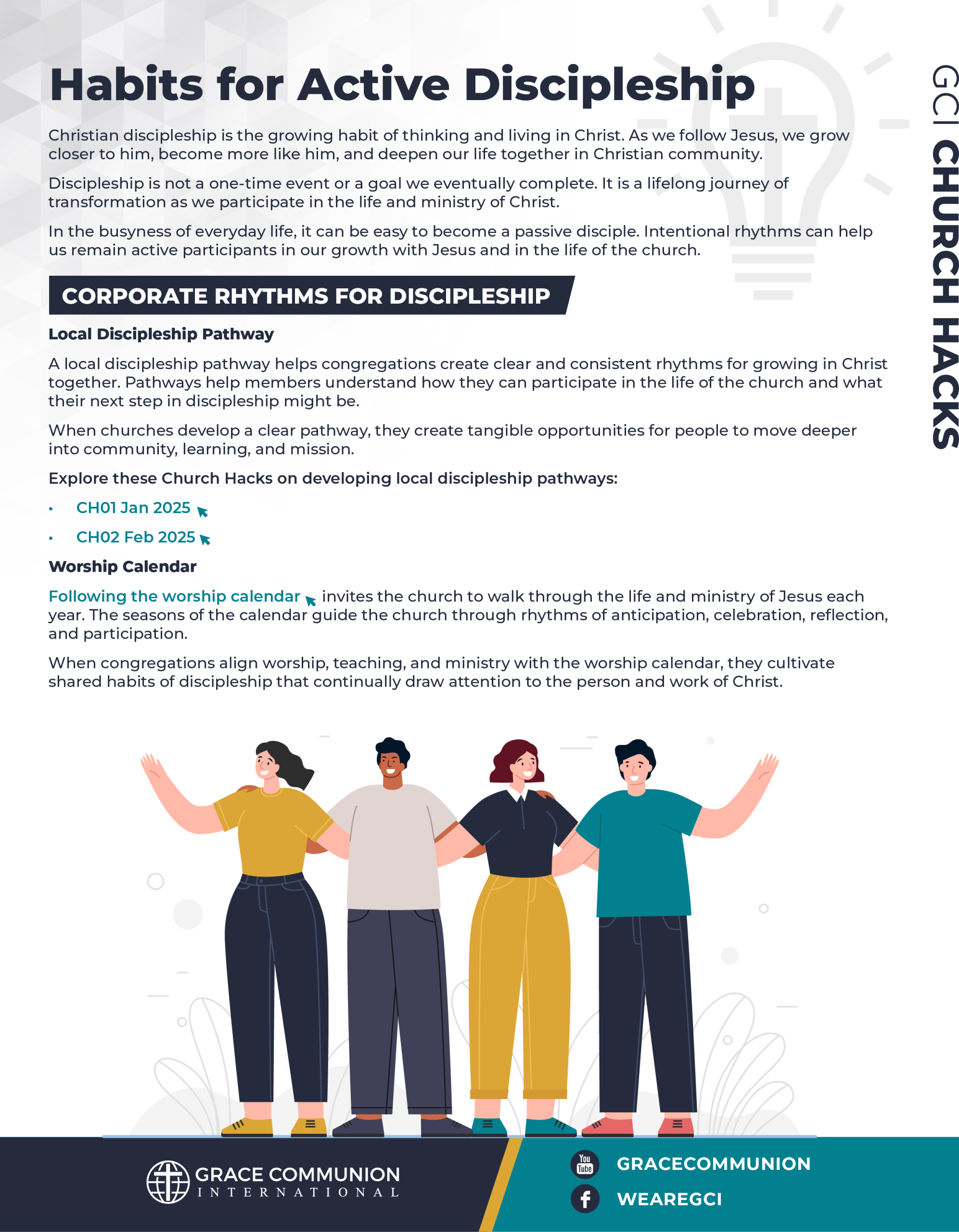
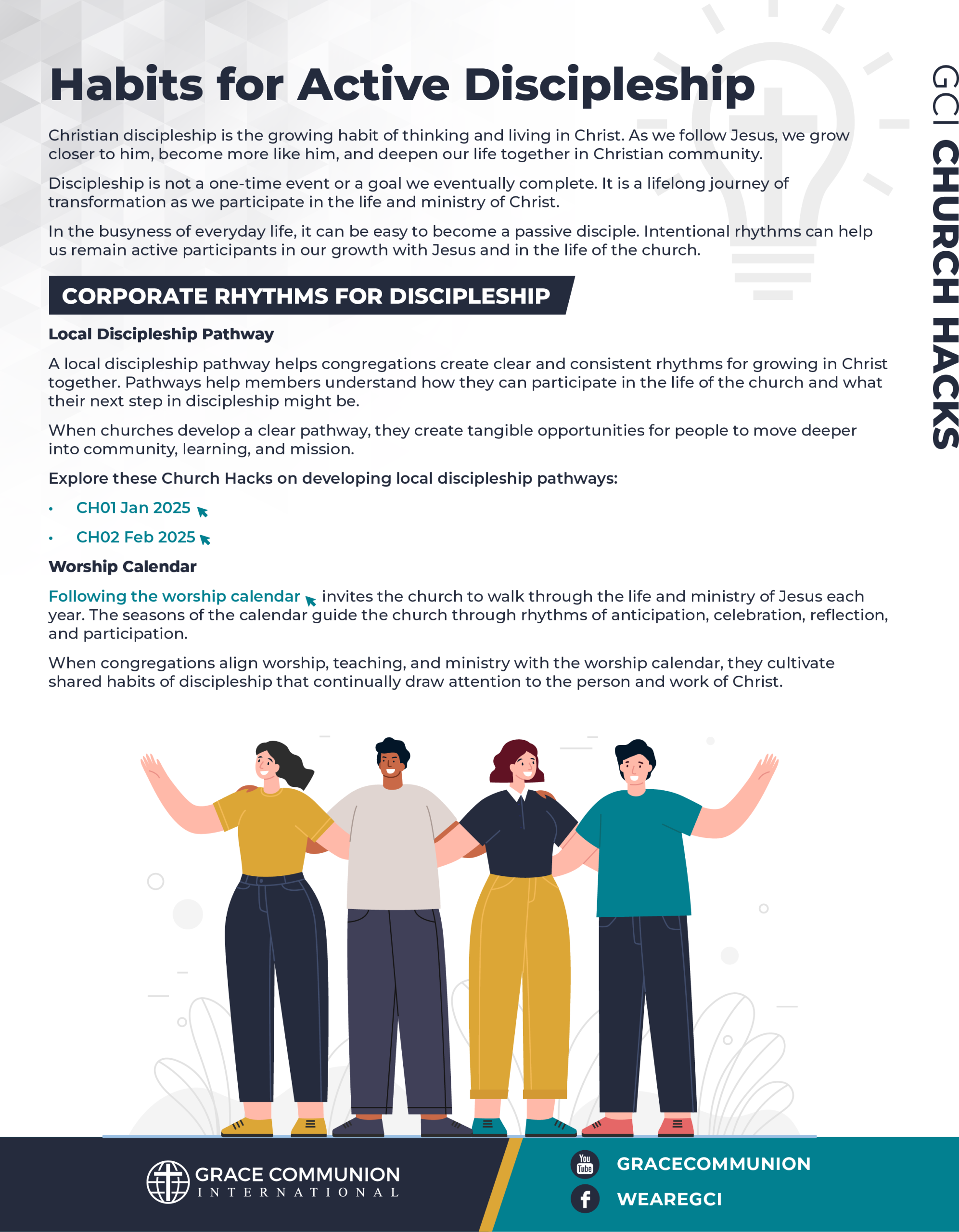
Church Hack—Habits for Active Discipleship

In the busyness of everyday life, it can be easy to become a passive disciple. This month’s Church Hack offers Intentional rhythms that can help us remain active participants in our growth with Jesus and in the life of the church.

Read the full Church Hack here.

Making Space for Young Leaders

Our leaders follow the Spirit’s lead, who emboldens
our young people to live and share the gospel.

Sinead Henderson, Elder and Church Planter
Market Harborough, England, UK

Young people can and do love the Lord with just as much passion, energy, and creativity as those who have been walking with Jesus for many decades. Many young people have it on their hearts from the minute they accept Jesus as their personal Lord and Saviour to go and tell their story to others and that is inspiring. They are not always as inhibited or lacking in drive in the way many people older than them sometimes are. Young people often have a confidence that comes naturally with youth that can be infectious. It is a beautiful thing to witness.

In our small church plant here in Market Harborough, UK, we were blessed with several young people as part of the launch team from its very beginnings. They have been at the forefront of our worship services, sharing their testimonies, their love of Scripture and their desire to acknowledge God in every aspect of their lives with the new and not yet believers who have been joining our small fellowship over the last couple of years. The youngest of our church family to have this missional mindset was only eight years old but bold for the gospel and with a heart full of a desire to honour and serve Jesus, both at church and at our community outreach events.

It is our belief that churches are for the whole family and the whole community. We believe every single person has a role to play and can find a way to participate in the life of the church, and this includes the children and the young people. In our small church, the children’s church leader is only twenty-two years old but has a heart for those even younger. Our team supports the children’s leader to go out and support our children in their journey of faith. Often a more meaningful and profound connection is made when the age gap is not so great!

As for the mission work that happens outside of our weekly church gatherings, the young people are full of ideas and initiatives. And we listen intently, carefully, and prayerfully. We very much know that the Lord is at work amongst our young people and if we don’t make room for them or listen to them, then we will miss out on the profound and important work God is doing through them. Not only are their ideas relevant, timely, and innovative but we are encouraging them to follow the call of Jesus and to lean into the leading of the Holy Spirit. It is not for us to put any limitations on them but to look to them for leadership now.

We are a team, a family. We all share one mission and that is to serve God in whatever ways he asks of us. And we serve God with all the resources and people he gives to us. We to go to all the people and communities he sends us to in order to love people in his name and tell them about the life saving truth of the gospel. Young people are being led right now to be at the heart of this mission. So, we as the church, should support, encourage, and embolden them in every possible way. Of course, we also cover them in prayer for the work the Lord is calling them to.

Hiring HR and Risk Coordinator

Grace Communion International is seeking a Human Resources and Risk Coordinator to serve in our Financial Services Department. This full-time, non-exempt position is based in Charlotte, NC, and reports to the Chief Financial Officer.

Applications are now being accepted. See the job description here.

If you would like further details on the position or would like a GCI job application, please contact Human Resources at humanresources@gci.org or 980-495-3960.

Please share this announcement with qualified candidates who may be gifted for this position at the Home Office.

GCPodcast

In 2026, the GC Podcast introduced a new format. Instead of monthly episodes, the podcast will feature two miniseries. This shift allows us to go deeper into meaningful conversations that support our shared journey of Kingdom Living. 

The first series featured Rev. Dr. Walter Kim, president of the National Association of Evangelicals (NAE) and keynote speaker for the 2026 Denominational Celebration. With host Cara Garrity, Dr. Kim explored what it means to live as citizens of God’s kingdom in today’s world. 

Stay tuned for the second series that begins in August.

In the meantime, why not revisit these popular episodes?

Theological Ethics w/ Gary Deddo

Ministry Leadership w/ Lance McKinnon

Cory Rice—Year A Propers 13–16

Cory Rice—Year A Propers 13–16

Matthew 14:13-21 ♦ Matthew 14:22-33 ♦ Matthew 15:21-28 ♦ Exodus 1:8-2:10

The host of Gospel Reverb, Anthony Mullins, welcomes Dr. Cory Rice to unpack the August 2026 RCL Pericopes. Cory is the Teaching Pastor and part of the counseling team at Hill City Church in southern Indiana. He is also Associate Professor of Counseling and Coaching at Global Grace Seminary. He is the co-host of the popular podcast 2 Pastors and a Mic. He is the author of several books including Jailbreak: Escaping Religion Discovering Sonship Living Free.

Sunday, August 2, 2026 — Proper 13
Matthew 14:13–21 ESV

Sunday, August 9, 2026 — Proper 14
Matthew 14:22–33 ESV

Sunday, August 16, 2026 — Proper 15
Matthew 15:21–28 NIV

Sunday, August 23, 2026 — Proper 16
Exodus 1:8–2:10 NIV


If you get a chance to rate and review the show, that helps a lot. And invite your fellow preachers and Bible lovers to join us!

Follow us on Spotify and Apple Podcast.

Program Transcript


Cory Rice—Year A Proper 13–17

Welcome to the Gospel Reverb podcast. Gospel Reverb is an audio gathering for preachers, teachers, and Bible thrill seekers. Each month our host, Anthony Mullins, will interview a new guest to gain insights and preaching nuggets mined from select passages of Scripture in that month’s Revised Common Lectionary. The podcast’s passion is to proclaim and boast in Jesus Christ, the one who reveals the heart of God, Father, Son, and Holy Spirit. And now onto the episode.


Anthony: Hello friends, and welcome to the latest episode of Gospel Reverb. Gospel Reverb is a podcast devoted to bringing you insights from Scripture found in the Revised Common Lectionary and sharing commentary from a Christocentric and Trinitarian view.

I’m your host, Anthony Mullins, and it’s my delight to welcome our guest, Dr. Cory Rice. Cory is the teaching pastor and part of the counseling team at Hill City Church in southern Indiana. He’s also associate professor of counseling and coaching at Global Grace Seminary. He’s the co-host of a popular podcast called Two Pastors and a Mic, and he’s the author of several books, including his latest, What If I Told You? — a devotional that you can find on Amazon or wherever you get your books. And on top of that, Cory holds three master’s degrees and a doctorate in ministry. And I find myself asking, “What am I doing with my life?”

Cory: I know.

Anthony: Cory, thanks for being with us, and welcome to the pod. And since this is your first time here, we’d like to know a little bit about you, your story, and especially what has you experiencing delight these days.

[00:01:05] Cory: Man, what an intro. I am honored to be a part of this. Yeah, my name is Cory, teaching pastor at a church called Hill City. We have an incredible team. I work more in the counseling; throughout the weekdays, writer, podcast host myself. Man, my life goal is to help people believe they matter. So, that’s how … I’ve been asked that question a lot lately, so I’ve had to dial it in with a simple response. But that’s been my life mission for a while now. So, my work kind of lives at that intersection of theology, emotional health, and human wholeness. A huge part of my own story, being a pastor’s kid, has been unlearning fear-based religion and rediscovering the goodness of God through even what you already said, a Christ-centered lens, Christocentric and Trinitarian.

And so, what brings me the most delight in this season is probably watching people breathe again spiritually, watching people realize that they’re not trying to earn their union with God, but awaken to the union that was already accomplished because of Christ.

And we’ve had a lot of people recently come be a part of our church that have either a lot of church hurt or been hurt by the church or hate church, and I’m like, “Man, this is the church for you for sure.” and so that’s been really a fun experience for us.

And I am very educated on one platform. I’ve had to unlearn a great deal of that. And so, a lot of our pushback that we hear, and we hear a lot of it, I’m like, “Man I used to be on that side of the fence,” and so I get it. So, it is my honor to be here with you. Thank you for having me on. I’m excited.

[00:02:47] Anthony: Of course. And that intersection you talked about of wellness and well-being. I’ve noticed that you do a lot of work with grief, at least based on the social media posts I’ve seen.

And I’m curious — what is the genesis of that work? What have you learned along the way that you could especially share with our listening audience? And how does it interact with theology? Just tell us a bit about this background of grief.

[00:03:19] Cory: Yeah. So, my counseling is, I do more in childhood traumas, but over the last eight months I’ve personally been dealing with grief. We lost one of our founding church members, super close family member and lost one of our best friends at 46, super unexpected, just two months ago.

[00:03:41] Anthony: I’m sorry.

[00:03:41] Cory: And so, I’ve been in this boat literally. And we’ve had some other issues that we’ve had to deal with in leadership that we’ve never had to deal with before in the previous 14 years that I’ve been on staff at this church and a part of making these decisions. And so, the last eight months really have been some of the worst moments of my life.

And so, I’m speaking to grief a lot, but that’s really because I’m feeling it, and this has been entirely new for me trying to navigate that. So, it’s one side to be on the side of the table helping people experience grief, and then I’ve gotten a totally different perspective now living through it.

But ultimately, to answer that question, is our theology does shape how we see God. And so, counseling ultimately helps uncover how we see ourselves, and therefore then coaching helps us move forward from there. And even in my own experience with the church and education around Christianity is, bad theology will create emotional fragmentation every time.

And if someone believes God is disappointed in them or distant from them or constantly evaluating them, that will affect how their nervous system, how their identity and relationships exist. And so, what we believe about God shapes what we believe about ourselves, and therefore then what we believe about other people.

And so, this works specifically even with grief and mental health and childhood traumas is counseling helps people become aware of their wounds, their fears, their triggers, the narratives that they carry. And then coaching will help people live intentionally from the truth instead of their nervous system or these survival instincts that we get.

And so, at the center of these things is ultimately Jesus. He’s the center of everything. And because Jesus reveals what humanity was always meant to look like in union in God, then it helps us thrive in the midst of heartbreak, in the midst of grief, in the midst of all the things that we experience as humans.

[00:05:48] Anthony: Yeah, that’s helpful. And sometimes I hear people say that we’re an over-therapeutic society. What would you say to someone who thinks that therapy, counseling is really an over-dependence on this particular discipline? Do you have anything to say?

[00:05:58] Cory: Yeah. You’re catching me off guard with that one, so I would just say that if someone tells me that, I’ll show you somebody who’s never done it.

Anthony: Oh, ah.

Cory: Mic drop. I was just counseling with a guy for the first time the other day, and he talked about how he was always told that this type of therapy is weak. He was told that you’re weak as a man to have to go to the counseling.

Anthony: Sure.

Cory: And it was after a two-hour session; I’m looking at him and obviously the weak people are people that think they don’t need this.

[00:06:48] Anthony: I think there’s something very true in what you just said and thanks be to God that we can have Jesus and a therapist, right? Have that counselor along the way.

Cory: Heck yeah. Yeah. We’re meant for connection, right?

Anthony: Absolutely.

Cory: That’s the whole idea. Yeah.

Anthony: Amen and amen.

Let’s do this. Let’s dive into the lectionary text that we have for this month. Our first pericope is Matthew 14:13–21. I’ll be reading from the New Revised Standard Version, the updated edition. It is the Revised Common Lectionary passage for Proper 13 in Ordinary Time, August 2.

Now when Jesus heard this, he withdrew from there in a boat to a deserted place by himself. But when the crowds heard it, they followed him on foot from the towns. 14 When he went ashore, he saw a great crowd, and he had compassion for them and cured their sick. 15 When it was evening, the disciples came to him and said, “This is a deserted place, and the hour is now late; send the crowds away so that they may go into the villages and buy food for themselves.” 16 Jesus said to them, “They need not go away; you give them something to eat.” 17 They replied, “We have nothing here but five loaves and two fish.” 18 And he said, “Bring them here to me.” 19 Then he ordered the crowds to sit down on the grass. Taking the five loaves and the two fish, he looked up to heaven and blessed and broke the loaves and gave them to the disciples, and the disciples gave them to the crowds. 20 And all ate and were filled, and they took up what was left over of the broken pieces, twelve baskets full. 21 And those who ate were about five thousand men, besides women and children.

Cory, for the start, let’s think about God’s side of this. What does the Lord’s act of multiplying loaves and fish reveal about the nature of God, his divine provision, and especially as it reveals the relationship of God’s abundant grace?

[00:08:35] Cory: Man, just listen to that. So, I’ve got two thoughts on this, maybe three. But first, like, the miracle begins with honesty. I love, “we only have five loaves and two fish.” I like that part because that reveals the humanity in people, because I think like that. Even in my education I still deal with doubt and frustration.

“All right, God, I only have this situation.” So, I’m a big key on that only thing. Grace begins with honesty, and Jesus always meets people there. And so, the rhythm of the kingdom is found in Jesus’ response to that honesty is, “Yeah, bring them to me.” He doesn’t rebuke them for the fact that they only said “only.”

And so, what looks like lack in our hands often is what becomes abundance in his. I would say that the second one is this miracle reveals the nature of God, right? Not that he is transactional, but that he is self-giving love himself. The Trinity has always existed in abundance, generosity, overflow, you name it. So, this miracle to me is not God meeting a need reluctantly, but rather Jesus revealing what God is — always abundant, always compassionate, always generous. And that word compassion is very interesting in the Greek. One of my funniest stories of all time …

Anthony: Come on …

Cory: … has to do with the Greek word for compassion, which is where in the English it gets translated as your inner bowels. And five times in Scripture, it tells us that Jesus is moved with compassion, and all five times when it specifically says that, he does a miracle. And it’s almost like this uncontainable reaction that happens internally that flows outward expressively.

And so, I always talk about because I was a college athlete, and I got food poisoning on a road trip in Oklahoma once, and I got violently sick. And I woke up one evening covered in poo, and I realized it was my own. I had pooped my own bed, which is like wildly insane to talk about. I usually preach a really funny story around this, and then I tie it into — that’s compassion. If literally the Greek word is our inner bowels, something happens that we can’t contain it, it has to come out. And that’s the love of Christ, that’s the compassion of Christ, that’s the miracles of Christ. I know way too much information, but …

[00:10:53] Anthony: I did not have it on my bingo card for today that we were going to talk about poo, but here we are. And he couldn’t …

Cory: You never know.

Anthony: … he can’t contain it. Hallelujah. So, let’s talk about the flip side of that same coin.

God’s abundant grace — but he’s always kind of inviting us into what he’s doing. “Come along. Come and see.” So, what about human participation, especially with the imperative, “You give them something to eat”? What does that unveil? What does that tell us about God?

[00:11:22] Cory: Yeah. Honestly, I’m still learning this because there’s aspects of me that it’s, “All right, God, what are you doing?”

And I think that his response every time is, “Yeah, I’ve given you the power to do it. What are you doing about it?” And so, this miracle, to me it reveals, yes, human participation matters 100%, but participation is not pressure. Honestly, it’s the overflow of divine love and you have to understand your union to be able to overflow in divine love.

And so, the Church as a whole, big letter Church, it doesn’t create bread because Jesus is the Bread, but we do get to distribute what we’ve received. We’re not the source. We’re the resource. And so, sometimes we reduce ministry to information rather than nourishment. I kind of like to use that word, especially since Jesus calls himself the Bread of Life and I’m not just talking about literally.

You’ve got physically, emotionally, spiritually. The Church co-labors when we participate in the healing, in the reconciliation, in mercy, in justice, in compassion, in presence — you name it, right? And I think that our participation is massive. I know one of my spiritual fathers, Jamie Engelhardt, he always talks about when people talk about, “Oh, God doesn’t need you,” … Without us, he chooses to do nothing because he has no body except yours. So, if you want to see the manifestation of Christ on the earth, then the sons and daughters have to recognize their power.

[00:12:49] Anthony: Yeah, there is this tension, isn’t there, Cory, about …

[00:12:52] Cory: Oh, yeah …

[00:12:52] Anthony: … knowing God’s grace and yet participation. There’s such joy in it. God loves you regardless, but there’s just something that that eyes can only see when they see it, when they do and participate, right? Without it ever being pressure. It’s this … I can almost always see the Spirit going, “Come on. This is going to be so good. Let’s go.”

[00:13:15] Cory: Yeah. So much.

[00:13:15] Anthony: All right. Yeah, let’s transition to our next pericope of the month. It’s Matthew 14:22–33. It is a Revised Common Lectionary passage for Proper 14 in Ordinary Time, which is August the 9. Please read it for us, Cory.

[00:13:30] Cory: Yeah.

Immediately he made the disciples get into a boat and go on ahead to the other side, while he dismissed the crowds. 23 And after he had dismissed the crowds, he went up the mountain by himself to pray. When evening came, he was there alone, 24 but by this time the boat, battered by the waves, was far from the land, for the wind was against them. 25 And early in the morning he came walking toward them on the sea. 26 But when the disciples saw him walking on the sea, they were terrified, saying, “It is a ghost!” And they cried out in fear. 27 But immediately Jesus spoke to them and said, “Take heart, it is I; do not be afraid.” 28 Peter answered him, “Lord, if it is you, command me to come to you on the water.” 29 He said, “Come.” So Peter got out of the boat, started walking on the water, and came toward Jesus. 30 But when he noticed the strong wind, he became frightened, and, beginning to sink, he cried out, “Lord, save me!” 31 Jesus immediately reached out his hand and caught him, saying to him, “You of little faith, why did you doubt?” 32 When they got into the boat, the wind ceased. 33 And those in the boat worshiped him, saying, “Truly you are the Son of God.”

[00:14:42] Anthony: Lord, save me. And what did Jesus do? He did it. Too often I’ve heard this text preached in such a way that Peter is the focus as maybe initially a hero and then a zero. What I want to know is what this text shows us about the goodness of the triune God revealed in Jesus Christ.

[00:15:01] Cory: Man, I kind of like that hero or zero perspective. I think we don’t hear enough about how this story, however, reveals a God who moves toward people in fear and doubt, not away from them every time. Even the story of Thomas, he shows up. We don’t oftentimes talk about that. I hate that Thomas is even known as Doubting Thomas because he asked a question that he wasn’t around for, and Jesus shows up, without shame. And isn’t that the gospel, how God continually moves towards people that have fear and doubt?

Praise God, because that’s me all the time.

Anthony: Yes, me.

Cory: And people are terrified. They are overwhelmed, battling whatever it is that they’re battling, and Jesus shows up in the middle of that, walking on the water. And so, the Gospel reveals, to me at least, a God who’s not afraid to enter our chaos, enter our suffering, enter our human weakness and human experience.

And so, what stands out to me the most is not Peter’s failure or success, which by the way I’m going to steal that hero or zero line because that’s pretty funny. But in my opinion, I think it’s Jesus’ steadiness in all of it. Like what you already said. He reached out his hand. And so, what is the Trinity like? Restorative in every possible way.

[00:16:20] Anthony: Let’s talk about Peter and the 11 left in the boat. Again, kind of going back to this topic of participation, or in some cases the lack thereof. But I’m struck by this, Cory, before you answer, that the 11 still witnessed this miracle …

[00:16:36] Cory: Right …

[00:16:36] Anthony: … and shared a testimony. And so, there’s a lot to be said about the participation in this. What do you have to say?

[00:16:45] Cory: So much. Truthfully, I think that Peter gets criticized totally unfairly here. Like you just said, there are 11 dudes witnessing this …

Anthony: That’s right.

Cory: … scared in the boat. Where are they? They’re scared in the boat. They didn’t do it. Peter at least walked on water. And what I tend to think on this specific instance is, even it can come off even how Jesus is confrontational with Peter when he says the phrase, “You of little faith,” or, “Why did you lack faith?” Whatever translation you’re looking at.

Honestly, that phrase isn’t a story of try harder, because there’s actually four times in the Scripture where Jesus says this phrase, and he never says it to anybody except his disciples, which is wild to think about. Actually this, “You of little faith,” if, when you look it up in Greek commentaries, they talk about this idea that this is a metaphoric phrase, and literally it gets translated as dull of hearing or disinterested in walking intimately or lacking confidence.

And so, in other words, it simply means, “Do you really not understand?” And I think it’s fair that they don’t understand, because even after the three years, Jesus is about to send them out on the Great Commission, and it says, I think it’s Matthew 27:17, I think. That’s one of my favorite verses where it says, “Some worshiped and some doubted.” This is after the resurrected Jesus, right?

Anthony: Yes. Yes.

Cory: And I think it just reveals the humanity. And when we ask questions like, “Didn’t the disciples, didn’t they understand?” we’re reading from a 21st century lens, and we have the whole story, right? And so, for them to not fully understand, I think is totally fair, because Peter sinks when he does something that we all do as humans, when we focus on what’s going on externally instead of the presence of God internally within us in Christ.

And then, when Jesus grabs him, I think it reveals another aspect of the Gospel. This security is not found in the strength of our grip on God. It’s found in God’s grip on us, which is eternal and everlasting, thank God.

[00:18:48] Anthony: Yeah. Yeah, you’re right. Peter often gets shamed, and I’m thinking, wait a second. In human history, only two people have ever walked on water that I know of. Peter’s one of them. Before he sank, he walked on water. There is something about joining Jesus in the unknown, and there was so much unknown to getting out of the boat. And it seems to me, Cory, that’s what participation often looks like. We, we only have so much vision to see around the bend.  And if we could see more, where’s the need for trust, right?

[00:19:24] Cory: For sure.

[00:19:25] Anthony: Yeah. Our next passage is Matthew 15:21–28. It is the Revised Common Lectionary passage for Proper 15 in Ordinary Time, August 16.

Jesus left that place and went away to the district of Tyre and Sidon. 22 Just then a Canaanite woman from that region came out and started shouting, “Have mercy on me, Lord, Son of David; my daughter is tormented by a demon.” 23 But he did not answer her at all. And his disciples came and urged him, saying, “Send her away, for she keeps shouting after us.” 24 He answered, “I was sent only to the lost sheep of the house of Israel.” 25 But she came and knelt before him, saying, “Lord, help me.” 26 He answered, “It is not fair to take the children’s food and throw it to the dogs.” 27 She said, “Yes, Lord, yet even the dogs eat the crumbs that fall from their masters’ table.” 28 Then Jesus answered her, “Woman, great is your faith! Let it be done for you as you wish.” And her daughter was healed from that moment. And her daughter was healed from that moment.

Seems like there’s a lot going on there. “Have mercy on me, Lord, Son of David.” Isn’t this the cry of every human heart, whether they know it or not? Tell us more, Cory.

[00:20:49] Cory: Yeah. Man, I get lost in listening to you read. I think you should read the entire Bible so we can all listen to the ear candy that you have when you read the Scriptures. I love it. Man, of course, this is the cry of every human heart. I see this in daily counseling sessions. I see this in myself all the time. And whether people use religious language or not, humanity longs for wholeness, healing, belonging, mercy, you name it. So, I think every human is searching for the God that they already belong to.

What’s beautiful to me in this story is the woman refusing to disengage even when everything and everyone around her appears silent or resistant.

[00:21:26] Anthony: Preach.

[00:21:27] Cory: So, she already determined in her mind that something in Jesus is worth pursuing, and I love that. And so, to me, mercy is restorative compassion. It’s the heart of the Father always moving toward suffering people, which I think a lot of us can relate to that.

[00:21:46] Anthony: Can you talk a little bit more about pursuing as it relates to relationship? Because it seems like love always moves toward the other. We’re in Christ and he is in face-to-face relationship with the Father. He’s pursued us. He continues to pursue us by the Spirit. Anything else you’d like to say about just the act of God’s pursuit and us pursuing others in relationship?

[00:22:10] Cory: Yeah. I think it just comes to awakening to the reality that’s always a constant thing.

As you know, I grew up in a very religious setting, even went to a lot of schools where you learn only one lens to look at, and so I totally understand people in this approach of, “Can I even approach God? Is he distant? Is he disappointed?” Because he’s either distant or disappointed in most Christian circles.

And so, to catch the revelation that when God looks at you, that he’s actually smiling, is a wild experience. That was one of my first, in my first counseling sessions with my counselor, is getting this revelation that when God looks at me, he’s smiling, and that vision actually helped me understand his constant pursuit of me.

And so, it’s just been a continual awakening to the fact that God will always and has always been in love with me and pursuing me.

[00:23:11] Anthony: I hope you don’t mind. I’d like to follow up on that a little bit, because you’ve talked about, just in passing, your past being, and I don’t want to put words in your mouth, but it sounds like in a legalistic environment, where having to unlearn that God is pure grace, God is pure love on God’s side. And many of our listeners around the world are coming from a very similar environment.

What would you … Maybe just tell us a little bit about how you came out of that kind of place of feeling like you had to maybe earn God’s approval, to win his love, to a place where now you’ve just been awakened to the goodness of God in Jesus. Can you tell us a little bit about that?

[00:23:52] Cory: Yeah. So, I have an “aha” moment. It came, I actually got to listen to Brennan Manning live before he passed away in 2011, I think it was, at the Brooklyn Tabernacle is when he spoke. So again, that’s my undoing of legalism started really in 2012. Now, I always pushed against; even in university I was known for, “That doesn’t make sense.” But I didn’t have like …

[00:24:17] Anthony: Oh, that’s you.

[00:24:18] Cory: I didn’t have the language for it, like the union it was first grace. You talk about grace all day long until you need it, right? And then it was into eschatology, and then it was really into this union message.

And I heard a lot of people, but it was Brennan Manning. He said something, I’m going to butcher it. I’m sure you can find it online, but it’s something along the lines of, he asked this question of, “What’s the only question you’re going to hear when you meet your maker face to face?” And he, his perspective is, he believes that question is going to be God saying, “Did you really believe that I loved you?”

And then he followed that up with a statistic, a percentage, 90%, and wherever he gets this number from. But 90% of Christians, he believes, will answer that question with a heartbreaking, “No, I did not truly believe that you love me.” And it was that moment, I remember sitting there listening to that. Kind of at this point I already had two masters, right?

So, I thought my relationship with God was in concrete, and that took me on a season of revelation, of learning to unlearn everything I’ve always thought I’d known. And then I moved to the church I’m at in 2012, and I began relationships with so many different people that I now have different ministry experiences with.

But it was really my lead pastor, Channock, and I, and our friend Reggie at the time, the three of us — just being able to ask questions without shame is really what started that. And so, that 2011 “aha” moment, then for the next eight years not necessarily finding answers, but being free enough to be able to ask them without shame attached to the response, is really what began that journey of undoing everything that I thought I knew and believed about God.

And I’m still on this journey. I think we would … The sexy term now is deconstruction, right? We’ve been doing this since, for us in our setting, since 2012. We just didn’t have the language for it, right? But becoming aware not only of our union, but of a God that’s way better than we thought he was.

And so, I think I’m going to die on that hill, or at least I’m going to live on it, is when people say a whole lot of things about our ministry and about what we teach is I don’t think that I’m going to get to heaven and God’s never going to say, “You know what, Cory? You presented me a little too loving.” And so, if that’s the statement, then I think that we can go all, as far as we want with revealing a God who’s better than we think he is.

[00:26:45] Anthony: Yeah, and Karl Barth says as much. We can’t put any sort of limit on God’s lovingkindness. Thank you for sharing, and I’m so grateful for your journey. It’s very similar to a journey many of us have been on, and God is just so faithful. And we see it in this text.

And Cory, one of the things that grieves me is, we say we’re a Christocentric podcast. We focus on Jesus as much as we know how by the Spirit. But often when I hear texts preached, it’s human-centric. We go immediately, like in this text, we want to go immediately to this woman’s response, and it’s valuable. So, I want to or ask you this question: Did the Canaanite woman’s faith activate Jesus’ willingness to heal her daughter? I hear it read that way. Tell us about the theological implications one way or the other.

[00:27:43] Cory: Man, I got a couple things — don’t know if they’re going to be good. Personally, I don’t believe that her faith changed Jesus’s perspective or willing or unwillingness to heal her. I think Jesus reveals the willing heart of God all the time. Otherwise, we risk creating a picture where God must be persuaded into compassion, and it naturally flows from him, right?

So, I think her faith allowed her to participate in what was already present in Christ, because faith isn’t earning. It’s trustful participation. But I also think that there’s something culturally profound in this specific story, more than even the miracle. It’s that Matthew’s intentional highlight of a woman and a Canaanite, and someone that’s considered outside the covenant story, at least in Matthew’s gospel presentation.

And yet, Jesus, in this moment, reveals that the heart of God extends beyond ethnic and religious boundaries. And so, in other words, grace is not expanding because God changed or because our faith changed him. It’s expanding because humanity is awakening to how expansive and inclusive God has always been.  It’s just we’re catching up to that revelation.

[00:28:54] Anthony: Yeah. Amen and amen. Let’s transition to our final pericope of the month. It’s Exodus 1:8 –2:10. It’s a long one. It’s the Revised Common Lectionary passage for Proper 16 in Ordinary Time, August 23. Cory, we’d be grateful if you read it.

[00:29:14] Cory: Yeah. And I did notice that you gave me the long one. Here we go.

[00:29:17] Anthony: It was on purpose.

[00:29:19] Cory:

Now a new king arose over Egypt who did not know Joseph. 9 He said to his people, “Look, the Israelite people are more numerous and more powerful than we. 10 Come, let us deal shrewdly with them, or they will increase and, in the event of war, join our enemies and fight against us and escape from the land.” 11 Therefore they set taskmasters over them to oppress them with forced labor. They built supply cities, Pithom and Rameses, for Pharaoh. 12 But the more they were oppressed, the more they multiplied and spread, so that the Egyptians came to dread the Israelites. 13 The Egyptians subjected the Israelites to hard servitude 14 and made their lives bitter with hard servitude in mortar and bricks and in every kind of field labor. They were ruthless in all the tasks that they imposed on them. 15 The king of Egypt said to the Hebrew midwives, one of whom was named Shiphrah and the other Puah, 16 “When you act as midwives to the Hebrew women and see them on the birthstool, if it is a son, kill him, but if it is a daughter, she shall live.” 17 But the midwives feared God; they did not do as the king of Egypt commanded them, but they let the boys live. 18 So the king of Egypt summoned the midwives and said to them, “Why have you done this and allowed the boys to live?” 19 The midwives said to Pharaoh, “Because the Hebrew women are not like the Egyptian women, for they are vigorous and give birth before the midwife comes to them.” 20 So God dealt well with the midwives, and the people multiplied and became very strong. 21 And because the midwives feared God, he gave them families. 22 Then Pharaoh commanded all his people, “Every son that is born to the Hebrews you shall throw into the Nile, but you shall let every daughter live.” 2:1 Now a man from the house of Levi went and married a Levite woman. 2 The woman conceived and bore a son, and when she saw that he was a fine baby, she hid him three months. 3 When she could hide him no longer she got a papyrus basket …

[00:31:38] Anthony: Yes, that’s an easy word, isn’t it?

[00:31:38] Cory:

… for him and plastered it with bitumen and pitch; she put the child in it and placed it among the reeds on the bank of the river. 4 His sister stood at a distance, to see what would happen to him. 5 The daughter of Pharaoh came down to bathe at the river, while her attendants walked beside the river. She saw the basket among the reeds and sent her maid to bring it. 6 When she opened it, she saw the child. He was crying, and she took pity on him. “This must be one of the Hebrews’ children,” she said. 7 Then his sister said to Pharaoh’s daughter, “Shall I go and get you a nurse from the Hebrew women to nurse the child for you?” 8 Pharaoh’s daughter said to her, “Yes.” So the girl went and called the child’s mother. 9 Pharaoh’s daughter said to her, “Take this child and nurse it for me, and I will give you your wages.” So the woman took the child and nursed it. 10 When the child grew up, she brought him to Pharaoh’s daughter, and he became her son. She named him Moses] “because,” she said, “I drew him out of the water.”

[00:32:41] Anthony: How about we just take a break and allow you to breathe? And I want to tell our listening audience Cory earned his money here today. We’re not paying him anything, but he earned it by that text. Oh my. I did not realize it had all of that in it, so thank you for enduring it.

But there’s a lot happening here, and one of the things I’m just struck by, Cory, first of all, is that God allows human beings, his children, to tell his story. And I don’t know that we always do it justice, but we get to tell the story.

And this narrative is marked by oppression and fear under Pharaoh. So, how does God’s grace operate through the courageous and often overlooked actions of individuals, in this case, the Hebrew midwives? And what does this suggest about the ways God advances liberation in and through us? As you said earlier, we’re not the source, we’re the resource.

[00:33:47] Cory: Yeah.

[00:33:47] Anthony: How does he resource his liberation through people like these women?

[00:33:50] Cory: Man, If we’re looking at those three, the Hebrew midwives and Moses’ mother, Pharaoh’s daughter, those specific three, one of the most beautiful things to me about this story is that God’s liberating work often moves through ordinary people who choose courage over fear, specifically these women, even in a culture that didn’t honor them.

And so, the midwives resist empire. Moses’ mother protects life. Pharaoh’s daughter shows compassion across enemy lines. I think those three things are, like, the big takeaways that I have in this story, and liberation begins through those small acts of courage and compassion. And so, I think that matters because we often look for God only in dramatic moments, at least I often did.

When I was searching and that was … “Give me the dramatic moments,” the parting of the sea — all these — the raising of the dead, and all these things while overlooking quiet faithfulness, because the quiet faithfulness is super steady. It’s consistent. It’s not intense. It’s not super sexy.

And I think grace frequently moves loudest through hidden people making humanizing choices in dehumanizing systems. We see this all throughout Scripture. We also see this all throughout our current life right now. So, that’s what I would have to say on that.

[00:35:10] Anthony: Yeah. We, in Grace Communion International that hosts this podcast, we follow the Christian calendar, and we’re in a season called Ordinary Time, which is the longest season on the calendar. And I sometimes wonder if this season feels like, “you guys should’ve given me a better name. Ordinary sounds boring and mundane.”

But it does mean that ordered time where we learn the rhythms, the light rhythms of God and Jesus, that we, as we join him, we see him in the most common things, like you were mentioning, the everyday things.

To me, it’s one of the beauties of sharing the Eucharist or communion together. Like bread, it’s just so commonplace. Wine, you find it everywhere. But it is in the common acts of courage that we see the goodness of God manifest. And I think this season has a lot to teach us in that way, that it’s not in the ministry highlight reel. And I used to be wired in such a way, Cory.

Cory: Right.

Anthony: That’s what I wanted people to see, the highlight reel.

[00:36:15] Cory: Oh, yeah.

[00:36:16] Anthony: I’m sure I’m the only one that has dealt with that. But that’s facetiousness. I know we all do on some level.

Cory: Yeah.

Anthony: We’re trying to project. And this is why theology’s so important, that once I realize there is nothing to prove and nothing to protect in Christ, I can lay all those things down, accomplishments, all the accolades, and just be like, “Here I am, Lord.  You know me.”

What else would this text have to teach us? If you were preaching this text to your congregation, what else would you say?

[00:36:49] Cory: Man, okay. I would I would focus on, and probably to speak to a lot of our listeners who have what we talked about earlier about coming out of legalism and whatnot, is oppressive systems, especially in church cultures, are always going to be driven by fear. And the kingdom of God obviously moves differently because it’s within, and it’s always revealing. Romans 14:7 or 17:14 is, it’s righteousness, peace, and joy. And I think, if you are holding on to any type of view of God or lens of God and it’s baked in any type of fear, then you know that’s not from the Spirit, because perfect love casts out all fear.

And I would ultimately say that lastly this story points to Christ even before his physical appearance because Christ is the true deliverer, who enters humanity’s oppression not to condemn humanity, but to liberate humanity. And I think if we can take anything from that story, that should be the story of our lives as we walk into people’s oppression and help liberate them because we are a resource of the source of Christ within us.

[00:38:13] Anthony: I’m going to take that line with me. He’s the source. We’re the resource. And thanks be to God that he allows us, and allows not even the right word, in the overflow of his love, he just desires to be with us. Isn’t this the story of the Old Testament with the people of Israel that just kept messing things up, murmuring, and frustrated, and complaining and he just continues to be with them because this is the God who just refuses to be God without us.

And so, we get to join him in what he’s doing. And in this season of Ordinary time, friends, I want to leave you with this quote from one of my favorite contemporary theologians. Her name is Julie Canlis, and she says, “All of life is spiritual: work, bearing children, hobbies, friendship, repairing gutters, commuting. This is our worship, the offering of our everyday stuff to God.” Amen and amen.

Cory, thanks for being with us. You are a joy. May God continue to bless you, your family, and your participation in his ministry. I want to thank our team behind the podcast that make it possible, and as is our tradition here in Gospel Reverb, we want to end with a word of prayer, and we’d be delighted if you’d pray for us.

[00:39:17] Cory: Yeah. I would love to. Before, before I jump into that, since I’m going close on prayer, I want to highlight that first conversation we had around Matthew 14 and Jesus multiplying the bread. I think the disciples were so rattled by prayer. They’re Jewish and they know how to pray, and this is one of the questions they asked Jesus on how to pray, because in a moment where he breaks bread and feeds 5,000 men, the only thing he said in prayer were thanks. And I think that’s a perfect way to close, in just a state of thankfulness.

And so, Jesus, we’re just thankful. I’m grateful for who you are, and I’m grateful that you continue to reveal your union. May people look within to find Christ instead of externally, because that’s where you are. And we love you; we thank you, and may your love continue to rule and reign in the lives of people as we love people the way that you have loved us. In Jesus’ name.

[00:40:22] Anthony: Amen.


Thank you for being a guest of Gospel Reverb. If you like what you heard, give us a high rating, and review us on iTunes, Spotify, or wherever you get your podcast content. Share this episode with a friend. It really does help us get the word out as we are just getting started. Join us next month for a new show and insights from the RCL. Until then, peace be with you!


 

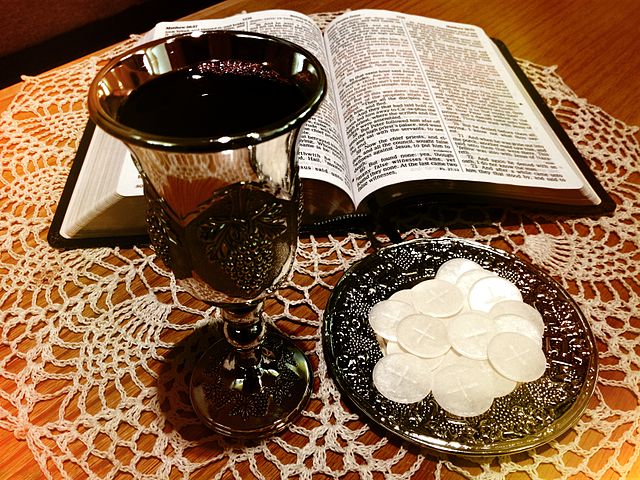
Offering and Communion Starters | August

Last year, we introduced a new resource to help you prepare for the time of giving and taking communion in your Hope Avenue. These are meaningful formational practices that we can plan with care and intentionality.

The Communion and Offering Starters are posted a month ahead, like the sermon resources. Below are the August starters. In case you missed it: July Starters are here.


How to Use This Resource

An outline is provided for you to use as a guide, followed by a sample script. Both the offering moment and communion can be presented as a short reflection before the congregation participates. Here’s how to use it effectively:

  • Scripture Reflection: Include the relevant Scripture to root the offering and communion in biblical teaching.
  • Key Point and Invitation: Briefly highlight the theme’s key point and offer an invitation that connects the theme to the practice.
  • Prayer: Include a short prayer that aligns with the theme. Invite God to bless the gifts and the givers. Ask God to bless the bread and the wine and the partakers.
  • Logistics: Explain the process; this helps everyone know how they can participate. For giving, indicate whether baskets will be passed, if there are designated offering boxes, or if digital options like text-to-give or web giving are available. Clearly explain how the communion elements will be shared and that participation is voluntary.
  • Encouragement: For the giving moment, invite congregants to reflect on their role in supporting the church’s mission, reminding them that their gifts impact both local and global ministry. For communion, encourage congregants to express gratitude for Jesus’ love poured out for us and the unity present in the body of Christ.

For more information, see Church Hack: Offering and Church Hack: Communion


August

Offering Theme: Beautiful Feet

Scripture Focus: Romans 10:13–15 NRSVUE

Key Point: We’ve been sent to proclaim the beautiful news of Jesus.

Invitation: May we be among those who have beautiful feet as we do all we can to help others proclaim the name of the Lord and be saved.

Sample Script

Paul dedicated his life to sharing the good news of Jesus’ life and love to others. And he continually encouraged believers to do the same. In Romans 10, he reminded the recipients of his letter that Jesus is Lord of both Jew and Greek.

13 For “everyone who calls on the name of the Lord shall be saved.”

14 But how are they to call on one in whom they have not believed? And how are they to believe in one of whom they have never heard? And how are they to hear without someone to proclaim him? 15 And how are they to proclaim him unless they are sent? As it is written, “How beautiful are the feet of those who bring good news!” Romans 10:13–15 NRSVUE

Paul gets real practical with the believers in Rome (and with us).

We have been sent, so we are called to proclaim the name of the Lord. “How beautiful are the feet of those who bring good news!”

That’s our hope, to have beautiful feet. May we acknowledge we’ve been sent and to do all we can to reach out and share the good news about Jesus to our neighbors. And may they call upon his name and be saved.

This is Kingdom Living. This is why we participate in Jesus’ mission and ministry. This is why we give of our time and our treasure, so we can be the beautiful feet of those who bring good news.


Communion Theme: One Body, Many Members

Scripture Focus: Romans 12:4–8 NRSVUE

Key Point: Each one of us has been chosen to participate in the One body — Out of Many, One.

Invitation: May we receive the bread in thanksgiving, remembering that Jesus is the bread of life who is offered to all, making all one body. When we take the cup, we rejoice that we’ve all been cleansed at the foot of the cross, making us equal before Father, Son, and Spirit. This truth enables the many to acknowledge our oneness.

Sample Script

In Romans 12, we read:

For as in one body we have many members and not all the members have the same function, so we, who are many, are one body in Christ, and individually we are members one of another. We have gifts that differ according to the grace given to us: prophecy, in proportion to faith; ministry, in ministering; the teacher, in teaching; the encourager, in encouragement; the giver, in sincerity; the leader, in diligence; the compassionate, in cheerfulness. Romans 12:4–8 NRSVUE

In One, many. Jesus is the One, and out of him, many — you, me, believers all around the world. Millions and millions are part of the One. And the many have been given differing gifts which make the one complete.

As we take the bread today, we remember that Jesus is the One. He is the one Bread of Life, the one shepherd, the one door, the one Son of Man, the one Son of God, the one Savior, the one Redeemer, and the one Body. And he has invited all of us to be part of that one Body — all valuable, all wanted, all included, all loved equally.

As we take the cup, we remember we have all been cleansed, we have all been forgiven, we have all been redeemed, we have all been saved. We are equal at the foot of the cross. We, who are many, are one body in Christ


Sermon for August 2, 2026—Proper 13

Speaking of Life 5037 │ Prevailing with God

This week we’re sharing a Speaking of Life message from our archive as a supplemental resource. We encourage you to use this for reflection and preparation, or small group discussion. For your worship gathering, consider how a call to worship from a local voice or contextualized introduction to the theme might serve your congregation well.

Jacob wrestling with God in Genesis 32 shows how God humbly engages with us, allowing us to boldly wrestle and be transformed. By surrendering ourselves to be molded and transformed by God’s unwavering love, we fulfill the intimacy desired by the Father, Son, and Holy Spirit.

Program Transcript


Speaking Of Life 5037 Prevailing with God
Cara Garrity

If you’ve ever spent any time in a park, you’ve probably observed a parent with a toddler who wants to race. The three-year-old doesn’t care that her legs are about a third of the length of her parent’s legs – she simply wants the joy of running and connecting with her parent. You may have watched the parent let the toddler get a head start and then take smaller steps to give the little one a chance. The parent may have even let the toddler win despite being superior in size and coordination. When I see something like this, it makes me think of how God approaches us with humility, compassion, and kindness, wanting us to boldly wrestle and engage with him. There’s no better story to illustrate this than Jacob wrestling with God as told in Genesis 32.

The chapter begins with Jacob receiving the news that his brother Esau is coming to meet him with 400 men. Jacob is worried because he schemed to get Esau’s firstborn birthright, and he was sure Esau was coming to take revenge. Jacob divided his camp to make it look smaller, and he sent his wives and children ahead of him, along with gifts for Esau. That night, alone and in his solitude, Jacob wrestles with an unidentified man until daybreak. Let’s see what happens next:

When the man saw that he did not prevail against Jacob, he struck him on the hip socket, and Jacob’s hip was put out of joint as he wrestled with him. Then [the man] said, “Let me go, for the day is breaking.” But Jacob said, “I will not let you go, unless you bless me.” So [the man] said to him, “What is your name?” And he said, “Jacob.” Then the man said, “You shall no longer be called Jacob, but Israel, for you have striven with God and with humans and have prevailed.” Then Jacob asked him, “Please tell me your name.” But [the man] said, “Why is it that you ask my name?” And there he blessed [Jacob]. So Jacob called the place Peniel, saying, “For I have seen God face to face, yet my life is preserved.” The sun rose upon him as he passed Penuel, limping because of his hip.
Genesis 32: 25-31 (NRSVUE)

Up to this point in his life, Jacob had relied on scheming and manipulation to get what he wanted. These methods weren’t without consequence, though. He was estranged from his family and fearful of his brother’s wrath. Jacob’s wrestling match with the man, whom Jacob identified as God in verse 30, resulted in his transformation because Jacob refused to let go of God, and God was willing to let Jacob prevail to help him change.

The evidence of this radical transformation is both physical and emotional. Jacob’s damaged hip caused him to limp, and though we don’t know how long his hip injury persisted, we do know that the Israelites would not eat that hip muscle of a sacrificial animal, out of respect for Jacob’s wound from God. We also see that Jacob’s name was changed to Israel, which means “one who prevails with God and humans.”

We can learn from this story that some of our transformations come through perseverance and wrestling with God. More importantly, God wants us to engage this way – boldly asking for blessing, unafraid, not because we deserve it but because we know God wants to give it. Jacob’s face-to-face confrontation with God shows us the intimacy God desires from us. God comes to us in humility, letting us prevail like a toddler racing a parent.

May we boldly wrestle with God when the mysteries of life confront us, like great beauty and great sorrow. May we offer the Father, Son, and Holy Spirit the intimacy they desire by allowing ourselves to be sculpted, renamed, and transformed by the Love that won’t let us go.

I’m Cara Garrity, Speaking of Life.

Psalm 145:8–9, 14–21 • Isaiah 55:1–5 • Romans 9:1–5 • Matthew 14:13–21

The theme for this Sunday is Jesus is the miracle worker. Our psalm for this Sunday shows us who God is. He is gracious, merciful, slow to anger, and very loving. He is good to all, including every part of his creation. He provides for each human person, plant, and animal. The prophet Isaiah reminds us that if we hunger or thirst, God is the source of all we need. We are encouraged to eat what is good by listening to God so that we may live. In Romans, the apostle Paul yearns for the transformation of his people. He longs for them to receive the gracious gift of salvation given to all in Christ Jesus. The Gospel passage tells how Jesus preached to a large crowd. When he saw they were hungry, he fed all of them. This miracle began with five loaves of bread and two fish. And it ended with thousands having their hunger satisfied. Jesus satisfies; he is more than enough.

Reminder: This introductory paragraph is intended to show how the four RCL selections for this week are connected and to assist the preacher prepare the sermon. It is not intended to be included in the sermon.

How to use this sermon resource.


Jesus is the Miracle Worker

Matthew 14:13–21 ESV

[Read or ask someone to read the pericope.]

13 Now when Jesus heard this, he withdrew from there in a boat to a desolate place by himself. But when the crowds heard it, they followed him on foot from the towns. 14 When he went ashore he saw a great crowd, and he had compassion on them and healed their sick. 15 Now when it was evening, the disciples came to him and said, “This is a desolate place, and the day is now over; send the crowds away to go into the villages and buy food for themselves.” 16 But Jesus said, “They need not go away; you give them something to eat.” 17 They said to him, “We have only five loaves here and two fish.” 18 And he said, “Bring them here to me.” 19 Then he ordered the crowds to sit down on the grass, and taking the five loaves and the two fish, he looked up to heaven and said a blessing. Then he broke the loaves and gave them to the disciples, and the disciples gave them to the crowds. 20 And they all ate and were satisfied. And they took up twelve baskets full of the broken pieces left over. 21 And those who ate were about five thousand men, besides women and children. Matthew 14:13–21 ESV

Today we hear a story about hunger, grief, and the generous love of God. We will see how Jesus is the miracle worker.

Verse 13:

Now when Jesus heard this, he withdrew from there in a boat to a desolate place by himself. But when the crowds heard it, they followed him on foot from the towns.

Sometimes it’s a real challenge to find time alone. Has this ever happened to you? You plan to get away to rest, to reflect — maybe take a day trip or a minivacation. But obstacles keep popping up. A work issue. A family emergency. Or maybe everyone you know decides they want to come with you. There goes your quiet solitude. [You may want to share a personal story about not having been able to find time alone so you could rest.]

In our story today, Jesus withdraws to be alone. He has just received terrible news. King Herod has killed John the Baptist. John was not only a prophet. He was Jesus’ relative and friend. John was the one who pointed people to Jesus as the Messiah and said, “This is the Lamb of God,” meaning the One sent by God to rescue the world from sin and evil.

So, Jesus is grieving. He wants to be alone for a while. He gets into a boat and heads to a quiet place. But the crowds follow him.

The thing about grief is life keeps on going. Even though loss devastates us, life moves forward. The earth keeps revolving. And difficulties and challenges still happen. Maybe you’ve experienced this.

When a loved one dies, the loss is significant. While being fully God, Jesus is fully human also. He experiences grief just as we do. In Jesus, we have a God who understands what we are going through when someone we love dies.

So, Jesus cares for the crowds even though he wants some time alone to grieve.

Verse 14:

When he went ashore he saw a great crowd, and he had compassion on them and healed their sick.

And when Jesus steps onto the shore, he does not push the people away. He heals them because Jesus is the miracle worker.

Matthew says, “He had compassion on them.” Compassion means his heart moved toward people in pain. Jesus heals the sick and cares for the crowd, even while carrying his own sorrow.

Here we see the heart of God. Jesus does not turn away from suffering people. He moves toward them. He’s not thinking of himself — he’s thinking of them and their needs.

Here Jesus demonstrates that love is unselfish. Long before he lays his life down on the cross, he lays down his life to serve these people in need. He shows them the love of his heavenly Father through his ministry to them. The Holy Spirit enables him to love and care for others in the middle of his own personal loss and grief.

Verse 15:

Now when it was evening, the disciples came to him and said, “This is a desolate place, and the day is now over; send the crowds away to go into the villages and buy food for themselves.”

As evening comes, the disciples seem worried. Thousands of people are far from town, and there is no food nearby. The disciples want Jesus to send the people away. Jesus says something surprising.

Verse 16:

But Jesus said, “They need not go away; you give them something to eat.”

The disciples count their food; it is not enough for thousands of people. Do you think they felt panic?

Verses 17 and 18:

They said to him, “We have only five loaves here and two fish.” And he said, “Bring them here to me.”

The loaves and fish are enough to feed one person, maybe two. They clearly are not enough to feed thousands. It’s obvious the disciples are unable to do what Jesus has told them to do.

But Jesus is not troubled. Jesus knows the generosity of his Father. So, Jesus tells them, “Bring the food to me.”

Verse 19:

Then he ordered the crowds to sit down on the grass, and taking the five loaves and the two fish, he looked up to heaven and said a blessing. Then he broke the loaves and gave them to the disciples, and the disciples gave them to the crowds.

Jesus takes the bread and fish into his hands. Then he offers up the small meal of five loaves and two fish to his heavenly Father. A miracle begins to happen. Out of his infinite resources, the Father multiples the loaves and the fish for Jesus. Jesus is the miracle worker.

The astonished disciples begin to hand out what they have to the waiting crowds. Soon everyone has had something to eat.

Verses 20 and 21:

And they all ate and were satisfied. And they took up twelve baskets full of the broken pieces left over. And those who ate were about five thousand men, besides women and children.

Suddenly there is enough. Not just enough for a few people. Enough for everyone. More than enough — twelve baskets left over. Everyone eats. Everyone is satisfied.

Christians have long called this “the feeding of the five thousand” or the miracle of the fish and loaves. And it was a miracle. The disciples had only two fish and five loaves of bread. They did not have enough.

Maybe you feel like the disciples and think, “I do not have enough.” Not enough strength. Not enough wisdom. Not enough money. Not enough faith. Not enough time.

Yet amazingly, Jesus invited the disciples to join him. And God invites us to join him too. God wants us to participate in his ongoing mission of love.

See Jesus continues his mission in the world. The Father is still restoring lives. The Son is still welcoming sinners and healing the broken. The Spirit is still drawing people into the love of God.

Notice this carefully: the disciples’ actions or choices did not set the miracle in motion. Jesus is the miracle worker. But Jesus did invite them to join in, and they responded with trust. That is still how life with God works today.

This is what it means to live missionally. God is already at work restoring the world through Jesus Christ, and the Spirit invites us to join that work in everyday life. We do not bring people to God the Father; Jesus already has. We do not change hearts ourselves; the Holy Spirit does. We do not carry the weight of saving the world; Jesus already carries it.

So, we can live with peace and generosity. We can trust the Father’s care. We can follow the Son. We can walk in the Spirit.

And when we feel empty or overwhelmed, we remember this story: the God who fed the crowd is still faithful. The Father still provides. The Son still welcomes. The Spirit still works. And there is still more than enough in Jesus Christ for the life of the world.

The feeding of the five thousand is not mainly about the crowd. It’s not mainly about the disciples — what they did or how we need to imitate them. It is about Jesus. He is always the main character.

This story in Matthew 14 helps us understand who Jesus is and what he came to reveal about God, his Father. It also helps us understand miracles. Miracles are signs that reveal who God is.

When modern people hear the word “miracle,” they may think of something strange, magical, or impossible. But in the Bible, miracles are never random displays of power meant simply to amaze people. Miracles are signs that point beyond themselves to reveal the presence, character, and kingdom of God. We understand God’s kingdom as God’s gracious rule, already present in Christ. It’s the reality of God renewing the world according to his love and purposes.

A miracle in Scripture is an act of God in which the Creator’s power breaks into the ordinary world. This breaking in reveals that God is restoring what sin and evil have broken. The world as we experience it is not the world as God intended it to be. Human beings experience sickness, grief, fear, injustice, hunger, loneliness, and death. The Bible describes this as the result of sin and the brokenness that flows from it.

So, when Jesus heals the sick, feeds hungry people, calms storms, or raises the dead, he is not performing tricks. He is giving signs of God’s kingdom — glimpses of creation being restored under the reign of God. You see, in the kingdom, in the fullness of God’s reign, there will be no more illness, no more hunger, nature will no longer be destructive, and everyone who has every died will be raised to life.

The miracle of the feeding of the five thousand reveals that Jesus is not merely a teacher or prophet. Throughout the Old Testament, certain miraculous actions belong uniquely to God. God feeds his people in the wilderness. God rules over nature. God provides life. God rescues and sustains his people.

Yet in the Gospels, Jesus is the miracle worker. Jesus begins doing the very works associated with God himself. This is why the miracles shocked people so deeply. Jesus acts with divine authority. He commands creation, and creation obeys him.

Jesus’ miracles revealed that he was the Son of God. And this mattered because he was also the Son of Man, fully human. When he cut his foot, he bled. He got tired and needed rest. He got hungry and needed food. People knew who his mother and father and siblings were. How can this son of Mary and a carpenter be God?

In this miracle, the connection to God’s work in the Old Testament is especially important. In three weeks, we will begin a series of sermons in the book of Exodus. We’ll see how Israel once wandered in the wilderness hungry, and God fed them with manna from heaven. Now Jesus stands in a deserted place with another hungry crowd, and once again bread is provided in abundance.

The writer of the Gospel of Mathew wants all to recognize that the God who fed Israel in the wilderness is now present among his people in Jesus Christ. The miracle reveals that Jesus is God — the eternal Son of God who has come in human flesh.

Yet the miracle does more than reveal Jesus’ divine power. It reveals the heart of the Father. Jesus said, “Whoever has seen me has seen the Father” (John 14:9). Jesus came not only to save humanity but also to show us what God is truly like.

Many people imagine God as distant, harsh, impatient, or reluctant to care for human beings. But when we watch Jesus in this story, we see the exact opposite.

In this miracle, Jesus reveals the compassion of the Father. God is not cold toward human suffering. God moves toward struggling people in love. The meaning is deeper than merely showing us the God is capable of multiplying food. We see that the heart of the Father is abundantly generous. God is more than enough. He is overflowing in goodness and provision.

This miracle also points ahead to the cross. Jesus takes the bread, blesses it, breaks it, and gives it to the people. Later, at the Last Supper, Jesus will again take bread, bless it, break it, and say, “This is my body, given for you” (Matthew 26:26–29). The feeding of the crowd becomes a picture of the gospel itself.

Humanity is spiritually hungry and unable to save itself. We cannot heal our own brokenness or restore ourselves to God. So, the Father sends the Son into the world. Jesus becomes human for us. He lives the faithful life we failed to live, and at the cross he gives himself completely for the life of the world. In his death and resurrection, Jesus does for us what we could never do for ourselves.

The miracle also reveals the life of the Trinity. The Father is the source of all provision. The Son receives from the Father and gives generously to the people. The Holy Spirit empowers and reveals the work of God. Throughout his earthly ministry, Jesus lives in loving fellowship with the Father through the Spirit. And through Jesus, humanity is invited into that same relationship with God.

The feeding of the five thousand shows us that Christianity begins not with human effort but with God’s generosity. Before the crowd asks, Jesus already sees their need. Before the disciples understand what is happening, Jesus is already preparing provision. Before humanity even knows it needs rescue, the Father already sent the Son.

Miracles are signs that God has come near and that Jesus is the divine Son sent by the Father. And miracles are signs that Jesus’ kingdom is arriving — and this is what the kingdom looks like: a world made whole.

Finally, the miracle of the fish and loaves points us beyond bread itself to Jesus. The bread mattered because the people were hungry. But Jesus is the greater gift. He is the true Bread from heaven given for the life of the world.

Jesus is the miracle worker.


Cory Rice—Year A Proper 13

Sunday, Aug 2, 2026 — Proper 13
Matthew 14:13–21

CLICK HERE to listen to the whole podcast.


If you get a chance to rate and review the show, that helps a lot. And invite your fellow preachers and Bible lovers to join us!

Follow us on Spotify and Apple Podcast.

Program Transcript


Cory Rice—Year A Proper 13

Anthony: Let’s do this. Let’s dive into the lectionary text that we have for this month. Our first pericope is Matthew 14:13–21. I’ll be reading from the New Revised Standard Version, the updated edition. It is the Revised Common Lectionary passage for Proper 13 in Ordinary Time, August 2.

Now when Jesus heard this, he withdrew from there in a boat to a deserted place by himself. But when the crowds heard it, they followed him on foot from the towns. 14 When he went ashore, he saw a great crowd, and he had compassion for them and cured their sick. 15 When it was evening, the disciples came to him and said, “This is a deserted place, and the hour is now late; send the crowds away so that they may go into the villages and buy food for themselves.” 16 Jesus said to them, “They need not go away; you give them something to eat.” 17 They replied, “We have nothing here but five loaves and two fish.” 18 And he said, “Bring them here to me.” 19 Then he ordered the crowds to sit down on the grass. Taking the five loaves and the two fish, he looked up to heaven and blessed and broke the loaves and gave them to the disciples, and the disciples gave them to the crowds. 20 And all ate and were filled, and they took up what was left over of the broken pieces, twelve baskets full. 21 And those who ate were about five thousand men, besides women and children.

Cory, for the start, let’s think about God’s side of this. What does the Lord’s act of multiplying loaves and fish reveal about the nature of God, his divine provision, and especially as it reveals the relationship of God’s abundant grace?

Cory: Man, just listen to that. So, I’ve got two thoughts on this, maybe three. But first, like, the miracle begins with honesty. I love, “we only have five loaves and two fish.” I like that part because that reveals the humanity in people, because I think like that. Even in my education I still deal with doubt and frustration.

“All right, God, I only have this situation.” So, I’m a big key on that only thing. Grace begins with honesty, and Jesus always meets people there. And so, the rhythm of the kingdom is found in Jesus’ response to that honesty is, “Yeah, bring them to me.” He doesn’t rebuke them for the fact that they only said “only.”

And so, what looks like lack in our hands often is what becomes abundance in his. I would say that the second one is this miracle reveals the nature of God, right? Not that he is transactional, but that he is self-giving love himself. The Trinity has always existed in abundance, generosity, overflow, you name it. So, this miracle to me is not God meeting a need reluctantly, but rather Jesus revealing what God is — always abundant, always compassionate, always generous. And that word compassion is very interesting in the Greek. One of my funniest stories of all time …

Anthony: Come on …

Cory: … has to do with the Greek word for compassion, which is where in the English it gets translated as your inner bowels. And five times in Scripture, it tells us that Jesus is moved with compassion, and all five times when it specifically says that, he does a miracle. And it’s almost like this uncontainable reaction that happens internally that flows outward expressively.

And so, I always talk about because I was a college athlete, and I got food poisoning on a road trip in Oklahoma once, and I got violently sick. And I woke up one evening covered in poo, and I realized it was my own. I had pooped my own bed, which is like wildly insane to talk about. I usually preach a really funny story around this, and then I tie it into — that’s compassion. If literally the Greek word is our inner bowels, something happens that we can’t contain it, it has to come out. And that’s the love of Christ, that’s the compassion of Christ, that’s the miracles of Christ. I know way too much information, but …

Anthony: I did not have it on my bingo card for today that we were going to talk about poo, but here we are. And he couldn’t …

Cory: You never know.

Anthony: … he can’t contain it. Hallelujah. So, let’s talk about the flip side of that same coin.

God’s abundant grace — but he’s always kind of inviting us into what he’s doing. “Come along. Come and see.” So, what about human participation, especially with the imperative, “You give them something to eat”? What does that unveil? What does that tell us about God?

Cory: Yeah. Honestly, I’m still learning this because there’s aspects of me that it’s, “All right, God, what are you doing?”

And I think that his response every time is, “Yeah, I’ve given you the power to do it. What are you doing about it?” And so, this miracle, to me it reveals, yes, human participation matters 100%, but participation is not pressure. Honestly, it’s the overflow of divine love and you have to understand your union to be able to overflow in divine love.

And so, the Church as a whole, big letter Church, it doesn’t create bread because Jesus is the Bread, but we do get to distribute what we’ve received. We’re not the source. We’re the resource. And so, sometimes we reduce ministry to information rather than nourishment. I kind of like to use that word, especially since Jesus calls himself the Bread of Life and I’m not just talking about literally.

You’ve got physically, emotionally, spiritually. The Church co-labors when we participate in the healing, in the reconciliation, in mercy, in justice, in compassion, in presence — you name it, right? And I think that our participation is massive. I know one of my spiritual fathers, Jamie Engelhardt, he always talks about when people talk about, “Oh, God doesn’t need you,” … Without us, he chooses to do nothing because he has no body except yours. So, if you want to see the manifestation of Christ on the earth, then the sons and daughters have to recognize their power.

Anthony: Yeah, there is this tension, isn’t there, Cory, about …

Cory: Oh, yeah …

Anthony: … knowing God’s grace and yet participation. There’s such joy in it. God loves you regardless, but there’s just something that that eyes can only see when they see it, when they do and participate, right? Without it ever being pressure. It’s this … I can almost always see the Spirit going, “Come on. This is going to be so good. Let’s go.”

Cory: Yeah. So much.


Small Group Discussion Questions

  1. What stands out to you most about Jesus’ response to the crowd in the middle of his own grief?
  2. Why do you think it matters that this miracle reveals not only Jesus’ power, but also the heart of the Father?
  3. Where do you most relate to the disciples’ feeling of “not enough” in your own life right now?
  4. How does this story help you understand miracles as signs of God’s kingdom rather than just displays of power?

Sermon for August 9, 2026—Proper 14

Speaking of Life 5038 | Remembering Salvation

This week we’re sharing a Speaking of Life message from our archive as a supplemental resource. We encourage you to use this for reflection and preparation, or small group discussion. For your worship gathering, consider how a call to worship from a local voice or contextualized introduction to the theme might serve your congregation well.

When we forget God’s presence and what he has done for us, we experience fear and anxiety. Through constant reminders from the Bible and our Christian community, we can find peace and joy in remembering that Christ is always with us even in our darkest days.

Program Transcript


Speaking of Life 5038 | Remembering Salvation
Greg Williams

Have you ever had your memory save you?

For example, you find yourself locked out of your house and after hours of trying to find a way in you finally remember that you left a spare key hidden in the flower bed. Or, you have a flash of panic in the security line at the airport when you discover that your wallet is not in your back pocket. But then you recall that you chose to pack it in your carry-on for safekeeping. Or perhaps you wake up fearing you have overslept because you forgot to set your alarm only to have your wife or husband remind you that it’s a holiday.

You may never have found yourself in one of these exact scenarios, however, I imagine you have had similar experiences where your memory bailed you out of a tense situation. Of course, we realize it wasn’t really our memory that saved us, rather it was that hidden key, misplaced wallet, or forgotten holiday that amounted to our rescue. But what an important role our memory played. What we needed most in those moments we already had, but when forgotten, we were left in fear, anxiety, and panic.

I think it is safe to say that this is very similar to our lives of faith. We have been saved by our Lord and Savior, Jesus Christ. That’s a fact that cannot be taken away. He is everything we need, and we never need to fear that he leaves or forsakes us. However, when we forget his saving presence, we experience fear and anxiety. In those moments, what we need most is to remember who Jesus is and what he has done for us. Either we are reminded of what the Lord has said to us in his word, or a fellow believer reminds us of the good news we have in Christ. It’s these constant reminders that chase away our fears and worries and help us return to the peace and joy held out to us in Jesus.

Unfortunately, we are very forgetful creatures. But thankfully, we have been given God’s word in scripture and a community of brothers and sisters in Christ to worship with as a way of remembering over and over the extraordinary good news of who our Father is and what he has done for us in his Son Jesus by the Holy Spirit.

Listen to the interplay of worship and remembering that leads to rejoicing in this Psalm:

“Oh give thanks to the LORD; call upon his name; make known his deeds among the peoples!
Sing to him, sing praises to him; tell of all his wondrous works!
Glory in his holy name; let the hearts of those who seek the LORD rejoice!
Seek the LORD and his strength; seek his presence continually!
Remember the wondrous works that he has done, his miracles, and the judgments he uttered,
O offspring of Abraham, his servant, children of Jacob, his chosen ones!”
Psalm 105:1-6 (ESV)

This exhortation to worship and remember is echoed throughout scripture. Jesus gave us the communion sacraments so that we would remember. May we continue to remind one another of the good news we have in Christ Jesus as we worship together and make witness of his wondrous works.

I’m Greg William, Speaking of Life.

Psalm 105:1–6, 16–22, 45b • Genesis 37:1–4, 12–28 • Romans 10:5–15 • Matthew 14:22–33

The theme for this Sunday is Jesus comes to us in the storm. In Genesis 37, Jacob’s son, Joseph, is thrown into the darkness of a well by his brothers and left for dead. In the end, Joseph is rescued out of the well and sold to Midianite traders, who sold him into slavery in Egypt. The psalmist reminds us to give thanks to our God, who was faithful to deliver Jacob and his family from famine. He did this by lifting Jacob’s son, Joseph, out of his unjust imprisonment and making him second in command in Egypt. In Matthew’s Gospel, the disciples are on the sea, in danger from the storm and the threat of evil. Jesus, the Son of God, comes to them and saves them, just as he came to us in the storm of our humanity and saved us from evil, sin, and death. The apostle Paul reminds us that we are saved by faith. We confess Jesus as Lord, believing in our hearts that God raised him from the dead, and we are saved.

Reminder: This introductory paragraph is intended to show how the four RCL selections for this week are connected and to assist the preacher prepare the sermon. It is not intended to be included in the sermon.

How to use this sermon resource.


Jesus Comes to Us in the Storm

Matthew 14:22–33 ESV

[Read or ask someone to read the Matthew passage.]

22 Immediately he made the disciples get into the boat and go before him to the other side, while he dismissed the crowds. 23 And after he had dismissed the crowds, he went up on the mountain by himself to pray. When evening came, he was there alone, 24 but the boat by this time was a long way from the land, beaten by the waves, for the wind was against them. 25 And in the fourth watch of the night he came to them, walking on the sea. 26 But when the disciples saw him walking on the sea, they were terrified, and said, “It is a ghost!” and they cried out in fear. 27 But immediately Jesus spoke to them, saying, “Take heart; it is I. Do not be afraid.”

28 And Peter answered him, “Lord, if it is you, command me to come to you on the water.” 29 He said, “Come.” So Peter got out of the boat and walked on the water and came to Jesus. 30 But when he saw the wind, he was afraid, and beginning to sink he cried out, “Lord, save me.” 31 Jesus immediately reached out his hand and took hold of him, saying to him, “O you of little faith, why did you doubt?” 32 And when they got into the boat, the wind ceased. 33 And those in the boat worshiped him, saying, “Truly you are the Son of God.” Matthew 14:22–33 ESV

Sometimes life can feel like a storm. Have you felt this? We try to move forward, but the wind is against us and everything feels heavy and difficult. We keep rowing, but we do not seem to get anywhere. Whatever kind of storm we face, this Gospel passage reminds us of a deep and hopeful truth: Jesus comes to us in the storm. He enters the story, comes near to us, makes himself known to us, and comforts us.

Our gospel story for this Sunday draws us into the middle of a chaotic storm on a very deep lake called the Sea of Galilee. This event on the lake takes place at the end of an extraordinarily long day. The narrative picks up where we left off last Sunday. It’s the same day.

Here’s a quick recap: Jesus attempts to get some solitude, but the crowds follow him. He took compassion on them and healed those who were sick. Then much to the disciples’ astonishment, Jesus asks the disciples to feed them. The crowd is more than five thousand people!

They only have five loaves and two fish. Jesus takes this small amount of food and offers it up to his heavenly Father.

Then Jesus tells them to give the two fish and five loaves to the thousands of people. When they do, the food is miraculously multiplied. In the end, the disciples come away with more scraps than the food they started with!

Let’s continue the story in Matthew 14.

Immediately he made the disciples get into the boat and go before him to the other side, while he dismissed the crowds. And after he had dismissed the crowds, he went up on the mountain by himself to pray. When evening came, he was there alone, (verses 22–23)

Jesus is alone. Finally! He goes up the mountain to pray. Well, Jesus isn’t exactly alone, is he? The Son lives in constant communion with his Father in the Spirit. Even in his humanity, Jesus depends completely upon the Father’s love and presence, living by the Spirit. We say our God is “triune” because that means relating to three. God is three-in-one, the Trinity. God has always existed as Father, Son, and Holy Spirit — three distinct Persons in perfect union and harmony.

As Jesus prays to his Father, “the boat by this time was a long way from the land, beaten by the waves, for the wind was against them” (verse 24). When night falls over the Sea of Galilee, a storm blows up. The image is vivid. The disciples must be exhausted. Jesus saw them laboring against the waves (Mark 6:48). The sea is violent.

In the ancient world, the sea often represented chaos, danger, and forces beyond human control. Superstition caused people to believe this deep lake at night was a place of demons and haunted by evil. Now the storm makes it an even more unnerving and scary place. And the disciples are caught in the middle of it.

The disciples are not making bad choices or sinning when the storm comes. In fact, they are exactly where Jesus told them to be. That matters because many people quietly assume that the “storms” of life only happen when they have failed themselves, others, or God. Yet here the disciples obey Jesus, and still the waves rise against them.

Now as we look at this Gospel story, our focus will not be “How can we brave the watery storm.” No, our focus is “What kind of God walks into the storm to be with us and save us?”

Let’s continue with verses 25 and 26.

And in the fourth watch of the night he came to them, walking on the sea. 26 But when the disciples saw him walking on the sea, they were terrified, and said, “It is a ghost!” and they cried out in fear.

Then, sometime between three and six in the morning, Jesus comes to them walking on the water. Instead of relief, the disciples react with terror. They think it’s a ghost; they do not recognize Jesus.

Jesus is with them now, but the storm is still raging. Do we ever assume that if God were really present, things would feel calmer? Do we expect Jesus to remove the storm before he comes near to us? In this story, the waves are still crashing. The wind is still howling. Yet there, in the middle of the chaos, Jesus draws near. Jesus comes to us in the storm.

Verse 27:

But immediately Jesus spoke to them, saying, “Take heart; it is I. Do not be afraid.”

The phrase “it is I” carries deep meaning. Jesus is not simply saying, “Don’t worry; it’s just me, your Rabbi.” In the language of Scripture, these words echo the divine name God. In the Old Testament, God revealed himself to Moses, the leader of ancient Isreal. And God told Moses his mysterious divine name, which meant something like, “I AM” — the One who is always present, always living, always faithful. So, when Jesus says, “It is I,” he is identifying himself as the Son of God, as divine. He reveals that the living God has come near to frightened people in the person of Jesus.

The God who revealed himself to ancient Israel has come near in Jesus Christ. This is Immanuel — God with us. God has not stayed far away from human suffering. In Jesus, God himself has stepped into the storm with us. The One who rules over the chaos is now standing beside frightened people, speaking peace. “Take heart; do not be afraid.”

Even so, it’s unclear whether or not the disciples understand who this is yet because Peter still has a question. Verse 28:

And Peter answered him, “Lord, if it is you, command me to come to you on the water.”

Peter’s words hold both trust and uncertainty together. On one hand, there is clearly trust in Jesus. Peter actually believes Jesus can command him onto the water. No ordinary rabbi could do that.

But on the other hand, the wording “if it is you” does carry a note of uncertainty and questioning. Peter does not yet fully understand who Jesus is. Yet Jesus meets him there anyway. Jesus comes to us in the storm.

Verse 29:

[Jesus] said, “Come.”

Let’s pause here for a moment. This world is obsessed with power and proving authority by force and might. But here we see our God, the Creator of the universe who submits to the request of his creation! Peter says, “Command me to come;” and Jesus does.

God is omnipotent, all-powerful and has nothing to prove. God is also all-loving and draws near to us so that we may come to know and trust him.

Continuing in verse 29–31:

So Peter got out of the boat and walked on the water and came to Jesus. 30 But when he saw the wind, he was afraid, and beginning to sink he cried out, “Lord, save me.” 31 Jesus immediately reached out his hand and took hold of him, saying to him, “O you of little faith, why did you doubt?”

Peter demonstrates both faith and confusion, trust, and fear at the same time. And that makes him deeply relatable. We struggle to trust God’s identity and goodness without demanding reassurance on our own terms. It’s part of our unhealed humanity. Like many of us, Peter reaches toward Jesus with a faith that is real but still trembling.

So, Peter is neither a pure hero of faith nor a villain of doubt. He is a disciple in process. Peter’s understanding is incomplete, but Jesus draws him further into relationship all the same. This is very good news for all of us.

Our emphasis should fall less on analyzing Peter’s feelings and actions, anyway. Our emphasis is on what Jesus does in this encounter.

The important movement is this: Jesus comes toward frightened disciples. Then Peter responds imperfectly, but Jesus sustains and rescues him anyway. Jesus comes to us in the storm.

When Peter cried, “Save me,” we see an example of recognition and dependence. It’s not meant to be an example of magic words that we must say first before God will act. Can we imagine if Peter had not said it? Would Jesus have let him drown? Of course not! God acts first. God has acted first in sending his Son while we were still sinners (Romans 5:8).

In this story, we see Jesus perform a miracle by walking on water, then calming the storm. We see Jesus lovingly save Peter from drowning. But maybe you’re wondering what this story that happened more than two thousand years ago has to do with you? Why should it matter to you?

This storm on the lake pointed to a greater storm still to come for Jesus. One day Jesus would step into the darkest storm of all — sin and judgment. On the cross, the Son of God did not stand above the storm; he entered it fully for us. He took our fear, our failure, our guilt, and our death upon himself. He sank into the depths so that we would not drown. And when he rose from the grave, he broke the power of that storm forever.

The cross was not an accident. It was rescue. Jesus did for us what we could never do for ourselves. So, when we cry, “Lord, save me,” we are crying to the One who has already saved us. He stepped into the ultimate storm and came out victorious for us.

Peter’s cry, “Lord, save me,” then becomes profoundly representative of all humanity. We all need God. It is the proper human response when confronted with the reality that we cannot rescue ourselves. Salvation is grounded in the faithfulness and action of Christ himself. Jesus immediately grasps Peter. Grace precedes, surrounds, and sustains the human response.

Verses 32 and 33:

And when they got into the boat, the wind ceased. And those in the boat worshiped him, saying, “Truly you are the Son of God.”

That is where this story has been leading all along. The miracle is the revelation of who Jesus is. Jesus walking on the sea is a revelation of divine identity. In the Old Testament, God alone treads upon the waters of chaos (Job 9:8). Jesus reveals himself as the Lord who stands sovereign over all that threatens humanity.

And the revelation of who Jesus is leads to worship. He is the Son of God who rules over chaos. He is the Savior who comes near to frightened people. He is the Lord who reaches into the deep to rescue those who are sinking.

Jesus comes to us in the storm.

But some may feel exhausted from rowing against the wind. Some may feel overwhelmed by grief, anxiety, suffering, loneliness, illness, addiction, or failure. Some may feel ashamed of choices you have made. Others may simply feel tired and afraid.

This gospel announces that Jesus has not abandoned you. The Father sees you. The Son has entered the storm for you. The Spirit is present with you even now. Your rescue does not depend upon the strength of your faith, but upon the strength of the Savior who holds you.

He holds you even while your storms rage on.

The good news is not that Christians never face storms. The good news is that Jesus meets us there. He comes walking across the very chaos that threatens to undo us. He speaks peace into our fear. He reaches out his hand when we are sinking.

Remember, Jesus does not remain safely on the shore. He does not ask us to meet him halfway. He comes into the storm itself. God does not save humanity from a distance. In Jesus Christ, God enters our condition fully — this is the Incarnation. The Son of God steps into the depths of human existence — fear, suffering, alienation, death — in order to redeem humanity from within.

Because he has already gone through the deepest storm of the cross and emerged victorious in resurrection, we can trust that no storm will finally overcome those who belong to him.

So, when the waves rise and the night feels long, hear again the words of Jesus: “Take heart; it is I. Do not be afraid.” Jesus is with you through the presence of the Holy Spirit in you. You are never alone.

The good news of this story is not that courageous people can rise above storms or be bold enough to step out of the boat. It is that Jesus Christ enters humanity’s chaos, unites himself to us, and brings us safely into communion with the Father through the Spirit.

Jesus comes to us in the storm.

This is the good news. May it lead us to worship Jesus.


Cory Rice—Year A Proper 14

Sunday, Aug 9, 2026 — Proper 14
Matthew 14:22–33

CLICK HERE to listen to the whole podcast.


If you get a chance to rate and review the show, that helps a lot. And invite your fellow preachers and Bible lovers to join us!

Follow us on Spotify and Apple Podcast.

Program Transcript


Cory Rice—Year A Proper 14

Anthony: All right. Yeah, let’s transition to our next pericope of the month. It’s Matthew 14:22–33. It is a Revised Common Lectionary passage for Proper 14 in Ordinary Time, which is August the 9. Please read it for us, Cory.

Cory: Yeah.

Immediately he made the disciples get into a boat and go on ahead to the other side, while he dismissed the crowds. 23 And after he had dismissed the crowds, he went up the mountain by himself to pray. When evening came, he was there alone, 24 but by this time the boat, battered by the waves, was far from the land, for the wind was against them. 25 And early in the morning he came walking toward them on the sea. 26 But when the disciples saw him walking on the sea, they were terrified, saying, “It is a ghost!” And they cried out in fear. 27 But immediately Jesus spoke to them and said, “Take heart, it is I; do not be afraid.” 28 Peter answered him, “Lord, if it is you, command me to come to you on the water.” 29 He said, “Come.” So Peter got out of the boat, started walking on the water, and came toward Jesus. 30 But when he noticed the strong wind, he became frightened, and, beginning to sink, he cried out, “Lord, save me!” 31 Jesus immediately reached out his hand and caught him, saying to him, “You of little faith, why did you doubt?” 32 When they got into the boat, the wind ceased. 33 And those in the boat worshiped him, saying, “Truly you are the Son of God.”

Anthony: Lord, save me. And what did Jesus do? He did it. Too often I’ve heard this text preached in such a way that Peter is the focus as maybe initially a hero and then a zero. What I want to know is what this text shows us about the goodness of the triune God revealed in Jesus Christ.

Cory: Man, I kind of like that hero or zero perspective. I think we don’t hear enough about how this story, however, reveals a God who moves toward people in fear and doubt, not away from them every time. Even the story of Thomas, he shows up. We don’t oftentimes talk about that. I hate that Thomas is even known as Doubting Thomas because he asked a question that he wasn’t around for, and Jesus shows up, without shame. And isn’t that the gospel, how God continually moves towards people that have fear and doubt?

Praise God, because that’s me all the time.

Anthony: Yes, me.

Cory: And people are terrified. They are overwhelmed, battling whatever it is that they’re battling, and Jesus shows up in the middle of that, walking on the water. And so, the Gospel reveals, to me at least, a God who’s not afraid to enter our chaos, enter our suffering, enter our human weakness and human experience.

And so, what stands out to me the most is not Peter’s failure or success, which by the way I’m going to steal that hero or zero line because that’s pretty funny. But in my opinion, I think it’s Jesus’ steadiness in all of it. Like what you already said. He reached out his hand. And so, what is the Trinity like? Restorative in every possible way.

Anthony: Let’s talk about Peter and the 11 left in the boat. Again, kind of going back to this topic of participation, or in some cases the lack thereof. But I’m struck by this, Cory, before you answer, that the 11 still witnessed this miracle …

Cory: Right …

Anthony: … and shared a testimony. And so, there’s a lot to be said about the participation in this. What do you have to say?

Cory: So much. Truthfully, I think that Peter gets criticized totally unfairly here. Like you just said, there are 11 dudes witnessing this …

Anthony: That’s right.

Cory: … scared in the boat. Where are they? They’re scared in the boat. They didn’t do it. Peter at least walked on water. And what I tend to think on this specific instance is, even it can come off even how Jesus is confrontational with Peter when he says the phrase, “You of little faith,” or, “Why did you lack faith?” Whatever translation you’re looking at.

Honestly, that phrase isn’t a story of try harder, because there’s actually four times in the Scripture where Jesus says this phrase, and he never says it to anybody except his disciples, which is wild to think about. Actually this, “You of little faith,” if, when you look it up in Greek commentaries, they talk about this idea that this is a metaphoric phrase, and literally it gets translated as dull of hearing or disinterested in walking intimately or lacking confidence.

And so, in other words, it simply means, “Do you really not understand?” And I think it’s fair that they don’t understand, because even after the three years, Jesus is about to send them out on the Great Commission, and it says, I think it’s Matthew 27:17, I think. That’s one of my favorite verses where it says, “Some worshiped and some doubted.” This is after the resurrected Jesus, right?

Anthony: Yes. Yes.

Cory: And I think it just reveals the humanity. And when we ask questions like, “Didn’t the disciples, didn’t they understand?” we’re reading from a 21st century lens, and we have the whole story, right? And so, for them to not fully understand, I think is totally fair, because Peter sinks when he does something that we all do as humans, when we focus on what’s going on externally instead of the presence of God internally within us in Christ.

And then, when Jesus grabs him, I think it reveals another aspect of the Gospel. This security is not found in the strength of our grip on God. It’s found in God’s grip on us, which is eternal and everlasting, thank God.

Anthony: Yeah. Yeah, you’re right. Peter often gets shamed, and I’m thinking, wait a second. In human history, only two people have ever walked on water that I know of. Peter’s one of them. Before he sank, he walked on water. There is something about joining Jesus in the unknown, and there was so much unknown to getting out of the boat. And it seems to me, Cory, that’s what participation often looks like. We, we only have so much vision to see around the bend.  And if we could see more, where’s the need for trust, right?

Cory: For sure.


Small Group Discussion Questions

  1. The disciples obeyed Jesus and still found themselves in a storm. How does that challenge the idea that suffering or hardship always mean we have done something wrong?
  2. Jesus came to the disciples while the storm was still raging. How have you experienced God’s presence during difficult seasons?
  3. The sermon says the focus of the story is not “How can we brave the storm?” but “What kind of God walks into the storm to be with us and save us?” How does it challenge your ideas about God?
  4. The sermon ends by saying, “Jesus Christ enters humanity’s chaos, unites himself to us, and brings us safely into communion with the Father through the Spirit.” What part of that good news stands out most to you today, and why?

Sermon for August 16, 2026—Proper 15

Speaking of Life 5039 │ God Redeems our Misfortunes

This week we’re sharing a Speaking of Life message from our archive as a supplemental resource. We encourage you to use this for reflection and preparation, or small group discussion. For your worship gathering, consider how a call to worship from a local voice or contextualized introduction to the theme might serve your congregation well.

Just as James Clear’s tragic accident led him on a path of growth and resilience, Joseph’s trials and hardships eventually placed him for greatness and allowed him to be a blessing to many. In both stories, God is present. We are reminded that even during our difficulties, we can trust that God is working for our good and that he can bring beauty out of our pain.

Program Transcript


Speaking Of Life 5039 God Redeems our Misfortunes
Heber Ticas

When James Clear was in High School, he was accidentally struck in the face by a classmate’s baseball bat. The injury was so severe that he almost died at the hospital. After his horrific injury, James had a long road to recovery.

A year after the accident, James fell behind his teammates, but during his junior year he made it on the junior varsity baseball team. The next year they put him on the varsity team, but he saw almost no playing time.

James decided to find out how he could make improvements to his game. He studied everything he could find about making small daily habits that would eventually help him to succeed.

By his junior year in college, he not only played on his varsity team, but he also became the team-captain, and was named as an Academic All-American.

James became passionate about sharing his results with others and started writing a series of articles for major publications. His writings were read by coaches of various professional sports leagues, who in turn, shared those articles with their players.

His book, Atomic Habits, became a #1 New York Times bestseller which has inspired millions. He states none of this would have been possible without the tragedy that befell him on the baseball field.1 

The Bible records a similar success story of a boy who had to overcome his own tragedy. Out of jealousy, his brothers threw him into a pit and then sold him to slave merchants who sold him to Egypt.

As Joseph grew, he found favor in Pharoah’s household. He even becomes one of the most powerful individuals in the land.

Years later, during a famine, Joseph’s brothers come to Egypt for grain. When they arrive, they are brought before Joseph and don’t recognize him. Joseph recognizing his brothers, decided to play a little game with them. Ultimately, he couldn’t contain his emotions and he revealed who he is.

Then Joseph said to his brothers, “Come closer to me.” And they came closer. He said, “I am your brother, Joseph, whom you sold into Egypt.  And now do not be distressed or angry with yourselves because you sold me here, for God sent me before you to preserve life.
Genesis 45:4-5 (NRSVUE)

Despite the tragedies he went through, because of God’s intervention, Joseph was able to accomplish great things. If Joseph had just lived his life without his trials, he wouldn’t have ended up in the position to be a blessing to so many people.

Joseph recognized how God used his life circumstances to prepare him for leadership. As he gave God praise for his plan, wisdom, and graciousness. Joseph also learned to hold no bitterness towards those who were responsible for his trials.

Most of us have probably encountered events that caused us to feel helpless. Situations where we ended up thinking there can’t possibly be anything good that comes from this. However, we can look back and see that God did make something good out of the situation. What once felt hopeless, turned to another reason to praise God.

Maybe you are going through something difficult right now. Acknowledge that God is greater than your situation. Ask him to help see you through whatever it is that you are facing, all the while trusting that his intentions for you are always wise and loving.

Mi nombre es Heber Ticas, Hablando de Vida.

1) James Clear: “Atomic Habits” An Easy & Proven Way to Build Good Habits & Break Bad Ones: (New York, NY: Avery, An Imprint of Penguin Random House LLC, 2018)

Psalm 133:1–3 Genesis 45:1–15Romans 11:1–2a, 29–32 Matthew 15:10–28

This week’s theme is Jesus brings outsiders to the table of mercy. In our call to worship psalm, the psalmist declares how good it is when brethren dwell together in unity. In Genesis, we witness the story of Joseph reconciling with his brothers. In the book of Romans, Paul informs the church there that both the Jews and the Gentiles have received the same mercy from God. And in Matthew’s Gospel, we have a Canaanite woman who asserts that God’s favor and blessings do not belong solely to the Jews.

Reminder: This introductory paragraph is intended to show how the four RCL selections for this week are connected and to assist the preacher prepare the sermon. It is not intended to be included in the sermon.

How to use this sermon resource.


Jesus Brings Outsiders to the Table of Mercy

Matthew 15:21–28 NIV

[Read or ask someone to read the passage.]

21 Leaving that place, Jesus withdrew to the region of Tyre and Sidon. 22 A Canaanite woman from that vicinity came to him, crying out, “Lord, Son of David, have mercy on me! My daughter is demon-possessed and suffering terribly.”

23 Jesus did not answer a word. So his disciples came to him and urged him, “Send her away, for she keeps crying out after us.”

24 He answered, “I was sent only to the lost sheep of Israel.”

25 The woman came and knelt before him. “Lord, help me!” she said.

26 He replied, “It is not right to take the children’s bread and toss it to the dogs.”

27 “Yes it is, Lord,” she said. “Even the dogs eat the crumbs that fall from their master’s table.”

28 Then Jesus said to her, “Woman, you have great faith! Your request is granted.” And her daughter was healed at that moment. Matthew 15:21–28 NIV

Imagine a communal celebration — a wedding banquet, a birthday, a festival, a public holiday. The room is full of relatives, neighbors, and friends. There is music, laughter, the smell of food in the air, and the easy joy of people who know they belong.

But at the edge of all that joy stands someone in the doorway — close enough to see the lights, the table, the smiles, and the celebration, yet still outside. They are not on the guest list. No one has welcomed them in. They can see the feast, but they do not know if there is a place for them.

Most of us know that feeling — the feeling of being left out. Maybe it happened at a party, in a family, at school, at work, at church, or even on social media. Our world is constantly sorting people into categories: in or out, accepted or ignored, welcomed, or dismissed. Some people seem to know the rules, the language, and the place they occupy. Others are left wondering, “Do I belong here at all?”

That is exactly where this story begins — not at the center of the room, but at the doorway. Jesus steps into a place his own people would have considered “outside,” and there he meets a woman whom his followers would have marked as “out.” But by the end of the story, Jesus shows that his mercy is larger than the lines people draw, and his table is wider than anyone expected.

Jesus brings outsiders to the table of mercy.

As we go through this Gospel story, let’s keep this in mind: the real question for us is not, “How can we muster up a faith like this woman’s?” but “What kind of God moves into enemy territory, draws out such faith, and seats outsiders at his table?” The grace of Jesus creates great faith in those who seem far away and brings outsiders to the table of God’s mercy. We’ll see God’s amazing reconciling work.

Jesus Walks Into Outsider Territory

Let’s verse 21:

Leaving that place, Jesus withdrew to the region of Tyre and Sidon.

Tyre and Sidon were not Jewish cities. That matters. They were outsider places — foreign places, places faithful Jewish people usually avoided. Jewish people kept separate from Gentiles, who were non-Jewish people. Jews viewed Gentiles as hostile or unclean. If you were an Israelite listening to this story, you would immediately feel uncomfortable. Why is Jesus there?

And then our Gospel writer, Matthew, introduces a woman into the story. She’s not just any woman, but a Canaanite woman, a Gentile. That word carried centuries of hostility and division. She represented the wrong people, the outsiders, the people far from God. She is exactly the kind of person people assumed did not belong at God’s table. But she comes to Jesus anyway.

Verse 22:

A Canaanite woman from that vicinity came to him, crying out, “Lord, Son of David, have mercy on me! My daughter is demon-possessed and suffering terribly.”

She calls him Lord, and by saying, “Son of David,” she is recognizing Jesus as the Messiah, the Savior. The significance is huge, especially given who she is and where the story takes place.

When the Canaanite woman calls Jesus “Son of David,” she is using a distinctly Jewish, messianic title — a title rooted in Israel’s Scriptures and promises. As a Gentile and a Canaanite (a people long viewed as enemies of Israel), she should not “know” or claim this title, yet she recognizes Jesus as Israel’s promised King and Savior even when many insiders do not.

That makes her confession striking: an outsider speaks insider truth. This highlights that true faith is not about ethnicity or geography, but about recognizing who Jesus truly is, and trusting him for mercy.

She believes Jesus can help her daughter. She believes mercy might still be possible for someone like her.

The Silence

But then the story gets uncomfortable. The woman cries for help, and Jesus says nothing.

Verse 23:

Jesus did not answer a word. So his disciples came to him and urged him, “Send her away, for she keeps crying out after us.”

The disciples get annoyed: “Send her away.” They want her gone. She is disrupting things, interrupting them, making things awkward.

Then Jesus says something even harder. It’s one of the most difficult and important lines in the story.

Verse 24:

 He answered, “I was sent only to the lost sheep of Israel.”

At first glance, it sounds like harsh rejection. But God is love, and Jesus is never cruel. So, what is really going on here?

First, who is Isreal?

When you hear “Israel,” you might think of the modern nation-state. But in the Bible, Israel is the name God gave to the family and people descended from Abraham, who lived nearly two thousand years before Jesus was born. Over centuries, they became the Jewish people.

We call Isreal God’s chosen people because God made a promise to Abraham to bless him and his family that would become a nation.

And God promised to send a Savior, the Messiah, to Isreal. And Jesus is that Messiah, so he came to Isreal, the Jews of his day, to fulfill that promise. Jesus himself was Jewish. His first followers were Jewish.

So why does Jesus call them “lost sheep”?

Ancient shepherd-and-sheep imagery mattered deeply in the biblical world. Sheep were understood as dependent and easily lost. So, the comparison suggests a people who are scattered, vulnerable, exposed, and in need of rescue.

And it suggests a people who need a shepherd. A good shepherd was responsible to guide, protect, gather, and even risk himself for the flock. Scripture calls Jesus, the Messiah, the Good Shepherd (John 10:11).

So, when Jesus speaks of “the lost sheep of Israel,” he is drawing a connection to all of that background, to Isreal’s long story with God. In essence, he is saying:

The people of God’s promise are scattered.
They need a true Shepherd.
They need gathering.
They need rescuing.
And I have come to do just that.
Because God keeps his promises through me, his Son.

This sounds pretty good for Isreal, but what about the rest of us?

As modern listeners, we may hear verse 24 as, “Jesus only cared about the ancient nation of Israel, who in Jesus’ time were Jewish people.”

But God told Abraham, “All nations on earth will be blessed through you” (Genesis 12:3).

God chose Israel not because they were better than everyone else, but because he wanted to bless the whole world through them. Jesus comes to Israel first because God made promises to Israel, but those promises were always meant to overflow to the world. So, we can understand “only” here to be about order, not exclusion or rejection.

The broader New Testament teaching shows us that salvation is for all nations. Jesus left these instructions for his disciples: “Therefore go and make disciples of all nations, baptizing them in the name of the Father and of the Son and of the Holy Spirit” (Matthew 28:19).

Even the immediate context of this passage must affect how we interpret the word “only.” Here, in this very story, we see that God’s mercy is already spilling over to more than Isreal. That is why this story matters so much. Jesus shows that God’s rescue was meant for the whole world.

Jesus brings outsiders to the table of mercy.

Let’s read on to see how. Verses 25–26:

The woman came and knelt before him. “Lord, help me!” she said.

He replied, “It is not right to take the children’s bread and toss it to the dogs.

These words shock us. But it’s contrary to Jesus’ nature to do harm. Jesus is doing something other than insulting her; he’s doing something important. He is bringing the hidden prejudice and bias out into the open.

The words “children” and “dogs” seem to function here to be provocative, to name the absurdity of the existing bias. It gives voice to the disciples’ expectations that the woman does not belong. It disrupts opinions by creating discomfort and sets up the opportunity for Jesus to reveal God’s wider mercy.

The disciples have already tried to send her away. They already believe she is not included. She’s a Gentile; she’s an outsider. Jesus exposes that whole system so he can overturn it.

The woman seems to understands that her hope is not in proving she belongs. Her hope is in the goodness of Jesus. She does not argue, “But I deserve this.” Listen to what she says instead. Verse 27:

“Yes it is, Lord,” she said. “Even the dogs eat the crumbs that fall from their master’s table.”

In other words: “Jesus, I believe there is so much mercy in you that even the overflow is enough.” She is simply trusting that Jesus is good.

Jesus often teaches through tension and delayed resolution. We see this elsewhere: Jesus teaches not only by telling, but by asking questions that expose. Here, Jesus allows the conversation to unfold publicly so everyone sees the wideness of God’s mercy and the failure of religion — religion always has insiders and outsiders. God is about relationship not religion. Jesus is not trying to discourage her faith; he reveals it.

Jesus brings outsiders to the table of mercy.

Before this interaction with the Gentile woman, some Pharisees and teachers of the law came to Jesus from Jerusalem and asked him a question (You can read it at the beginning of this chapter). It’s really an accusation that Jesus and his followers don’t keep the law. And Jesus responds with an explanation — perhaps more for the listening crowd than the Pharisees. And the Pharisees and teachers go away offended. Jesus responds:

“You hypocrites! Isaiah was right when he prophesied about you:

‘These people honor me with their lips,
but their hearts are far from me.’” Matthew 15:8

The Pharisees were Jewish leaders, experts in Israel’s law, but their hearts were far from Jesus. Jesus came for “the lost sheep of Israel,” he came preaching and teaching to the Jews, but many rejected him.

Yet here we see a woman who is not in the “inside,” and her heart has been drawn near to Jesus. She recognizes he is Lord, confesses him as the Messiah. She kneels and begs for help and mercy. She would only do this if she trusted that he was Lord and could heal her daughter.

In verse 28, Jesus acknowledges her faith:

Then Jesus said to her, “Woman, you have great faith! Your request is granted.” And her daughter was healed at that moment.

Notice what Jesus does not say. He does not say, “You finally proved yourself worthy,” or “You earned your request.” He says, “You trusted me.” Her faith is great because Jesus is great, and her daughter is healed immediately.

This is not a trade or transaction, as if her great faith purchases the miracle. Faith is not a reward system, and grace is not something we unlock by believing hard enough. In the Bible, faith is fundamentally trust — a reliance on Jesus that reshapes how we live because we act on what we trust.

And even that trust is not something we manufacture on our own. Jesus is the one with perfect faithfulness to the Father, and he shares his life with us by grace. We come not with spiritual strength, but with need, not with perfection, but with empty hands. And Jesus meets us there with mercy and healing.

Jesus brings outsiders to the table of mercy. The outsider woman is not sent away. She is welcomed. The table is already growing larger.

That is why this story matters. The gospel is for all people including those who don’t feel included or accepted by God. The gospel is for people who feel like they’re on the outside — outside of meaning, outside of purpose, outside of belonging, outside of hope, outside of love, outside the feast. And honestly, we all feel this at times. And Jesus steps into outsider territory to bring people home, to meet the universal longing to be included, to belong.

The outsider is welcomed — in fact, the outsider becomes the insider. The border is crossed. The banquet grows larger. This story was never about who is in and who is out. It is about the kind of king Jesus is — a king whose mercy is bigger than the boundaries people build, a king whose table is wider than we imagined, a king who goes looking for people standing outside the doorway.

Are there people we consider “outsiders”? Who do we consider and then think: Surely, they do not deserve God’s mercy or receive it!

God is at work in people we do not expect. Maybe the person is even you.

So, if you feel today like the person standing outside the celebration, hearing the music but unsure if there is a place for you, hear this clearly: In Jesus Christ, the door is open.

The table is bigger than we think. And there is room for us in the house of God. And there we find love, belonging, and acceptance. Not because we somehow worked our way into becoming insiders. But because Jesus is generous. Because the Father loves the world. Because the Spirit draws people home.

Jesus Becomes the Outsider for Us

Here is the deepest truth in this story: Jesus does not merely welcome outsiders. He becomes one. In the Incarnation, when the Son of God became human, he entered our world as a stranger. He was misunderstood, rejected, mocked, cast out. At the cross, Jesus was pushed outside the city gates — outside the place of blessing, outside the circle, outside the celebration. He took our outsider status onto himself.

Why? So that outsiders could be brought in. So that people far from God could be welcomed home. So that people could all sit together at the Father’s table.

Jesus lived the faithful human life we could not live. Jesus trusted the Father perfectly in our place. Jesus died the death our sin and rebellion deserved. Jesus rose again to bring humanity into new life with God.

This is good news. The Father has made room at his table through the Son. And the Holy Spirit draws people into that welcome even now.

Jesus brings outsiders to the table of mercy.


Cory Rice—Year A Proper 15

Sunday, Aug 16, 2026 — Proper 15
Matthew 15:21–28

CLICK HERE to listen to the whole podcast.


If you get a chance to rate and review the show, that helps a lot. And invite your fellow preachers and Bible lovers to join us!

Follow us on Spotify and Apple Podcast.

Program Transcript


Cory Rice—Year A Proper 15

Anthony: Yeah. Our next passage is Matthew 15:21–28. It is the Revised Common Lectionary passage for Proper 15 in Ordinary Time, August 16.

Jesus left that place and went away to the district of Tyre and Sidon. 22 Just then a Canaanite woman from that region came out and started shouting, “Have mercy on me, Lord, Son of David; my daughter is tormented by a demon.” 23 But he did not answer her at all. And his disciples came and urged him, saying, “Send her away, for she keeps shouting after us.” 24 He answered, “I was sent only to the lost sheep of the house of Israel.” 25 But she came and knelt before him, saying, “Lord, help me.” 26 He answered, “It is not fair to take the children’s food and throw it to the dogs.” 27 She said, “Yes, Lord, yet even the dogs eat the crumbs that fall from their masters’ table.” 28 Then Jesus answered her, “Woman, great is your faith! Let it be done for you as you wish.” And her daughter was healed from that moment. And her daughter was healed from that moment.

Seems like there’s a lot going on there. “Have mercy on me, Lord, Son of David.” Isn’t this the cry of every human heart, whether they know it or not? Tell us more, Cory.

Cory: Yeah. Man, I get lost in listening to you read. I think you should read the entire Bible so we can all listen to the ear candy that you have when you read the Scriptures. I love it. Man, of course, this is the cry of every human heart. I see this in daily counseling sessions. I see this in myself all the time. And whether people use religious language or not, humanity longs for wholeness, healing, belonging, mercy, you name it. So, I think every human is searching for the God that they already belong to.

What’s beautiful to me in this story is the woman refusing to disengage even when everything and everyone around her appears silent or resistant.

Anthony: Preach.

Cory: So, she already determined in her mind that something in Jesus is worth pursuing, and I love that. And so, to me, mercy is restorative compassion. It’s the heart of the Father always moving toward suffering people, which I think a lot of us can relate to that.

Anthony: Can you talk a little bit more about pursuing as it relates to relationship? Because it seems like love always moves toward the other. We’re in Christ and he is in face-to-face relationship with the Father. He’s pursued us. He continues to pursue us by the Spirit. Anything else you’d like to say about just the act of God’s pursuit and us pursuing others in relationship?

Cory: Yeah. I think it just comes to awakening to the reality that’s always a constant thing.

As you know, I grew up in a very religious setting, even went to a lot of schools where you learn only one lens to look at, and so I totally understand people in this approach of, “Can I even approach God? Is he distant? Is he disappointed?” Because he’s either distant or disappointed in most Christian circles.

And so, to catch the revelation that when God looks at you, that he’s actually smiling, is a wild experience. That was one of my first, in my first counseling sessions with my counselor, is getting this revelation that when God looks at me, he’s smiling, and that vision actually helped me understand his constant pursuit of me.

And so, it’s just been a continual awakening to the fact that God will always and has always been in love with me and pursuing me.

Anthony: I hope you don’t mind. I’d like to follow up on that a little bit, because you’ve talked about, just in passing, your past being, and I don’t want to put words in your mouth, but it sounds like in a legalistic environment, where having to unlearn that God is pure grace, God is pure love on God’s side. And many of our listeners around the world are coming from a very similar environment.

What would you … Maybe just tell us a little bit about how you came out of that kind of place of feeling like you had to maybe earn God’s approval, to win his love, to a place where now you’ve just been awakened to the goodness of God in Jesus. Can you tell us a little bit about that?

Cory: Yeah. So, I have an “aha” moment. It came, I actually got to listen to Brennan Manning live before he passed away in 2011, I think it was, at the Brooklyn Tabernacle is when he spoke. So again, that’s my undoing of legalism started really in 2012. Now, I always pushed against; even in university I was known for, “That doesn’t make sense.” But I didn’t have like …

Anthony: Oh, that’s you.

Cory: I didn’t have the language for it, like the union it was first grace. You talk about grace all day long until you need it, right? And then it was into eschatology, and then it was really into this union message.

And I heard a lot of people, but it was Brennan Manning. He said something, I’m going to butcher it. I’m sure you can find it online, but it’s something along the lines of, he asked this question of, “What’s the only question you’re going to hear when you meet your maker face to face?” And he, his perspective is, he believes that question is going to be God saying, “Did you really believe that I loved you?”

And then he followed that up with a statistic, a percentage, 90%, and wherever he gets this number from. But 90% of Christians, he believes, will answer that question with a heartbreaking, “No, I did not truly believe that you love me.” And it was that moment, I remember sitting there listening to that. Kind of at this point I already had two masters, right?

So, I thought my relationship with God was in concrete, and that took me on a season of revelation, of learning to unlearn everything I’ve always thought I’d known. And then I moved to the church I’m at in 2012, and I began relationships with so many different people that I now have different ministry experiences with.

But it was really my lead pastor, Channock, and I, and our friend Reggie at the time, the three of us — just being able to ask questions without shame is really what started that. And so, that 2011 “aha” moment, then for the next eight years not necessarily finding answers, but being free enough to be able to ask them without shame attached to the response, is really what began that journey of undoing everything that I thought I knew and believed about God.

And I’m still on this journey. I think we would … The sexy term now is deconstruction, right? We’ve been doing this since, for us in our setting, since 2012. We just didn’t have the language for it, right? But becoming aware not only of our union, but of a God that’s way better than we thought he was.

And so, I think I’m going to die on that hill, or at least I’m going to live on it, is when people say a whole lot of things about our ministry and about what we teach is I don’t think that I’m going to get to heaven and God’s never going to say, “You know what, Cory? You presented me a little too loving.” And so, if that’s the statement, then I think that we can go all, as far as we want with revealing a God who’s better than we think he is.

Anthony: Yeah, and Karl Barth says as much. We can’t put any sort of limit on God’s lovingkindness. Thank you for sharing, and I’m so grateful for your journey. It’s very similar to a journey many of us have been on, and God is just so faithful. And we see it in this text.

And Cory, one of the things that grieves me is, we say we’re a Christocentric podcast. We focus on Jesus as much as we know how by the Spirit. But often when I hear texts preached, it’s human-centric. We go immediately, like in this text, we want to go immediately to this woman’s response, and it’s valuable. So, I want to or ask you this question: Did the Canaanite woman’s faith activate Jesus’ willingness to heal her daughter? I hear it read that way. Tell us about the theological implications one way or the other.

Cory: Man, I got a couple things — don’t know if they’re going to be good. Personally, I don’t believe that her faith changed Jesus’s perspective or willing or unwillingness to heal her. I think Jesus reveals the willing heart of God all the time. Otherwise, we risk creating a picture where God must be persuaded into compassion, and it naturally flows from him, right?

So, I think her faith allowed her to participate in what was already present in Christ, because faith isn’t earning. It’s trustful participation. But I also think that there’s something culturally profound in this specific story, more than even the miracle. It’s that Matthew’s intentional highlight of a woman and a Canaanite, and someone that’s considered outside the covenant story, at least in Matthew’s gospel presentation.

And yet, Jesus, in this moment, reveals that the heart of God extends beyond ethnic and religious boundaries. And so, in other words, grace is not expanding because God changed or because our faith changed him. It’s expanding because humanity is awakening to how expansive and inclusive God has always been.  It’s just we’re catching up to that revelation.

Anthony: Yeah. Amen and amen.


Small Group Discussion Questions

  1. Jesus initially responds with silence and tension. How does that challenge or stretch your understanding of how God works when we cry out for help?
  2. The woman does not argue that she deserves mercy; she trusts Jesus’ goodness. What does this teach us about faith as trust rather than performance?
  3. The sermon emphasizes that Jesus exposes and overturns hidden prejudice. What attitudes or assumptions might Jesus be inviting us to examine in ourselves or in the church?
  4. How does the idea that “Jesus becomes the outsider for us” shape the way we think about grace, belonging, and who is welcome at God’s table?

Sermon for August 23, 2026—Proper 16

Program Transcript


Exodus: Freedom and the Presence of God

Sometimes the most important moments in life feel like standing at a doorway. Behind you is the life you have always known. Ahead lies a future you cannot yet see.

The book of Exodus tells the story of a people standing at such a threshold. It is the story of a God who opens a path from bondage to freedom and leads his people into a new life shaped by his presence.

God hears the cries of an oppressed people and moves with compassion and power to bring them out of slavery and into a new life.

Through Moses, God confronts the powers that hold his people captive. The plagues reveal that the God of Israel is not distant or indifferent. He is the living Lord who sees suffering and acts to bring deliverance.

When the people pass through the waters of the sea and step onto dry ground, they discover that freedom is not simply escape from oppression. It is the beginning of a relationship.

God rescues his people so they can belong to him.

In the wilderness, God begins forming his people into a new kind of community. At Mount Sinai, he gives them his covenant and his law. These instructions are not meant to burden them, but to guide them into a life that reflects God’s justice, mercy, and holiness.

The law becomes a way of learning how to live as a people shaped by God’s character.

Freedom leads to a life shaped by God’s ways.

But the story of Exodus goes even deeper. At its heart is not only freedom or instruction, but the presence of God himself.

God tells his people to build a tabernacle so that he may dwell among them. The Creator of heaven and earth chooses to live in the midst of his people, guiding them through the wilderness and forming them into a community that reflects his glory.

God’s deepest desire is to dwell with his people.

The story of Exodus reminds us that God’s work of salvation is not only about rescue. It is about relationship. The God who brings his people out of bondage also leads them forward into a life shaped by his presence.

The journey of Exodus shows us a God who hears, rescues, and remains with his people. In the passage that follows, we hear the words that reveal God’s heart and his promise to dwell among those he has redeemed.

14 The Lord replied, “My Presence will go with you, and I will give you rest.”

15 Then Moses said to him, “If your Presence does not go with us, do not send us up from here. 16 How will anyone know that you are pleased with me and with your people unless you go with us? What else will distinguish me and your people from all the other people on the face of the earth?”

17 And the Lord said to Moses, “I will do the very thing you have asked, because I am pleased with you and I know you by name.”

Exodus 33:14-17

May we remember that the God who delivers his people is also the God who walks with them. And may our lives reflect the freedom, trust, and hope that come from living in his presence.

Psalm 124:1–8Exodus 1:8–2:10 Romans 12:1–8 Matthew 16:13–20

This week’s theme is even when we cannot see him, God is at work to rescue us. In our call to worship psalm, the psalmist praises God for rescuing Israel from overwhelming danger and confesses that their help comes from the Lord alone. In Exodus, God preserves Moses’ life from the hand of Pharoah so that he can later lead God’s people out of slavery. In Romans, Paul urges believers whom God has shown mercy, to offer themselves as living sacrifices. And in Matthew’s Gospel, as Peter confesses Jesus as Messiah, Jesus entrusts to Peter, and the church, with kingdom authority to carry out God’s work on earth.

Reminder: This introductory paragraph is intended to show how the four RCL selections for this week are connected and to assist the preacher prepare the sermon. It is not intended to be included in the sermon.

How to use this sermon resource.


Even When We Cannot See Him,
God Is at Work to Rescue Us

Exodus 1:8–2:10 NIV

[Read or ask someone to read Exodus 1:8–2:10.]

Then a new king, to whom Joseph meant nothing, came to power in Egypt. “Look,” he said to his people, “the Israelites have become far too numerous for us. 10 Come, we must deal shrewdly with them or they will become even more numerous and, if war breaks out, will join our enemies, fight against us and leave the country.”

11 So they put slave masters over them to oppress them with forced labor, and they built Pithom and Rameses as store cities for Pharaoh. 12 But the more they were oppressed, the more they multiplied and spread; so the Egyptians came to dread the Israelites 13 and worked them ruthlessly. 14 They made their lives bitter with harsh labor in brick and mortar and with all kinds of work in the fields; in all their harsh labor the Egyptians worked them ruthlessly.

15 The king of Egypt said to the Hebrew midwives, whose names were Shiphrah and Puah, 16 “When you are helping the Hebrew women during childbirth on the delivery stool, if you see that the baby is a boy, kill him; but if it is a girl, let her live.” 17 The midwives, however, feared God and did not do what the king of Egypt had told them to do; they let the boys live. 18 Then the king of Egypt summoned the midwives and asked them, “Why have you done this? Why have you let the boys live?”

19 The midwives answered Pharaoh, “Hebrew women are not like Egyptian women; they are vigorous and give birth before the midwives arrive.”

20 So God was kind to the midwives and the people increased and became even more numerous. 21 And because the midwives feared God, he gave them families of their own.

22 Then Pharaoh gave this order to all his people: “Every Hebrew boy that is born you must throw into the Nile, but let every girl live.”

2:1 Now a man of the tribe of Levi married a Levite woman, and she became pregnant and gave birth to a son. When she saw that he was a fine child, she hid him for three months. But when she could hide him no longer, she got a papyrus basket for him and coated it with tar and pitch. Then she placed the child in it and put it among the reeds along the bank of the Nile. His sister stood at a distance to see what would happen to him.

Then Pharaoh’s daughter went down to the Nile to bathe, and her attendants were walking along the riverbank. She saw the basket among the reeds and sent her female slave to get it. She opened it and saw the baby. He was crying, and she felt sorry for him. “This is one of the Hebrew babies,” she said.

Then his sister asked Pharaoh’s daughter, “Shall I go and get one of the Hebrew women to nurse the baby for you?”

“Yes, go,” she answered. So the girl went and got the baby’s mother. Pharaoh’s daughter said to her, “Take this baby and nurse him for me, and I will pay you.” So the woman took the baby and nursed him. 10 When the child grew older, she took him to Pharaoh’s daughter and he became her son. She named him Moses,saying, “I drew him out of the water.” Exodus 1:8–2:10 NIV

Today and the next eight Sundays we will be discussing what the book of Exodus shows us about God. The book is called Exodus because it tells the story of God bringing his people out — out of slavery in Egypt and into freedom. The word “Exodus” literally means “exit” or “way out.”

So, the title, Exodus, isn’t just about a journey or leaving Egypt — it’s about deliverance. And the people in the Bible story we will hear today are longing for deliverance — hoping for a “way out.” But they have not yet seen that deliverance.

In this way, Exodus is not merely ancient history. It matters to us because it reflects the realities and conditions of all humans — even today. Sometimes God seems absent. But even when it looks like nothing is getting better, God has not abandoned us.

Even when we cannot see him, God is at work to rescue us.

We begin in verse 8:

Then a new king, to whom Joseph meant nothing, came to power in Egypt.

So how did we get here? You might want to read the full backstory. Genesis 37 is a good place to begin.

But for now, here’s a little background. This story is about Abraham’s family, and last Sunday, we learned about God’s promise to Abraham. We call Abraham and his family — his children and their children and their children, and so on — God’s chosen people. It’s important to remember as we hear this story that these were the people who God promised to bless, be their God, and make them a great nation.

A severe famine hit the land where the Hebrew family of Jacob was living. Jacob is Abraham’s grandson. Years earlier, Jacob’s son Joseph had been sold into slavery in Egypt by his brothers. Over time, Joseph rose to a powerful position in Egypt and gained the king’s trust and favor. Joseph’s advice helped Egypt survive the famine.

When the famine came, Israel and his whole family went to Egypt to buy food. Joseph recognized them and invited them to settle there. So, the Hebrew people moved to Egypt to survive the famine — and this family of 70 people grew into a large nation.

In the Bible, “Hebrew” is often the name other peoples (like the Egyptians) used for them, especially in earlier stories. Later on, they’re more often called Israelites (after Jacob, whose name was changed to Israel). “Hebrew” may have originally meant “descendant of Eber,” an ancestor of Abraham. So, in our story today, you will hear this nation referred to by both names: Hebrews and Israelites.

The book of Exodus is fundamentally about God acting to rescue, dwell with, and form a people. And the trajectory of the story — where everything is leading — is deliverance. But today we are at the beginning, before rescue is visible. And we can learn something valuable and hopeful about God from this position.

Because even when we cannot see him, God is at work to rescue us.

Favored Guests to Feared Slaves

Let’s hear verse 8 again where Israel’s story turns.

 Then a new king, to whom Joseph meant nothing, came to power in Egypt.

Joseph was the one who had the favor of the king of Egypt, who we also call Pharaoh. But Joseph is now a forgotten man. The new pharaoh looks at Israel and sees a threat. And the Pharaoh holds the power of life and death.

Look… the Israelites have become far too numerous for us. Come, we must deal shrewdly with them… (verse 9–10).

Fear begins to drive Pharoah’s decisions. “What if they turn on us?” So, Pharaoh sets slave masters over them “to oppress them with forced labor” (verse 11).

Egypt’s leader enslaves the Israelites. Their lives are made “bitter with harsh labor… in all their harsh labor the Egyptians worked them ruthlessly” (verses 13–14).

Slavery is an unspeakable evil. It is dehumanizing and inflicts grave harm. No doubt Pharaoh intended it to break their will and stop the Israelites from growing. But verse 12 tells us:

But the more they were oppressed, the more they multiplied and spread.

Pharaoh intended to shrink them. But God had already made them his own, generations earlier. God keeps his promises. God does not abandon his children.

Even when we cannot see him, God is at work to rescue us.

Midwives Who Fear God, Not Pharaoh

Pharaoh’s first plan has failed, so he moves from enslavement to genocide.

The king of Egypt said to the Hebrew midwives, whose names were Shiphrah and Puah, “When you are helping the Hebrew women during childbirth on the delivery stool, if you see that the baby is a boy, kill him …” (verse 15–16).

Pharaoh believes he can force the Hebrew midwives to carry out murder. In the ancient world, midwives were women who assisted mothers during childbirth. Often, they were the only help available. They weren’t just medical helpers; they were trusted figures responsible for receiving and caring for newborns in their first moments. Pharoah tried to exploit a time when the Israelites were at their most vulnerable — a woman enduring the pains of labor and a fragile, dependent newborn.

But he underestimated the midwives. Shiphrah and Puah rebelled against Pharaoh and did not obey his orders. Their civil disobedience must have taken great courage. What could inspire the kind of courage it takes to defy the empire and your enslavers?

Verse 17, tells us:

The midwives, however, feared God and did not do what the king of Egypt had told them to do; they let the boys live.

Shiphrah and Puah’s reverence for God empowered their courage. They are obedient to God and to preserving life. They are defiant in the face of evil even though they were risking their own lives.

We can be inspired by this story — not because the midwives are the main characters or the heroes — because the very same God who was faithful in them, is faithful in us. The same God who would raise Jesus from the dead and opposes death, moves in these midwives.

Pharaoh orders Shiphrah and Puah to appear before him. And he asks them,

“Why have you let the boys live?” The midwives answered Pharaoh, “Hebrew women are not like Egyptian women; they are vigorous and give birth before the midwives arrive.” So God was kind to the midwives and the people increased and became even more numerous. And because the midwives feared God, he gave them families of their own. (verse 18b — 20)

Certainly, from Pharoah’s perspective, Shiphrah and Puah were troublemakers. We would probably agree that their resistance — their refusal to participate in evil was good trouble!

God’s grace comes first, before the midwives’ trust and obedience. God acts first. God has already bound himself to this people. His intention and mission to bless and multiply is already in motion.

Shiphrah and Puah’s “no” to Pharaoh is really a “yes” to the God who is the life-giver and is opposed to death. Their “yes” and courage to preserve life is itself a work of his Spirit, joining God’s good mission.

And just as God called these women, God is also calling us today to join him, to participate in his mission. God is a calling and sending God. He calls us to him where we find and experience restored life. And he sends us out into the world, into everyday places — work, neighborhoods, family systems — as signs of his freedom. God doesn’t want to be God without us.

A Death Order and a Desperate Plan

Trying to force the Hebrews to participate in their own genocide fails. Now Pharoah gives an order to all Egyptians:

“Every Hebrew boy that is born you must throw into the Nile, but let every girl live” (verse 22).

The brutality of this order from the king is unimaginable. Yet in the middle of this horror, something unexpected happens. Chapter 2, verses 1–4:

Now a man of the tribe of Levi married a Levite woman, and she became pregnant and gave birth to a son. When she saw that he was a fine child, she hid him for three months. But when she could hide him no longer, she got a papyrus basket for him and coated it with tar and pitch. Then she placed the child in it and put it among the reeds along the bank of the Nile. His sister stood at a distance to see what would happen to him.

Here we see another ordinary woman willing to defy the power of the empire to save a life. If the baby is to have any chance of surviving, his mother must give him away. What a heartbreaking choice! But the God who opposes death moves in her, and she chooses life for her son even at great risk to herself.

An Unexpected Adoption

Pharaoh’s daughter goes down to the river to bathe, and she sees the basket. Verse 6:

She opened it and saw the baby. He was crying, and she felt sorry for him. “This is one of the Hebrew babies,” she said.

She knows her father’s laws, but compassion moves her. She pities the small infant and spares him. She chooses life, not death.

Next, we see the baby’s sister defy the empire and Pharoah’s plan for death. Verse 7:

Then his sister asked Pharaoh’s daughter, “Shall I go and get one of the Hebrew women to nurse the baby for you?”

It must have taken courage to approach the princess. What if it is discovered that it’s her mother she’s bringing — the baby’s very own mother? Verses 7–8:

“Yes, go,” she answered. So the girl went and got the baby’s mother. Pharaoh’s daughter said to her, “Take this baby and nurse him for me, and I will pay you.”

Seemingly without knowing, Pharaoh’s daughter hires Moses’ own mother to be his nurse. You see in the ancient world, wealthy families often hired a wet nurse who would breastfeed and care for a child during the first years of life. The woman who had feared losing her son is now paid by Pharaoh’s household to raise him.

The princess is not part of the chosen people of Isreal, but the God who opposes death moves in her, too, and she chooses life. Last Sunday, we spoke about how people can be labeled in or out (Matthew 15:21–28). She was definitely “out.” Her father was the very one who ordered the Israelites be forced into slavery and murdered! She was a part of the enemy’s household. Yet she also defies the empire to save this baby from death.

This should remind us to reconsider before we count anyone out. Even the most unlikely people are invited to participate in God’s saving mission — in Egypt and in our world, too.

Verse 10:

When the child grew older, [his mother] took him to Pharaoh’s daughter and he became her son. She named him Moses, saying, ‘I drew him out of the water’

Moses’ was rescued from death. He was born into very dark circumstances. And this passage does not minimize suffering. God does not ask us to either. The Christian life is not pretending things are all good when they are not. This mindset can lead us to downplay, ignore, or outright deny the suffering of ourselves and our neighbors.

In fact, some of us learned that to admit we struggle or experience suffering means our faith is weak. But the Christian life is not pretending we do not suffer. It’s trusting we have a God in Jesus who understands our suffering, has joined himself to us, and shares in our suffering. Jesus said, “In this world you will have trouble. But take heart! I have overcome the world” (John 16:33 NIV).

Exodus is about people trapped inside powers larger than themselves. We too live under forms of bondage: poverty and famine, inequity, exploitation, greed, violence, war, and injustice.

The bondage of sin is larger than any one person. It takes shape in systems, cultures, and institutions. Our individual problems and the world’s problems feel bigger than us … because they are!

And that’s why this story resonates today. Isreal struggled against what looked like impossible odds.

Yet everything that happened points to divine faithfulness: Israel multiplies; people resist death orders; Moses survives.

The future deliverance begins long before the Israelites can see it. Even when we cannot see him, God is at work to rescue us.

This story also shows us that Isreal cannot save itself. The Israelites are powerless. They cannot overthrow Pharaoh. They cannot liberate themselves.

Just like us.

We need God to rescue us, and in Jesus, he has. God the Father sent his Son to enter the human condition. Jesus was born a human and joined himself to our humanity. That’s the Incarnation.

Jesus accomplished our exodus, our “way out.” The exodus we could never accomplish on our own.

This is the good news: Jesus does not only show us deliverance — he becomes it. He carries our slavery into his death on the cross and breaks its power. The rescue is done, and the Holy Spirit makes the rescue and freedom real in our lives.

The Father sees the suffering of humanity. The Son comes down into that suffering. The Spirit unites us to Christ and assures us that we are never abandoned.

Even when we cannot see him, God is at work to rescue us.

Go Deeper:
The word for “basket” is tebah — the same word used for Noah’s ark. The waters that once threatened humanity carried an ark of salvation; now the river that threatens Hebrew boys bears up the tiny ark of the one who God will use to lead his people out of Egypt. It looks like a desperate mother and a fragile basket; faith sees God preserving life through a little ark on the waters. And from the riverbank, it looks like loss and risk. But the God who delivered Noah, is still the God of Moses. The same Lord who brought one family through the flood will bring Israel through the waters of Egypt’s violence.


Cory Rice—Year A Proper 16

Sunday, Aug 23, 2026 — Proper 16
Exodus 1:8–2:10

CLICK HERE to listen to the whole podcast.


If you get a chance to rate and review the show, that helps a lot. And invite your fellow preachers and Bible lovers to join us!

Follow us on Spotify and Apple Podcast.

Program Transcript


Cory Rice—Year A Proper 16

Anthony: Let’s transition to our final pericope of the month. It’s Exodus 1:8 –2:10. It’s a long one. It’s the Revised Common Lectionary passage for Proper 16 in Ordinary Time, August 23. Cory, we’d be grateful if you read it.

Cory: Yeah. And I did notice that you gave me the long one. Here we go.

Anthony: It was on purpose.

Cory:

Now a new king arose over Egypt who did not know Joseph. 9 He said to his people, “Look, the Israelite people are more numerous and more powerful than we. 10 Come, let us deal shrewdly with them, or they will increase and, in the event of war, join our enemies and fight against us and escape from the land.” 11 Therefore they set taskmasters over them to oppress them with forced labor. They built supply cities, Pithom and Rameses, for Pharaoh. 12 But the more they were oppressed, the more they multiplied and spread, so that the Egyptians came to dread the Israelites. 13 The Egyptians subjected the Israelites to hard servitude 14 and made their lives bitter with hard servitude in mortar and bricks and in every kind of field labor. They were ruthless in all the tasks that they imposed on them. 15 The king of Egypt said to the Hebrew midwives, one of whom was named Shiphrah and the other Puah, 16 “When you act as midwives to the Hebrew women and see them on the birthstool, if it is a son, kill him, but if it is a daughter, she shall live.” 17 But the midwives feared God; they did not do as the king of Egypt commanded them, but they let the boys live. 18 So the king of Egypt summoned the midwives and said to them, “Why have you done this and allowed the boys to live?” 19 The midwives said to Pharaoh, “Because the Hebrew women are not like the Egyptian women, for they are vigorous and give birth before the midwife comes to them.” 20 So God dealt well with the midwives, and the people multiplied and became very strong. 21 And because the midwives feared God, he gave them families. 22 Then Pharaoh commanded all his people, “Every son that is born to the Hebrews you shall throw into the Nile, but you shall let every daughter live.” 2:1 Now a man from the house of Levi went and married a Levite woman. 2 The woman conceived and bore a son, and when she saw that he was a fine baby, she hid him three months. 3 When she could hide him no longer she got a papyrus basket …

Anthony: Yes, that’s an easy word, isn’t it?

Cory:

… for him and plastered it with bitumen and pitch; she put the child in it and placed it among the reeds on the bank of the river. 4 His sister stood at a distance, to see what would happen to him. 5 The daughter of Pharaoh came down to bathe at the river, while her attendants walked beside the river. She saw the basket among the reeds and sent her maid to bring it. 6 When she opened it, she saw the child. He was crying, and she took pity on him. “This must be one of the Hebrews’ children,” she said. 7 Then his sister said to Pharaoh’s daughter, “Shall I go and get you a nurse from the Hebrew women to nurse the child for you?” 8 Pharaoh’s daughter said to her, “Yes.” So the girl went and called the child’s mother. 9 Pharaoh’s daughter said to her, “Take this child and nurse it for me, and I will give you your wages.” So the woman took the child and nursed it. 10 When the child grew up, she brought him to Pharaoh’s daughter, and he became her son. She named him Moses] “because,” she said, “I drew him out of the water.”

Anthony: How about we just take a break and allow you to breathe? And I want to tell our listening audience Cory earned his money here today. We’re not paying him anything, but he earned it by that text. Oh my. I did not realize it had all of that in it, so thank you for enduring it.

But there’s a lot happening here, and one of the things I’m just struck by, Cory, first of all, is that God allows human beings, his children, to tell his story. And I don’t know that we always do it justice, but we get to tell the story.

And this narrative is marked by oppression and fear under Pharaoh. So, how does God’s grace operate through the courageous and often overlooked actions of individuals, in this case, the Hebrew midwives? And what does this suggest about the ways God advances liberation in and through us? As you said earlier, we’re not the source, we’re the resource.

Cory: Yeah.

Anthony: How does he resource his liberation through people like these women?

Cory: Man, If we’re looking at those three, the Hebrew midwives and Moses’ mother, Pharaoh’s daughter, those specific three, one of the most beautiful things to me about this story is that God’s liberating work often moves through ordinary people who choose courage over fear, specifically these women, even in a culture that didn’t honor them.

And so, the midwives resist empire. Moses’ mother protects life. Pharaoh’s daughter shows compassion across enemy lines. I think those three things are, like, the big takeaways that I have in this story, and liberation begins through those small acts of courage and compassion. And so, I think that matters because we often look for God only in dramatic moments, at least I often did.

When I was searching and that was … “Give me the dramatic moments,” the parting of the sea — all these — the raising of the dead, and all these things while overlooking quiet faithfulness, because the quiet faithfulness is super steady. It’s consistent. It’s not intense. It’s not super sexy.

And I think grace frequently moves loudest through hidden people making humanizing choices in dehumanizing systems. We see this all throughout Scripture. We also see this all throughout our current life right now. So, that’s what I would have to say on that.

Anthony: Yeah. We, in Grace Communion International that hosts this podcast, we follow the Christian calendar, and we’re in a season called Ordinary Time, which is the longest season on the calendar. And I sometimes wonder if this season feels like, “you guys should’ve given me a better name. Ordinary sounds boring and mundane.”

But it does mean that ordered time where we learn the rhythms, the light rhythms of God and Jesus, that we, as we join him, we see him in the most common things, like you were mentioning, the everyday things.

To me, it’s one of the beauties of sharing the Eucharist or communion together. Like bread, it’s just so commonplace. Wine, you find it everywhere. But it is in the common acts of courage that we see the goodness of God manifest. And I think this season has a lot to teach us in that way, that it’s not in the ministry highlight reel. And I used to be wired in such a way, Cory.

Cory: Right.

Anthony: That’s what I wanted people to see, the highlight reel.

Cory: Oh, yeah.

Anthony: I’m sure I’m the only one that has dealt with that. But that’s facetiousness. I know we all do on some level.

Cory: Yeah.

Anthony: We’re trying to project. And this is why theology’s so important, that once I realize there is nothing to prove and nothing to protect in Christ, I can lay all those things down, accomplishments, all the accolades, and just be like, “Here I am, Lord.  You know me.”

What else would this text have to teach us? If you were preaching this text to your congregation, what else would you say?

Cory: Man, okay. I would I would focus on, and probably to speak to a lot of our listeners who have what we talked about earlier about coming out of legalism and whatnot, is oppressive systems, especially in church cultures, are always going to be driven by fear. And the kingdom of God obviously moves differently because it’s within, and it’s always revealing. Romans 14:7 or 17:14 is, it’s righteousness, peace, and joy. And I think, if you are holding on to any type of view of God or lens of God and it’s baked in any type of fear, then you know that’s not from the Spirit, because perfect love casts out all fear.

And I would ultimately say that lastly this story points to Christ even before his physical appearance because Christ is the true deliverer, who enters humanity’s oppression not to condemn humanity, but to liberate humanity. And I think if we can take anything from that story, that should be the story of our lives as we walk into people’s oppression and help liberate them because we are a resource of the source of Christ within us.

Anthony: I’m going to take that line with me. He’s the source. We’re the resource. And thanks be to God that he allows us, and allows not even the right word, in the overflow of his love, he just desires to be with us. Isn’t this the story of the Old Testament with the people of Israel that just kept messing things up, murmuring, and frustrated, and complaining and he just continues to be with them because this is the God who just refuses to be God without us.

And so, we get to join him in what he’s doing. And in this season of Ordinary time, friends, I want to leave you with this quote from one of my favorite contemporary theologians. Her name is Julie Canlis, and she says, “All of life is spiritual: work, bearing children, hobbies, friendship, repairing gutters, commuting. This is our worship, the offering of our everyday stuff to God.” Amen and amen.

Cory, thanks for being with us. You are a joy. May God continue to bless you, your family, and your participation in his ministry. I want to thank our team behind the podcast that make it possible, and as is our tradition here in Gospel Reverb, we want to end with a word of prayer, and we’d be delighted if you’d pray for us.

Cory: Yeah. I would love to. Before, before I jump into that, since I’m going close on prayer, I want to highlight that first conversation we had around Matthew 14 and Jesus multiplying the bread. I think the disciples were so rattled by prayer. They’re Jewish and they know how to pray, and this is one of the questions they asked Jesus on how to pray, because in a moment where he breaks bread and feeds 5,000 men, the only thing he said in prayer were thanks. And I think that’s a perfect way to close, in just a state of thankfulness.

And so, Jesus, we’re just thankful. I’m grateful for who you are, and I’m grateful that you continue to reveal your union. May people look within to find Christ instead of externally, because that’s where you are. And we love you; we thank you, and may your love continue to rule and reign in the lives of people as we love people the way that you have loved us. In Jesus’ name.

Anthony: Amen.


Small Group Discussion Questions

  1. Where in your life right now does it feel like God is unseen or silent — and how does this passage challenge that perspective?
  2. What does the courage of these women teach us about trusting God in situations where doing the right thing is costly or risky?
  3. Where else in the Bible do we see a ruler trying to destroy baby boys — and what happens next?
  4. How does knowing that “even when we cannot see Him, God is at work to rescue us” change the way we face fear, suffering, or uncertainty this week?

Sermon for August 30, 2026—Proper 17

Speaking of Life 5041│Christ, Conqueror of My Soul

This week we’re sharing a Speaking of Life message from our archive as a supplemental resource. We encourage you to use this for reflection and preparation, or small group discussion. For your worship gathering, consider how a call to worship from a local voice or contextualized introduction to the theme might serve your congregation well.

The passage from Ernest Henley’s poem “Invictus,” contrasts the idea of being in control of our fate with the importance of surrendering to Christ as the true conqueror of our souls. Following Jesus, letting go of our self-will, and trusting in His greater purpose for humanity leads to true life.

Program Transcript


Speaking of Life 5041Christ, Conqueror of My Soul
Cara Garrity

The English poet, William Ernest Henley, was an avowed atheist. You might recognize his name from his famous poem entitled, “Invictus.” Invictus is Latin for “Unconquered.”

Several generations of high school and college students have had this poem quoted to them at their graduation ceremonies around the world.

The last line of this poem boasts this:

It matters not how strait the gait,  

how charged with punishments the scroll,

I am the master of my fate,   

I am the captain of my soul.1

Many have risen to their feet with applause upon hearing this inspiring declaration. I wonder how these words fall on your ears. Do they make you want to go out and conquer the world?

While we mortal beings do possess great power and can achieve a great many things, are we truly the masters of our own fate, the captains of our own souls?

In his gospel, Matthew records Jesus’ stinging rebuke to one of his closest disciples. After hearing from Jesus that he was going to suffer and die, Peter challenged Jesus to be the master of his own fate, the captain of his soul.

Jesus stopped that train of thought and informed Peter in no uncertain terms that he didn’t have the things of God in mind. Following those words, Jesus clarifies where true life is found – by following him.

Then Jesus said to his disciples, “whoever wants to be my disciple must deny themselves and take up their cross and follow me. For whoever wants to save their life will lose it, but whoever loses their life for me will find it. What good will it do for someone to gain the whole world, yet forfeit their soul? Or what can anyone give in exchange for their soul?”
Matthew 16:24-26

Jesus makes it clear to his disciples, and to us, that as his followers, we must die to our self-will. Entering into life with Christ, opens us to experience his love and the greater reality of his kingdom.  Captived by Christ we realize that our longings and desires are met through participating with him in drawing humanity into the Father’s loving embrace. We trade our self-generated ideas of glory in for giving him the glory trusting he is working for our good.

We must die to the very idea of being the masters of our own destinies. Someone else is in charge, and that someone is Jesus. He is the One who entered into our suffering, conquered our souls with the Father’s love, and who through the leading of the Holy Spirit brings us into a destiny that is far greater than one who we could ask for or imagine.

In response to Henley’s “Invictus”, Dorothy Day penned her poem, entitled “Conquered”. The opening line states:

Out of the light that dazzles me,                                    

bright as the sun from pole to pole,                                        

I thank the God I know to be,                                             

for Christ-the conqueror of my soul.2

Captivated by Christ may you trade your self will for the glorious destiny he has in store for all of humanity.

I’m Cara Garrity, Speaking of Life.

1) Invictus by William Ernest Henley | Poetry Foundation

2) www.desiringgod.org/articles/invictus-redeemed

Psalm 105:1-6, 23-26, 45bExodus 3:1–15Romans 12:9–21 Matthew 16:21–28

This week’s theme is God comes down. In our call to worship psalm, the psalmist calls God’s people to remember the Lord’s saving acts and respond with faithful love. In Exodus, God calls Moses at the burning bush to risk himself in love by leading Israel out of oppression. In Romans, Paul describes a community whose genuine love overcomes evil with good even when it is costly. And in Matthew’s gospel, Jesus walks the way of the cross and calls His disciples to follow Him in self-denying, costly love.

Reminder: This introductory paragraph is intended to show how the four RCL selections for this week are connected and to assist the preacher prepare the sermon. It is not intended to be included in the sermon.

How to use this sermon resource.


God Comes Down

Exodus 3:1–15 NIV

[Read or ask someone to read the passage.]

Now Moses was tending the flock of Jethro his father-in-law, the priest of Midian, and he led the flock to the far side of the wilderness and came to Horeb, the mountain of God. There the angel of the Lord appeared to him in flames of fire from within a bush. Moses saw that though the bush was on fire it did not burn up. So Moses thought, “I will go over and see this strange sight—why the bush does not burn up.”

When the Lord saw that he had gone over to look, God called to him from within the bush, “Moses! Moses!”

And Moses said, “Here I am.”

“Do not come any closer,” God said. “Take off your sandals, for the place where you are standing is holy ground.” Then he said, “I am the God of your father, the God of Abraham, the God of Isaac and the God of Jacob.” At this, Moses hid his face, because he was afraid to look at God.

The Lord said, “I have indeed seen the misery of my people in Egypt. I have heard them crying out because of their slave drivers, and I am concerned about their suffering. So I have come down to rescue them from the hand of the Egyptians and to bring them up out of that land into a good and spacious land, a land flowing with milk and honey—the home of the Canaanites, Hittites, Amorites, Perizzites, Hivites and Jebusites. And now the cry of the Israelites has reached me, and I have seen the way the Egyptians are oppressing them. 10 So now, go. I am sending you to Pharaoh to bring my people the Israelites out of Egypt.”

11 But Moses said to God, “Who am I that I should go to Pharaoh and bring the Israelites out of Egypt?”

12 And God said, “I will be with you. And this will be the sign to you that it is I who have sent you: When you have brought the people out of Egypt, you will worship God on this mountain.”

13 Moses said to God, “Suppose I go to the Israelites and say to them, ‘The God of your fathers has sent me to you,’ and they ask me, ‘What is his name?’ Then what shall I tell them?”

14 God said to Moses, “I am who I am. This is what you are to say to the Israelites: ‘I am has sent me to you.’”

15 God also said to Moses, “Say to the Israelites, ‘The Lord, the God of your fathers—the God of Abraham, the God of Isaac and the God of Jacob—has sent me to you.’

“This is my name forever,
the name you shall call me
from generation to generation. Exodus 3:1–15 NIV

Last Sunday, we saw Israel, the people of God’s promise, move from welcomed guests in Egypt to tortured slaves under an evil Pharaoh, the king of Egypt. God made a promise to bless Isreal. But here they are experiencing slavery and genocide. Pharoah has ordered all baby boys be killed.

There were no miracles. No prophets or messengers from God. No words from heaven. To an onlooker, God appears nowhere in the story.

But we have the benefit of knowing the end of the story. And when we look back from the end, we see that from the beginning, God was there — in his people. He refuses to be God without us. He doesn’t need us but he invites us to join the work of his saving mission.

Though Isreal was suffering, God’s rescue was already unfolding in ways that were not always visible. Through ordinary people — the midwives, a mother and her daughter, and even Pharaoh’s own daughter — God preserved life and protected a baby named, Moses. Moses was the one God would lead to bring his people out of slavery in Egypt.

This passage reminds us that even when God seems absent or silent, he is actively at work bringing about rescue. Though they cannot yet see it, the deliverance Israel is longing for has already begun.

This example matters for us today. We may not be enslaved in Egypt, but we probably have seasons when God seems absent. Like Israel, we know what it is like to feel trapped by circumstances beyond our control. Some carry grief that has not lifted. Some struggle with illness that has not gone away. Others wrestle with loneliness, anxiety, addiction, family conflict, financial pressures, or disappointments that seem to have no end.

There are moments when we can wonder whether God sees what is happening, whether he hears our cries, whether he knows what we are carrying. We find ourselves asking the same question the Israelites must have asked: Where is God in all of this?

That is precisely the question lingering in the tension going into Exodus 3.

And Exodus 3 answers that question in a beautiful way. It reveals that the God who seems absent is often closer than we realize. More than that, it reveals that our God is not a distant observer of human suffering. Instead, God comes down.

When the story opens in Exodus 3, Moses is now eighty years old. He’s no longer in the palace; he’s a fugitive tending sheep a long way from Egypt. When we left Moses last week, he was a toddler. His mother cared for him until he was probably three or four years old. Then he was considered old enough to be brought into the princess’ household. Adopted by the king’s daughter, Moses had enjoyed all the privilege of growing up in the palace.

So how did he end up here?

Why not read the section between where we left off last Sunday and where we begin today? It’s Exodus 2:11–25. Since we are spending nine Sundays preaching in the book of Exodus, this is an excellent time to study Exodus at home, in your connect group, or over coffee with friends and neighbors.

As an adult, Moses witnessed a slave, one of his own people, being beaten by an Egyptian. Moses killed the Egyptian. When Pharaoh found out, he wanted to have Moses killed. So, Moses fled into the wilderness.

Have you ever looked at your own life and also wondered, “How did I end up here?” You’ll see from Moses’ story that you can never get so far “off track” that God would abandon you. God is near to you. God comes down.

Year after year, Moses has lived a quiet life on the far side of the wilderness. Moses is not searching for God. He is simply tending a flock.

Yet that is exactly where God meets him. Verse 1–3:

Now Moses was tending the flock of Jethro his father-in-law, the priest of Midian, and he led the flock to the far side of the wilderness and came to Horeb, the mountain of God. There the angel of the Lord appeared to him in flames of fire from within a bush. Moses saw that though the bush was on fire it did not burn up. So Moses thought, “I will go over and see this strange sight—why the bush does not burn up.”

The miracle was not the bush, but the presence of God. Incredibly, the fire did not destroy what it filled.

Throughout Scripture, fire and smoke often symbolizes the presence of God. God’s holiness burns brightly, and his glory shines. God’s life is powerful and pure. In the burning bush, God draws near without destroying. We see a glimpse of God’s character. He is holy, yet he is not hostile. He comes near without harming.

Verse 4:

When the Lord saw that he had gone over to look, God called to him from within the bush, “Moses! Moses!”

And Moses said, “Here I am.”

God calls him by name. This is deeply personal. The God who created the heavens and the earth knows Moses. God knows his history, every disappointment, and every regret. God knows his mistakes and the shame that Moses likely has carried after killing the Egyptian.

Yet God came near and called to Moses anyway.

The same is true for us. God knows your name and your story because God is a relational God. God is a family that he has included us into. The Father, his Son Christ Jesus, and the Holy Spirit share a perfect, harmonious relationship, each unselfishly centering and giving to the other. By the Spirit, Jesus shares the relationship he has with his Father with us!

Verse 5–6:

“Do not come any closer,” God said. “Take off your sandals, for the place where you are standing is holy ground.” Then he said, “I am the God of your father, the God of Abraham, the God of Isaac and the God of Jacob.” At this, Moses hid his face, because he was afraid to look at God.

This is a needed reminder for us: God is intimately near to us but also holy. Our culture often struggles to hold these two concepts together. Some imagine God as distant, uninvolved, easily ignored. Others imagine God as familiar, like a spiritual buddy who exists to support our goals. The God of Exodus allows for neither.

God is near enough to know Moses by name, yet holy enough that Moses removes his sandals. God is relational, yet not manageable. He is loving, yet not tame. The holiness of God means he is utterly unique. He is not merely a bigger version of ourselves. He is the Creator, life, and goodness itself. He is the Holy One.

The remarkable thing is that this holy God draws near. God comes down.

Then comes the heart of the passage. God begins to reveal what has been happening all along. Verses 7–9:

The Lord said, “I have indeed seen the misery of my people in Egypt. I have heard them crying out because of their slave drivers, and I am concerned about their suffering. So I have come down to rescue them from the hand of the Egyptians and to bring them up out of that land into a good and spacious land, a land flowing with milk and honey—the home of the Canaanites, Hittites, Amorites, Perizzites, Hivites and Jebusites. And now the cry of the Israelites has reached me, and I have seen the way the Egyptians are oppressing them.

God says, “I have seen.” “I have heard.” “I am concerned.” This is not a distant deity scrolling through our pain like a news feed. This is the everlasting promise-keeping Lord who has bound himself to a people and refuses to look away.

For generations, the people have suffered. Their cries have risen into the air. Their pain seemed unanswered. Yet now God reveals that none of it has been hidden from him. God is aware of every injustice, every cry, every sorrow, and he is “concerned.” He is moved to compassion and moved to act.

So, God has come down to rescue.

Verse 10:

“So now, go. I am sending you to Pharaoh to bring my people the Israelites out of Egypt.”

So now, go. God said, “I have come down to rescue … so now, go. I am sending you …” God is a sending God. We are “sent” people. God sends us out into the world to participate in his mission of restoring, renewing, and redeeming creation.

What is Moses’ response to being sent? Verses 11–12:

11 But Moses said to God, “Who am I that I should go to Pharaoh and bring the Israelites out of Egypt?”

12 And God said, “I will be with you. And this will be the sign to you that it is I who have sent you: When you have brought the people out of Egypt, you will worship God on this mountain.”

“Who am I?”

Moses remembers the mistakes that drove him into exile. We can understand his question. How often do we feel this way?

We may wonder why God would send us to our neighbors as signs of his kingdom. What do we have to offer or contribute?

God’s response to our doubt is the same he gave to Moses. “I will be with you.”

Of course, we have limitations, like Moses. But God is with us. Our hope is never grounded in our own ability, faithfulness, or strength. Our hope rests in the God. God comes down.

Finally, Moses asks God’s name.

13 Moses said to God, “Suppose I go to the Israelites and say to them, ‘The God of your fathers has sent me to you,’ and they ask me, ‘What is his name?’ Then what shall I tell them?”

14 God said to Moses, “I am who I am. This is what you are to say to the Israelites: ‘I am has sent me to you.’”

15 God also said to Moses, “Say to the Israelites, ‘The Lord, the God of your fathers—the God of Abraham, the God of Isaac and the God of Jacob—has sent me to you.’

“This is my name forever,
the name you shall call me
from generation to generation.

God answers, “I AM WHO I AM.” God exists in and of himself. God is not created, dependent, or derived from anything else. God profoundly simply is and gives existence to everything. The Creator cannot be named or defined by his creation.

Then God calls himself the God of Abraham, Isaac, and Jacob. This grounds God’s identity in history and promise. The last two Sundays, we learned about God’s promise to Abraham and his family. That family grew into the nation of Isreal. God promised to bless them, be their God, and make them a great nation.

By naming Abraham, Isaac, and Jacob, it’s as if God is saying, “I am the same God who made those promises to your forefathers, that covenant includes you, and I keep my promises.”

Centuries later, Jesus says, “Before Abraham was, I am” (John 8:58). Jesus revealed that he is divine, the Son of God and the same God of the burning bush. The One who came down to rescue Israel is the One who comes down to rescue the world.

Because here’s the good news. Father, Son, and Spirit’s blessing did not stop with Isreal. God promised that through Abraham’s family all nations would be blessed. The promise to Abraham always pointed toward God’s intention to bless all creation.

And through Jesus, God has done just that.

The Father sent his Son to be born of a human virgin. God comes down — this is the Incarnation. Fully God and fully human, Jesus lived a life without sin by the Spirit.

Jesus lived the faithful life we could not live and carried our sin to the cross. He united himself to us in his death, resurrection, and ascension back to the Father. So, Jesus’ death, resurrection, and ascension are also our death, resurrection, and ascension! And the life he shares with his Father, is also ours, by the Spirit.

This is our rescue!

God has rescued us.

God is rescuing us. Moment by moment, he shares his life with us by the Spirit. The Holy Spirit lives in us and comforts, helps, and guides us. The Spirit is God’s personal presence in us. The Spirit opens our eyes to know God and equips us to “go.” The Spirit produces his fruit in us (Galatians 5), growing us in holiness, and conforming us to the image of Christ.

God will rescue us. God’s rescue will come to completion when he comes again and there will be no more suffering. When Christ returns, he will set everything right. Evil will be judged, the dead will be raised, and creation itself will be renewed. And in that new creation, there will be no more death, pain, or sorrow, because the God who came down has come to dwell with his people forever.

We recognize God’s faithfulness most clearly when we look back or when we know the end of the story. Well, this is our ending: everything that causes suffering will be finally defeated.

The Israelites could not yet see their escape from slavery. Moses could not yet imagine himself leading the Israelites out of Egypt. But God had already set in motion their rescue.

The same is true for us. We may not yet see how God is at work. But the God revealed at the burning bush and in Jesus Christ is not absent. That is good news worth trusting.

God sees, hears, knows, and has compassion. God rescues us.

God comes down.


Small Group Discussion Questions

  1. Where do you most identify with Israel’s experience of feeling unseen or unheard by God?
  2. Moses responds to God’s call with “Who am I?” Do insecurity or past failures make it hard for you to step into what God might be calling you to do?
  3. God’s answer to Moses is “I will be with you.” How does God’s presence (rather than your ability) change the way you think about obedience or mission?
  4. “God comes down” is a central theme — from the burning bush to Jesus’ Incarnation. How does seeing God as one who moves toward us in love and rescue impact your trust in him during difficult seasons?